For years, custom software was a luxury reserved for enterprises with deep pockets. Small and midsize businesses were stuck choosing between off-the-shelf SaaS that almost fit, or expensive consultancies that almost delivered on time. That gap just closed.
Generative AI has collapsed the cost and time of building software so dramatically that the conversation has shifted from “Can we afford a custom app?” to “Why are we still paying $500 a month for a tool we use 10% of?”
This article walks through how SMBs are using AI to build custom apps that replace bloated SaaS, automate workflows, and finally fit how their business actually works. We’ll cover what going custom means in 2026, how to build an app with AI step by step, and what to watch out for before launching anything that real customers depend on. And if you’re ready to build from scratch, modern AI custom software development services now offer SMBs a realistic path that didn’t exist 24 months ago.
Building Apps with AI: The Shift That Made It Possible
Three things changed at once and made building apps with AI cheap enough for SMBs. None of them on their own would have been enough, but together they tipped the scales.
First, the build cost curve collapsed. Tasks that took weeks in 2023 now take days, and tasks that took days now take an afternoon. Retool’s 2026 enterprise survey found that 35% of respondents have replaced at least one SaaS tool with a custom build, and 78% expect to build more of their own tools in 2026.
Second, SaaS started to feel like a tax. The average company now manages about 100 SaaS applications, and 78% of IT leaders reported unexpected costs that surfaced after a SaaS contract was signed. Throw in the new wave of usage-based AI pricing, and the bills get scarier still. SMBs feel this acutely: every per-seat fee on a half-used tool feels like another paper cut.
Third, AI-augmented development teams closed the talent gap. A two-person team in 2026 ships what a six-person team shipped in 2023. When all three forces hit at once, building apps with AI went from “interesting experiment” to “obvious next step” for SMB owners running fast-growing businesses on toolchains that no longer quite fit.
What Going Custom with AI Actually Means in 2026
It doesn’t mean rolling your own ChatGPT. Most SMBs aren’t training models from scratch, and they shouldn’t. AI custom app development today means three more practical things, and getting clear on which one you actually need is half the battle.
Using AI Inside the Development Process to Shrink Build Times
AI copilots draft code, generate tests, scaffold APIs, and refactor legacy systems. The same effort that produced a basic MVP last year produces a polished, near-production-ready version today.
Embedding AI Inside the App Itself
Custom apps now bake intelligence into the workflow: a custom CRM that drafts follow-ups from call notes, an inventory tool that predicts reorders, a scheduling platform that learns staff preferences. To build custom business apps in 2026 is to treat AI as the workflow itself, not a chatbot bolted into the corner.
Using AI to Replace Generic SaaS with Hyper-Personalized Tools
Why pay for an all-in-one project tool when 80% of its features are dead weight? 30% of traditional SaaS workflows will be replaced by AI-driven automation by 2027, and AI replacing SaaS is no longer a thought experiment; it’s a likely reality. The net result is affordable custom software development for SMBs: software shaped around your processes, not the other way around.
How to Build an App with AI: A Step-by-Step Guide
Now to the practical core. Here’s how SMBs that successfully use AI to build an app actually get there, without burning six figures or shipping something that breaks on day three. Treat these as a guide rather than a rulebook, though each step is there for a reason.
Step 1: Start With a Real Problem, Not a Cool Idea
The single biggest cost trap in software is fuzzy scope. Before you touch a model, write the painful sentence: “Right now we lose [X hours/dollars/customers] because [specific broken workflow].”
Good first projects:
- replacing a SaaS tool you use less than 30% of
- automating a repetitive back-office task
- eliminating manual data entry between two systems
- building a customer-facing feature your current vendor refuses to ship
If you’re not sure where to start, an AI-powered discovery phase compresses what used to take weeks of stakeholder interviews into a structured one to two week sprint.
Step 2: Pick the Right Build Approach
You have four realistic paths. No-code or low-code with AI generation works for simple internal tools (Retool, n8n, and similar). Vibe-coding tools like Claude Code or Cursor let semi-technical founders ship working prototypes. Custom development with an AI-augmented team is the right call when the app is mission-critical and touches money, customer data, or compliance. A hybrid combines a no-code shell with custom components for the parts that matter most.
The mistake SMBs make is treating these as interchangeable. A prototype that runs on sample data is impressive. A production tool that respects role-based access, connects to your real Salesforce instance, and survives a security review is something else entirely.
Step 3: Build the MVP, Don't Build the Roadmap
Every SMB software project should start as an MVP, the smallest version that solves the problem for real users. Industry research consistently shows that the majority of feature backlogs go unused, so building everything upfront is the most expensive way to learn what users actually want. Our team has written guides on how to build an MVP that gets to market without cutting the wrong corners, and on MVP development with AI, which can compress early build times from months to weeks.
Step 4: Decide Where the AI Lives
This is the part most non-technical teams get wrong. AI in your app can mean several things:
- a single LLM call (cheap, simple, easy to break)
- a retrieval-augmented system that grounds responses in your data (better for accuracy)
- a single AI agent that handles one task end-to-end
- a multi-agent system where specialized agents coordinate
For 90% of SMB use cases, the right answer is the simplest one that solves the problem. If you’re weighing whether you actually need agents at all, the comparison between multi-agent and single-agent AI systems is worth reading before you commit to architecture. Adding agents for the sake of agents is how you spend $40,000 on infrastructure for a task a $20 API call could handle.
Step 5: Test It Like a Real Product
AI-generated code looks polished, but it routinely ships with subtle logic bugs, broken edge cases, and security blind spots that a casual review will miss. A prototype that works on sample data is a very different thing from a tool that handles real customer records, payment data, and unpredictable user behavior without breaking. Treat testing as a non-negotiable phase: unit tests, integration tests, manual QA on the messy edge cases, and a proper security pass before anything goes near production.
Step 6: Plan for Maintenance From Day One
Building software is not the same thing as keeping it running. The model you used last year is deprecated. The API you integrated changed its rate limits. The cute feature you loved generates 40% of support tickets.
Plan for 15-25% of build cost per year in maintenance, plus headroom for adaptation as the AI tooling around you keeps changing. The teams that win build for the lifecycle, not the launch.
Real SMB Use Cases: Custom Apps That Pay Off
Across various industries, midsize companies are abandoning their legacy systems and stepping into the future. They are finding highly creative ways to leverage intelligent workflow automation to serve their audiences better. Here’s what SMBs are actually building with AI right now, drawn from the field and from our own client work.
Automating Specialized Workflows
Every business has that one tedious, manual process that drains hours of productivity every single week. It could be onboarding new clients, categorizing support tickets, or generating custom reports from scattered data sources. For instance, building smart onboarding automation with AI can transform a chaotic, paperwork-heavy ordeal into a seamless, welcoming experience for new hires or customers.
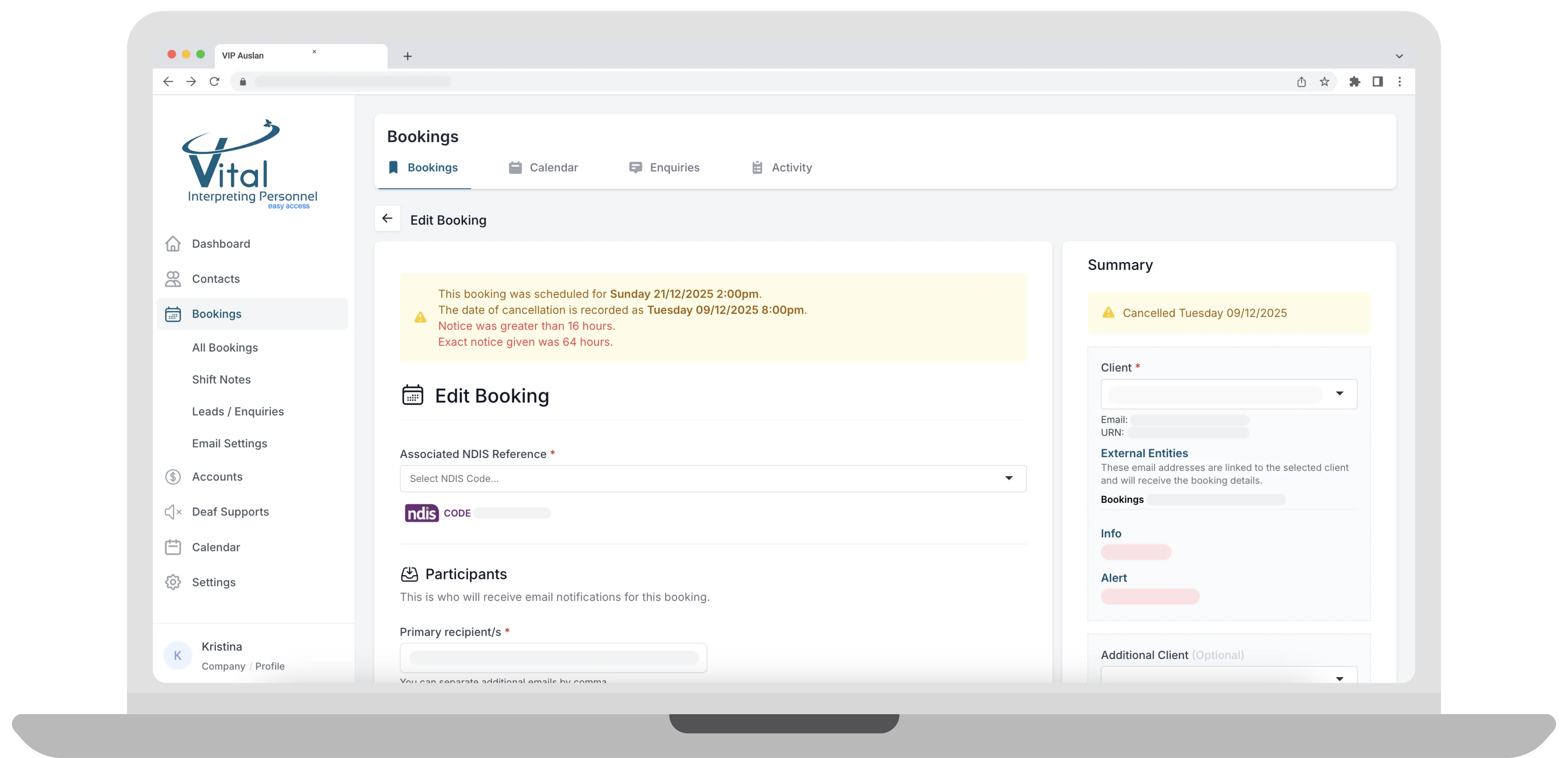
We have seen this need for specialized workflows firsthand. Take a look at our work on a highly specific sign language interpreter booking platform designed to connect individuals with crucial services seamlessly. A generic calendar application simply could not handle the nuanced requirements of matching certified interpreters with specific client needs in real time. Custom logic ensures that the right professionals are booked accurately, taking into account location, certification levels, and urgent availability.
Replacing a SaaS Subscription Stack With One Custom Tool
The most common category SMBs are rebuilding with AI is internal admin tools: the dashboards, intake forms, approval workflows, and reporting panels that every business needs but no SaaS vendor builds correctly for any one of them. The top SaaS categories that companies have replaced or considered replacing include:
- workflow automations (35%)
- internal admin tools (33%)
- BI tools (29%)
- CRMs (25%)
These categories share a pattern: every company’s internal workflows are different, so off-the-shelf tools were always an awkward fit, and AI now makes the custom alternative affordable.
Spencer Handley, founder of online guitar education business Sonora, has become a notable example of what aggressive SMB-side AI adoption looks like in practice. By April 2026, he had used AI to build custom tools that replaced HubSpot, Calendly, Vimeo, and DocuSign with software tailored to his company, saving roughly $250,000 a year, and centralized all of his customer data so that he could run AI agents on it more easily.
Building Operational Tools That Used to Be Out of Reach
Fathom AI, not to be confused with the AI meeting notetaker of the same name, is a small healthcare sales platform built by three founders working alongside twelve AI agents. As reported in Fortune, it solves a specific pain that pharmaceutical sales reps had been complaining about for years: stitching together account data, real-time search trends, and territory mapping into one tool that surfaces every nearby account ranked by fit.
The CEO had no prior software background, but the team still shipped a working product and reached profitability quickly. A platform that once required $10 million in seed funding to staff can now be assembled by three experienced operators and a suite of AI agents for the cost of a dinner out, Fortune notes, and that change in cost structure is exactly what makes ambitious AI custom app development viable for SMBs in 2026.
How Agencies Have Adapted: The Rise of AI Custom App Development
A new service category has emerged, and it doesn’t look much like the consulting model of five years ago. The pivot has been swift, and SMBs are the biggest beneficiaries.
Traditional custom software engagements required six to ten months of exhaustive requirements gathering, manual coding, and slow iteration. AI custom app development uses generative models to compress that initial build from months to weeks or even days.
The financial barrier dropped because the cost-per-line of human syntax generation no longer dominates the budget. What used to cost $200K can now land closer to $40-60K for comparable scope, putting hyper-personalized applications squarely within reach for SMBs that previously had to settle for SaaS workarounds.
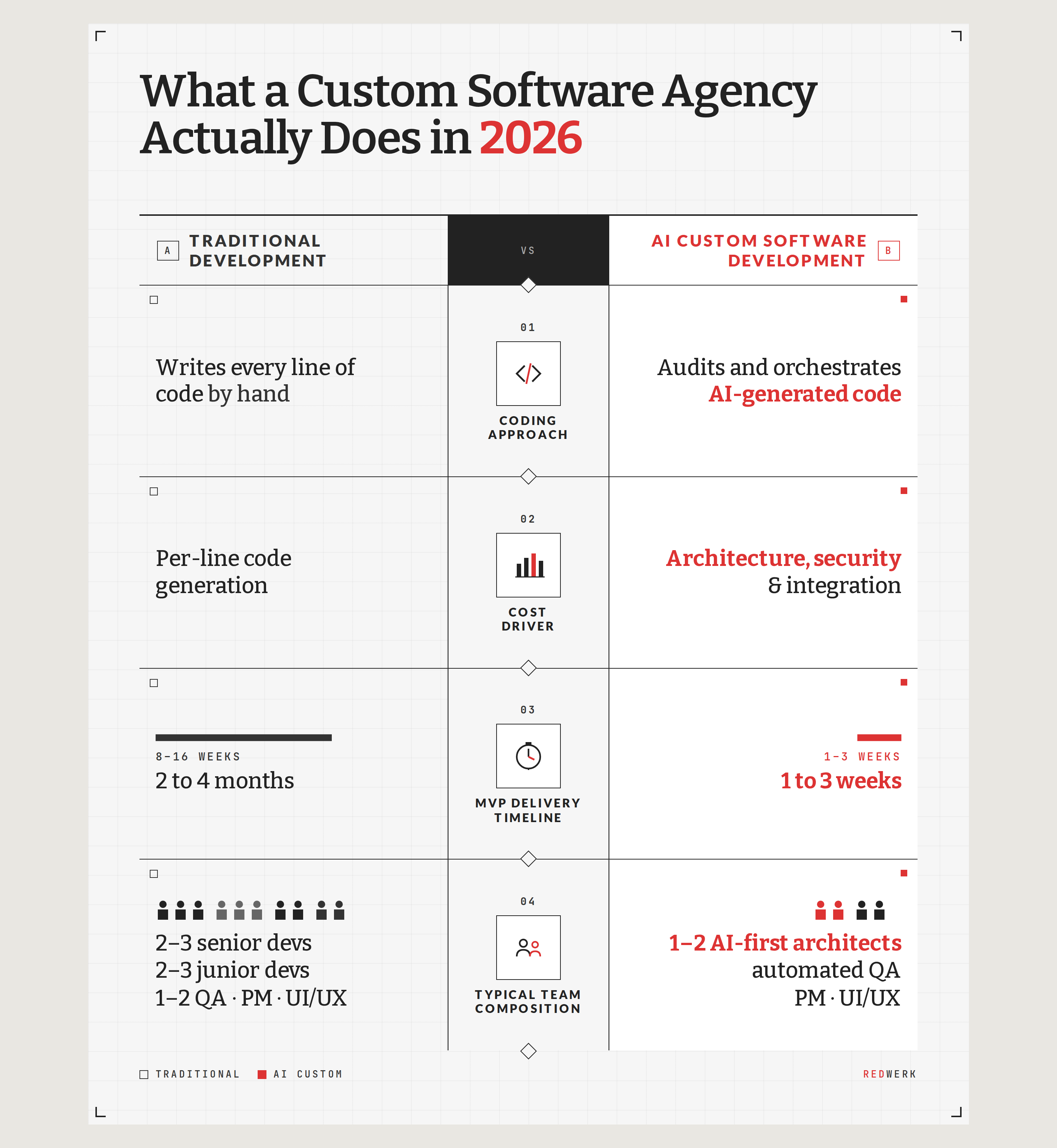
The role of a software agency in 2026 is no longer to write every line but act as an architectural guardian. Agencies now audit and clean up AI output, secure data flows, design system architecture, scale infrastructure, and orchestrate the software that clients and AI tools have already collaboratively conceptualized.
Why Partner With Redwerk to Build Custom Apps With AI
Redwerk works with founders and SMBs building products that are mission-critical to their users. These aren’t experiments meant to be thrown away. They need to be secure, scalable, and trustworthy from week one, and that’s exactly the gap a modern agency is built to fill.
Smart SMBs run an enterprise AI implementation audit before greenlighting any AI-augmented build: a structured review of where AI fits, what data it can safely touch, and what guardrails the team needs.
Here’s what makes us a strong partner for SMBs going custom with AI in 2026:
- We’ve shipped real products for SMBs, not just enterprise. From Muskelhirn’s recruitment platform to gigmit’s data mining, we’ve delivered working software for businesses that can’t afford a six-figure mistake.
- We treat AI as one tool in the stack, not a magic wand. Our engineers are AI-augmented, but we don’t ship code we haven’t reviewed, and we don’t deploy systems without a security pass.
- We cover the full lifecycle. Discovery, MVP, scaling, audits, and ongoing maintenance — you don’t have to find a new partner every time your product moves to the next stage.
- We’re transparent about cost. Our discovery phase tells you what your project will actually take, and what it won’t, before you commit to a build.
If you’ve been waiting to build custom apps with AI because the price tag scared you off, the price tag has moved. The conversation worth having now is about what to build first, and how to make sure it lasts. When you’re ready, let’s talk.
See how we cut manual admin work by 40% and critical errors by 90% on a booking platform trusted by 100+ Australian government institutions