
Every software project starts with a question: what exactly are we building? The discovery phase exists to answer it. It’s the structured planning stage where you define the scope, validate assumptions, and align everyone involved before a single line of code gets written.
For two decades, this phase relied on manual interviews, static wireframes, and specs that took weeks to produce. AI changed the equation. Here’s what that shift looks like in practice, where AI genuinely helps, and where it still falls short.
The Expensive Mistake AI Is Fixing
Software projects still fail at alarming rates — and the numbers get worse as complexity grows. Gartner predicted that at least 30% of generative AI projects would be abandoned after proof of concept by the end of 2025 due to poor data quality, unclear business value, and escalating costs. By early 2026, that pattern held across broader software initiatives as well.
The common thread across these failures: incomplete requirements, misaligned stakeholders, and scope that kept shifting after development started. In other words, the discovery phase either didn’t happen or it fell apart under its own weight. The question for founders and CTOs is no longer whether to use AI during discovery, but how.
What Discovery Used to Look Like
If you’ve been through this before, the pattern will sound familiar. Weeks of stakeholder interviews. A 40-page spec document that nobody reads past page five. Wireframes that change ten times. A scope document already outdated by the time coding kicks off.
The friction points were consistent across projects and industries:
- Stakeholder alignment required days of meetings and follow-up emails, often producing ambiguous results.
- Requirements lived in scattered documents across three different tools.
- Traditional requirement gathering tools helped organize information, but every insight had to be manually extracted and structured.
- Estimation relied on gut feel as much as data.
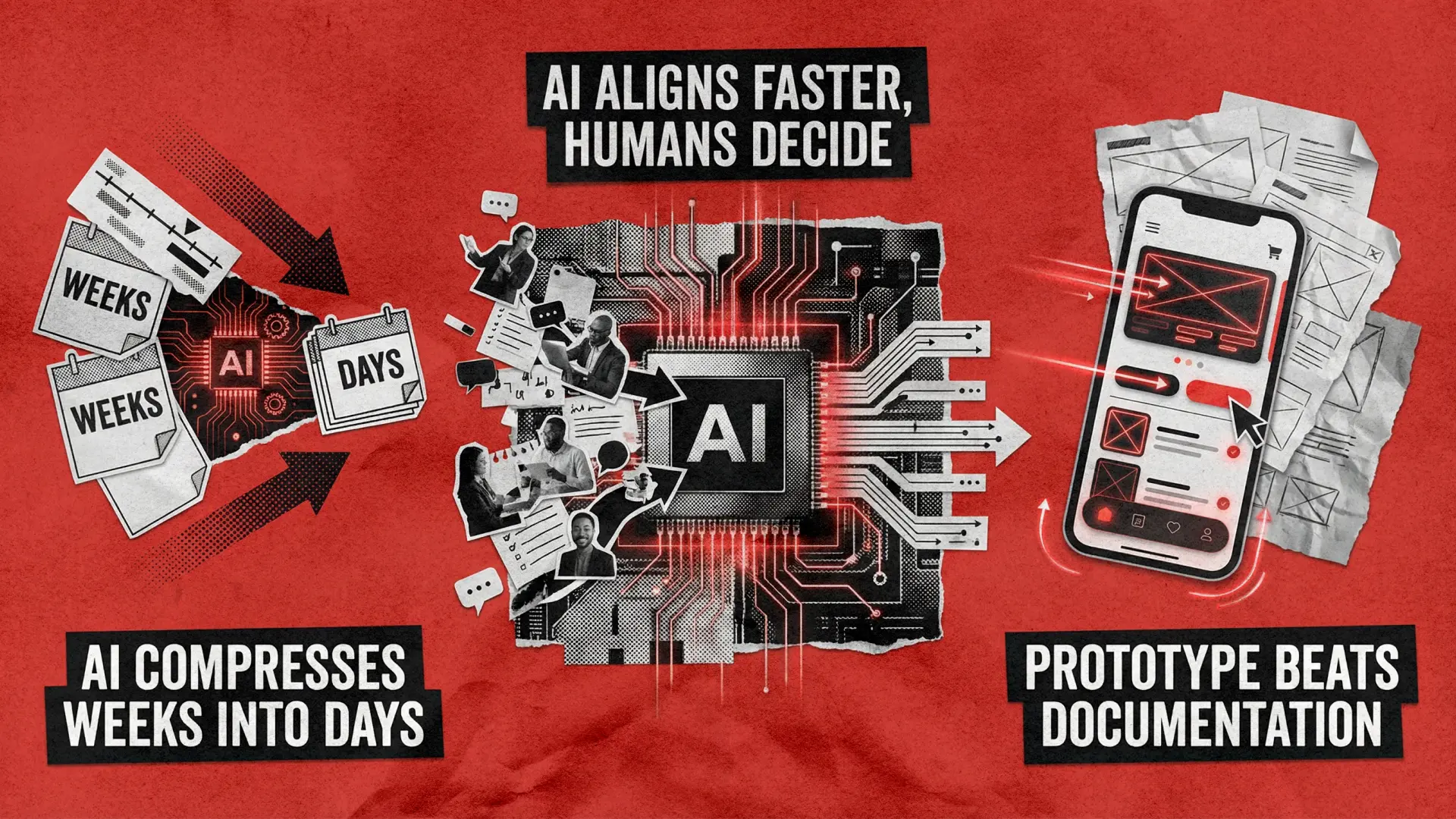
AI entered the picture and compressed what used to take weeks into days.
Five Ways AI Reshapes Software Discovery Phase Services
The impact of AI on discovery is specific and measurable. It touches five areas that together define whether a project starts on the right foundation or drifts into scope creep, budget overruns, and misaligned expectations.
Requirements That Actually Match Reality
AI in requirements gathering changes the dynamic of how teams capture and structure what a product needs to do. Instead of relying solely on manual note-taking during stakeholder calls, tools like Fireflies.ai and Otter.ai record, transcribe, and analyze every conversation automatically.
Feed that raw output into Claude or ChatGPT, and within minutes you get structured user stories, prioritized feature lists, and flagged contradictions between stakeholders. NLP catches conflicting inputs early, before they snowball into scope creep.
McKinsey’s 2025 Global AI Survey found that organizations seeing real financial returns from AI were twice as likely to have redesigned their workflows before selecting specific tools. That redesign starts in discovery. For a deeper look at how we approach structured requirements work, check out our functional specification services.
Sharper Project Scoping and AI Project Cost Estimation
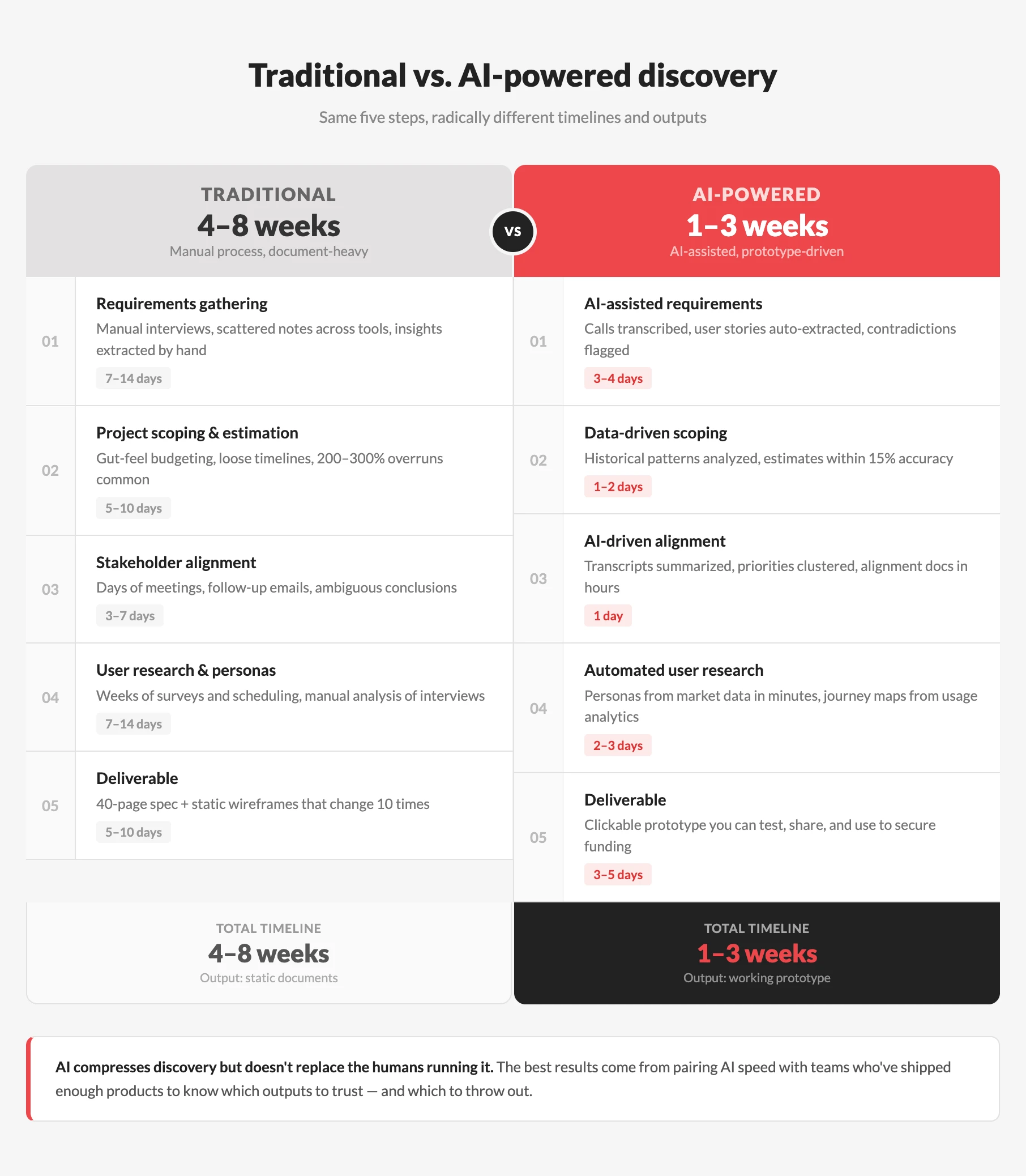
Here’s a comparison that puts the impact into perspective:
AI project scoping works by analyzing historical data — timelines, team compositions, tech stacks, and complexity factors — to produce estimates grounded in patterns from similar projects. It eliminates the blind spots that lead to budget surprises.
A well-defined product scope definition before development starts means fewer change requests, tighter budgets, and a team that knows exactly what they’re building from day one.
Stakeholder Alignment at Machine Speed
Every development project involves multiple people with different priorities. Marketing wants one thing, engineering says another, the CEO has a third vision. Traditionally, aligning those perspectives required days of meetings and rounds of follow-up emails.
AI acts as a neutral analyst here. It summarizes meeting transcripts, clusters priorities by theme, and identifies misalignment between departments before it derails the project. AI for software project planning is most valuable precisely at this stage: making sure the right people agree on the right thing to build.
Tools like Miro AI map dependencies across teams visually, making hidden conflicts surface early. With 78% of companies now using AI in at least one business function, the expectation for faster cross-functional alignment is becoming the norm.
User Research and Journey Mapping on Autopilot
User research during discovery used to mean weeks of surveys, interview scheduling, and manual analysis. AI compresses that cycle. There are now many tools that handle AI-powered UX research: transcribing interviews, tagging themes, and surfacing patterns that would take a human analyst days to find.
AI-powered user journey mapping identifies friction points from real usage data and app store reviews before you design anything new. It generates user personas from market data and competitor analysis in minutes rather than weeks.
The principle behind this approach has always held: involving users early in development improves outcomes. AI makes it faster, more thorough, and more affordable, especially for startups on tight timelines.
Prototypes Instead of Paperwork
This is the single biggest shift. Instead of 40-page specs followed by static wireframes, teams now deliver functional prototypes during discovery itself.
AI coding tools let development teams build clickable, interactive prototypes in days. You see a working demo before committing to full development. Not a PDF. Not a wireframe. A thing you can click, test, and share with investors.
The technical architecture benefits as well. AI suggests optimal tech stacks and architecture patterns based on your project’s requirements, reducing back-and-forth between architects and product managers. Your discovery deliverable becomes a prototype that proves the concept works — not a document that collects dust.
Where AI Still Needs a Human Co-Pilot
Knowing where AI falls short matters just as much as knowing where it shines.
Gartner predicts that through 2026, 60% of AI projects unsupported by AI-ready data will be abandoned. AI accelerates what’s already well-structured. Feed it bad inputs, and you get bad outputs faster. Things AI cannot replace during discovery:
- Understanding your unique business context and the politics between departments.
- Reading between the lines of what stakeholders really mean vs. what they say.
- Making judgment calls about market timing and competitive positioning.
- Risk assessment that accounts for factors no historical dataset captures.
That’s the same reason AI-powered code reviews still need human oversight — the pattern holds across every phase of the development lifecycle. AI makes a great analyst. It makes a terrible decision-maker.
What This Means for Your Next Project
If you’re about to start a new build, here are three questions worth asking your development partner:
- “Do you use AI during discovery, or only during coding?” If they only mention coding, they’re leaving value on the table.
- “Can I see a working prototype before committing to full development?” If the answer is no, ask why.
- “How do you handle requirements gathering — manually or AI-assisted?” The difference in accuracy and speed is measurable.
Traditional discovery runs 4–8 weeks. AI-powered discovery delivers the same depth in 1–3 weeks. Discovery typically costs 10–15% of the total project budget — AI makes that investment stretch 2–3x further.
The ROI compounds downstream. Validated requirements mean fewer change requests during development. Sharper estimation means fewer budget surprises. That’s how AI reduces software development costs — by making sure you build the right thing from the start.
We saw this firsthand with Utility Revenue Services, a Denver-based utility consulting company that needed to modernize a legacy Windows desktop app into a cloud-based SaaS. Our discovery effort produced a full-scale scope document with detailed business logic specifications. That upfront work delivered the project within the defined timeline and precise budget, transforming an outdated tool into a revenue-generating workflow automation platform accessible from any device.
Discovery Is Where AI Delivers the Most Leverage
Discovery was always the most underrated phase in product development. AI amplified it. Faster requirements, sharper scoping, aligned stakeholders, real prototypes instead of slide decks. Better discovery means fewer change requests, tighter timelines, and a development team that actually knows what they’re building.
This pattern extends beyond discovery. The same principles apply to how AI is reshaping software maintenance and deployment. AI delivers the most value when it’s built into the process from the start.
The teams that adopt AI-powered discovery will build with more confidence and fewer expensive surprises. Those that skip it will keep paying the 200–300% overrun tax. The choice is straightforward.Contact us.
FAQ
How long does an AI-powered discovery phase take?
Typically 1–3 weeks, depending on project complexity and number of stakeholders. Traditional discovery runs 4–8 weeks for the same depth.
Can AI fully replace human analysts during discovery?
No. AI accelerates data gathering, transcript analysis, and pattern recognition. Strategic decisions, like prioritizing features based on market timing, navigating organizational politics, still require human judgment and experience.
What AI tools are used in software project discovery?
Example tools include Fireflies.ai and Otter.ai for meeting transcription, ChatGPT and Claude for requirements structuring, Cursor and Replit for rapid prototyping, and Miro AI for dependency mapping.
Does AI-powered discovery cost more?
No. It typically reduces time and cost by making the same budget deliver 2–3x more depth and accuracy. The investment in AI tools is offset by fewer hours spent on manual analysis.
See how a structured discovery phase helped us transform a legacy desktop app into a cloud-based workflow automation SaaS — on time and on budget.

