Every business owner eventually asks us the same question: single AI agent or multi-agent AI system? And every time, the answer is also the same: it depends on what you are building, not on what sounds more impressive.
Most businesses either over-engineer with multi-AI-agent systems they do not actually need or under-build with a single agent that hits a wall the moment the task gets complex. This article provides the criteria for making the right call when choosing agentic AI automation tools for your unique business case.
Single AI Agent vs. Multi-Agent AI Systems: What Are We Actually Talking About?
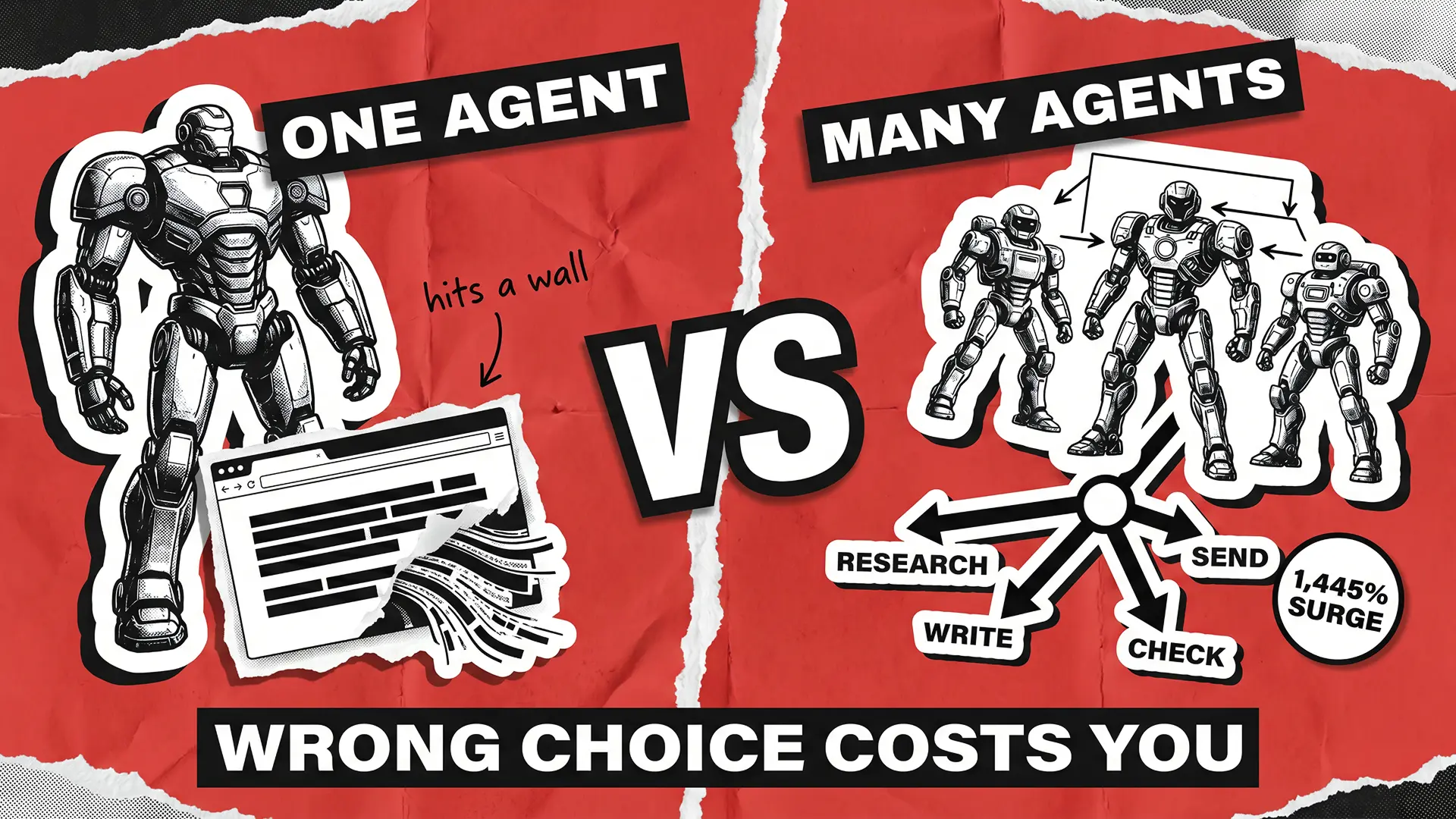
A single AI agent is one model running a loop. It takes input, calls tools, reasons through the problem, and produces output. It’s as if you have one specialist in a room with a phone and a laptop. They are fast, focused, and effective for specific jobs. However, if you are interested in AI development services that go deeper and offer a broader scope of functionalities, you’ll need multiple agents.
Multi-agent AI systems are different. Multiple agents, each with its own role, work under an orchestrator that assigns tasks and manages the flow. In this case, one agent researches, another writes, a third checks facts, and a fourth handles external communication. Each agent does what it’s best at, results get passed along, and the combined output is more capable than anything a single AI agent could produce alone.
The numbers reflect this shift. According to Gartner, enterprise interest in multi-agent systems in AI surged 1,445% between Q1 2024 and Q2 2025. That is not a trend, but a fundamental change in how businesses think about AI architecture.
Where a Single AI Agent Still Wins
Not every problem needs a team. A single AI agent is the right call when:
- The task has a clear, linear flow with predictable inputs and outputs.
- One context window comfortably holds all the relevant information.
- Speed and cost efficiency are the top priorities.
- You need something working within days, not weeks.
Real examples from production:
- An internal Q&A bot that answers questions about company documentation
- A customer support assistant for a SaaS onboarding flow
- A document summarizer for legal or compliance review
- A code review assistant that checks PRs against a predefined ruleset
A single AI agent starts to break down when tasks get complex, when context windows overflow, or when different stages of the problem require genuinely different reasoning styles. When that happens, adding more tokens to the prompt is not the fix.
Where Multi-Agent AI Systems Pull Ahead
Multi-agent AI systems were built for problems that single agents struggle with: long workflows, parallel processing, and tasks that require different kinds of expertise at different stages. Here is when you actually need multi-AI agent systems:
- The task has multiple distinct stages that benefit from specialization.
A research agent knows how to search and extract, while a writing agent knows how to synthesize and format. Running both roles in a single agent yields worse results than separating them properly. - You need parallel execution.
Multi-agent AI systems can run tasks simultaneously. A single AI agent processes steps sequentially. - The job exceeds one context window.
Long-form report generation, competitive analysis across dozens of sources, or full codebase reviews all exceed what a single model can process reliably in one pass. - Fault tolerance matters.
If one agent fails or returns a poor result, the orchestrator can retry or reassign. A single-agent pipeline doesn’t have that option. - You are building something that runs autonomously over long sessions.
While single-agent AI is better for short loops, multi-agent AI architecture is designed for long-horizon, autonomous agents and workflows.
According to MarketsandMarkets, the AI agents market is projected to grow from $7.84 billion in 2025 to $52.62 billion by 2030 at a CAGR of 46.3%. Multi-agent systems in AI specifically are growing faster than the overall market, at 48.5% CAGR through 2030. In the Deloitte State of Generative AI in the Enterprise report (2025), 45% of surveyed organizations named multi-agent systems as their top generative AI development priority.
Multi-agent AI use cases for business:
- Automated competitive intelligence pipelines: one agent scrapes sources, one categorizes data, one writes the brief.
- AI-driven software development pipelines: planning agent, coding agent, review agent, testing agent, each handling their part.
- Customer support at scale: a triage agent routes the ticket, specialist agents handle resolution by category.
- Compliance monitoring in fintech or legal: one agent tracks regulatory changes, another cross-references your policies, and a third flags the gaps.
- Due diligence automation: research, validation, and risk scoring run in parallel.
AI frameworks worth knowing: LangGraph is the tool of choice for production multi-agent AI systems because it gives precise control over state, cycles, and agent handoff. CrewAI and AutoGen are solid for teams prototyping role-based systems. We covered the tradeoffs between all three in detail in our LLM frameworks guide.

Five Questions to Ask Before Building Multi-Agent AI Systems
Whether you are a CTO choosing an AI agent orchestration architecture or a founder allocating AI budget, these questions cut through the noise:
- Can the task be completed in a single, linear flow?
If yes, start with a single agent. - Does it require genuinely different types of reasoning at different stages?
If yes, multi-agent. - Does it need parallel execution to meet latency or throughput requirements?
If yes, you need a multi-agent. - What is your tolerance for cost per run?
Multi-agent means more LLM calls, more tokens, more cost. Model selection per agent (lighter models for simpler tasks) is a standard cost optimization. - Do you need fault tolerance and recovery logic?
Multi-agent AI systems handle failures more gracefully than a single-agent pipeline.
One thing worth keeping in mind: Gartner’s own guidance says more agents are not inherently better. The goal is the right number of agents for the task, not the largest possible system.
What Actually Makes or Breaks a Multi-AI Agent System Build
Here is the part most articles skip: the architecture itself is not the hardest part — everything around it is.
AI agent orchestration design is where most builds go wrong. Deciding who passes what to whom, and when, is a genuine engineering problem. Poorly designed agent handoffs between agents create loops, redundant processing, and degraded output quality. This is the most underestimated part of any multi-agent system in AI.
- Prompt engineering per agent matters more in multi-agent AI systems than in single-agent ones. Each agent needs a tight, specific system prompt — generic prompts produce generic behavior, and chaining five agents with generic prompts quickly compounds the degradation.
- Observability is non-negotiable. Debugging a single AI agent is straightforward. Debugging a multi-agent chain means understanding what each agent received, what it decided, and what it passed forward. Without proper tracing, this becomes painful fast.
- Cost management deserves a line item in your project budget from the start. A multi-agent AI system for enterprise, making 15 LLM calls per request at GPT-4o pricing, will surprise you at scale. Plan it up front.
There is also a broader risk worth naming. Gartner projects that over 40% of agentic AI projects will be canceled by 2027, primarily due to escalating costs, unclear business value, and inadequate risk controls. To help teams navigate these hurdles, we’ve outlined security best practices for agentic AI using OpenClaw as an example. Ultimately, a clear ROI case and phased implementation are not optional. They are what separates the 60% that ship from the 40% that do not.
Multi-Agent AI Systems: Two Quick Architectures
To make this concrete, here are two real-world patterns of using AI agents for business.
- A SaaS onboarding assistant (single agent)
It’s one model with access to a knowledge base tool and a CRM (Customer Relationship Management) lookup tool. A new user asks a question, the single AI agent retrieves the relevant docs, checks the user’s plan tier, and answers accordingly. Linear, fast, cheap, and easy to monitor. - A competitive intelligence pipeline (multi-agent)
An orchestrator kicks off four autonomous agents simultaneously. Agent 1 scrapes competitor product pages, Agent 2 pulls recent news, Agent 3 summarizes customer reviews, and Agent 4 pulls pricing data. Results flow to a synthesis agent that writes the report. This is AI workflow automation with agents at its most practical — what would take a person three hours takes this system three minutes.
The difference is not complexity for complexity’s sake. The multi-agent setup is doing something that genuinely cannot be done efficiently in a single pass.
Multi-Agent vs. Single Agent AI System: Which Does Your Business Truly Need?
The choice between single or multi-agent AI systems comes down to task architecture, not budget or ambition. A focused single agent running well beats a bloated multi-agent AI system running poorly every time.
But when the problem genuinely calls for parallel execution, specialized roles, or long-horizon autonomy, multi-agent AI systems are the right tool. At Redwerk, we have been building AI-powered software since 2015, across multi-agent AI systems, LLM integrations, and full-stack AI product development. Tell us what you need, and we will map out the right architecture together.
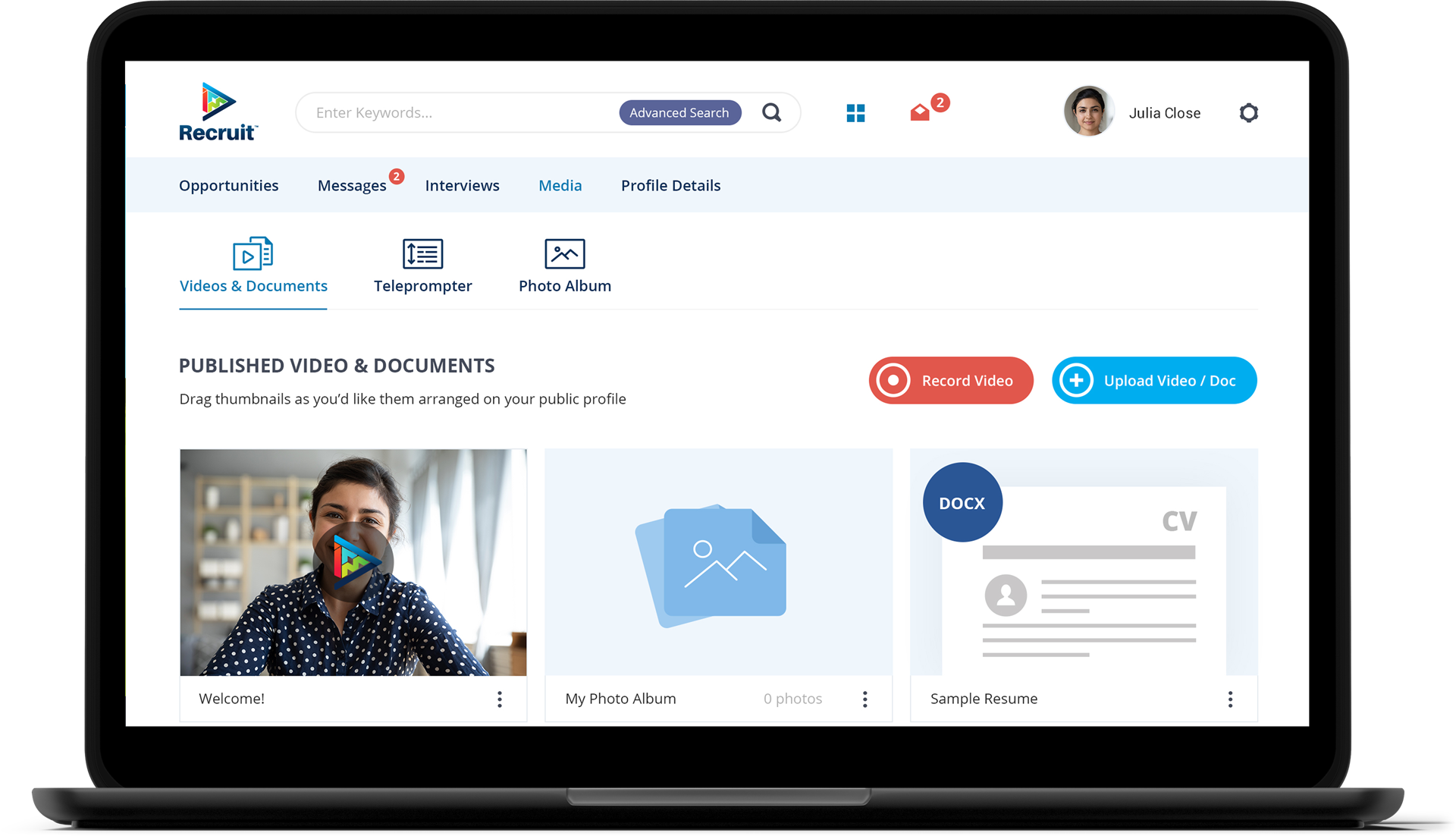
Check out the AI-powered recruitment app that we built.
It was bought by a US staffing giant