These days, getting a basic language model wrapper up and running is pretty easy. But turning that prototype into something secure and scalable across your company is astonishingly difficult. The upside is that most corporate AI projects fail for predictable reasons, not a single big mistake. This article shares a 7-step AI implementation audit you can use to get a stalled pilot back on track. If you’d like some outside help, our software development consulting team can run the audit with you.
The Reality of Corporate AI Implementation Failure
The tech industry is currently experiencing a massive reality check when it comes to generative tools. Early excitement led to a flurry of isolated experiments that were never designed to survive contact with real enterprise workflows. Now, businesses are facing the hangover of those initial investments.
The statistics surrounding this phase of technology adoption are sobering but necessary to acknowledge. According to a recent IBM study, only 25% of AI initiatives have delivered the ROI CEOs expected, and just 16% have scaled enterprise-wide. Furthermore, the future outlook for autonomous systems isn’t perfectly rosy either. Gartner recently predicted that more than 40% of agentic AI projects will be canceled by the end of 2027.
This high rate of corporate AI implementation failure usually stems from treating the technology like a science experiment rather than a core software engineering challenge. A successful enterprise AI implementation strategy requires rigorous planning, deep technical expertise, and an unwavering focus on business value. If you are struggling with enterprise AI implementation challenges, our 7-checkpoint audit will help you pinpoint the exact bottleneck.
The 7 Reasons AI Pilots Stall and How to Fix Each One
The model is rarely the reason an AI project fails; the conditions around it are. Data quality, workflow design, cost economics, and ownership decide whether a working demo turns into a working product, and those are the parts most pilots underinvest in because they feel less interesting than the AI itself. Following the fundamentals is the part of the work that actually compounds.
Reason 1: The Goal Is a Vibe, Not a Number
The first and most common place where projects meet their demise is right at the starting line. Many companies rush to build intelligent tools simply to prove they can, completely ignoring the need to tie the technology to a measurable business outcome. This purely experimental approach inevitably results in a flashy, expensive demo that nobody actually wants to pay for or maintain long-term. If you want your initiative to survive, you absolutely must anchor your pilot to concrete, quantifiable value.
Diagnostic Question: Does this tool solve a specific, quantifiable business problem that directly impacts revenue, operational costs, or measurable productivity?
The Artifact: You must have a formal ROI projection document. This is not a vague promise of “saved time” but a hard mathematical breakdown of current costs versus projected costs post-deployment.
The Failure Signature: The most common sign of failure here is the phrase “It’s really cool, but…” You might notice that leadership loves the demo, but no department head is willing to allocate their own budget to pay for the API costs or cloud infrastructure to run it.
The Fix-or-Kill Rule: If the project is just a novelty looking for a use case, kill it immediately. If the business value is real but poorly articulated, fix it by partnering with department heads to map the exact financial impact. Proper AI implementation strategy demands that technology serves the business, not the other way around.
Reason 2: You Have Data, But Not the Right Data
Even if you have a brilliant business case, your project will crash and burn if it is starved of quality information. Intelligent systems are only as smart as the context you feed them, and enterprise data is notoriously messy, siloed, and outdated. Many pilots succeed because they are built using a tiny, perfectly curated dataset, only to fail spectacularly when connected to a company’s live, chaotic data streams. You cannot skip the unglamorous work of data pipeline engineering.
Diagnostic Question: Does the system have a reliable, automated, and secure pipeline to access clean and up-to-date context?
The Artifact: You need a comprehensive data pipeline map. This document must show exactly where the system pulls its information from, how frequently that data is updated, and how errors are handled.
The Failure Signature: Your users are complaining about hallucinations, outdated answers, or incredibly generic responses that add no value. According to recent research by Informatica, 56% of leaders describe data reliability as a key barrier to advancing GenAI pilots.
The Fix-or-Kill Rule: Do not kill the project, but pause the deployment. Fix the foundation by investing heavily in data governance and proper retrieval techniques. Implementing strong RAG best practices (Retrieval-Augmented Generation) is usually the critical missing step here. Implementing AI properly means mastering the data that fuels it.
Reason 3: Token Costs Look Cheap Until They Don’t
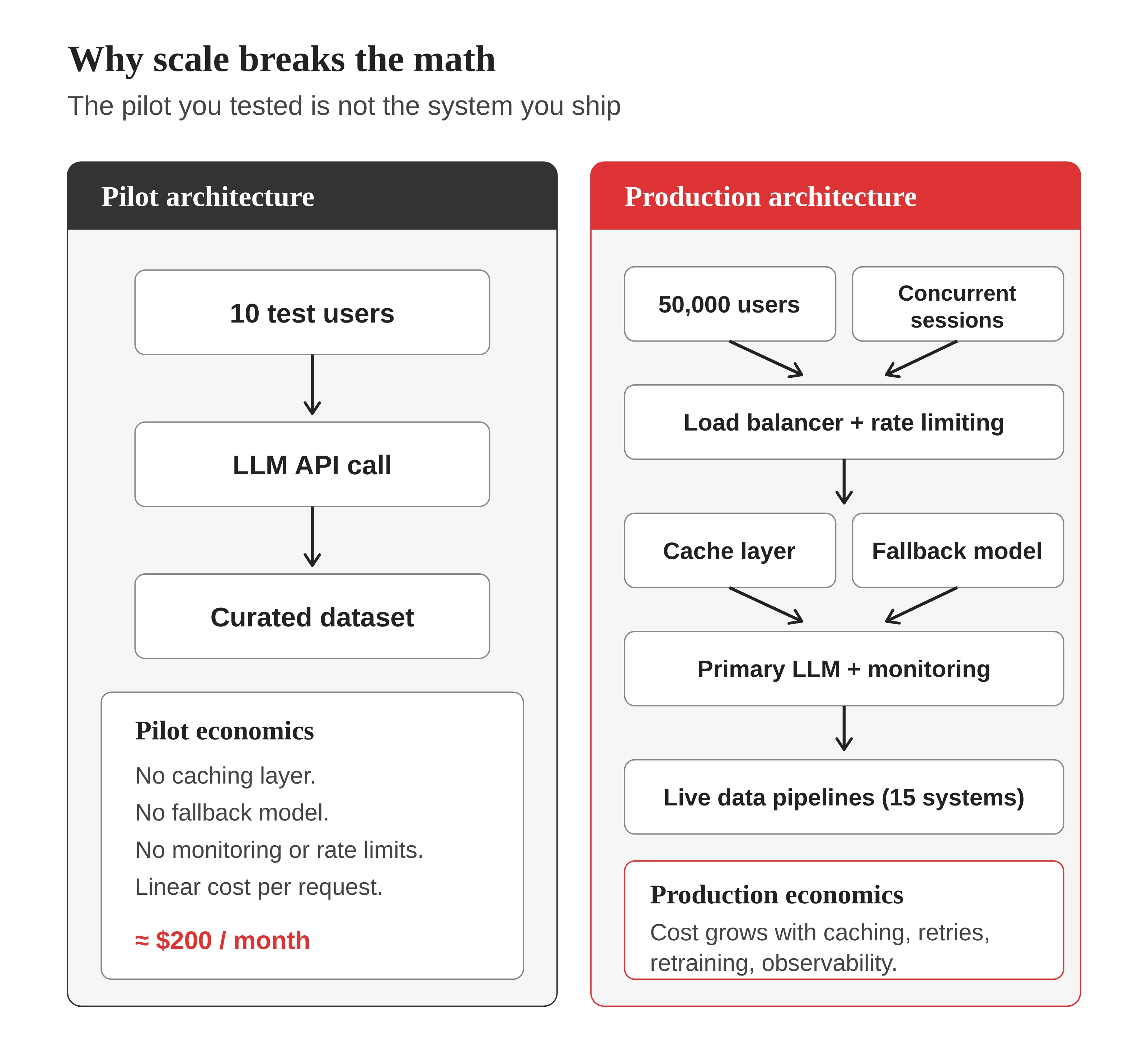
A pilot built for ten users will often implode when exposed to ten thousand users. Large language models are computationally expensive, and their inference times can be incredibly slow if not properly managed. Many companies mistakenly assume that scaling up just means buying a bigger cloud server, which leads to astronomical, unsustainable API bills. You need an architecture that balances performance, user experience, and unit economics. To avoid becoming another statistic, you need to rely heavily on proven AI strategy implementation best practices.
Diagnostic Question: Can this system handle production-level traffic, edge cases, and concurrent requests without timing out or bankrupting the IT department?
The Artifact: A production-grade architecture diagram. This must include load balancers, caching layers, fallback models, and a clear breakdown of estimated token costs at scale.
The Failure Signature: The system works perfectly for the testing group, but beta users experience massive latency. You might also notice that your API costs are scaling linearly or exponentially, destroying the ROI you calculated earlier.
The Fix-or-Kill Rule: Fix it by stepping back and re-architecting the backend. You will likely need to employ advanced LLM inference optimization techniques and rigorously apply standard SDLC best practices. Sometimes, this means switching from a massive proprietary model to a smaller, fine-tuned open-source model.
Reason 4: Nobody on the Team Has Done This at Scale Before
The most brilliant architecture diagram in the world is useless if you do not have the team to actually build and maintain it. Relying on a single enthusiastic developer to manage an enterprise-critical system is a recipe for disaster. You need a mature engineering culture.
Diagnostic Question: Do we have the internal talent required to securely build, monitor, test, and maintain this system over the next five years?
The Artifact: A formalized resource allocation and maintenance plan. This ensures that you have dedicated DevOps, backend engineers, and security specialists assigned to the product lifecycle.
The Failure Signature: The pilot was built by one genius developer who just quit, and no one else in the company knows how the code works. Gartner specifically notes that a lack of talent and skills is among the top barriers to AI implementation.
The Fix-or-Kill Rule: If you cannot hire the talent internally, fix this by partnering with external experts. You need to look for AI consulting firms that do implementation, not just advisory services. A true AI automation agency can parachute in and fortify your engineering team. Successful artificial intelligence implementation is fundamentally a human talent challenge.
Reason 5: Security and Governance Were Bolted On, Not Built In
When moving from a staging environment to production, the training wheels come off. If your intelligent assistant has access to your company’s entire knowledge base, you must ensure it respects the same access controls that a human employee would. A system that accidentally summarizes confidential HR salaries for a junior intern is a catastrophic failure. Security must be baked in from the ground up, not applied as an afterthought.
Diagnostic Question: Does this application strictly adhere to our corporate security policies, data privacy laws, and role-based access controls?
The Artifact: A signed security compliance checklist and penetration testing report. You must prove that the system is resistant to prompt injection and respects internal data silos.
The Failure Signature: Personally Identifiable Information (PII) is popping up in chat outputs, or the model is cheerfully writing malicious code when prompted creatively by your beta testers.
The Fix-or-Kill Rule: Kill the deployment until this is fixed. Security is entirely non-negotiable in the enterprise space. You must develop a strict responsible AI implementation roadmap to ensure compliance. When architecting these complex safeguards, choosing between the best multi-agent AI frameworks is critical. You might find yourself comparing Langchain vs Langgraph to ensure your data flows are perfectly constrained and auditable.
Reason 6: Friction Kills Adoption Faster Than Bugs
The final graveyard for well-built technology is the user interface. If an application requires employees to radically change how they work, switch between five different tabs, or learn complex prompting techniques, they simply will not use it. The best technological solutions are practically invisible to the end user. They should integrate seamlessly into the tools your team already uses every single day.
Diagnostic Question: Does this tool fit naturally into the existing daily workflow of its intended users without causing friction?
The Artifact: A user journey map and a friction-logging report from your beta testing group. You need to see exactly how many clicks it takes to get value out of the system.
The Failure Signature: The usage logs show a massive spike on launch day, followed by a sheer drop-off as employees slowly revert to their old manual processes.
The Fix-or-Kill Rule: Fix it by redesigning the UX/UI and deeply integrating the tool into your existing software ecosystem (like Slack, Salesforce, or your custom ERP). A well-executed AI agent implementation strategy focuses heavily on seamless integration. If you are exploring this route, partnering with a specialized AI agent development company can help you build tools that actually get used.
Reason 7: When the Sponsor Leaves, the Project Drifts
The exec who approved the pilot moves teams. Eighteen months later, nobody can say whether the project worked, the budget gets cut by default, and a working system quietly retires because no one’s defending it. This is how enterprise AI projects die slowly rather than catastrophically.
Diagnostic Question: If the original sponsor left tomorrow, who owns this project, and what does success look like in writing?
The Artifact: A written success contract: the named metric, baseline, target, kill threshold, plus a named owner with budget authority for the next 18 months and a quarterly review cadence.
The Failure Signature: The sponsor is “the person who happened to fund the pilot,” and there’s no plan for what happens when they’re not in the room. Six months in, you can’t get a clean answer to “is this working?”
The Fix-or-Kill Rule: If you can’t get a named, ranked owner for the next 18 months and a written success contract, don’t scale the pilot. Run it as an experiment, log the learning, and
If You Need an Implementation Partner, Not Another Deck
If you are looking for AI strategy and implementation consulting, you need more than just a deck of PowerPoint slides. You need builders. We’re not a consulting firm that pivoted to AI in 2023. Redwerk has been building custom software since 2005, and the engineering principles that make AI rollouts work (disciplined data foundations, secure integration, observable workflows, sustainable total cost of ownership) are the same fundamentals we’ve applied to enterprise software for two decades, including for clients like Siemens, J.B. Hunt, and Universal Music Group.
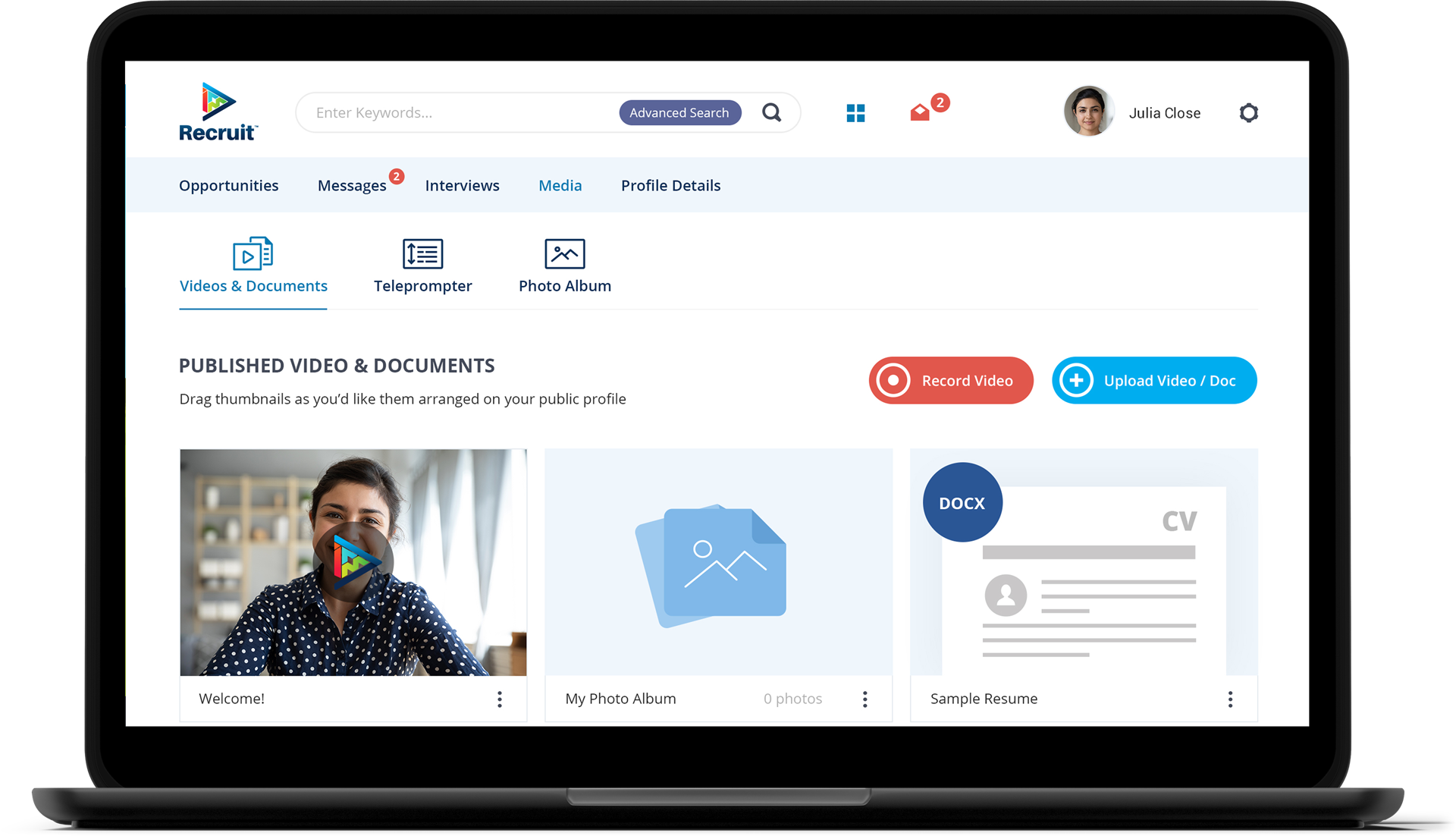
Our work has shipped real production systems, not pilot demos. We trained a neural network on more than 1.5 million documents for Recruit Media to power keyword assignment and integrated Azure Cognitive Services for content moderation across text, images, and video. The platform was acquired by HireQuest in 2021.
We’ve also been the long-term engineering partner for AI-driven platforms like Evolv, building the production frontend and desktop applications that turn AI optimization research into customer-facing software.
For agent-heavy implementations, our AI agent development practice handles both the agent design and the workflow scaffolding around it. That blend of engineering depth plus AI specialization is what makes us one of the few AI consulting firms that do implementation, not just recommendation. AI strategy and implementation consulting is only useful if the people giving the advice can also build the fix.
Ready to Cross the Pilot-to-Production Gap?
If your AI pilot is stuck somewhere between demo and production, and you’re not sure which of the seven checkpoints is actually broken, we can help. Two clicks away. Contact Redwerk for a brief intro call. We’ll walk through your situation, run the audit with your team, and tell you honestly whether the project is worth saving or worth replacing. If we can help, we’ll provide a free project estimation. If we can’t, we’ll tell you that too.
See how we built an AI-powered recruitment app acquired by a US staffing giant