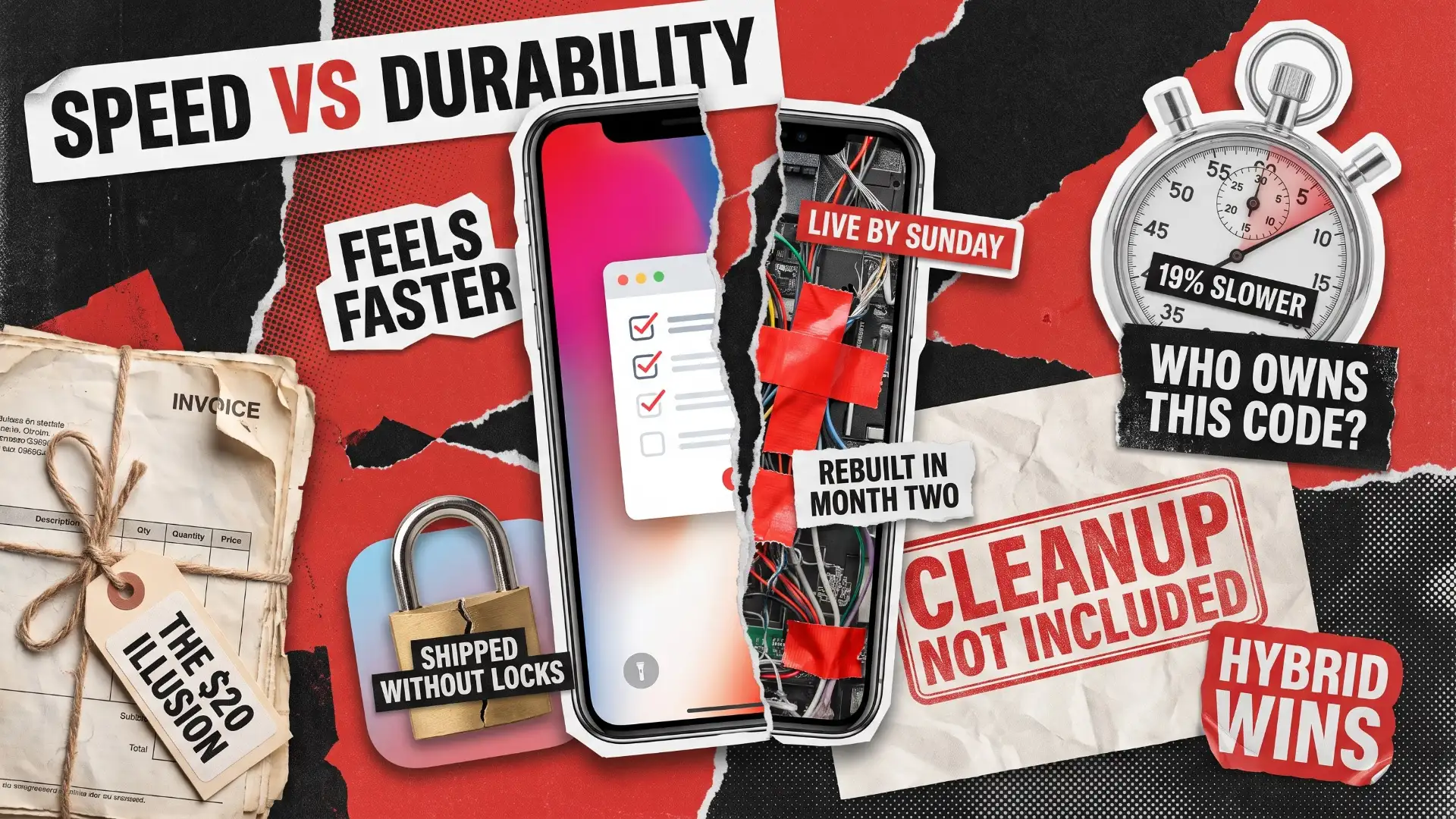
A great idea hits, and suddenly you are faced with two completely different paths to bring it to life. One friend tells you to fire up an AI assistant, prompt your vision into existence, and launch by Sunday night. However, your cautious co-founder insists on the proven route: hire a skilled engineering team, draft a detailed spec, and wait a few months for a bulletproof foundation. That is the real choice behind vibe coding vs traditional coding, and the catch is that both sides are right. The friction between these two mindsets is precisely where founders waste thousands of dollars and months of momentum.
Vibe coding gets you a working app in hours for the price of a subscription. Traditional coding takes weeks to months and costs a team’s rate, but it produces software that survives real users, a security review, and investor due diligence.
At Redwerk, we construct software through traditional development, leverage AI to accelerate workflows where it makes sense, and frequently step in to clean up vibe-coded apps when early traction starts straining the code. Because we operate across the entire spectrum, we don’t need to sell you on a single dogmatic approach.
The article below is an honest, practical look at how both approaches compare when put to the test on speed, cost, long-term technical health, and the hidden pitfalls you only encounter down the road.
Vibe Coding vs Traditional Coding at a Glance
If the term is new to you, vibe coding means describing what you want in plain English and letting an AI assistant write the code, an approach that has quickly become a popular way to build a minimum viable product, or MVP. Traditional coding is the familiar route, where developers write and review each part of the system by hand.
Most of the difference between these two approaches comes down to a single trade-off: how much speed you’re willing to swap for durability. Vibe coding hands you a working app almost immediately and asks you to accept some rough edges, while traditional development takes longer and costs more, in exchange for something built to last. The table below lays out how that plays out across the factors founders weigh most, and the sections after it dig into the two that usually decide the call.
Speed to a first version
Hours to days
Weeks to months
Upfront cost
Low, mostly tool subscriptions and your time
Higher, you’re paying a team
Who builds it
You, guided by an AI assistant
Professional developers
Reliability and security
Fine for the simple cases, shaky on the tricky ones
Built and reviewed for real conditions
Scaling to real users
Struggles as traffic and data grow
Designed to hold up under load
Long-term upkeep
Gets harder as the code tangles
Documented and easier to extend
Best fit
Prototypes, internal tools, testing an idea
Products people pay for and depend on
None of these rows is a knockout blow on its own. The right choice depends on what you’re building and how long it needs to last, so let’s look closer at the two factors founders ask about most.
Speed: How Fast Is Vibe Coding, Really?
The speed claim is real, but the situation isn’t clear-cut at all. If you’re starting from a blank screen and want to see your idea running, vibe coding is genuinely quick. You can go from a sentence to a clickable app in an afternoon, which is a wonderful way to find out whether an idea is worth pursuing at all.
Yet the picture changes once the app grows up. In a controlled study, the research group METR asked experienced developers to complete real tasks in code they knew well, some with AI help and some without. The result surprised almost everyone: the developers using AI were 19% slower, even though they felt they’d been faster. When the work is complex and the stakes are real, the time you save typing gets eaten by the time you spend checking, correcting, and untangling what the AI produced.
That mismatch between how quick it feels and how long it really takes shows up in the details. Therefore, vibe coding wins on speed while you’re exploring and testing an idea, but that advantage fades the moment you need the thing to be correct, secure, and ready for other people to rely on.
How Much Does Vibe Coding Cost vs Hiring Developers?
The honest answer is that vibe coding is the affordable way to begin, while the long-term cost of owning what it produces can climb well past the sticker price. To see why, it helps to follow three different ways your money leaves your pocket.
The vibe-coding path is the lightest on day one. Most of the popular AI builders offer a free tier, and their paid plans stay modest: tools like Cursor and Bolt run around $20 a month, Lovable begins at roughly $25, and team tiers tend to sit near $40 to $50. Usage-based credits can push a heavy month higher, yet for a first version you’re mostly paying a small subscription and spending your own time, so the cash cost can stay close to nothing. For a founder testing whether anyone wants the product, that’s hard to beat.
Meanwhile, the traditional path costs more at the start because you’re hiring a development team to design, build, and review the product properly. You’re paying for experience, for code that can handle real conditions, and for a system your future self can actually maintain. It’s a bigger cheque, and for anything customers will depend on, it usually buys peace of mind that pays for itself.
Then there’s the cost most comparisons quietly skip: the price of fixing what the fast path leaves behind. AI output looks polished, so it’s tempting to trust it, yet in Stack Overflow’s 2025 survey, 46% of developers said they don’t trust the accuracy of AI answers, up from 31% a year earlier. That distrust exists because someone still has to read the code, catch the near-misses, and repair them, and that time is real money whether you spend it yourself or pay someone else to. When a vibe-coded app needs to grow, a professional cleanup becomes its own line item, and budgeting for it honestly is the difference between a pleasant surprise and a nasty one. That’s the number vibe-only cost calculators never show you.
When to Use Vibe Coding Instead of Traditional Development
Put the money aside for a second, because the real question is what you’re building and how much it has to survive.

Vibe coding is the right call when speed matters more than durability. It shines for prototypes you’ll throw away, internal tools that only your team touches, and quick experiments that reveal whether an idea has legs before you commit a budget. It can even ship genuinely useful products, from a weekend messaging app to a breed-spotting tool on the App Store, as this roundup of notable vibe-coded apps shows. In all of these, a rough edge or two costs you nothing, and a quick answer this week is worth more than a flawless one next quarter.
Traditional development earns its keep the moment your app has to hold up. That covers apps that handle payments or personal data, products that need to scale well past a handful of users, and anything a strict gatekeeper will inspect. Apple is a vivid example. In 2026 it started blocking apps built with popular vibe-coding tools from the App Store for breaking its self-contained-app rule, which left some founders holding a finished product they couldn’t actually ship.
Security is a real concern too. AI tools tend to write code that works but skips the quieter protections, which is why a careful look at AI-augmented development matters before real users show up. The same goes for the problems that surface a month or two after launch, when a vibe-coded app meets its first paying customers and the early shortcuts start to show.
There’s also a moment founders rarely see coming. When you raise a round or field an acquisition offer, the buyer sends in technical reviewers, and their due diligence digs into how your software was built, who owns it, and whether anyone can explain how it works. A codebase full of undocumented AI output with no clear history is exactly what makes those reviewers nervous and gets deals repriced.
This is where an independent set of eyes pays off. When we reviewed the code behind Project Science, a quote management platform, our pass through 12,000 lines flagged 40 critical issues, including sensitive data sitting in a publicly accessible folder, and the fixes made the app far easier to maintain, an 80% improvement by our measures. For Site Compass, a network mapping app heading toward release, we reviewed 24,000 lines, found that large sections had almost no automated tests, and helped raise how easy the code was to maintain by 90% before a single real user arrived. Neither team was doing anything wrong. They simply couldn’t see, from the inside, what a fresh professional review surfaced in a couple of weeks.
The Hybrid Path Most Founders Should Take
For most people reading this, the answer isn’t one camp or the other but rather a hybrid of both. Use vibe coding to move fast where speed is free, then bring in professional engineers to harden the parts that carry your business.
In practice, that looks like this. Prototype your idea with AI, put it in front of real users, and learn what’s actually worth building. Once you have that answer and a bit of traction, hand the code to a team that can secure it, straighten out the structure, and add the automated tests that let you ship new features without holding your breath. You keep the speed of the early days while gaining the durability you’ll need for everything that comes next.
If you’ve already vibe-coded your way to something people use, and it’s starting to buckle under real traffic or a looming investor conversation, that’s the perfect time to bring in help. We’ll audit what you have, tell you plainly what’s solid and what needs work, and turn a fragile prototype into a product you can scale and defend with confidence. Get in touch, and we’ll map out the fastest safe route from your current app to the product it needs to become.
FAQ
Is vibe coding safe for handling payments or personal data?
Treat it as a starting point, not a finished product. AI-written code tends to handle the visible functionality well but quietly skips the security work, the kind of gap a professional review is built to catch before real payment or personal data is on the line.
Does a vibe-coded app hold up once it has real users?
Usually not for long. These apps are built and tested for a single smooth path, so once traffic, data, or concurrent users grow past that, cracks start to show. If growth is the plan, budget for an engineering pass that hardens the app before it has to carry real load.
Can a vibe-coded app get rejected from an app store?
Yes, and it already has happened. Apple began blocking apps built with several popular vibe-coding tools from the App Store in 2026 for breaking its self-contained-app rule, leaving some founders with a finished product they couldn’t ship.
Will investors or acquirers flag vibe-coded code during due diligence?
Often, yes. Technical due diligence looks at who wrote the code and whether its structure is documented, and an unexplained AI-generated codebase is exactly what makes reviewers nervous, sometimes enough to get a deal repriced.
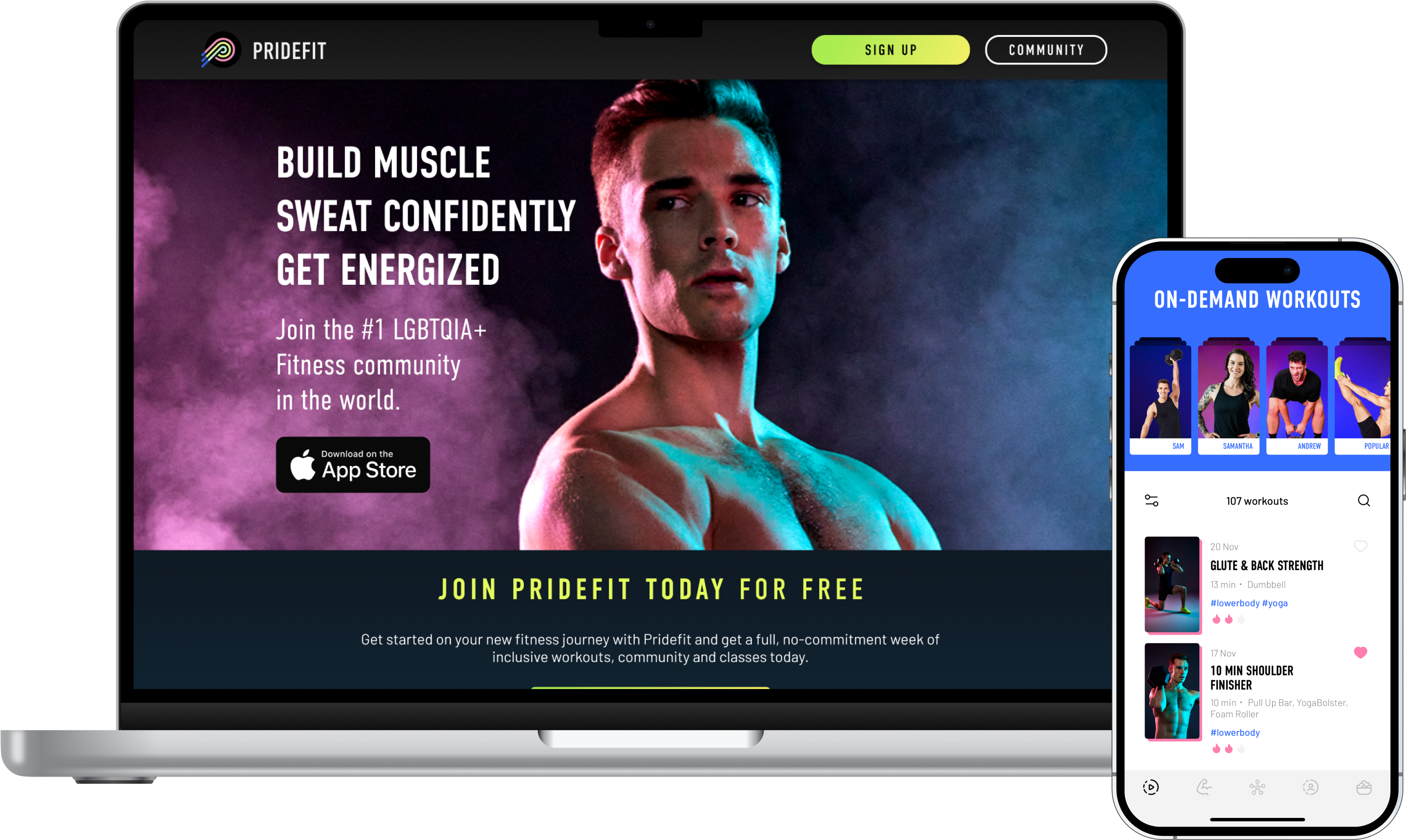
See how Redwerk took over a struggling fitness app from another vendor, cleaned up the inherited technical debt, and helped Pridefit grow subscriptions by 45%