You’re building an AI automation project, and the internet has opinions. Some say use LangChain. Others swear by n8n. A few confident voices tell you to pick both and go home early.
If you’re a founder, CTO, or product manager trying to match the right tech to the right problem, you don’t need more hype. You need to know what each tool actually does, where it breaks, and which one earns a spot in your stack.
The stakes are real. Gartner expects over 40% of agentic AI projects to be canceled by the end of 2027 due to escalating costs, unclear business value, or weak risk controls. The tools you choose won’t fix a bad strategy, but the wrong ones will definitely sink a good one.
LangChain vs n8n isn’t really a fight. They solve different problems. At Redwerk, we design, build, and operate both kinds of systems. Our n8n automation services cover visual workflow automation, while our engineering team ships custom AI agents for clients who need deeper control. This article walks you through the LangChain vs n8n comparison so you can make the call with your eyes open.
What Is n8n?
n8n is an open-source workflow automation platform. Think Zapier with superpowers: you can self-host it, drop in custom JavaScript or Python, and connect to 500+ apps through pre-built nodes. Workflows run on a visual canvas where a trigger fires, then a chain of nodes moves data, transforms it, calls APIs, or hands work off to an AI model. No reinventing the wheel for common integrations.
The adoption numbers tell the story. n8n sits in the top 50 open-source projects on GitHub with 184,000+ stars, has a 200,000+ member community, and has shipped 8,500+ workflow templates. Huel used it to build an AI-first company culture and save 1,000 hours of manual work. Vodafone saved £2.2 million by running threat intelligence workflows through it.
Where n8n Shines
When you’re weighing n8n vs LangChain workflow automation, n8n wins the procedural side cleanly: if this, then that, with branches and loops. It handles lead routing, CRM sync, invoice processing, IT ops, and security operations without breaking a sweat.
It also added native AI nodes, so you can plug models like OpenAI, Claude, or a self-hosted LLM into any workflow step. You don’t need to be a developer to ship something useful, and developers don’t feel boxed in either.
What Is LangChain?
LangChain is not a no-code tool. It’s an open-source orchestration framework for building applications powered by large language models. LangChain acts as a common interface for almost any large language model. It offers a single place to build LLM applications and connect them with outside data sources and software tools.
Launched by Harrison Chase in October 2022, LangChain became the fastest-growing open-source project on GitHub within months of release. It now reports 100M+ monthly open-source downloads and powers AI at Klarna, LinkedIn, Cisco, Cloudflare, Workday, and 5 of the Fortune 10. The framework gives you the Lego bricks to assemble LLM-driven systems: prompt templates, chains, memory, retrieval, tools, and agents.
Its sister project LangGraph adds graph-based orchestration for multi-agent workflows with low-level control. LangSmith handles observability and evaluation in production.
Where LangChain Shines
Flip the question to LangChain vs n8n for AI agents, and LangChain is the obvious pick. This is the territory where the agent has to reason, plan, and adapt on its own. Building a RAG system over your proprietary docs? LangChain. Deploying an agent that handles multi-turn conversations with memory and tool calls? LangChain. Need to switch between GPT, Claude, Gemini, and an open-source model depending on the task? LangChain makes that a config change instead of a rewrite.
The tradeoff: you’re writing code. Python or JavaScript, with your dev team in the driver’s seat. The flexibility is enormous, but you’re on the hook for infrastructure, testing, and lifecycle management.
If you’re sizing up the LangChain ecosystem in more depth, our deep dive on LangChain vs LangGraph breaks down when to reach for each.
n8n vs LangChain: Similarities You Shouldn't Miss
Before we get to the differences, here’s what these tools actually have in common:
- Both are open-source with active communities and commercial cloud offerings
- Both integrate with popular LLM providers
- Both support self-hosting, which matters for teams worried about data residency or compliance
- Both have added native MCP (Model Context Protocol) support to connect agents with external tools
Whether you pick n8n or LangChain, you’re not early anymore. You’re catching up.
So the question isn’t whether to automate. It’s which shape of automation fits the problem in front of you.
n8n vs LangChain: The Core Differences
Here’s where the n8n vs LangChain difference gets sharp.
n8n is a Visual Workflow Engine. You drag nodes, connect them, and ship. The logic is explicit, linear (with branches), and readable by anyone who can follow a flowchart. It’s fantastic when the process is known and you need to connect systems reliably.
LangChain is a Code-First AI Framework. You write Python or JavaScript to compose chains, agents, and pipelines. The logic can be non-deterministic: the model decides what tool to call, what to retrieve, and when it’s done. This is essential for building AI agents that handle open-ended tasks.
The mental model: n8n assumes you know the steps. LangChain assumes the agent will figure them out.

LangChain vs n8n Comparison Table
Here’s a side-by-side breakdown to anchor the LangChain vs n8n comparison in your head. Use it as a quick reference when scoping a new project. The columns below map the areas that tend to drive tooling decisions in real engagements.
Type
Visual workflow automation platform
Code-first LLM orchestration framework
Primary users
Technical teams, ops, growth, semi-technical builders
Software engineers, ML engineers, AI developers
Interface
Drag-and-drop canvas plus optional code nodes
Python or JavaScript libraries
Learning curve
Hours to days
Weeks for production-grade agents
Best for
Deterministic workflows, app integrations, RPA-style automation
Autonomous agents, RAG systems, multi-model orchestration
Integrations
500+ pre-built app nodes
25+ embedding methods, 50+ vector stores, tools via MCP and APIs
AI agent support
Built-in AI agent nodes; good for predictable reasoning
Deep agent patterns (ReAct, ReWOO, LangGraph multi-agent)
Observability
Execution logs, eval nodes, replay
LangSmith for tracing, evaluation, deployment
Hosting
Self-host (free) or n8n Cloud
Self-host (free); LangSmith cloud with pricing tiers
Customization ceiling
High for workflows, limited for agent cognition
Virtually unlimited
Licensing
Fair-code (Sustainable Use License)
MIT open source
n8n vs LangChain Use Cases: Real-World Applications
Theory is cheap. Here’s what each tool looks like in production, starting with workflows you can almost certainly recognize from your own company. We’ll cover n8n first, then LangChain, so you can see the gap in practice.
n8n in Action
A logistics company uses n8n to sync orders from Shopify to NetSuite, flag fraud using an AI classification step, and notify the warehouse team in Slack when a pallet ships. The workflow is linear, the logic is known, and the team can edit it without a pull request.
A marketing ops team uses n8n to ingest webinar attendees from Zoom, score them against ICP rules, push qualified leads to HubSpot, and trigger a personalized follow-up email sequence drafted by Claude. The AI does one job at one step. The rest is reliable plumbing.
For more inspiration, our breakdown of n8n workflow examples for business shows how teams ship these quickly.
LangChain in Action
A healthcare platform builds a clinical assistant that pulls from patient records, guidelines, and drug interaction databases. The agent decides when to retrieve, when to ask a clarifying question, and when to escalate to a human. That’s LangChain with LangGraph orchestrating the reasoning loop.
A legal tech company builds Harvey-style agents that review contracts, cite precedent, and draft negotiation responses across multiple model providers. The team uses LangSmith to trace every agent decision and catch regressions before customers see them. Klarna’s AI assistant, built on LangSmith, reduced case resolution time by 80%. C.H. Robinson automates 5,500 orders per day with LangSmith, saving over 600 hours of human work daily.
For teams thinking through which framework to standardize on, our guide to top LLM frameworks lays out the landscape.
n8n vs LangChain Agents: When to Pick Which
A quick decision tree for the n8n vs LangChain agents question. Use it as a gut check before you greenlight the stack. The lists below are not exhaustive, but they catch about 90% of real projects we’ve seen.
Pick n8n if:
- Your workflow is mostly integration and data movement with AI as a step
- Your team includes non-developers who should be able to edit flows
- You need to ship a working prototype in days, not weeks
- The process is predictable enough to diagram on a whiteboard
- You’re automating internal operations rather than building a product feature
Pick LangChain if:
- You’re building an AI agent that reasons across tools and data
- You need multi-model orchestration with fine-grained control
- The core of your product is the AI, not the integration
- Your team is comfortable with Python or JavaScript
- You need production-grade observability for agent behavior
Pick both if: you want the best of each. More on that below.
Why Many Teams Pick Both
The most interesting n8n vs LangChain comparison outcome is not picking a winner. It’s running both in complementary roles. This is where the real leverage lives for most mid-market and enterprise teams. And it’s where the n8n vs LangChain differences stop being a tradeoff and start being a pairing.
n8n handles the deterministic scaffolding: triggers, integrations, human-in-the-loop approvals, notifications. LangChain powers the intelligent core: a RAG pipeline, a reasoning agent, a multi-step planner. The n8n workflow calls a LangChain-powered service via HTTP. Each tool does what it’s best at.
This pattern also reduces risk. You keep the visible business logic in n8n where anyone on the team can inspect it, and you isolate the agent code in a service with its own tests, evaluations, and deployment pipeline. When the agent misbehaves, you don’t touch the rest of the stack. That kind of separation is part of what we cover in our guide to OpenClaw security best practices.
One caution: hybrid stacks multiply moving parts. If your team can’t support both, pick one and grow into the other.
The Real Risk in Any AI Automation Project
MIT’s NANDA initiative found that 95% of enterprise generative AI pilots deliver no measurable P&L impact, despite $30–40 billion in enterprise spending. The researchers blame a "learning gap," not the models: tools that don’t integrate with existing workflows, and teams that don’t adapt their processes to match.
Translated: teams pick the shiniest tool, skip the ROI math, and discover six months in that their agent costs more in inference than the process it’s automating. Or the agent hallucinates something customer-facing, and no one was tracing it in production. Neither outcome is fun to explain at a board meeting.
A sober LangChain vs n8n difference worth flagging: n8n makes it easier to test ROI quickly because you can ship a working workflow in a week. LangChain makes it easier to build impressive demos that never ship because the last mile of agent reliability is genuinely hard. Budget for evals, observability, and a kill switch. Your CFO will thank you. If you’re also thinking about cost, our piece on LLM inference optimization techniques covers how to keep bills from spiraling.
Redwerk: A Trusted AI Automation Agency
Redwerk has been building software since 2005 and shipping AI-powered products since the early days of the current wave. We run two tracks in parallel: custom AI engineering and workflow automation. The case studies below show what each looks like when it actually goes live.
Engineering the AI That Optimizes Millions of User Journeys
On the AI engineering side, our work with Evolv is a good snapshot. Evolv is an AI-driven digital growth platform that uses evolutionary algorithms and machine learning to optimize user journeys in real time. Our team has delivered 20+ production releases and 2,000+ man-hours on their core product, contributing to their Frost & Sullivan Best Practices Award in 2020.
15 Hours a Week Back in the Team’s Calendar
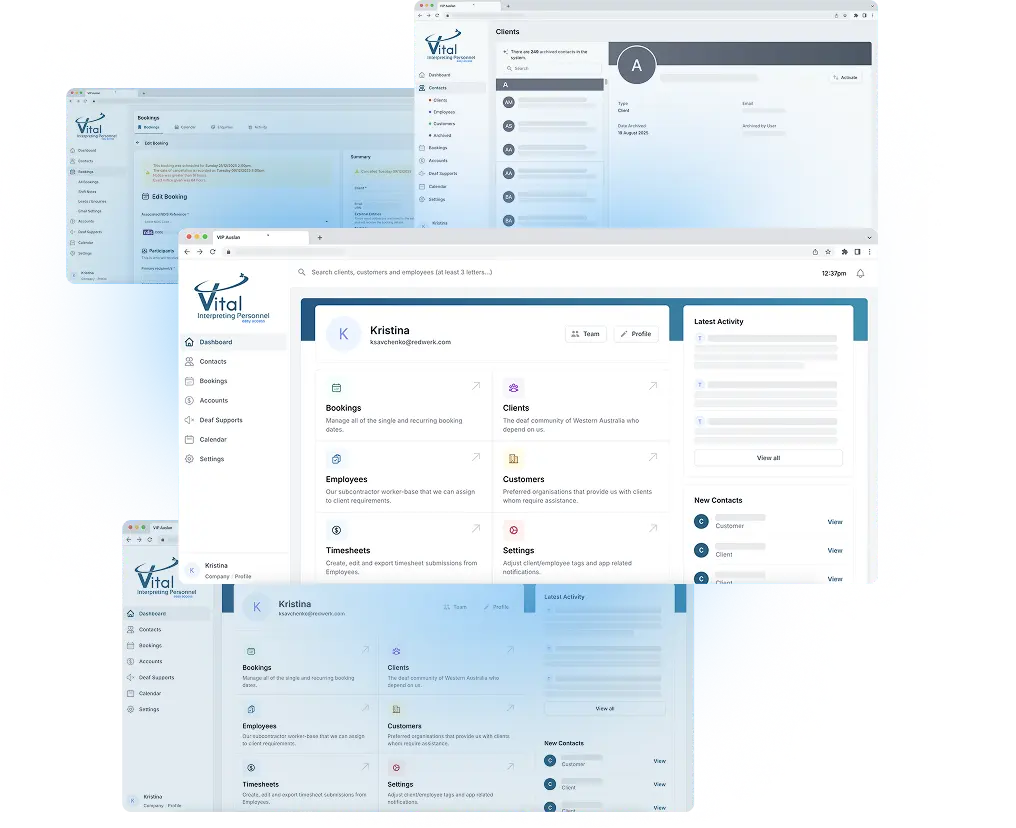
On the workflow automation side, our VIP Auslan engagement shows what replacing manual processes looks like in practice. VIP runs Australia’s main sign-language interpreter booking platform, serving over 100 government institutions. We replaced Excel-driven cancellation logic with automated, business-day-aware rules, stabilized the core booking flow, and cut manual admin work by 40% while reducing critical system errors by 90%. The team now saves 15 hours per week.
Real-Time Jira Notifications Without Leaving Telegram or Discord
For a different flavor of workflow automation, take MyJiraBot, a Telegram bot for Jira we designed and built from scratch. It pulls issues, pushes real-time notifications, and ships scheduled reports so teams stop switching between tools to stay on top of their work. Over 50 businesses use it today. The underlying pattern, which is connecting systems, triggering actions on events, scheduling data pulls, is exactly what teams now reach for n8n to do faster. Whether you need a custom bot or an n8n-powered stack, our AI automation agency team can scope and ship it.If you’re shipping an MVP with AI at the core, our playbook on MVP development with AI walks through the common traps.
Ready to Build?
The LangChain vs n8n question has a boring, honest answer: it depends on what you’re building. The interesting question is which combination earns its keep in your stack.
If you want a concrete recommendation for your use case, a second opinion on an existing build, or a team to ship the thing, we’re two clicks away. Tell us what you’re working on, and we’ll tell you honestly whether n8n, LangChain, or both belong in your project.
See how we helped VIP Auslan retire Excel-driven workflows and reclaim 15 hours a week