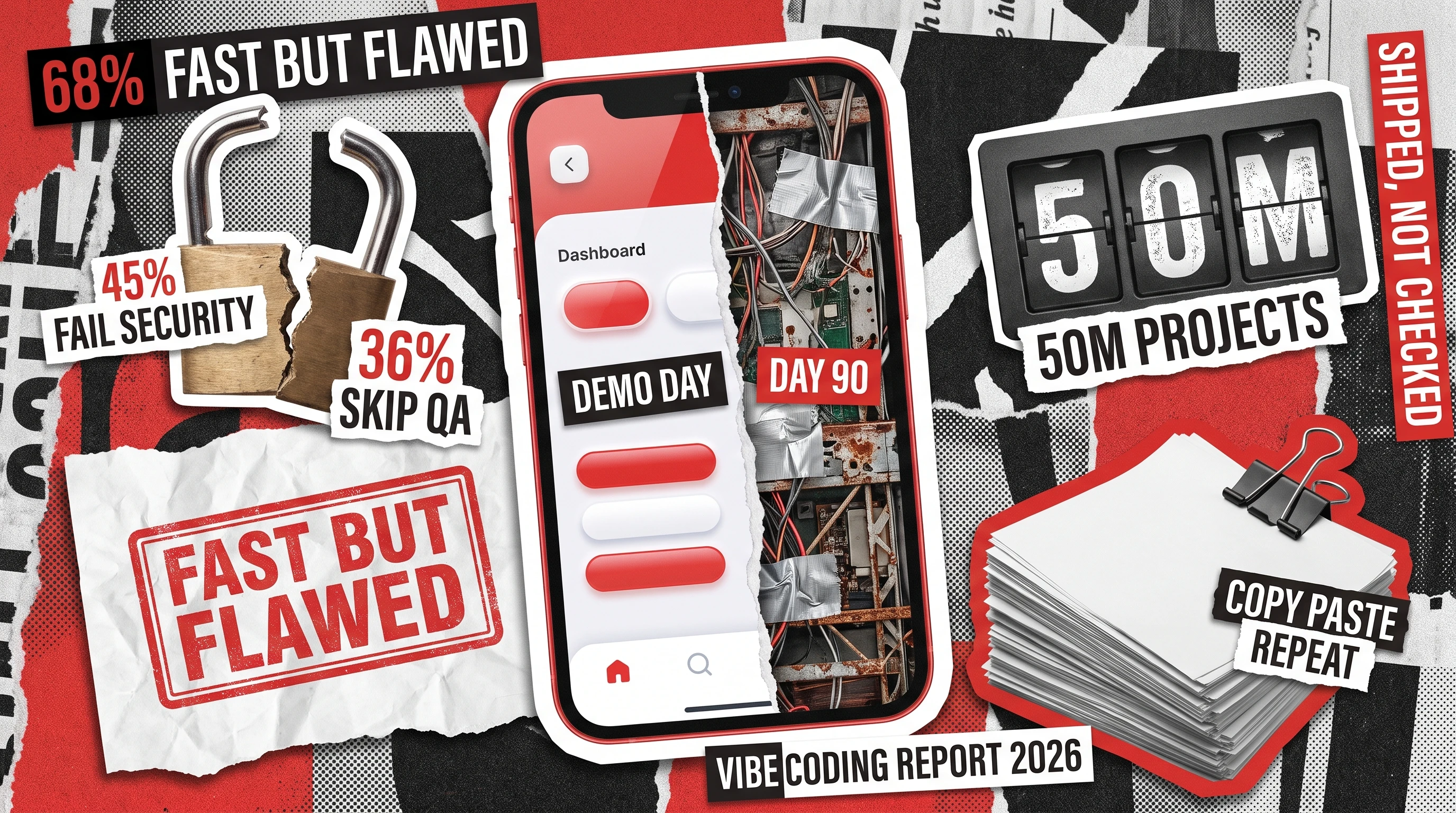
Ask the people building apps with AI what they think of their own code, and 68% call it “fast but flawed.” Not broken, not brilliant. Fast but flawed is the most expensive category of software there is, because it ships easily and fails later.
That figure comes from a peer-reviewed 2026 study, and it is the most honest of this year’s vibe coding statistics. If you came looking for a vibe coding report 2026 pdf, this page is it: every number below traced back to its primary source, free to read and free to cite, with no form in the way.
The short answer: as of August 2026, vibe coding is a mass-market way to create software and a minority way to ship it. Tens of millions of AI-generated projects exist, roughly 45% of AI-generated code samples fail security testing, and 60.5% of builders surveyed on one major platform are not earning money from what they made yet. Adoption is comfortably outrunning verification.
If your prototype has already outgrown its origins, that is what our vibe code cleanup service exists for.
The Vibe Coding Stats That Matter Most in 2026
AI coding adoption keeps gaining momentum across professional developers and non-technical builders alike, and nothing in this year’s data suggests that slows down. Trust has not followed it. Teams are now shipping code they do not fully believe in, at volumes they have never shipped before.
Vibe coders who call their own output “fast but flawed”
68%
Peer-reviewed, n=114 accounts
Vibe coders who skip QA entirely
36%
Peer-reviewed, n=132 accounts
AI-generated code samples failing security tests
45%
Benchmark, 100+ LLMs
Developers who do not fully trust AI code to be correct
96%
Survey, n=1,149
Developers using or planning to use AI coding tools
84%
Survey, n=49,000+
Developers who say vibe coding is not part of their pro workflow
77%
Survey, n=49,000+
Measured increase in completed tasks with AI tools
26.08%
RCT, n=4,867
Lovable projects created, roughly 1M added weekly
50 million
Vendor telemetry
Builders not yet earning money from what they made
60.5%
Vendor survey, n=14,300+
Security flaws officially traced back to AI coding tools
6 in January 2026, 35 by March
Public CVE tracking
Share of code changes spent tidying up existing code rather than piling on more
21% in 2022, down to 3.8% in 2026
Repo analytics
That last row is the sleeper. When developers stop reorganising what is already there and only add, a codebase gets harder to change every single week, and the cost shows up months later as “why does a small feature take three sprints now.”
What the Vibe Coding Adoption Statistics 2026 Actually Show
Here is the finding that should make you suspicious of every headline on this topic. Two reputable 2026 surveys measured the same behavior and landed almost exactly opposite. Adaptavist asked 240 US and UK professional engineers and found 83.9% currently vibe code in some form. Stack Overflow asked more than 49,000 developers across 177 countries and found 77% saying it is not part of their professional workflow.
Both are probably right. They asked different questions of different populations: one counted anybody who has ever prompted their way to a working result, including at home on a Sunday, and the other counted people who treat it as a professional practice. That gap is the most important thing in this report. Any vibe coding adoption statistics 2026 figure quoted without its definition attached should be treated as incomplete until you know what question was actually asked, which is why “84% of developers vibe code” is a claim nobody can currently support.
The broader AI-tooling picture is far less ambiguous. Google’s 2025 DORA research put AI adoption at 90% among nearly 5,000 technology professionals, with median usage around two hours a day and more than 80% reporting productivity gains. Gartner forecasts 90% of enterprise software engineers will use AI code assistants by 2028, up from under 14% in early 2024. The tools are everywhere. What people do with them varies enormously, which is why deciding where the approach fits matters more than deciding whether to allow it, and why we built a fit test for internal tools built with vibe coding.
How Many Apps Are Actually Built With AI Coding Tools?
Nobody knows, and anyone offering a confident global number is guessing. There is no census of AI-built applications, and platform figures cannot be added together because users overlap, one person creates many projects, and “project” covers everything from an abandoned experiment to a revenue-generating product. What we can do is line up the best available proxies and be clear about what each one counts.
Lovable reports 50 million projects created, adding roughly a million a week, up from 1.2 million in February 2025. That is projects, not apps: the figure includes websites, dashboards, duplicate attempts, and experiments abandoned within the hour, so “50 million vibe-coded apps” is a headline the source does not support. Vercel’s v0 reports more than 4 million users, which counts people rather than products. An arXiv preprint analyzing 128,018 public GitHub projects detected coding-agent adoption in 22.20% to 28.66% of them, and the authors note their method likely undercounts because it depends on visible traces. Apple received 557,000 new App Store submissions in 2025, up 24%, though nobody has classified how many were AI-built.
The number that deflates the hype is the money. In Lovable’s own survey of more than 14,300 users, 60.5% said they were not making money from what they had built yet but planned to, and only 10.7% reported direct product revenue. Projects created and businesses running are wildly different quantities. Closing that gap is almost always a cleanup job, because the code that got you a working demo is rarely the code that survives contact with paying customers, billing, and support tickets. We start every partnership with a software discovery phase before touching a line of code, which routinely saves clients hours of rework and thousands of dollars later by catching the architectural problem instead of the symptom. For a look at the projects that made the jump, we tracked the top vibe-coded apps that reached real users.
Who Is Doing the Building?
The demographic shift is the genuinely new thing in 2026, and it matters more than the volume story. On consumer prompt-to-app platforms, most builders are not developers at all. Lovable says roughly four in five of its users are non-technical, 45.7% identify as founders or co-founders, and just 5.8% as engineers. Bolt reports that 63% of its small-business users had never written a line of code.
Founders are the center of gravity. Y Combinator asked founders in one batch what share of their codebase was AI-generated, excluding imported libraries, and one quarter said more than 95%. Those are not toys. They are funded companies shipping to real customers. The figure gets stretched into “a quarter of startups are 95% AI-coded,” which it is not: the shares were self-estimated, and YC founders are unusually technical early adopters rather than a sample of startups generally. Meanwhile Stripe Atlas found 42% of the 23,000 companies incorporating through its platform in 2025 described themselves as AI startups, up from 15% in January 2023.
Gartner expects this to reach inside established organizations too, predicting that 40% of software team members could come from non-traditional technical backgrounds by 2028, roughly double the share at the time of the forecast. The pool of people who can build software is widening faster than the pool of people who can review it, which brings us to the uncomfortable part of the report.
Does Vibe Coding Actually Make Teams Faster?
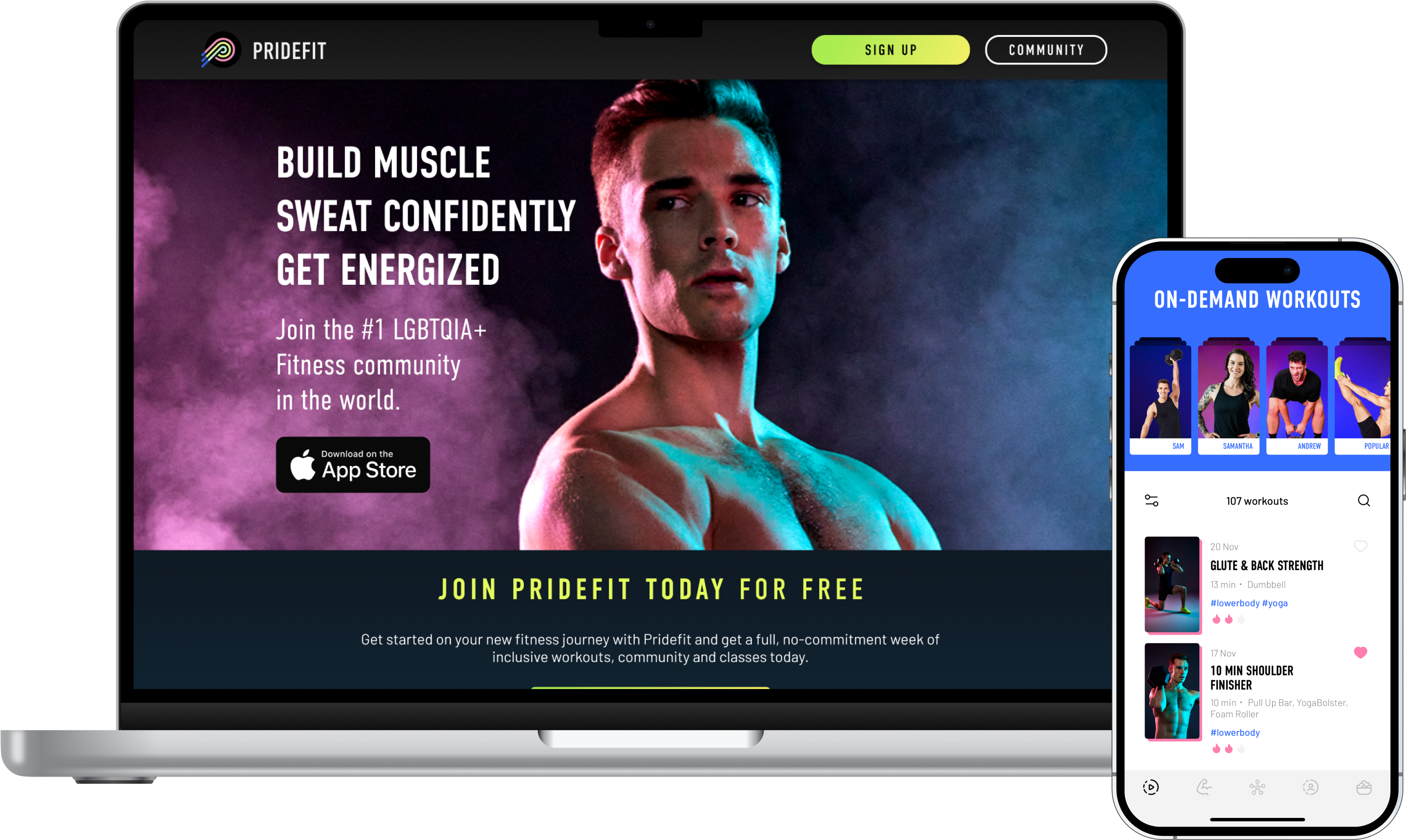
It can, and the combination that works is not vibe coding alone. Take Pridefit, a mobile fitness app and a Redwerk client. We started by reviewing their app and clearing technical debt inherited from a previous vendor, then delivered new features and added the analytics they had been flying without, which lifted app subscriptions by 45% and finally gave them visibility into their own growth. Today their team vibe codes new features themselves, and we review and clean up the output before it ships. That pairing, fast generation plus professional engineering, produces real time and cost savings in a way neither half manages on its own.
Zoom out to the wider research, though, and the picture gets messier, which is the useful part. The strongest positive evidence comes from Microsoft Research, whose randomized field experiments across 4,867 developers measured a 26.08% increase in completed tasks, with less experienced developers gaining most. Worth noting what that number is: a task-completion gain inside controlled trials of AI-assisted coding, not a universal 26% speed multiplier and not a measure of vibe coding specifically. McKinsey’s controlled study found documentation done in roughly half the time and some refactoring tasks in about a third, with gains shrinking as complexity rose.
The most sobering data point is how hard this has become to measure at all. METR ran a randomized trial in which 16 experienced open-source developers completed 246 real tasks in their own mature repositories, and they took 19% longer with AI tools while believing throughout that they had been faster. When METR repeated the study in 2026, developers increasingly refused tasks assigned to the no-AI condition, which broke the randomization and left the team describing its own newer estimate as a lower bound. Stack Overflow supplies the texture: 66% of developers are frustrated by solutions that are “almost right, but not quite,” and 45% say debugging AI code can take longer than writing it themselves.
The pattern across all of it is consistent. Gains are large and reliable on bounded, verifiable work, and they get unpredictable the moment someone has to understand a mature codebase, which is exactly the point at which a reviewed handoff starts paying for itself.
The Quality and Security Numbers
Speed is the part everyone measures. What the following numbers describe is the bill that arrives afterward, and it lands in three places: security holes nobody looked for, duplication that makes every future change riskier, and secrets sitting in a repository. Each row below is a different research team arriving at a version of the same conclusion from a different direction. The full mechanics live in our analyses of vibe coding security risks and technical debt in AI-generated code.
Developers hit by at least one AI technical-debt effect
88%, led by 53% who found code that looked correct but proved unreliable
Security-test failure rate across 100+ models
45% of samples failed or introduced an OWASP Top 10 weakness
15 apps built by 5 leading AI tools from identical prompts
69 vulnerabilities total, about 6 rated critical; every app lacked CSRF protection and security headers
Issue density across 470 open-source pull requests
10.83 issues per AI-authored PR vs 6.45 for human-only, with security issues up to 2.74x higher
Commits that leaked a password or API key
3.2% of AI-assisted commits vs 1.5% baseline, out of 28.65 million secrets found on public GitHub in 2025
Copy-pasted duplicate code per million lines changed
40.3 blocks in 2023, 73.0 in 2026, the highest on record
Two caveats keep these numbers honest. Veracode’s 45% and Tenzai’s 69 vulnerabilities come from controlled benchmarks, not audits of live production apps, and CodeRabbit identified AI-authored pull requests through co-authorship signals rather than direct confirmation. They describe what these tools reliably produce, not a census of what is currently running.
The Tenzai result deserves a second look, because it is more interesting than “AI writes insecure code.” The tools were excellent at the textbook problems: researchers found no exploitable SQL injection or XSS anywhere across all 15 apps. What they found instead were authorization logic flaws, business logic holes, and server-side request forgery, the vulnerabilities where safe and dangerous depend entirely on context the model was never given. AI has largely solved the vulnerabilities you can memorize. It has not touched the ones that require knowing what your business considers a permission.
The Vibe Security Radar, run by Georgia Tech’s Systems Software and Security Lab, is now tracking the consequences in public. Officially catalogued vulnerabilities traceable to AI coding tools rose from 6 in January 2026 to 35 in March, and the project’s founder estimates the true figure is five to ten times higher, since most AI-written code leaves no detectable signature at all.
Practitioner Perspective: What We See When We Open a Vibe-Coded Codebase
This section is Redwerk’s first-hand observation from client work, not research. It is here because aggregated data cannot tell you what these codebases feel like from the inside.
The pattern that surprises clients most is that the code usually works. The demo runs, the happy path is clean, and the UI is often better-looking than what a rushed in-house team would have produced. What is missing is almost never the feature. It is the layer underneath: authorization that assumes one kind of user, data access with no tenancy boundary, secrets sitting in the repository, no migration path, and no tests to tell anyone when a change broke something three screens away.
The second pattern is duplication that hardens over time. Because the fastest way to get a new screen is to prompt for a new screen, near-identical logic accumulates in five places, and the sixth change to a business rule silently misses two of them. GitClear’s finding that tidy-up work fell from 21% of code changes in 2022 to under 4% in 2026 is the industry-scale version of what we see file by file. This is also why the peer-reviewed “fast but flawed” figure rings so true: the people who built these apps usually sense something is off, they just cannot see where. That is what a structured vibe code audit or a broader software development audit is for.
Where This Is Heading in 2027
The forecast worth taking seriously is not about capability. It is about the widening gap between how much code gets deployed and how much of it anyone understands. Security researchers increasingly expect the first high-profile production failure traced directly back to unreviewed AI-generated code, and the reasoning is simple arithmetic: more untested code reaching production every quarter, in systems handling money and personal data, maintained by people who did not write it and cannot fully read it.
The academic literature is converging on the same boundary from a different direction. An experience report on vibe coding in production found that generated code consistently under-specified multi-tenancy, access control, and asynchronous processing, and identified architectural areas the authors call “non-delegation zones.” Their central observation is that the effort does not disappear, it relocates: away from writing boilerplate, toward specifying constraints and auditing whether they held.
That is the real 2027 story. Generating software is becoming trivial and verifying it is becoming the whole job, which makes long-term maintenance of vibe-coded apps the discipline most teams have not staffed for yet. It is also why the debate over whether AI will replace software developers keeps missing the point: the job is shifting toward verification, not disappearing.
Why Partner With Redwerk on a Vibe-Coded App
If your prototype is now carrying real users, the question is not whether AI wrote it. The question is whether the foundation underneath can hold what you are about to build on top. We do this work daily, and we would rather tell you the app is fine than sell you a rebuild you do not need.
We start with a discovery phase to understand your business needs and goals, because the answer often is not a code problem at all. Sometimes the architecture needs rethinking, sometimes the security model was never there, and sometimes the code is fine and the data model is the thing that will break at 10,000 users. You get an estimate before we touch anything.
To see how that plays out over a full engagement, the Pridefit case study covers the whole arc: technical debt inherited from a previous vendor cleared first, then new features and the analytics the team had been flying without, a 45% lift in app subscriptions, and a product team that now vibe codes new features confidently because someone reviews the output before it ships.
Underneath all of it are the fundamental engineering principles and security practices honed across two decades of building custom software for businesses in North America and Europe, including Fortune 500 companies like Siemens, J.B. Hunt, and Universal Music Group. Whether you need a targeted vibe code cleanup or a full AI custom software development engagement built properly from the start, you will know which one you need before you commit a budget. Contact us and we will tell you honestly which side of that line your app falls on.
FAQ
What Is the State of Vibe Coding in 2026?
Vibe coding is a mainstream way to create software and a minority way to ship production systems. Tens of millions of AI-generated projects exist on individual platforms, 68% of practitioners describe their own output as “fast but flawed,” and 60.5% of surveyed builders on one major platform are not yet earning money from what they made. Creation has scaled; verification has not.
How Many Apps Are Built With AI Coding Tools?
No credible global count exists. Lovable alone reports 50 million projects created, and an analysis of 128,018 public GitHub projects detected coding-agent adoption in 22.20% to 28.66% of them. Projects are not the same as deployed, maintained applications, and platform numbers cannot be summed because users and projects overlap.
What Percentage of AI-Generated Code Has Security Issues?
Veracode’s benchmark across more than 100 large language models found 45% of generated samples failed security testing or introduced an OWASP Top 10 weakness. A separate study of 15 apps built by five leading AI tools found 69 vulnerabilities, roughly 6 rated critical, with every app missing CSRF protection and security headers. CodeRabbit’s analysis of 470 open-source pull requests puts a number on the gap: AI-authored PRs averaged 10.83 issues each versus 6.45 for human-only PRs, with security issues up to 2.74 times higher.
Is Vibe Coding Safe for Production?
It depends entirely on what the app does. Internal tools, dashboards, and prototypes carry a limited blast radius. Anything handling payments, personal data, or multi-tenant access needs an independent review first, because the research consistently shows AI handles memorizable vulnerabilities well and context-dependent authorization logic poorly.
Can a Vibe-Coded App Be Saved, or Does It Need a Rewrite?
Usually saved. In our experience the features are fine and the foundation is thin, which means targeted work on architecture, authorization, and test coverage rather than starting over. An audit tells you which of the two you are dealing with, and it costs considerably less than guessing.
See how Redwerk took over a struggling fitness app from another vendor, cleaned up the inherited technical debt, and helped Pridefit grow subscriptions by 45%