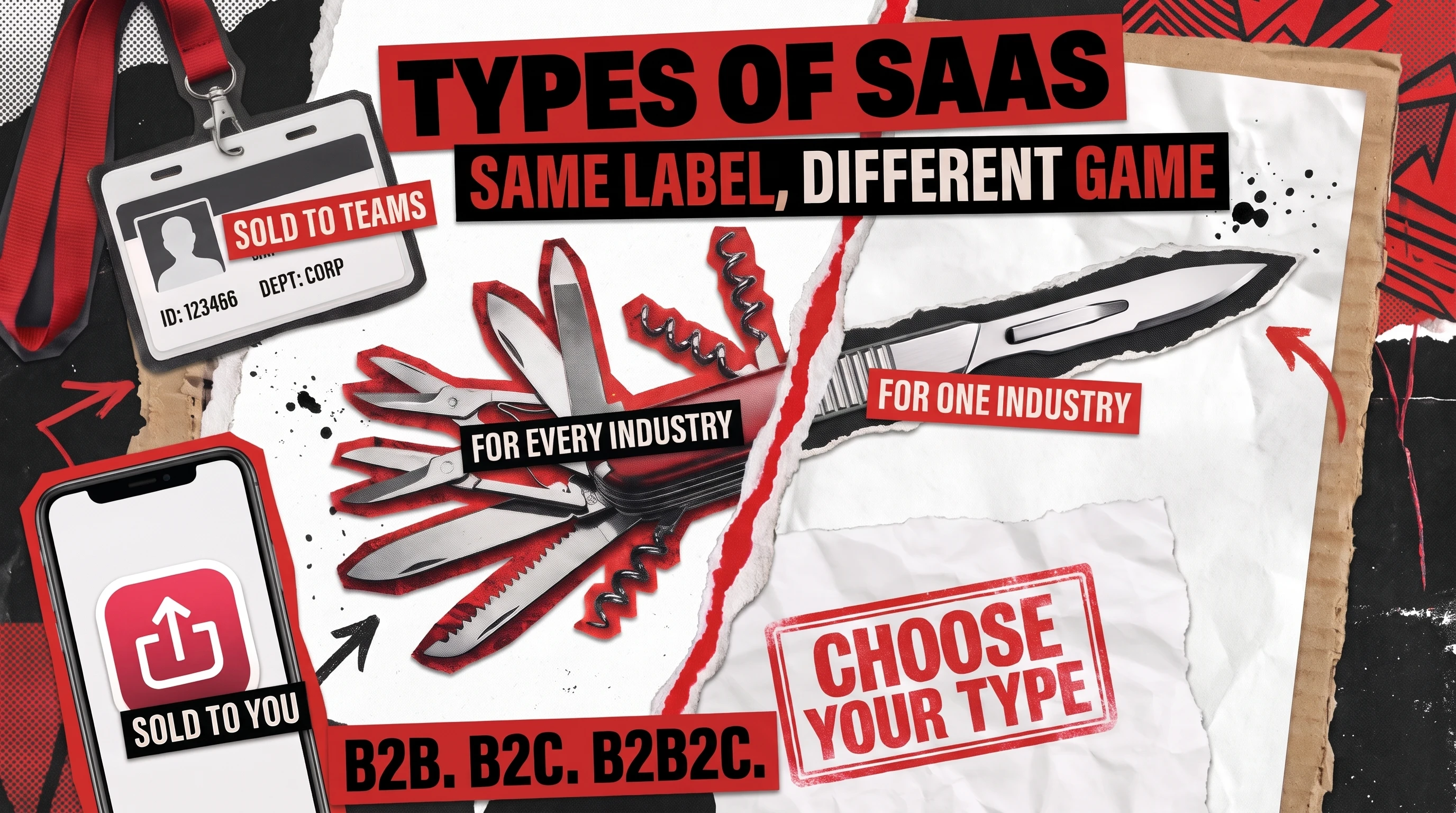
If you are planning a software as a service (SaaS) product, its type decides who signs the contract, how you price it, and how much domain depth the first release needs. There are four main types of SaaS, sorted along two axes: who buys it (B2B, B2C, or the hybrid B2B2C) and how specialized it is (vertical, built for one industry, or horizontal, built for one business function across every industry). Every product sits on both axes at once.
This guide explains each type with real platforms, several of them built by our team as part of our SaaS development services, and shows what the choice changes for pricing, sales, and the product itself.
The Types of SaaS on Two Axes
B2B, B2C, vertical, and horizontal answer two different questions, so a single product always carries one label from each:
- Who buys it: B2B (business-to-business), B2C (business-to-consumer), or B2B2C (business-to-business-to-consumer), where an organization such as a library or employer pays and its members or customers use the product.
- How specialized it is: vertical (one industry, deep domain features) or horizontal (one function, any industry).
B2B
Practice management software for dental clinics, property management software for real estate firms, electronic health records for hospitals
CRM systems, team messaging apps, email marketing tools
B2C
Language learning apps, fitness tracking apps
Personal cloud storage, writing assistants
B2B2C
Mental health apps that employers provide to staff, telehealth apps that insurers offer to policyholders
Less common, since organizations usually buy for an industry-specific purpose

B2B SaaS vs B2C SaaS: Who Is Actually Buying
B2B (business-to-business) SaaS is sold to companies. A purchase usually involves the team that will use the product, IT or security, and finance, so sales cycles run longer and each account pays more. B2C (business-to-consumer) SaaS is sold to individuals who sign up on their own, usually with a card and a free trial, so the business depends on volume, self-serve onboarding, and low churn.
B2B buyers have grown stricter about what they renew. Zylo’s 2026 SaaS Management Index found that organizations leave an average of 36% of their SaaS licenses unused, while spend on AI-native apps rose 108% year over year. Narrow tools that prove daily use keep finding room, which is the opening behind many micro SaaS ideas.
The consumer side is crowded in a different way. RevenueCat’s State of Subscription Apps 2026 reports that apps launched before 2020 generate 69% of all subscription revenue, while apps launched in 2025 or later account for just 3%.
Buyer
A company, often several decision-makers
One person
Price per account
Higher, per seat, tier, or module
Lower, usually a flat monthly plan
Sales cycle
Weeks to months, with demos and security review
Minutes, through self-serve signup
Must-have features
Admin roles, audit logs, integrations, single sign-on
Fast onboarding, mobile access, simple billing
Main growth risk
Long sales cycles and unused seats at renewal
Churn and customer acquisition cost
Vertical SaaS vs Horizontal SaaS: How Specialized the Product Is
Vertical SaaS is built for one industry and encodes its workflows, regulations, and vocabulary, such as appointment rules for dental practices or eligibility rules for government benefits. Horizontal SaaS is built for one business function, such as customer relationship management (CRM), project management, or email marketing, and companies in any industry can use it.
The vertical category is large. Bessemer Venture Partners’ State of the Cloud 2024 notes that the top 20 US publicly traded vertical SaaS companies represent a combined market capitalization of about $300 billion, and predicts that vertical AI will grow to at least 10 times the size of legacy vertical SaaS.
Built for
One industry
One function across industries
Feature depth
Deep domain workflows and compliance
Broad, configurable features
Competition
Fewer direct rivals
Crowded, many alternatives
Pricing power
Higher, since switching means losing domain workflows
Lower, under pressure from alternatives
Customer loyalty
Deep, high switching costs
Weaker, easier to replace
Growth speed
Slower, limited by industry size
Faster, any company is a prospect
Our breakdown of IaaS vs PaaS vs SaaS (infrastructure, platform, and software as a service) lists more vertical and horizontal products by category.
Real Examples of Each Type of SaaS
Most of these are platforms our team has built or upgraded, plus one widely known horizontal product for comparison. If you are earlier on that path, our guide from MVP to full SaaS covers how a first release grows into a platform like these.
Vertical B2B SaaS: Current, Enorasys, and Recruit Media
Current is a platform we built for the Change & Innovation Agency (C!A) to help US human services agencies run state-administered programs, with one dashboard for work assignment, alerts, and staffing forecasts. It is 100% compliant with the Americans with Disabilities Act (ADA), and ten state and county agencies have integrated it.
Enorasys is a security analytics SaaS from Encode, an Athens-based cybersecurity firm recognized with an IBM Beacon Award. We moved its data store from MySQL and Splunk to Elasticsearch, built a multi-tenant architecture so one instance serves every client with isolated data, and added role-based access control (RBAC) and an audit log.
Recruit Media is a recruitment SaaS for recruiters and job seekers, with teleprompter-assisted video CVs and in-app interviews. We ran the full product cycle on .NET and Azure, including a neural network trained on more than 1.5 million texts that suggests search keywords. HireQuest acquired Recruit Media in October 2021.
B2B2C SaaS: AWE Learning and Kooky
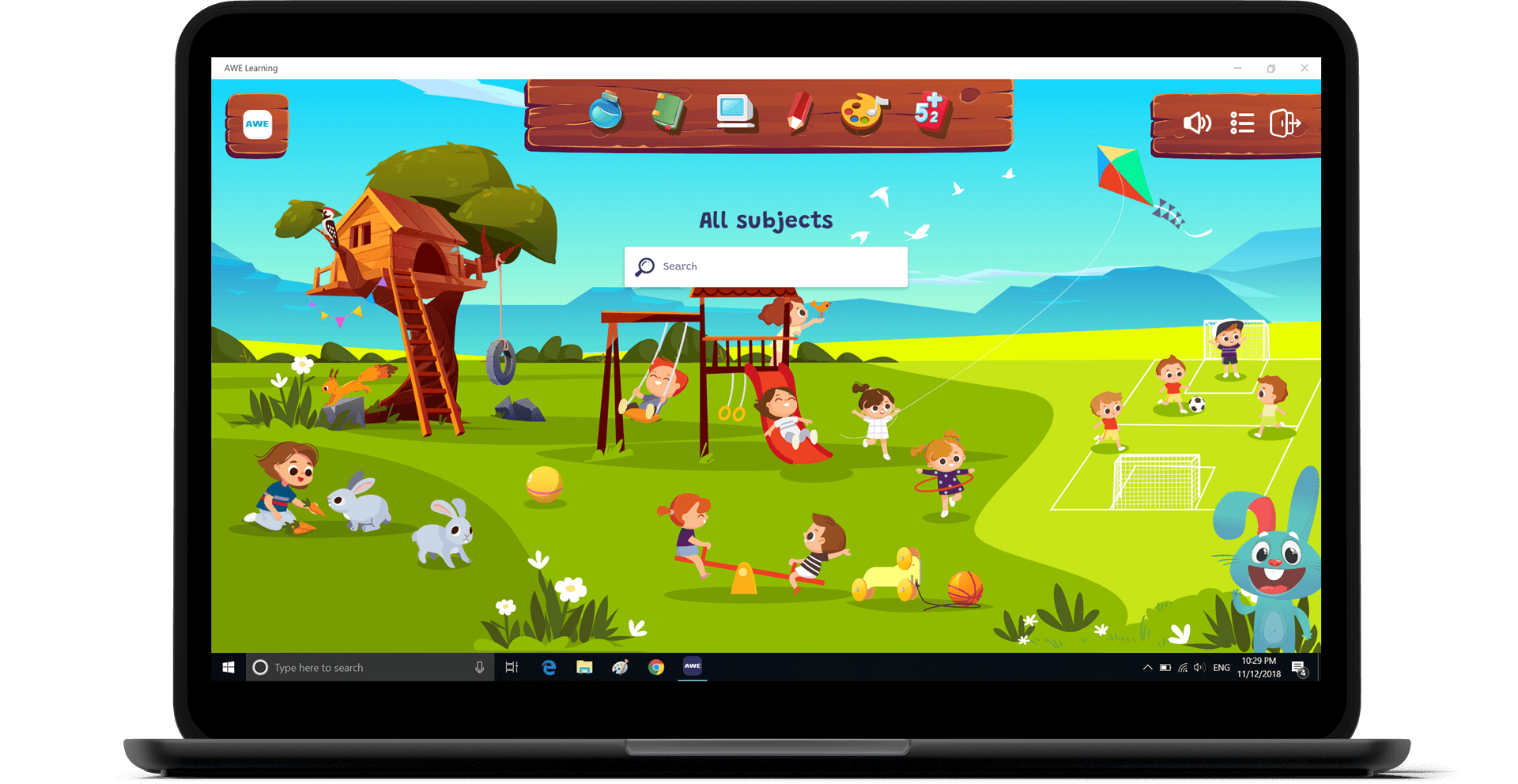
AWE Learning supplies early literacy content for children ages 2 to 12. We built its cloud SaaS from the ground up on ASP.NET Core and Azure, replacing dedicated library workstations. Libraries buy it and families use it, so it needed an admin panel for access, subscriptions, and reports alongside a child-safe interface. Today it is used by 50% of US public libraries.
Kooky runs a reusable cup system in Switzerland, launched with Swiss Federal Railways. Coffee drinkers pay a 1 Swiss franc deposit per cup, and cafes manage their cup stock through a Partners Portal we built, alongside the Operations Center and the APIs behind the Kooky Boxes and mobile app.
Horizontal B2B SaaS: Cakemail and Slack
Cakemail offers email marketing to businesses in any industry. We built the frontend for its Subscription Forms module from scratch in React in under 90 days, working against static mock data because the backend was not ready yet.
Slack is a team messaging platform that companies in every industry use for channels, direct messages, video huddles, and integrations with the rest of their workplace tools. A law firm and a game studio use the same product with the same features, which is what makes it horizontal. Salesforce acquired Slack in 2021.
Why the Type of SaaS Changes Pricing, Sales, and the Roadmap
Vertical SaaS trades growth speed for pricing power and customer loyalty. Horizontal SaaS trades differentiation for a much larger market. The type you choose shapes three decisions from day one:
- Pricing: Vertical products can charge more because they replace industry-specific work. Horizontal products compete on usability, integrations, or a free tier. B2C pricing has to work at a self-serve price point.
- Sales motion: B2B and B2B2C products need demos, security questionnaires, and procurement. B2C products need onboarding and retention that work without a salesperson. Vertical products sell through industry channels and references, which is slower and builds more trust.
- Roadmap and architecture: B2B buyers expect multitenancy, RBAC, and audit logs early, as with Enorasys. Vertical products need compliance and domain logic, as with Current. B2B2C products carry two roadmaps in one, as with AWE Learning. Each of these shapes your SaaS tech stack and where you will hit limits when scaling SaaS.
Once you know your type, the next step is testing the concept with real users, covered in our guide to product discovery & validation. For the build itself, see how to develop a SaaS product without building the wrong thing.
When Your SaaS Type Is Still Unclear
Many products change type as they grow. A horizontal tool can find one industry that loves it and go vertical, and a vertical product can add a self-serve plan for smaller customers. If you already have paying customers, their behavior is a better guide than any category framework.
If the category is still open, our discovery phase services test it with real buyers before a large budget goes in one direction. Full specifications are not required to start: we ran architecture workshops with the Recruit Media founders before writing code, and built Cakemail’s frontend while its backend was still in progress. A focused MVP development project then puts the chosen type in front of paying users, and our guide to outsourcing SaaS development covers what to check before bringing in an external team.
Choosing Your Type of SaaS
The type of SaaS you build shapes nearly every later decision, from pricing and sales motion to how deep the domain features go. We have built vertical, horizontal, and B2B2C platforms across recruitment, government, cybersecurity, e-learning, sustainability, and marketing. If you are deciding which type your product should be, talk to our team.
FAQ
What are the main types of SaaS?
The main types of SaaS are B2B (business-to-business), B2C (business-to-consumer), B2B2C (business-to-business-to-consumer), vertical, and horizontal. The first three describe who buys the product and the last two describe how specialized it is, so every SaaS product carries one label from each group.
What is the difference between vertical SaaS and horizontal SaaS?
Vertical SaaS is built for one industry, such as recruitment or government services, with deep domain workflows. Horizontal SaaS is built for one function, such as email marketing, that any industry can use. Vertical products usually earn higher prices and loyalty, while horizontal products scale to larger markets faster.
What is the difference between B2B SaaS and B2C SaaS?
B2B SaaS is sold to companies, with higher prices per account and longer sales cycles. B2C SaaS is sold to individuals through self-serve signup at lower prices, so it depends on volume and retention.
What is B2B2C SaaS?
B2B2C SaaS is bought by an organization and used by its members or customers. AWE Learning is an example: public libraries pay for the platform, and children and families use it.
Find out how AWE Learning could reach users beyond the US by implementing scalable SaaS and cloud migration