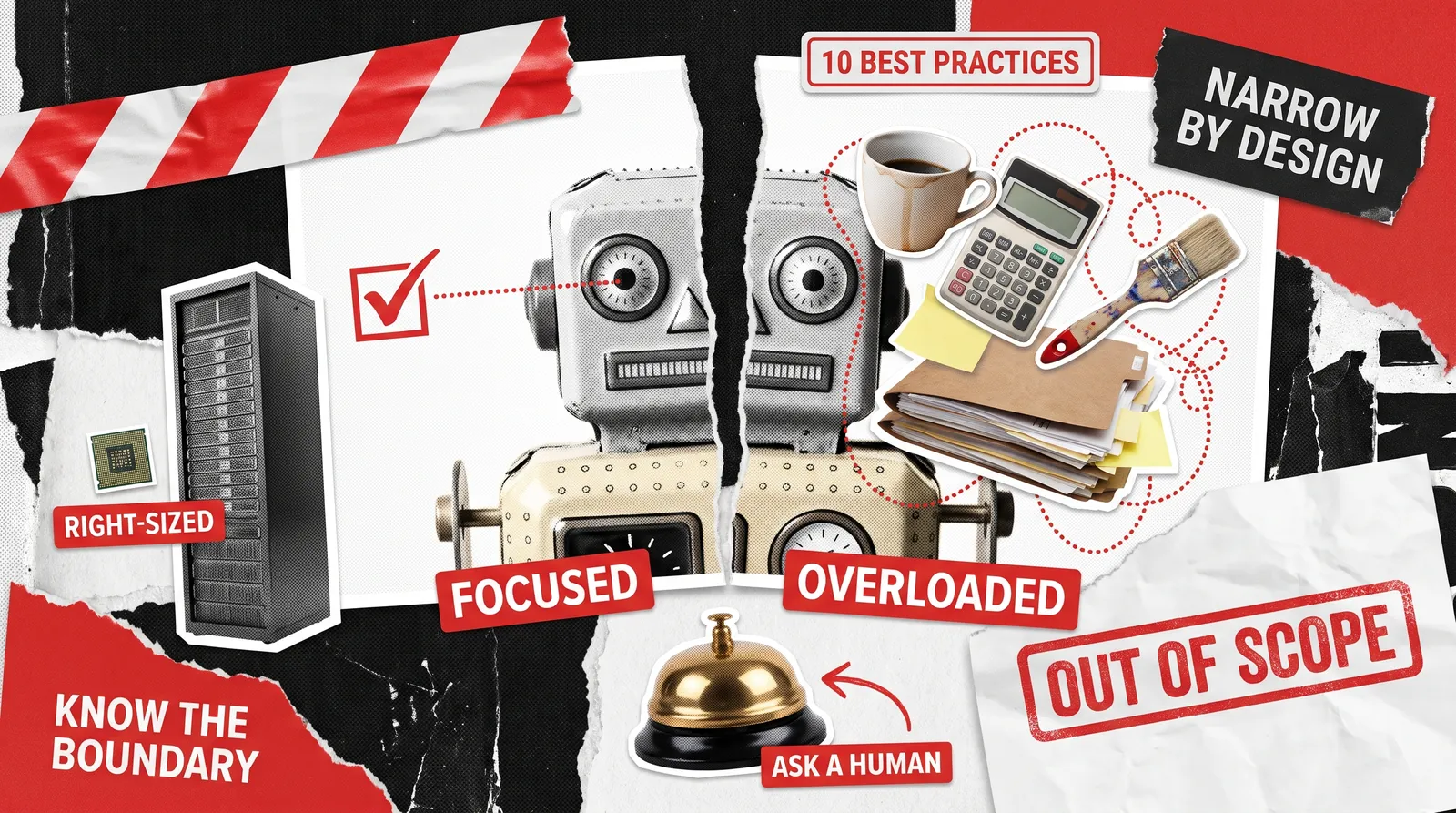
The best practices for narrow AI development come down to one discipline: define exactly what the system is responsible for, constrain its knowledge to that job, and keep the boundary visible as the product grows. That means precise scoping, grounded data, task-specific testing and monitoring, right-sized models, and an explicit handoff to a human for everything outside the boundary.
For a founder or Head of Product with an AI feature on the roadmap, the expensive decisions happen before anyone picks a model: what the system owns, where its knowledge comes from, and who takes over when it is unsure. When those answers stay vague, projects stall at the demo stage. In our artificial intelligence development services, settling them comes first, and a medium-complexity narrow AI system then typically goes from a working prototype in days to production in 6 to 12 weeks.
What Is Narrow AI?
Narrow AI (also called weak AI or artificial narrow intelligence) is artificial intelligence built to perform one specific task or a tightly defined set of tasks, such as recommending products, routing support tickets, or flagging fraudulent payments. It cannot carry its skill over to an unrelated problem. Artificial general intelligence (AGI), a system that could learn and reason across any domain the way a person does, does not exist yet, so every AI system in production today is narrow AI, from voice assistants to streaming recommendation engines.
In practice, a business rarely runs one narrow AI system. E-commerce AI automation, for example, usually means several separate ones: one recommends products, another approves returns, and a third flags suspicious orders.
Large language models blur the picture a little, because one model can write, summarize, and translate. Once you deploy that model inside your product to do a specific job, though, you are building a narrow AI system, and its success depends on how well you define and defend that job.
10 Best Practices for Narrow AI Development at a Glance
Knowing these practices before you start lets you spend the budget on what decides whether a narrow AI system survives real users: its scope, its data, and its handoff to people. They also give you a concrete way to judge a vendor proposal or an in-house plan, because a team that cannot explain its escalation rules or evaluation set is likely to learn those lessons on your budget. And they turn the question of whether the AI will work into a set of checks you can run before launch and after it.
1. Define the task boundary
“Help the support team” as the spec
Write the inputs, outputs, allowed decisions, and handoffs before coding
2. Constrain knowledge
Let the model answer from its general training data
Ground answers in a curated, versioned domain knowledge base (RAG)
3. Plan for real failure modes
Use a generic AI risk checklist
List the failures specific to this task and rank them by cost
4. Scope memory
No memory, or memory of everything
Persist only the state the task needs, with checkpoints and audit logs
5. Build escalation paths
Let the model guess on unfamiliar inputs
Detect out-of-scope cases and hand them to a human with context
6. Monitor task drift
Watch uptime, latency, and token cost only
Track accuracy on the specific job, sampled from production
7. Test real edge cases
Run a generic QA checklist
Build an evaluation set from messy, real inputs in the domain
8. Right-size the model
Default to the largest frontier model
Match model size to the task’s actual difficulty and volume
9. Document the boundary
Keep the scope in someone’s head
Maintain a boundary document next to the code
10. Plan boundary changes
Expand scope through ad hoc feature requests
Treat every expansion as a small new discovery cycle
1. Define Your Narrow AI's Task Boundary Before Writing Any Code
The most common failure mode in narrow AI is scope creep. A system built to do one job well gets asked to do a second and a third, and its accuracy on all of them slides.
Write the boundary as a short specification that anyone on the team could test against:
- Inputs: what the system accepts (an inbound email in English or German, under 2,000 words)
- Outputs: what it produces (one of 12 ticket categories plus a draft reply for 4 of them)
- Decisions: what it may do on its own (tag and route) and what it may only suggest (refunds)
- Handoffs: what it passes to a person, and how
A spec like “classify inbound tickets into 12 categories and draft replies for the 4 with documented answers” gives developers, testers, and the business owner the same thing to check.
You do not need complete requirements to get here. Working out the boundary is exactly what discovery is for, and as we explain in how AI is changing the discovery phase in software, AI-assisted discovery now delivers the same depth as a traditional 4 to 8 week process in 1 to 3 weeks, turning stakeholder interviews into user stories, flagged contradictions, and a scope document.
2. Constrain Your Narrow AI System's Knowledge Deliberately
A narrow AI system should know your domain well and everything else barely at all. Retrieval-augmented generation (RAG) is the standard way to do that with language models: the system retrieves relevant passages from your own knowledge base and answers only from them.
The practices that matter most, covered in depth in our RAG best practices guide:
- Instruct the model to answer only from the supplied context and to say it does not know when the answer is missing
- Whitelist the sources it may draw from and version the knowledge base
- Evaluate retrieval (did it find the right passage?) separately from generation (did it use the passage faithfully?)
Retrieval is the better default for knowledge that changes often or needs citations, while fine-tuning suits strict output formats and tone. Our fine-tuning vs RAG decision framework walks through when each one fits and why most production systems end up combining them.
None of this works without usable data. Gartner predicts that through 2026, organizations will abandon 60% of AI projects unsupported by AI-ready data, and the same Gartner release found that 63% of organizations either lack or are unsure they have the right data management practices for AI. Structured data needs the same care: AI in CRM features such as lead scoring only work when outcomes are labeled and fields are filled in consistently. Audit the documents, tickets, or records your system will rely on before you build the pipeline around them.
3. Design Narrow AI Around the Task's Real Failure Modes
Safety-critical domains show this most clearly. In our guide to building AI-powered automotive software, functional safety under ISO 26262 is a constraint that runs through every engineering decision from day one. Advanced driver assistance systems (ADAS) have to stay accurate under conditions their training data never included, and Automotive Safety Integrity Levels (ASIL A to D) set how much safety effort each function needs.
Most business systems carry lower stakes, but the method transfers. For a ticket classifier, the costly failure is a cancellation request filed as general feedback, while a slightly lower average accuracy barely matters. For an invoice extraction model, a wrong total is far worse than a missing vendor address. In AI for iGaming, a responsible gambling model that misses a player at risk has a regulatory and human cost that a few extra false alerts do not.
List the five to ten ways your system can fail on its actual task, estimate what each one costs the business, and design a specific control for the expensive ones: a confidence threshold, a validation rule, a second check, or a mandatory human review.
4. Give the System Real Memory Within Its Scope
Memory is where many narrow AI agents break in production. An agent that forgets what it was doing halfway through a multi-step task repeats work, contradicts itself, or drops the case.
It is one of the three architecture decisions that make or break a production support agent, as our walkthrough of an AI customer support agent built in n8n shows. In practice, scoped memory means:
- Persisting the state the task needs (the open case, the customer’s history on that case, the current workflow step) and nothing beyond it
- Saving database checkpoints so an interrupted task resumes where it stopped
- Logging every action with its input, the context the agent retrieved, and its output
Audit logs pay for themselves the first time someone asks why the system made a particular decision. They are also the raw material for the monitoring and testing practices further down this list.
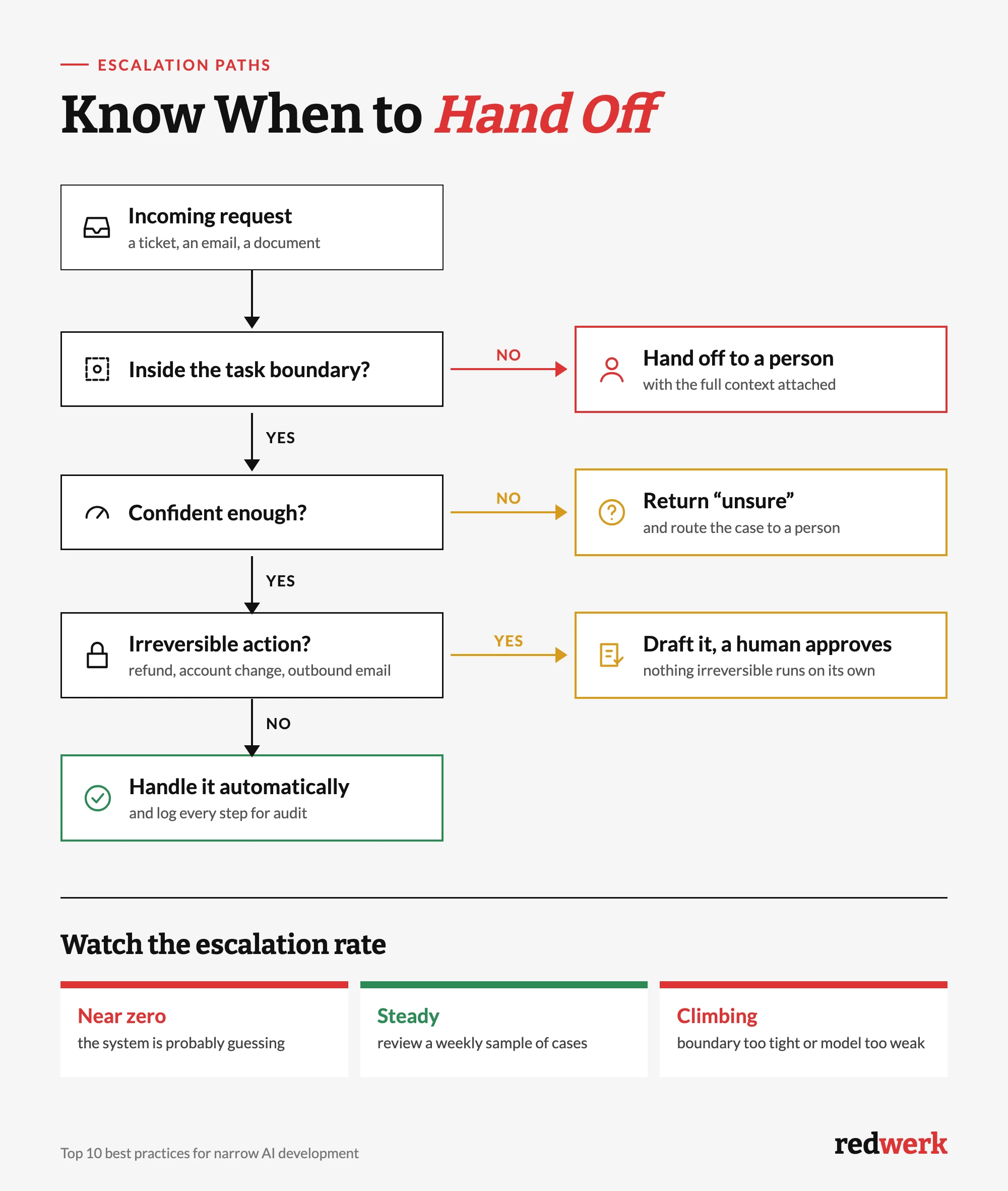
5. Build Escalation Paths for What Falls Outside the Task Boundary
Every narrow AI system will receive inputs it was never designed for. A language model asked something outside its scope tends to produce a fluent, confident guess, which is the riskiest behavior a customer-facing system can have.
Design the exit explicitly:
- Give the model an “out of scope” or “unsure” outcome and reward it for using one
- Set confidence thresholds below which the case goes to a person
- Require human-in-the-loop approval for irreversible actions such as refunds, account changes, or outbound emails
- Hand over the full context so the person does not start from zero
Then watch the escalation rate. A rate that keeps climbing means the boundary is too tight or the model is too weak. A rate near zero usually means the system is guessing.
6. Monitor for Drift Within the Specific Task
Standard dashboards track uptime, latency, and token cost, which show that the system is running without showing whether its answers are still correct.
Drift in narrow AI shows up as declining accuracy on the specific job: new product names the model has never seen, a change in how customers phrase requests, a policy update the knowledge base has not caught up with. Track metrics tied to the task itself:
- Share of AI decisions that people override or correct
- Escalation rate over time
- Groundedness of answers against the knowledge base
- Accuracy on a weekly random sample of production cases reviewed by a person
Capture these numbers before launch, too. As our overview of enterprise AI use cases points out, a deployment without a pre-launch baseline has nothing to prove its results against.
Re-run your evaluation set on every model, prompt, or knowledge base change, and alert on drops in task accuracy the same way you alert on downtime.
7. Test Narrow AI Against the Task's Actual Edge Cases
Generic test suites miss the failure modes specific to what a narrow AI system actually does, because those failures live in the quirks of your domain’s data.
Build the evaluation set from real historical data, anonymized where needed:
- Messy inputs: typos, forwarded email chains, scanned PDFs, mixed languages
- Ambiguous cases where even your own staff disagree
- Boundary cases sitting just inside and just outside the task scope
- Adversarial inputs such as prompt injection, if the system reads user-supplied text
Agree on pass thresholds with the business owner before launch, and turn every production incident into a new test case, so the evaluation set grows with the system.
8. Match Model Size to What the Task Actually Needs
Defaulting to the largest available model is a common and costly habit. Gartner predicts that by 2027, organizations will use small, task-specific AI models at least three times more than general-purpose LLMs, noting that general models lose accuracy on tasks that need specific business context.
The research supports it. The LoRA Land study fine-tuned 310 models across 31 tasks and found that 4-bit LoRA fine-tuned models outperform base models by 34 points and GPT-4 by 10 points on average, with 25 fine-tuned 7-billion-parameter models served from a single GPU.
A sensible path is to prove the value with a frontier API first, collect real traffic and an evaluation set, then test whether a smaller model matches it at a fraction of the running cost. That smaller model can come from LLM fine-tuning on your own examples or from model distillation, where the large model teaches a compact one to do the same job. We cover the economics in why a small distilled model can beat GPT-5 at your one job.
9. Document the Boundary for Whoever Maintains This System Next
The task boundary that made sense at launch fades from memory within a year. A new engineer adds a “small” capability, a prompt gets edited to handle one awkward customer, and the system drifts outside the scope it was tested for.
Keep a boundary document in the repository next to the code, covering:
- The task, in one paragraph
- What is in scope and, explicitly, what is out of scope
- Data sources and their versions
- Escalation rules and confidence thresholds
- The evaluation set, pass thresholds, and the named owner
Update it with every scope change, in the same pull request. It is also the first document we ask for when Redwerk takes over a half-built AI system from another team.
10. Plan for Your Narrow AI's Boundary to Change as the Business Does
A narrow AI system’s scope is not fixed forever, and it should not be. New product lines, markets, and regulations will all pull at it.
Expanding the scope is a new task, and the original evaluation results do not cover it. When Google DeepMind applied machine learning to data center cooling, the system achieved a 40 percent reduction in the energy used for cooling, yet the team noted that each data center has a unique architecture and environment, so a custom-tuned model for one system may not be applicable to another.
Treat every boundary change as a small discovery cycle: update the boundary document, add failure modes and edge cases to the evaluation set, adjust the escalation rules, and review the scope with the product owner on a fixed schedule, such as once a quarter.
When Narrow AI Is the Wrong Tool
Some problems do not need a narrow AI system at all. If a few deterministic rules solve the task reliably, rules are cheaper to run, easier to audit, and never drift. If the work is low-volume, creative, or changes every week, a general-purpose assistant used by a person will usually serve you better than a custom system. Narrow AI earns its cost on repetitive, well-defined, high-volume work where the inputs are messy enough that rules break down.
How Redwerk Builds Narrow AI Systems
Our AI custom software development work starts with the boundary. A 1 to 3 week AI-assisted discovery turns incomplete requirements into a testable scope, a working prototype follows within days to three weeks, and the evaluation set, escalation rules, and audit logs are built alongside the features. You get a senior team that ramps up fast and keeps you informed at every step, whether the system is a support agent or an internal workflow tool.
Building narrow AI well depends on how precisely you define, constrain, and maintain the boundary around what it is supposed to do. If you want a team that has done that before, tell us about the task you want to automate.
FAQ
What is narrow AI in simple terms?
Narrow AI is artificial intelligence designed to do one specific job, such as recommending products, filtering spam, or routing support tickets. It can perform that job very well but cannot apply its skill to unrelated tasks. Every AI system in use today is narrow AI.
What are some examples of narrow AI?
Common examples include voice assistants, streaming and e-commerce recommendation engines, email spam filters, fraud detection in banking, image recognition in photo apps, and customer support agents that answer questions from a company’s own knowledge base.
Is ChatGPT narrow AI or general AI?
By the usual definition, ChatGPT is still narrow AI. It is a general-purpose language model that handles many text tasks, but it cannot independently learn and reason across any domain the way artificial general intelligence would. Once you deploy a model like it to do a specific job in your product, you are building a narrow AI system.
How long does it take to develop a narrow AI system?
On Redwerk projects, AI-assisted discovery takes 1 to 3 weeks, a working prototype takes a few days to three weeks, and a production-ready system of medium complexity takes 6 to 12 weeks. Larger systems with many integrations take 3 to 6 months.
What is the difference between narrow AI and AGI?
Narrow AI performs specific, predefined tasks and is what every production AI system uses today. Artificial general intelligence (AGI) would understand, learn, and reason across any domain at a human level. AGI remains a research goal and has not been built.
See how Redwerk trained a neural network on 1.5M+ records to power an AI matching platform, later acquired by a US staffing giant