A SaaS MVP is the leanest version of your subscription software that customers in your target market would pay for, use regularly, and miss if it disappeared. That bar sits well above the smallest thing your team could technically ship. Getting that definition wrong is a common reason a first release ends up proving nothing.
We’ve built new products for startups and enterprises in fintech, healthtech, SaaS, and e-commerce through our MVP development services. You can check out our SaaS product development playbook, where we map the path from first idea to $1M in yearly revenue. In this article, we’ll cover MVP development in depth, including how to scope the first release and what technical choices can’t wait. We’ll also talk about what has to happen before you grow the product into a full platform.
What a SaaS MVP Actually Is (and Isn't)
SaaS, short for software as a service, means an online product that customers pay for by subscription. MVP stands for minimum viable product, the first release you put in front of paying users to test whether the idea works in the market.
In our playbook, we define an MVP as the smallest product a real customer “would pay money for, use regularly, and feel the loss of if it disappeared.” Each part of that definition is a check the early version has to pass:
- Payment: A paid plan, even a discounted one, shows that the buyer values the product enough to spend money on it.
- Regular use: Subscription revenue relies on renewals, so an app that gets opened once and forgotten won’t survive the next billing date.
- Dependence: If users could switch back to a spreadsheet without much trouble, the product hasn’t solved a painful enough problem yet.
It’s just as useful to know what a SaaS MVP isn’t. A free beta that nobody pays for can look like an MVP, but it only measures interest. A trimmed copy of the full platform can pass for one too, but it spreads the budget too thin to test any single feature well.
The Most Common SaaS MVP Scoping Mistake
The most common mistake we see in founders’ MVP plans is aiming the first release at several types of customers. Our playbook calls this “trying to solve for three different customer profiles at once.” The finished product may well serve all of those groups later. The problem is timing: before launch, nobody knows which features each group will pay for. As a result, building for everyone means guessing on many fronts and testing none of them properly.
Picture an invoicing tool meant for freelance designers, cleaning companies, and construction contractors. Each group bills in its own way: designers send project quotes, cleaning companies send the same bill every month, and contractors bill after each phase of work. Launching with all three billing styles triples the work before you know whether any group will pay. Feedback from several groups at once also gets mixed. Starting with one group puts the product in front of paying users sooner. The other two billing methods can follow later as added features.
MarketBee took that approach. When we built the platform from scratch, it served one audience: aggregates producers who supply sand, gravel, and crushed stone to the construction industry. Every screen and calculation was designed around how that group evaluates its markets. Now that the tool is live, users rate it 4.7 out of 5.
Validating a SaaS Idea with One Customer Profile
Validating a SaaS idea means collecting evidence that one specific group has a recurring problem and will pay to solve it. The work happens before most of the build, in four steps:
- Name one customer profile. Describe the company size, the industry, and the job title of the daily user and of the person who approves the purchase.
- Talk to people who fit that profile. Find out how they handle the problem today and what that workaround costs in time or money.
- Ask for a commitment. Request a signed pilot agreement, a paid pre-order, or a letter of intent to confirm a real plan to buy.
- Decide what the MVP must prove. Turn the riskiest assumption from those conversations into the one question the first release will answer. For example, if cleaning companies say they lose hours sending the same monthly bills by hand, the question becomes whether they’ll pay for automatic recurring invoices.
Founders without a technical background can find a fuller walkthrough of this validation work in how to develop a SaaS product without building the wrong thing first.
What a Real SaaS MVP Engagement Looks Like
A focused project starts with our discovery phase, which takes 1 to 2 weeks. During that time, the team runs workshops, maps how users will move through the product, and creates clickable screen designs to test with future customers and your staff.
The whole project, discovery included, typically delivers a working MVP in 8 to 12 weeks. The scope stays on the 3 to 5 core features that solve the main customer problem. For a subscription product, the first release also includes payments, a guided setup for newcomers, and basic usage tracking. Payments and setup help turn trial users into paying customers, while tracking shows which features people actually use.

Choosing where the product runs also keeps the scope small. Many SaaS products start on the web, because customers can open a browser without installing anything. When mobile use is central to the idea, we launch on one type of phone first or use a cross-platform framework such as React Native or Flutter. This type of framework lets one set of code run on both iPhones and Android devices. The rest of the tools depend on what you’re building. To help with that choice, we compare the best SaaS tech stack for five common scenarios in a separate article.
The work can begin with an idea that’s still taking shape. Founders often bring a clear problem, a target customer, and undecided details such as pricing or which features come first. The discovery phase is designed to work from there. You choose who the first release serves and what it must prove. Our team then turns those decisions into a plan the developers can build from.
For 1Amped, a web app that simulates electrical circuits for engineering students and professionals, discovery sorted every planned feature into what the MVP needed and what could wait. The technical setup we designed, using React, .NET 8, and Microsoft Azure, leaves room for the product to grow without a rebuild.
The Architectural Decisions a SaaS MVP Can't Defer
Architecture is the way a product’s parts are organized, including where each customer’s data lives and who can reach it. Most features in a SaaS MVP can start simple and improve later, but the first release has to settle the few decisions that are hard to reverse once people pay for and rely on the software.
The biggest such decision is multi-tenancy. With this setup, one copy of the software serves all your client businesses, called tenants, while keeping their data apart. Think of an apartment building: everyone shares the structure, but each household has a locked front door. Tenant isolation is that lock, the rule that one client business can never see another’s records. Adding it after launch means reworking how almost every part of the product reads and saves data. Multi-tenant SaaS architecture best practices compares the technical options and what each costs to run.
Products built for speed often skip the rules that keep each customer’s records private. In a 2025 scan reported by Semafor, a security researcher checked 1,645 apps made with the AI tool Lovable and found that 170 let anyone access their users’ data, including names, email addresses, and financial information. If your first version came from an AI tool, a vibe code cleanup review checks these weak points before real customers arrive.
Tenant isolation
Each customer company sees only its own data
In the MVP, because adding it later touches almost everything
Sign-in and user roles
Who can log in, and what each person is allowed to do
In the MVP, in a basic form such as admin and regular user
How you charge
Per user, per company, or by usage
In the MVP, because pricing shapes how accounts and data are set up
Activity records
A log of who changed what and when
In the MVP, in a basic form, since business buyers often ask for one
Single sign-on (SSO)
Letting employees log in with their work account
Later, unless your first customers are large companies
Advanced reports and dashboards
Detailed charts and exports for managers
Later, once you know what customers check
Formal security certification
An independent audit such as SOC 2
Later, but keep records from the start so the audit goes faster
Capacity for heavy traffic
Servers and databases sized for many more users
Later, once real usage shows where the load is
Every shortcut you take in the MVP becomes technical debt, meaning work you’ll have to redo, often at a higher price. The true cost of technical debt lays out a model for estimating how that extra work adds up.
From MVP to Full Platform: What Changes After Validation
The move from MVP to SaaS platform starts once you have evidence that people value what you’ve built. Good signs include customers renewing without reminders, logging in every week, and asking to add colleagues. At that point, the goal becomes making the product reliable for a much larger user base. That work usually covers three areas:
- Infrastructure review: Your team checks the current servers, database, and hosting against realistic growth plans. The aim is to find what will slow down or break at 10 times today’s usage before customers notice. Scaling a SaaS past 100K users walks through the six problems that usually appear first, in the order they tend to arrive.
- Cleanup of MVP shortcuts: Some quick fixes were fine for a SaaS MVP but won’t work for a larger customer base. Typical examples include tasks an admin still does by hand, missing automated tests, and features built for one early client’s special request. Planned cleanup is far cheaper than fixing the same problems after the product breaks.
- Security and compliance readiness: Before signing a contract, larger customers usually send a questionnaire asking how your product protects their information. In 2025, the cybersecurity association ISC2 surveyed 1,062 professionals in its field. Of those, 77% said their organizations require vendors to meet a recognized standard, such as ISO 27001, NIST, or SOC 2. Meeting one of these standards can take months of preparation. For that reason, it’s worth starting before a big deal depends on the outcome.
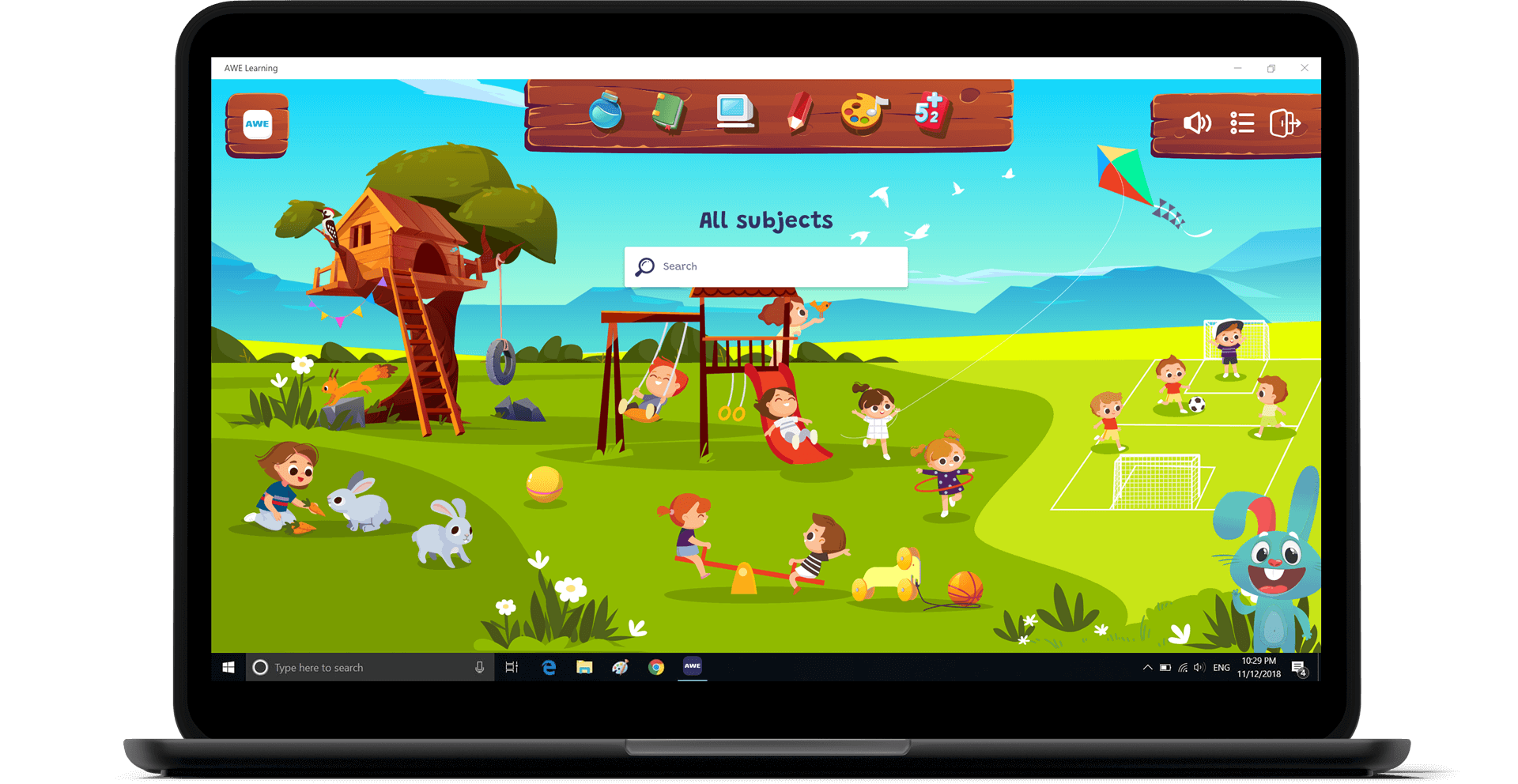
Our SaaS Development Services cover both MVP development and the move to a full platform. For AWE Learning, we took an established early learning product to the cloud and added the features a mature SaaS needs, including reports, access levels for different roles, and tools to manage subscriptions and content. Today, 50% of US public libraries use the software.
The cost of growing into a full platform depends on how the MVP was built. If the first release already has tenant isolation, basic user roles, and a clear pricing model, the work mostly adds the items that could wait, such as single sign-on, advanced reports, and room for more traffic. Without those foundations, parts of the product have to be rebuilt first, which takes longer and costs more.
Narrow by Design: Why the Best SaaS MVPs Stay Small
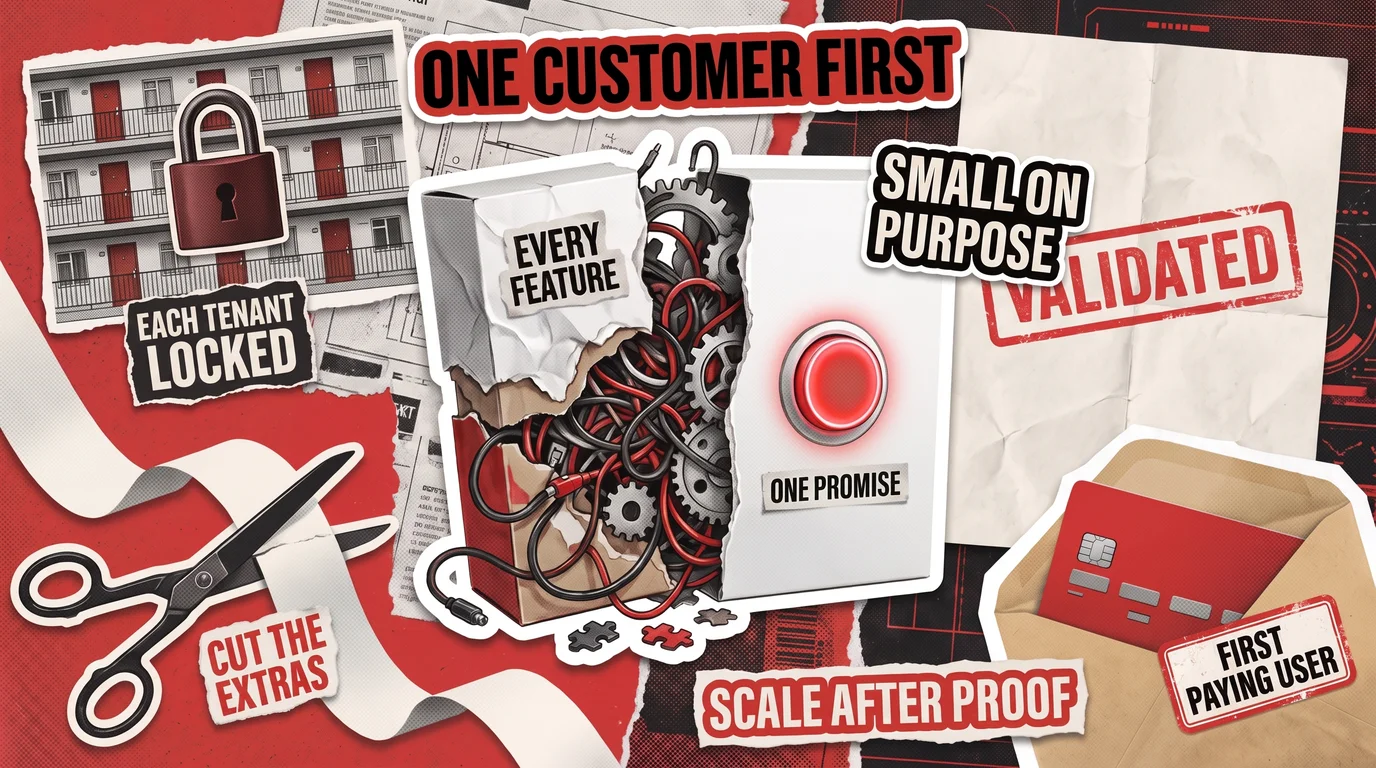
The first releases that prove an idea works are narrow on purpose. A strong SaaS MVP serves a single customer profile, delivers one core promise, and tests it with paying users. The few architectural choices that are hard to reverse get settled early. After that, the rest of the product grows as usage data comes in.
Redwerk’s development work follows that approach, with a working MVP in 8 to 12 weeks built on foundations that can support the full platform. If you have a SaaS idea and a customer in mind, tell us about your project and we’ll plan the first release with you.
FAQ
What is a SaaS MVP?
A SaaS MVP is a minimum viable product for subscription software: the first release people pay for on a recurring basis. Because customers renew every month or year, the product must keep delivering value long after the first login. For that reason, even an early SaaS release usually includes billing, user accounts, and a separate data space for each client company.
How long does it take to build a SaaS MVP?
A focused SaaS MVP usually takes 8 to 12 weeks from kickoff to launch, including 1 to 2 weeks of planning. Three factors stretch that schedule: connections to other software such as payment or accounting systems, industry regulations like healthcare privacy laws, and launching on web and mobile at the same time. A complex product with many such connections can need 14 to 16 weeks.
How do you validate a SaaS idea?
You validate a SaaS idea by finding evidence that a specific group of buyers will pay to fix a problem they face often. Convincing proof includes interviews showing that people already spend time or money on workarounds, plus commitments like paid pilots or pre-orders. Compliments and free waitlist sign-ups are weaker signals, because they cost the buyer nothing.
Should a SaaS MVP be multi-tenant?
In most cases, yes. Running every customer on one shared system, with each account’s records kept private, makes hosting and updates simpler as the user base grows. Adding that separation after launch forces changes across nearly the whole product. The main exception is a buyer with strict regulatory demands who needs a dedicated copy of the software. That option can sit alongside the shared setup.
Find out how AWE Learning could reach users beyond the US by implementing scalable SaaS and cloud migration