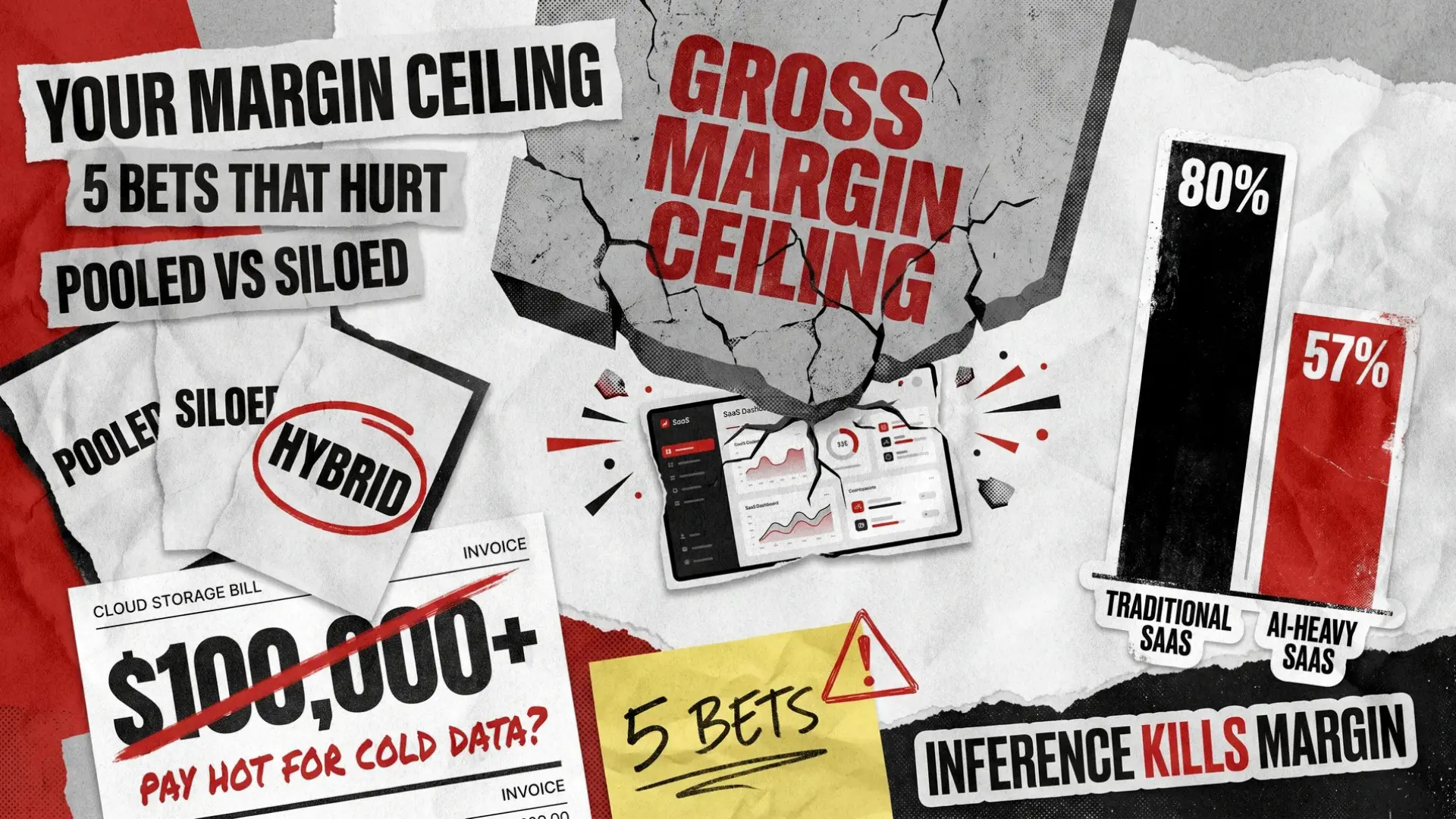
Most guides to multi-tenant SaaS architecture best practices read like engineering checklists, which is why they’re so easy to ignore in the boardroom. The most important thing that these checklists miss is that your architecture is also a line item on your income statement. Your tenancy model, storage tiers, inference stack, caching layers, and observability bill combine to set the ceiling on your gross margin. Once you hit it, no amount of sales heroics will lift it.
The math is uncomfortable because traditional Software-as-a-Service (SaaS) companies operate at 70–85% gross margin, while AI-heavy SaaS sits at a structurally lower level, around 50–65%. That gap is rarely about how well your team writes code. It’s about five architectural bets you make early, and that become painful to undo later. At Redwerk, we’ve been building SaaS products since 2005, and we can usually tell you where your ceiling sits before we see your dashboards. Today, our software architects will explain the five bets that determine where yours will land.
Why Multi-Tenant SaaS Architecture Best Practices Are a CFO Conversation
When your Chief Financial Officer (CFO) looks at your SaaS gross margin, they see three inputs:
- What you charge
- What it costs to deliver the product
- How both of those scale with your customer count
However, when your Chief Technology Officer (CTO) reviews your architecture, they see tenancy patterns, data models, compute flows, and infrastructure costs. These are the same conversations in two different languages, and most companies only translate between them during due diligence, when it’s too late to change much.
That’s the gap we want to close today, and we’ll start by citing Bessemer Venture Partners’ research in the State of AI reports, which finds that most AI-enabled companies lose six or more gross margin points directly to infrastructure choices, with the gap between higher and lower performers tracking closely with infrastructure maturity.
We’ll define a bet as a low-reversibility, high-impact decision made under uncertainty. The five bets below set your margin ceiling, and each comes with three things your board will eventually ask about: the margin math, the reversibility cost, and the signal that tells you you’ve already bet wrong.
Bet #1: Your Tenancy Model Is the Biggest Swing in Multi-Tenant SaaS Architecture
This is the foundational decision, and the one we see teams regret most often. You have three realistic options:
- Pooled Model (where many tenants share a single application instance)
Pooled multi-tenancy delivers the gross margin story investors love, because costs grow sub-linearly as you add customers. You can hit 75–85% without breaking a sweat. However, the catch is that your first regulated enterprise customer will ask for true data isolation, and if you don’t have an answer, you’ll either lose the deal or bolt on a compromise that pollutes the architecture for everyone else. - Siloed Model (where each tenant has their own dedicated stack)
Siloed multi-tenancy is the opposite of pooled. Enterprise sales get easier because isolation is baked in, but your Cost of Goods Sold (COGS) now grows roughly linearly with each new logo. In practice, siloed-heavy SaaS caps out around 60–68% gross margin once enterprise share crosses 40% of revenue. - Hybrid “Pool-of-Pools” Model (where you group tenants by tier or compliance profile)
The hybrid model is where most successful scale-ups land, and where most of them wish they’d started. You pool your self-service tier aggressively, silo the regulated or largest customers, and run everything off shared control planes. AWS publishes solid reference guidance on this trade-off in its SaaS Lens for the Well-Architected Framework, and it’s worth a read before you pick a path.
Let’s take a look at how this bet plays out for a business in real-life conditions:
- Margin math: Moving from a pure siloed model to a well-designed hybrid commonly recovers 8-12 gross margin points. On a $20M Annual Recurring Revenue (ARR) business, that’s $1.6M-$2.4M dropping to the bottom line every year.
- Reversibility cost: High because a full re-architecture typically takes 6-12 months of engineering time, plus tenant-by-tenant migration windows.
- Signal you bet wrong: Your gross margin flatlines while ARR keeps growing, your hosting bill scales in lockstep with tenant count, and per-tenant COGS reports show long-tail customers burning 100%+ of their Monthly Recurring Revenue (MRR).
Bet #2: Data Partitioning and Storage Tiering for Scalable SaaS
Once you’ve chosen a tenancy model, you have to decide how to partition the underlying data. The realistic options are:
- A shared database with a tenant identifier column
- A schema-per-tenant approach inside a shared database
- A full database-per-tenant setup. Each trades isolation for economics
The bigger margin lever most teams ignore is storage tiering. Cloud object storage gets dramatically cheaper as you move from hot to warm to cold tiers, but most SaaS companies we audit pay hot-tier rates for 100% of their data, including logs from 2022 that nobody has queried in 18 months. Fixing it isn’t glamorous engineering work, but it pays.
- Margin math: Proper lifecycle rules on a storage bill typically cut costs 40-60% with no user-visible impact. An $180K-per-month Amazon Simple Storage Service (S3) bill typically comes in at around $75K after tiering.
- Reversibility cost: Medium, as data migration costs engineering cycles, but it’s a known quantity and usually a one-quarter project.
- Signal you bet wrong: Storage growth outpaces revenue growth, p95 query latency rises with tenant count rather than query volume, and you’ve had at least one ‘noisy neighbor’ incident that forced you to over-provision.

Bet #3: Inference-Cost Architecture Is the New Line Item in SaaS Scalability
This is the bet that most companies building SaaS in 2024 and 2025 didn’t have in their budget. If you’ve shipped any AI feature in the last 24 months, inference cost is now a real and growing entry in your COGS, and its shape doesn’t behave like anything else in your infrastructure.
Bain Capital Ventures reports compute costs for AI-enabled products running at roughly one to three times their software hosting costs, which, on a traditional SaaS P&L, is the difference between a great margin and a mediocre one. ICONIQ Capital’s 2026 State of AI study puts inference at roughly 23% of revenue for scaling-stage AI B2B companies, and that share doesn’t meaningfully decline as they grow.
The architectural choices that matter here are concrete: model routing (try a cheap model first, fall back to a stronger one only when needed), semantic caching so that similar queries don’t hit the model twice, Retrieval-Augmented Generation (RAG) instead of fine-tuning when your data changes often, and per-tenant token budgets that stop one heavy user from eating your margin.
- Margin math: A well-architected AI feature typically costs 5-8 gross margin points. A naive one costs 15-22.
- Reversibility cost: Medium, because caching and routing can be retrofitted, but prompt architecture and data-retrieval design are stickier than they look.
- Signal you bet wrong: Marginal COGS rises sharply with power users, unit economics invert on your top 10% of heaviest accounts, and your finance team can’t tell you inference cost per tenant when you ask.
If your AI stack is built on chained calls and your team is debating orchestration frameworks, check out our deep dive on LangChain vs LangGraph, which neatly maps onto this decision.
Bet #4: Caching Is a Revenue Lever, Not Just a Performance Tool
Most engineering teams frame caching as a latency topic. Your CFO would frame it as an 8-point gross margin swing if they knew how to ask. Every request you serve from a cache is a request your backend didn’t have to compute, which means less Central Processing Unit (CPU) time, fewer database reads, lower egress, and smaller model invocation bills if you’re doing AI.
A well-designed cache hierarchy for multi-tenant SaaS looks like this:
- An edge cache for public and slow-changing assets
- An application-level cache for per-tenant data
- Database read replicas for heavy query patterns
- A semantic cache, if you have AI features
Getting the tenant-aware invalidation right is the hard part, and the piece that saves you a fortune when you do it early.
- Margin math: Tenant-aware caching on read-heavy workloads commonly cuts compute costs 20-40%, and semantic caching on AI endpoints can reduce inference spend by 30-50% once traffic stabilizes.
- Reversibility cost: Low, as caching is almost always additive, and you can introduce it in layers without a rewrite.
- Signal you bet wrong: Your compute bill grows faster than your Monthly Active Users (MAU), p95 latency rises faster than traffic, and your cache hit rate on hot endpoints sits below 60%.
Bet #5: Observability Spend as a Percentage of COGS in Your SaaS Architecture
Here’s the bet nobody puts on the whiteboard, because it looks like a procurement decision. Once you cross around $5M ARR, observability tooling quietly starts eating up 5-10% of revenue. We’ve audited companies where the observability bill showed up on the board’s monthly review, and still nobody called it a margin problem.
The decisions that matter are sampling strategy (you don’t need 100% of traces at 100% retention), tiered retention windows (7 days hot, 30 days warm, 90 days archived works for most teams), and a clear view of which tools are actually earning their keep. Four overlapping tools are almost always two too many.
- Margin math: Observability can sit at 3% of revenue or 10% of revenue while delivering roughly the same operational value. That’s a 7-point gross margin swing for what is, at root, a procurement and configuration decision.
- Reversibility cost: Low to medium, as tool migrations hurt, but they’re bounded projects, usually a quarter at most.
- Signal you bet wrong: Observability bill growth has outpaced revenue growth, you’re running four or more overlapping tools, and your team can’t remember what half of them are actually monitoring.
30-Minute Stress Test for Your SaaS Architecture Best Practices
Before you call anyone (including us), run this quick stress test. Answer all six questions with specific numbers, and your SaaS architecture is probably in reasonable shape. Stall on two or more, and it’s worth a deeper look.
- Can you produce per-tenant COGS in under 10 minutes?
- Do your top 10 heaviest users have a positive unit margin after inference cost?
- What percentage of your storage is hot-tier today, and should it be?
- What’s your cache hit rate on your top five endpoints?
- What percentage of revenue are you spending on observability tooling?
- How long would it take to move one customer from one tenancy model to another?
If you’d rather have another set of eyes on the answers, our software development consulting team runs this kind of architecture and margin audit as a fixed-scope engagement. Your architecture has already determined your gross margin ceiling, whether anyone on the team has said it out loud or not. However, if you want to get deeper into it and see what’s in your power to change, give us a call. Our team can tell you where that ceiling sits, whether it’s worth moving, and what it will cost to move it.
FAQ
What are the best practices for multi-tenant SaaS architecture?
The practices that actually matter are tied to gross margin:
- Pick a tenancy model that fits your customer mix (pooled, siloed, or hybrid)
- Tier your storage to match access patterns
- Architect AI inference with routing and caching from day one
- Treat caching as an economic lever
- Keep observability spend under 5% of revenue
Everything else is table stakes.
How does SaaS architecture affect gross margin?
Your architecture sets the ceiling on gross margin by deciding how COGS scales with customer count and usage intensity. Pooled multi-tenancy can sustain 75-85% gross margin at scale, while fully siloed models typically cap out around 60-68%. AI features add a new variable cost layer that strips 15-22 margin points if inference is architected naively, and only 5-8 points if it isn’t.
What's the difference between pooled, siloed, and hybrid multi-tenancy?
Pooled multi-tenancy means that many customers share a single application instance, maximizing efficiency but making strict isolation harder. Siloed multi-tenancy gives each customer their own stack, which simplifies compliance but makes COGS grow linearly with customer count. Hybrid multi-tenancy groups customers into pools by tier or compliance need, giving you most of the cost benefits of pooling while siloing the customers who genuinely require it.
What gross margin should a multi-tenant SaaS target in 2026?
Traditional SaaS products should target 70-85% gross margin at scale, with enterprise-focused products reaching the higher end. AI-heavy SaaS products typically run at 50-65% due to inference costs, and recent ICONIQ research suggests the median AI B2B company will land at around 52% in 2026 unless they actively architect against that ceiling.
When should you re-architect for multi-tenancy?
Re-architect when your gross margin plateaus despite ARR growth, when per-tenant COGS reports reveal long-tail customers burning their own MRR, or when your tenancy model is blocking a deal segment you want to unlock. A 9-12 month re-architecture is expensive, but a 10-point margin swing on a $20M ARR business pays for it roughly three times over in the first year alone.
See how we helped Complete Network's Project Science software achieve an 80% increase in code maintainability