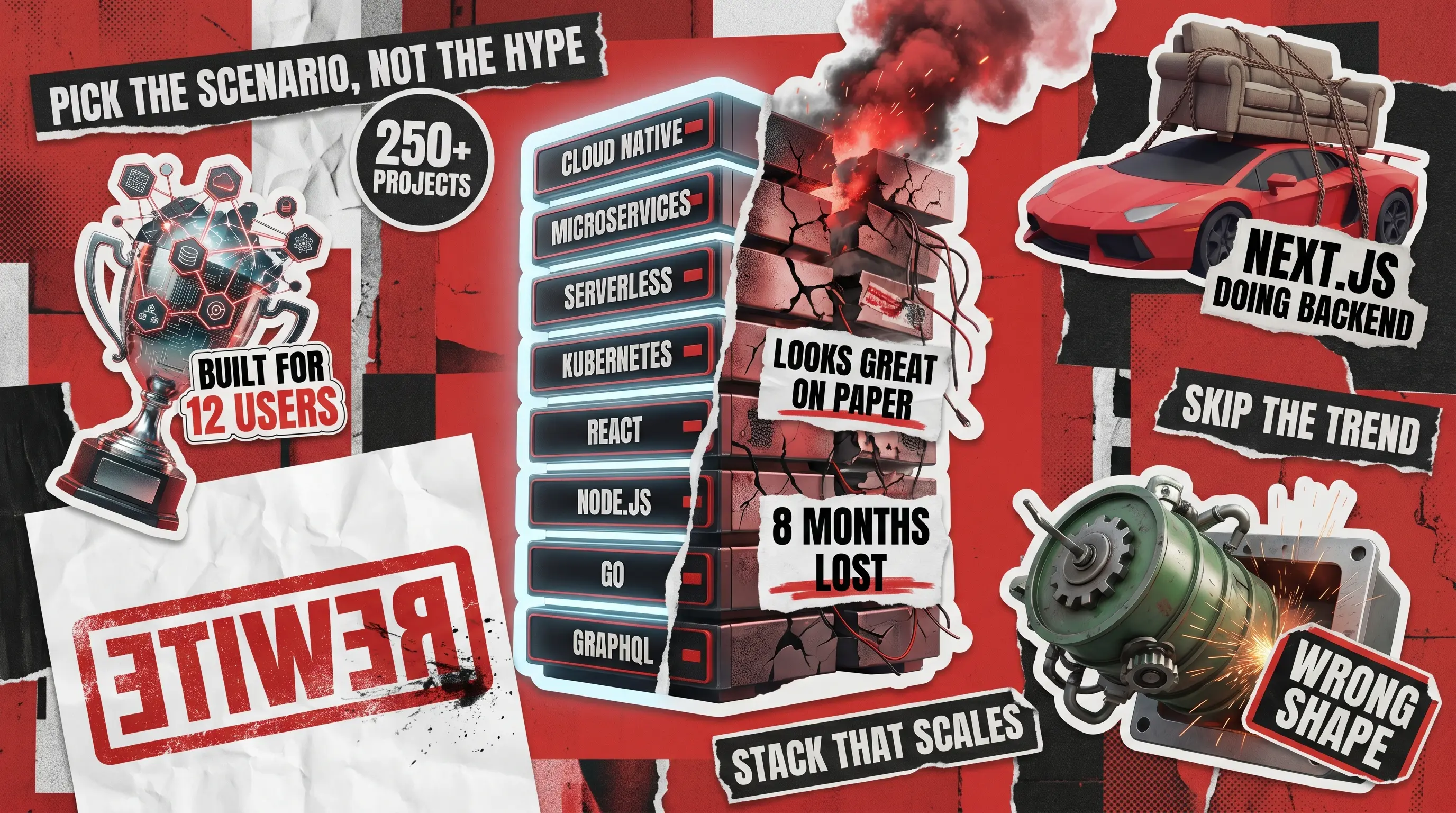
A trendy tech stack looks great on a resume until it costs you eight months of development time and a complete rewrite. That’s why choosing your SaaS tech stack must be based on your goals and scope, not the trendiest tech at the time.
A few years back, a founder came to us with a product that was finally hitting its stride. Market fit was solid, and the user base was exploding. The problem? Their backend was ticking like a time bomb. The original dev team had picked their stack based on a high-ranking blog post filled with hype that couldn’t handle real-world scale. Instead of building features, they were fighting their own infrastructure, which is the first thing you must watch out for during SaaS development.
With the global SaaS market projected to skyrocket from $375 billion this year to over $1.25 trillion by 2034, you cannot afford to waste a single engineering hour. Ans we’re here to help you with this.
After 20 years and 250+ delivered projects worldwide, we aren’t here to give you a passive list of frameworks and wish you luck. We’re giving you the exact stack to use for your specific scenario, the overhyped tech you should absolutely skip, and a brutal look at what poor architectural choices actually cost a growing business.
Why ‘The Best SaaS Tech Stack’ Is the Wrong Question
Every week, somebody publishes an article ranking the best SaaS tech stack and landing on the same answer: React on the frontend, Node.js or Python on the backend, PostgreSQL for the database, and AWS or Vercel for hosting. That answer is not wrong, but it is incomplete in a way that costs founders real money.
The best tech stack for SaaS in healthcare, like a compliance platform, looks nothing like the best tech stack for an early-stage marketplace. Meanwhile, the best stack for an AI-native SaaS product has almost no overlap with the right stack for a horizontal multi-tenant platform serving enterprise clients. Choosing the wrong one does not just create technical debt — it creates the kind of structural problem that requires a team to stop building new features for six months while they fix the foundation.
SaaS Tech Stack Comparison: All Five Scenarios at a Glance
Each scenario below reflects a distinct stage of product maturity and a distinct set of business risks. The right stack is not always the most popular one — it is the one that matches where your product is today and what it needs to do in the next twelve months. Pay particular attention to the final column: knowing what to leave off the table is just as valuable as knowing what to put on it.
Early MVP
First product, tight timeline, team of 2–5
React + Next.js
Node.js
PostgreSQL
AWS
Microservices, MongoDB for relational data
Scaling B2B SaaS
Enterprise clients, compliance needs, SSO
React
Python (Django / FastAPI) or .NET
PostgreSQL
AWS or Azure
Next.js for heavy backend logic
AI-Native SaaS
ML workloads as core product value
React
Python + FastAPI
PostgreSQL + pgvector
AWS
LangChain in production
Regulated / Healthcare SaaS
HIPAA, government, financial compliance
React
.NET (or Python)
PostgreSQL (encrypted, managed)
Azure
Serverless for core logic
Multi-Tenant Horizontal SaaS
Many clients, one platform, shared infrastructure
React
Python or Node.js
PostgreSQL (row-level security)
AWS or Azure
Premature microservices
Best Tech Stack for SaaS by Scenario
The five scenarios we cover in this article are the ones we see most often at Redwerk:
- Early-stage MVP (minimum viable product) with a short runway and an even shorter timeline
- Scaling business-to-business (B2B) SaaS with enterprise clients and compliance requirements
- AI-native SaaS with machine learning workloads at the core
- Regulated and healthcare SaaS where security is non-negotiable
- Multi-tenant horizontal SaaS serving many clients on a single platform
For each one, we will tell you what we would build with, what we would skip, and why.
What Is the Best Tech Stack for an Early-Stage SaaS MVP?
The job of an MVP stack is to get you to market fast, keep the team small, and leave the door open for change. It is not to impress investors with architectural sophistication. We have seen too many early-stage founders spend three months designing a microservices architecture for a product that had twelve users.
What we would pick:
React with Next.js is the right frontend choice here: the ecosystem is enormous, hiring is straightforward, and it handles both server-side and client-side rendering without forcing you to make that decision upfront. On the backend, Node.js works well when the team is small and needs to move across the stack without context-switching between languages. PostgreSQL is the database we reach for in almost every scenario. It handles relational data properly, supports flexible document storage through its JSONB column type, and scales further than most early-stage products will ever need.
On the infrastructure side, a managed platform like AWS (Amazon Web Services) with straightforward container deployment keeps operational complexity low. You do not need Kubernetes at this stage.
What we would skip:
Microservices architecture is the most common early-stage over-investment we see, because it solves problems you do not have yet while creating problems you did not ask for. A modular monolith, where you organize code cleanly into separate concerns within a single deployable application, gets you 80% of the architectural benefits at a fraction of the coordination cost. You can extract services later when you have real traffic data showing you where the load actually sits.
We would also skip MongoDB when your data model is relational-shaped. MongoDB is genuinely excellent for the right use cases: high-volume event logging, content systems with unpredictable schemas, and applications where the data is naturally document-structured. But if your product has users, organizations, subscriptions, roles, and permissions, you are dealing with relational data. Forcing it into a document database creates join problems that PostgreSQL solved decades ago. We have reviewed more than a few codebases where a team started with MongoDB for an early MVP because it was ‘flexible’, and then spent a year wrestling with it once billing and multi-tenant logic arrived.
As proof of our words, we invite you to take a look at Recruit Media, a full-stack HR SaaS platform for the US market with AI-assisted keyword matching and video communication tools that we built from scratch. The product was later acquired by HireQuest. That outcome required a stack that could support rapid iteration in the early phases and hold up under real-world commercial pressure in the later ones. Getting the foundation right at the start was not an accident.
What Do Scaling Enterprise Products Need in a B2B SaaS Tech Stack?
When your customers are companies rather than individuals, the technical requirements shift considerably. Enterprise buyers care about uptime, security, audit trails, single sign-on (SSO), and role-based access control before they care about the cleverness of your architecture. A beautiful microservices design that goes down on a Tuesday afternoon is a lost contract.
What we would pick:
Our most common backend recommendation for a scaling B2B SaaS platform is Python with Django or FastAPI. According to the 2025 Stack Overflow Developer Survey, Python saw a seven percentage point increase in adoption year over year, and its maturity in handling complex business logic, authentication systems, and API design makes it well-suited for products where reliability matters more than raw speed. .NET is a strong alternative, particularly for teams with a Microsoft-oriented background or enterprise clients who have existing infrastructure on Azure.
PostgreSQL is the right database call here too. In a B2B context, you need row-level security for multi-tenant isolation, proper foreign key constraints for billing and permission data, and the ability to run meaningful reports. PostgreSQL delivers all of that in one system.
Authentication at this level should be handled by a dedicated identity provider. Building your own authentication for enterprise clients is a risk that rarely pays off.
What we would skip:
We would skip Next.js for any product with heavy backend logic. Next.js is an excellent frontend framework and handles server-side rendering beautifully, but it struggles when teams start loading complex business rules, background jobs, and data transformation pipelines into it simply because it is the only server they have running. It was built for frontend concerns, and mixing heavy backend logic into a Next.js application is the equivalent of using a sports car to move furniture: technically possible, but not the right tool for the job.
What Powers a Production-Ready AI SaaS Tech Stack?
Building AI features into an existing product is very different from building a product where AI is the core value proposition. In the second case, your infrastructure, your data layer, and your development workflow all need to be designed around machine learning workloads from day one.
What we would pick:
Python is non-negotiable for AI-native SaaS. The ecosystem for machine learning, data processing, and model integration is simply unmatched. The 2025 Stack Overflow Developer Survey explicitly attributes Python’s accelerated growth to ‘its ability to be the go-to language for AI, data science, and back-end development’. FastAPI has become the standard for building high-performance AI APIs because it is fast, handles asynchronous workloads well, and integrates cleanly with most model inference libraries.
On the data and AI layer specifically, PostgreSQL with the pgvector extension handles semantic search and retrieval-augmented generation (RAG) workloads without requiring a separate vector database for most products. Unless you are operating at the kind of scale where you are running billions of vector comparisons per day, adding a dedicated vector database introduces operational complexity without proportional benefit. You can always migrate later when the data actually demands it.
When it comes to model integration, direct API calls to providers such as Anthropic or OpenAI are the right starting point. You get predictable behaviour, straightforward debugging, and no abstraction layers sitting between your code and the response.
What we would skip:
We would skip LangChain in production for anything beyond prototyping. LangChain is a highly useful tool for exploring what AI can do in your product, but the problem is that when you move from exploration to a production system, you want to know exactly what is happening at every step. LangChain’s abstraction layers make that difficult. Debugging a chain in production is a substantially different experience from debugging code you wrote yourself. Several teams we have worked with built prototypes in LangChain, were impressed by how fast they could move, shipped to production, and then spent weeks tracing errors that would have been obvious in a direct API call. For anything that your users depend on, write the integration yourself: it is more code upfront and far less mystery at 2 AM.
What Tech Stack Does a Regulated or Healthcare SaaS Actually Demand?
Building a SaaS product in healthcare, finance, or government is a different exercise entirely. The HIPAA alone has specific technical safeguard requirements covering access control, audit logging, encryption at rest and in transit, and data isolation between tenants. A data breach in healthcare now costs organizations an average of $7.42 million, according to recent enforcement data tracked by HIPAA compliance specialists. The stack choices you make determine how much of that risk you carry.
What we would pick:
Azure is our cloud platform of choice for regulated SaaS, particularly when the client base has existing Microsoft infrastructure. Azure holds HIPAA, HITECH, and FedRAMP Moderate compliance certifications and, unlike some competitors, includes a Business Associate Agreement automatically under enterprise licensing terms. That is one fewer legal negotiation at an already complicated stage of product development.
.NET on Azure is a natural pairing for the backend. The tooling integrates cleanly with Azure’s identity and access management layer, audit logging is well-supported through the platform, and the framework has a long track record in enterprise environments where security reviews are a commercial reality. Python is a viable alternative, but the .NET ecosystem’s depth in the Microsoft compliance world is a genuine advantage.
PostgreSQL remains the default database choice, hosted on a managed service with encryption at rest enabled. The key requirement is that your database layer enforces row-level security so that one tenant cannot access another’s data under any code path, including an application bug. This is not optional in regulated environments.
What we would skip:
We would skip serverless architecture for core application logic. Serverless works well for event-driven background tasks and auxiliary functions, but when you need a complete, immutable audit trail of every operation touching Protected Health Information (PHI), the ephemeral and distributed nature of serverless functions makes that harder to achieve consistently. The audit logging has to be airtight, and airtight is easier to guarantee in a single application where you control the logging pipeline from one place.
As an example, consider our case developed for Change & Innovation Agency, a 100% Americans with Disabilities Act (ADA)-compliant e-government SaaS used by welfare divisions across the United States. Government clients carry compliance expectations that rival healthcare in their specificity. Getting that right required the same disciplined approach to infrastructure that regulated SaaS demands.
What Tech Stack Scales Across Many Clients in a Multi-Tenant SaaS?
A multi-tenant horizontal SaaS product serves many different organizations on a single platform. Think project management tools, CRM (Customer Relationship Management) systems, and communication platforms. The architectural challenge is not raw performance but isolation: every client needs to feel like they have their own product, even though they are sharing infrastructure with hundreds or thousands of others.
What we would pick:
The tenancy model is the most consequential decision in this scenario, and it needs to be made before you write a line of application code. We recommend starting with a shared database, shared schema approach with row-level security in PostgreSQL. It is operationally simpler, costs less to run, and scales further than most teams expect. You can migrate to schema-per-tenant later if enterprise clients require stricter data isolation for their procurement process.
Python or Node.js both work well at the application layer. The more important choice is the architecture pattern. Start with a well-structured monolith rather than microservices.
Microservices are a solution to organizational and scaling problems that a sub-50,000-user product simply does not have. They introduce inter-service communication overhead, distributed tracing requirements, and deployment complexity that slow a small team down significantly. Build for clarity first. Extract services when traffic data tells you which parts of the system actually need to scale independently.
What we would skip:
Premature microservices is worth calling out specifically because it is probably the most common expensive mistake we see in SaaS architecture. The argument for microservices at an early stage is almost always based on ‘we might need to scale that component separately later’, which is a reasonable concern handled much more cheaply by a modular monolith with clear boundaries.
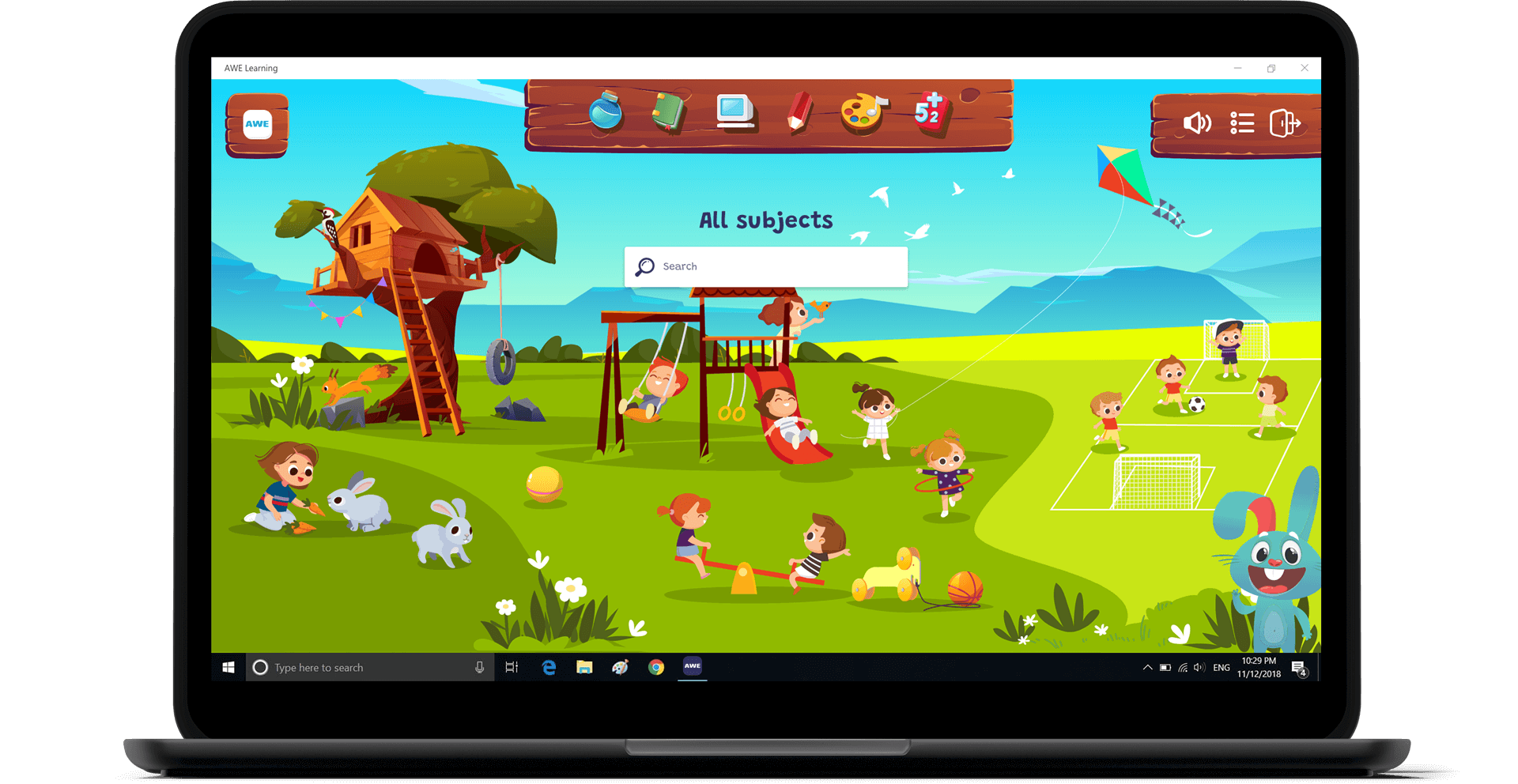
If you need proof, see AWE Learning e-learning SaaS from scratch, a platform we built that is now used by 50% of all US public libraries. That product serves a large number of independent institutional clients, each with their own content and user base, which is exactly the multi-tenant scenario. We implemented microservices on that project because the deployment context genuinely required it: independent library clients needed isolated updates and the platform’s scale justified the complexity. The reason that worked is because the decision was made deliberately, based on real requirements, not as a default.

What Bad Stack Decisions Actually Look Like: Lessons From Our Code Reviews
The section every other ‘SaaS tech stack’ article skips is the one that tells you what poor decisions look like in practice. Not as a cautionary tale from someone else’s project, but as a concrete picture of what arrives in a codebase when the original architecture choices were not properly thought through.
We do a significant number of code audits and backend reviews for SaaS products at Redwerk. Here is a compressed picture of what we consistently find when things have gone wrong.
The backend that grew into its own worst enemy: We audited the Python/Django backend for Project Science, a quote management SaaS built for the IT industry. The client came to us because they were remodelling the frontend and decided to take the opportunity to get an honest look at the backend before scaling it. What we found was a backend that had accumulated several structural issues that would have become serious at scale: missing environment variable documentation that made deployment fragile, a broken database backup workflow that required manual intervention to function, absent caching across both the application and database query layers, and a code formatter included by default that was built for JavaScript projects and was doing nothing useful in a Python codebase. None of these issues were catastrophic on their own. Together, they represented months of deferred work that would have arrived all at once during a high-traffic period or a security review.
The most consistent pattern we see across audits is not catastrophic failure but accumulated friction. A team makes a reasonable choice under time pressure, then makes another, and then another. Each one is defensible in isolation. Twelve months later, the codebase has a performance ceiling that nobody designed and that nobody is sure how to lift without breaking something.
The technology mismatch problem: One of the most common findings in our reviews is a database that does not match the data model. A team picks MongoDB because it is fast to get started with, and the schema flexibility sounds appealing. Then the product grows to include billing logic, user roles, organizational hierarchies, and multi-tenant data isolation. All of those problems are relational problems. MongoDB can handle them, but handling them well requires the kind of manual discipline that a relational database enforces automatically. By the time a team realises the mismatch, they have six months of production data in a format that does not want to be migrated.
The over-engineered early architecture: We have reviewed several codebases where a team built a full microservices architecture for a product with fewer than five thousand active users. The intent was good: they wanted to build something that would scale. What they built instead was a system where deploying a small feature required coordinating changes across three services, writing inter-service contracts, and managing distributed tracing to debug anything non-trivial. The team of four developers was spending roughly 40% of their sprint time on infrastructure coordination rather than product development. That is not a scaling problem but a premature optimization problem, and it has a straightforward fix: consolidate.
The underlying pattern is the same in every case. The stack was chosen based on what sounded right rather than what the product actually required at its current stage. Getting that diagnosis right before you start building is what the discovery phase of a project is actually for.
The One Rule of SaaS Tech Stack That Overrides Everything
We have given you specific stack recommendations for five scenarios. Here is the rule that sits above all of them: the best SaaS tech stack is the one your team can execute and maintain.
A brilliant architectural choice made by a team without the experience to implement it is worse than a boring stack executed with discipline. We have seen products built on thoroughly unremarkable technology combinations that scaled to millions of users because the code was clean, the team understood what they were building, and the decisions were made deliberately. We have also seen products built on technically impressive stacks that collapsed under their own complexity because the team was three people and the architecture assumed thirty.
When a client comes to us with a new SaaS product, the first question is never ‘which framework should we use’. The first question is: ‘What does this product actually need to do in the next twelve months, and what does the team look like?’ The stack follows from that.
If you are at this point in your journey now, let’s talk and select which tech stack is the best for your plans.
FAQ
What is the best tech stack for SaaS in 2026?
There is no single best SaaS tech stack in 2026, but there is a clear set of sensible defaults:
- React or Next.js on the frontend
- Python or Node.js on the backend
- PostgreSQL for the database
- AWS or Azure for infrastructure
The right combination depends on your product’s specific scenario: an AI-native SaaS has different requirements from a regulated healthcare platform, and an early MVP needs a very different architecture from a scaling B2B product. The most important thing is to match the stack to the stage and the scenario, not to what looks impressive on a technology blog.
What technologies are used to build a SaaS application?
A SaaS application typically has five layers: a frontend that users interact with, a backend that handles business logic, a database that stores data, cloud infrastructure that runs everything, and DevOps tooling that automates deployment and monitoring. Common choices include
- React or Next.js for the frontend
- Python, Node.js, or .NET for the backend
- PostgreSQL for relational data
- AWS, Azure, or Google Cloud for infrastructure
- GitHub Actions or similar tools for continuous integration and deployment.
For AI-native products, an additional inference and data layer is required.
What is the best backend for a SaaS product?
For most SaaS products in 2026, Python with FastAPI or Django is the strongest backend choice. It has the broadest ecosystem, handles both standard web API work and AI/machine learning workloads in the same language, and saw a seven percentage point increase in professional developer adoption between 2024 and 2025, according to Stack Overflow’s annual survey. Node.js is an excellent alternative for teams that want a single language across the full stack. .NET is the right choice for regulated industries or Microsoft-centric enterprise environments. The backend choice should follow the product scenario, not the other way around.
See how we helped AWE Learning build e-learning SaaS used by 50% of US public libraries