
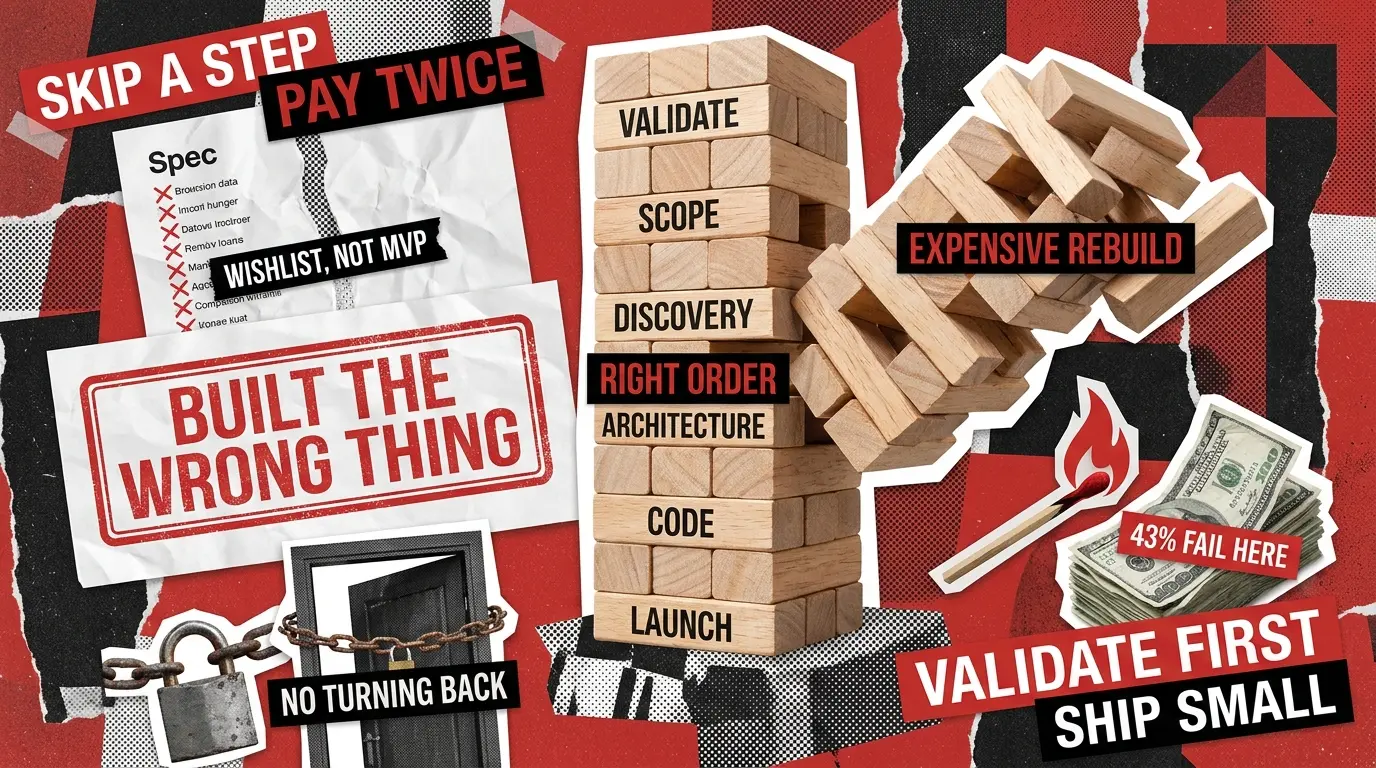
Most SaaS products that fail were built correctly. They solved the wrong problem, or solved the right one in the wrong order, and the code worked perfectly the whole way down.
According to a CB Insights analysis of 431 venture-backed startups that shut down since 2023, poor product-market fit drove 43% of failures and bad timing another 29%. Running out of cash is where the stories end. Building the wrong thing is why the cash ran out.
This is a guide on how to develop a SaaS product in the order that protects the budget and the product. Each step below has one decision to make and one question to ask the people writing the code.
Problem Validation Before the First Line of Code
The cheapest hour you will ever spend is the one before development starts. A founder who skips validation is paying their developer to discover, in production, what fifteen customer interviews would have revealed for free.
What validation looks like in practice: ten to fifteen conversations with people who fit your target user profile, a one-page landing test that captures sign-ups for a product that does not yet exist, and a willingness-to-pay signal that goes beyond polite enthusiasm. None of this needs code. All of it needs the founder.
The right question to ask any developer at this stage is simple: “What would you need to see from me before you feel comfortable scoping this?” A senior partner will ask for validation data, a problem statement, and a target user. A weaker one will ask for your budget and your deadline.
The Right Build Path for Where You Are
There are three honest paths when you are working out how to build a SaaS product, and the choice shapes everything that comes after. The SaaS development process for a non-technical founder hinges almost entirely on this decision.

No-Code, Custom, or Hybrid
No-code suits early validation, internal tools, and products with under five hundred users where speed beats flexibility. Tools like Bubble or Lovable get you to a working interface in weeks. Custom development suits products with complex business logic, compliance requirements, real-time features, or expected growth past several thousand concurrent users. Hybrid combines both: a no-code front end on top of a custom backend, or a custom MVP with no-code internal admin panels.
A useful rule: if your product survives a successful launch, will the platform you picked still serve it at ten times the load? If the answer is no, you are scheduling a rebuild.
The No-Code Trap
The pattern repeats often enough to name. A founder ships a no-code MVP, finds traction, and then learns the platform cannot handle concurrent sessions, fails a compliance audit, or charges per record in a way that breaks unit economics. The developer they hire to fix it comes back saying the whole thing needs to be rebuilt from scratch.
The right question to ask before committing to a no-code path: “If we outgrow this in eighteen months, what does the migration cost?” If the answer is hand-wavy, that is the answer.
MVP Scope When Every Feature Has a Price Tag
SaaS MVP development goes wrong in the same place every time. The founder writes a forty-feature spec. The developer quotes against it. Six months later, half the features ship, none of them are polished, and the early users churn because the core flow is rough.
The cap that works: three to seven features, three months from kickoff to first user. If the scope is bigger than that, it is not an MVP, it is a wishlist with deadlines.
A one-page brief any developer can quote against contains four things. The problem you are solving in plain language. The primary user and what they were doing before your product existed. The one job your product does better than the alternatives. The success metric that tells you it worked. Anything beyond this page is a feature the v2 should earn through user data.
Our team breaks this down in more depth in our guide on how to build an MVP, including the prioritization framework we use with founders on first calls.
Discovery Phase as the Cheapest Insurance You’ll Buy
Discovery is the step most people want to skip and most regret skipping. It feels like paying for a meeting. It is actually paying to avoid the change orders, the rework, and the architectural mistakes that get baked in when a team starts coding against an unclear spec.
A real discovery phase produces four artifacts you can read without an engineering background. A clickable prototype that shows the core user flow. A feature priority map that separates v1 from v2 from never. A technical risk register that names what could go wrong and what it would cost to fix. A development estimate with the assumptions written down so you can challenge them.
The math is uncomfortable for vendors who charge by the sprint. A short discovery phase up front removes the most expensive class of mistakes: the ones found in week sixteen, when the team has already built around a wrong assumption. The right discovery phase deliverables can cut total development time by trading two cheap weeks up front for the change-order battles that would otherwise consume the back half of the project.
The right question for any vendor who proposes skipping discovery: “Where will the misalignments surface, and who pays for the rework?” If they cannot answer, they have not run a real project before.
Architecture Decisions You Don’t Make but Should Understand
A non-technical founder does not pick the database. But you should be able to ask why this one. Three early calls lock in your future costs more than any feature decision.
Database choice
What happens to this choice when we hit 50,000 users?
“We will optimize when we get there.”
Auth provider
Are we locked in if this vendor changes pricing or shuts down?
“Everyone uses them.”
Multi-tenancy model
Why this, why now?
“It’s the standard for SaaS.”
The multi-tenancy answer matters most. Multi-tenant from day one has real architectural costs, and for a launch with under fifty customers, single-tenant with a clean upgrade path is often cheaper and faster. We walk through the trade-offs in our piece on multi-tenant SaaS architecture best practices. The short version: the right answer depends on customer count, data isolation requirements, and your willingness to ship slower in v1 to scale faster in v3.
The Decision-Reversibility Test
For each architectural call, the team should ask one thing: if we got this wrong, how long would it take to undo? Hours-to-days decisions get made fast and moved past. Weeks-to-months decisions get a peer review and a written rationale. Six-months-or-more decisions get outside eyes before anyone commits, because once you walk through a one-way door, you live with the choice.
A founder who asks “how reversible is this?” before each major call gets a clearer picture of where the real risk sits, without needing to read a single architecture diagram.
The Build Process from a Non-Technical Seat
Once development starts, your job changes. You are no longer choosing what to build. You are watching to make sure what gets built matches what you described.
Weekly demos beat written status reports. If you cannot see working software by the end of week two, something is off, and the answer is rarely “the team is still setting up”. Push for a click-through of whatever exists, even if it is rough. Working software you can poke is worth more than a Gantt chart that says the team is on track.
The three numbers worth watching every week: features shipped against features planned, bugs found in production against bugs found in QA, and weekly burn against budget. That is the whole dashboard until you have real users. Anything else is noise.
When you give feedback, describe the outcome the user should get, not the UI fix you imagined. “The signup flow feels slow” is useful. “Move the button two pixels left and make it red” turns your developer into a typist. The first lets them solve the actual problem. The second lets them solve the wrong one faster.
And one phrase to push back on every time. When a developer says “the framework doesn’t support that” without offering a follow-up option, ask what option they would propose if it had to ship. Constraints are real. Closed conversations about constraints usually are not.
A Small Launch as the Path to Scale
How to launch a SaaS product when you are non-technical: small, measured, and slowly. The temptation is to open the doors wide on day one. The discipline is to launch to a controlled group, watch what happens, and only widen the door when the numbers say to.
Define the KPIs before launch day. Activation rate, retention at day seven and day thirty, conversion from free to paid, and Net Promoter Score from the first cohort. If you do not set these in advance, you will set them after the data is in, which means you will set them to whatever number flatters the result.
The pilot-to-production gap catches almost every first-time SaaS founder. The system that handled ten users in a controlled pilot is not the same system that handles fifty thousand on a live launch. Caching, rate limiting, fallback models, monitoring, and observability all become real requirements at scale. Plan the rebuild work as the next sprint after launch, not as a surprise when the first thousand-user day takes the site down.
Gartner’s April 2026 forecast puts global software spending growth at 15.1% for the year, with total software spend crossing $1.44 trillion. The market is buying. Whether it buys yours depends on whether your launch holds up when it gets the attention you want.
The full sequence from validation to launch is exactly how we run SaaS development at Redwerk, end to end and in the order that protects the budget.
The Right Thing, in the Right Order
The skill of developing a SaaS product without coding is sequencing. Validate before scope. Scope before discovery. Discovery before architecture. Architecture before code. Code before launch. Launch small before scaling.
Every step in this article costs less than the mistake it prevents. A founder who follows the order ships a smaller product, with fewer features, more slowly than they wanted. They also ship a product that works, that scales, and that customers pay for.
If you have the idea and you are sizing up the next move, contact us and let us walk through your sequence together.
See how a market assessment SaaS was built from scratch, validated, and scaled across 12 countries without the founder writing a line of code.

