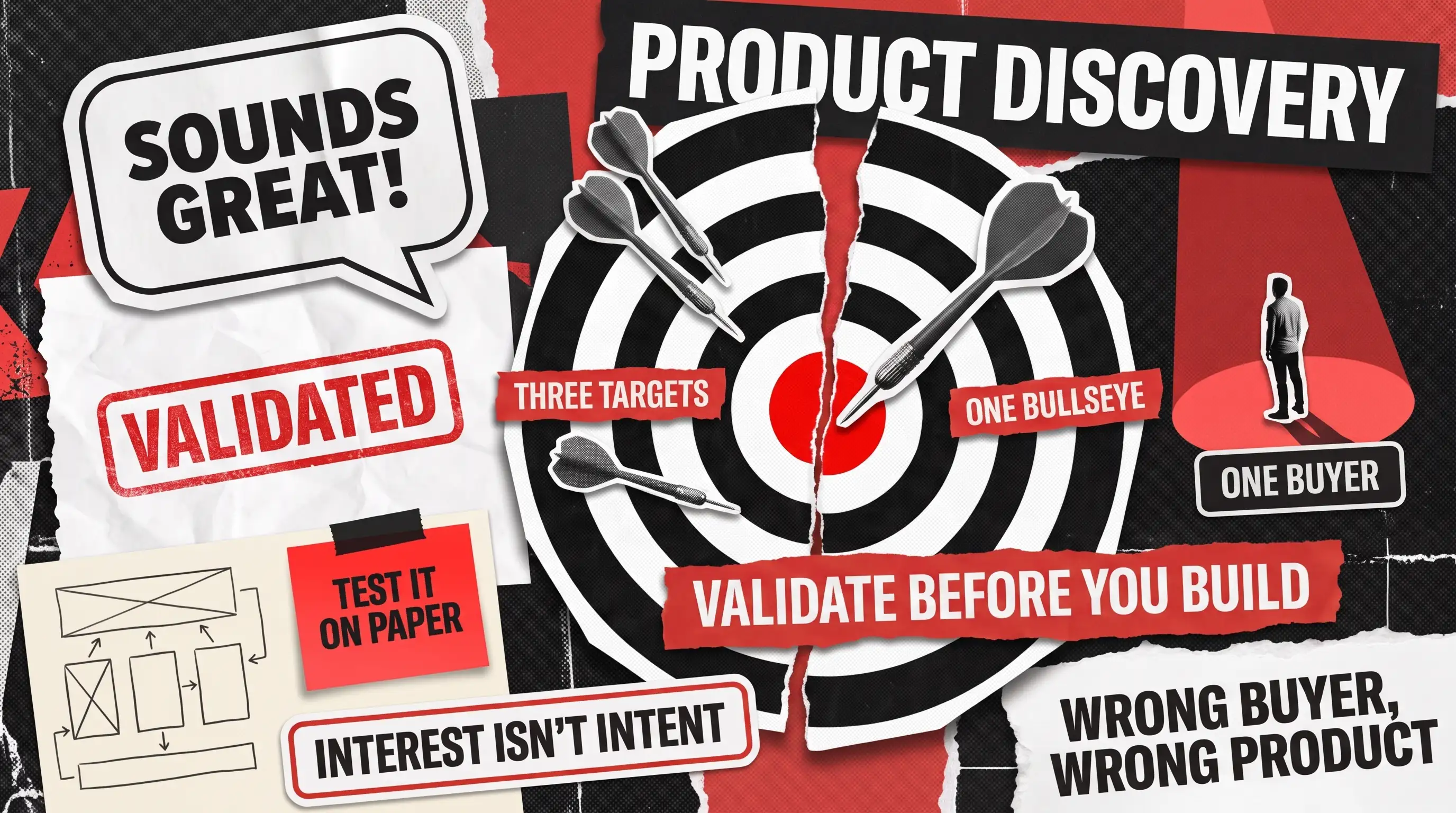
Before a SaaS team commits its MVP budget, one question decides whether that money is well spent: will the customer it plans to build for actually pay? Product discovery answers it first, through stakeholder interviews, customer journey mapping, and lightweight prototypes that validate the problem and one narrow buyer before any production code is written. It usually takes 2 to 6 weeks.
The decision usually lands on a Head of Product scoping a new module or a founder with a funded idea and a launch date. Building straight away feels faster, especially now that AI-assisted development can produce a working first version quickly. A fast build does nothing for an unvalidated idea, though: a SaaS product can be well engineered and still fail if it was built for a customer profile nobody tested. Discovery catches that at the prototype stage, where a change of direction costs days of design work.
What Product Discovery Actually Involves
Product discovery answers two questions in order. First, is the problem painful enough that someone will pay to have it solved? Second, what is the smallest product that solves it for one specific buyer? Redwerk treats these as separate steps because a team that skips the first ends up designing a solution for a problem it only assumed.
Stakeholder Interviews
These are conversations with the people who feel the problem, the people who would pay to fix it, and the internal stakeholders who have to sell, support, or integrate the product. In mid-market B2B SaaS they are rarely the same person: an operations lead feels the pain, a finance director signs the contract, and IT decides whether the integration is allowed.
The goal is evidence of intent, and the usual trap is confusing it with interest. Intent shows up as behavior, such as a prospect sharing what the current workaround costs them, introducing the budget owner, or agreeing to a paid pilot.
Customer Journey Mapping
A journey map lays out, step by step, how the target customer handles the problem today: the tools they use, the handoffs between people, and where the time and the errors go. For a SaaS product, this map decides what the product has to connect to (the CRM, the billing system, the spreadsheet that runs half the process). It also shows the one step where software saves the most effort, which becomes the core of the MVP.
Lightweight Prototypes
Clickable wireframes or a simple interactive mockup go in front of the same people who were interviewed. A prototype tests whether the proposed workflow makes sense to the user before anyone writes backend code, and changing it costs a few days of design time. Changing the same workflow after the MVP ships means reworking the database, the API, and the interface.
SaaS Idea Validation Methods That Separate Interest From Intent
SaaS idea validation is the part of discovery that turns interviews into evidence a budget holder can act on. The same methods work for a new module inside an established platform and for the micro SaaS ideas a small team can launch on its own. These hold up best for B2B SaaS:
- Problem interviews before solution pitches. Ask how the customer handles the problem today and what it costs them in hours, headcount, or lost revenue. Describe the product only at the end, if at all.
- Commitment tests. A letter of intent, a paid pilot, a design-partner agreement, or a discounted pre-sale is stronger evidence than a long list of enthusiastic interviews.
- Workaround audits. If the customer already pays for a partial solution, or has built a spreadsheet process around the problem, the pain is real and already has a budget.
- Prototype walkthroughs with the actual user role. Watch the person who would use the product daily try the clickable flow. The places where they hesitate are the places the MVP scope needs work.
- A single-profile filter. Every finding gets checked against one target customer profile. Feedback from outside that profile gets logged and parked for later.
What Shapes the Length and Effort of a Discovery Process
The early work splits into two stages, problem validation and solution shape, the first two of the seven stages of SaaS product development. Solution shape is the core of the discovery process, with its stakeholder interviews, journey mapping, and lightweight prototypes, and the team is small: the founder (or, inside an established company, the product owner), a product strategist or business analyst, and a UX lead. Most of Redwerk’s discovery phase engagements run 2 to 6 weeks, depending on product complexity, integrations, and how much validation the idea still needs.
Problem validation
A confirmed problem someone will pay to solve
Founder plus 1 to 2 domain-expert advisors
Interest gets mistaken for intent
Solution shape (discovery)
A value hypothesis with a named buyer
Founder, product strategist or business analyst, UX lead
The product tries to serve several customer profiles at once
MVP scope and build
A buildable, testable product slice
Product owner, 2 to 4 developers, one QA engineer, one designer
Feature overload stretches the timeline before launch
Where a discovery project lands inside the 2 to 6 week range depends on four things:
- how many customer segments get interviewed (one is cheaper, and better, as the next section explains)
- how polished the prototypes need to be
- how many existing systems the product has to integrate with
- whether there is legacy code to audit before anything new is designed
If discovery shows that the chosen buyer will not pay, the team has spent a few weeks of a small team’s time learning it. Learning the same thing after launch means the MVP budget is spent and the product needs a new direction.
The Most Common Way Product Discovery Goes Wrong
The most common failure at this stage is trying to solve for three different customer profiles at once. It feels commercially sensible, since more potential buyers look like more revenue, but the result is a mediocre product for everyone.

Breadth damages validation in three ways:
- Interview signal gets averaged. Three profiles describe three different pains, and the requirements synthesized from them match none of the three exactly.
- Prototype feedback turns lukewarm. Each group finds the flow partly relevant, and that is easy to misread as mild validation.
- MVP scope grows. Covering every profile’s must-have features raises the build budget and delays launch.
To choose the one profile to validate first, look for:
- the most acute and most frequent pain
- a budget owner you can actually reach during the interviews
- a segment narrow enough that you could list the first ten companies you would sell to
Narrowing feels like shrinking the market, but it is a sequencing decision: a product that wins one segment can expand into adjacent ones once retention proves the core works.
How Product Discovery Makes the SaaS Build Faster
Founders and product leads often push back on discovery as weeks spent before the real work starts. That time comes back during the build. Redwerk’s SaaS development services start with a discovery phase that covers business analysis, architecture, user stories, initial design, and MVP scope, so development moves faster and the first release stays focused and cost-efficient.
Discovery removes the slowest kind of work from the build, which is decisions made mid-sprint:
- Architecture choices settled early. Multi-tenancy, data isolation, and the billing model are expensive to change once the first customers are on the platform. Discovery settles them while they are still a diagram.
- User stories developers can estimate. A team that starts with prioritized stories and an agreed MVP scope can give effort ranges that hold up.
- Fewer reworked screens. A workflow problem found in a clickable prototype costs a design revision, while the same problem found after release costs a sprint.
- Integration surprises found on paper. Discovery maps the APIs and systems the product depends on before the team commits to a timeline.
You also do not need a full specification to start. Most teams that come to Redwerk for discovery bring an idea, a target market, and a deadline, and the specification is one of the things discovery produces.
When to Shorten or Skip Discovery
A full 2 to 6 week discovery phase is the wrong call in some situations:
- You already have paying customers asking for a specific feature or module, and the job is scoping it.
- The product is an internal tool for a known group of users you can talk to any day.
- A pre-sale or paid pilot has already validated the buyer, and what is missing is technical design.
In those cases, a short scoping workshop and an architecture review cover the risk. Full discovery earns its cost when the buyer, the problem, or the solution shape is still an assumption.
From Product Discovery to MVP
A finished discovery process hands the build team a package, and the quality of that package decides how fast the MVP moves. At Redwerk it typically includes:
- one named target customer profile and a value hypothesis tested against it
- a prioritized MVP scope
- an architecture outline and technology choices
- integration notes for every external system the product touches
- a clickable prototype validated with real users
- a roadmap with effort ranges for the build
For a closer look at each of these documents and how they shorten the timeline, see discovery phase deliverables that reduce development time.
Sometimes discovery leaves one technical question open, such as whether a third-party API can handle the expected load or whether an AI feature is accurate enough to ship. A short proof of concept answers it before the MVP build starts, so the team commits to the build plan knowing the riskiest part works.
The next stage is turning that scope into a first release. Our SaaS MVP guide covers how to build the minimum viable product and grow it into a full platform.
How Redwerk Runs Product Discovery for SaaS
Discovery is the cheapest stage of SaaS product development to be wrong at. Redwerk runs it as the first stage of SaaS product development, with its own scope, team, and budget, and has completed more than 250 discovery projects. A business analyst or product strategist works alongside a UX lead, you stay in the loop on interview findings and prototype feedback throughout, and the engagement ends with a build plan your leadership team can approve.
If you have a SaaS idea and want to know whether it holds up before the build budget is committed, talk to Redwerk about a discovery phase.
FAQ
What is product discovery?
Product discovery is the stage before development where a team confirms that a problem is worth solving, picks one target customer, and tests a solution shape with that customer. It typically involves stakeholder interviews, customer journey mapping, and lightweight prototypes, and it ends with a prioritized MVP scope.
How long does product discovery take for a SaaS product?
Most discovery phases run 2 to 6 weeks. The length depends on product complexity, the number of integrations to map, and how much validation the idea still needs.
Does AI-assisted development make product discovery unnecessary?
No. AI coding tools speed up building, but they cannot tell you whether a customer will pay. A faster build gets an unvalidated idea to market sooner, which makes discovery more useful.
What is the difference between product discovery and an MVP?
Discovery validates the problem, the buyer, and the solution shape using interviews and prototypes, with no production code. An MVP is the first working product, built from the scope discovery produced and released to real customers.
Do I need a detailed specification before starting product discovery?
No. Discovery is where the specification comes from. Teams usually start with an idea, a target market, and a set of assumptions, and finish with user stories, an architecture outline, and an MVP scope.
Find out how AWE Learning could reach users beyond the US by implementing scalable SaaS and cloud migration