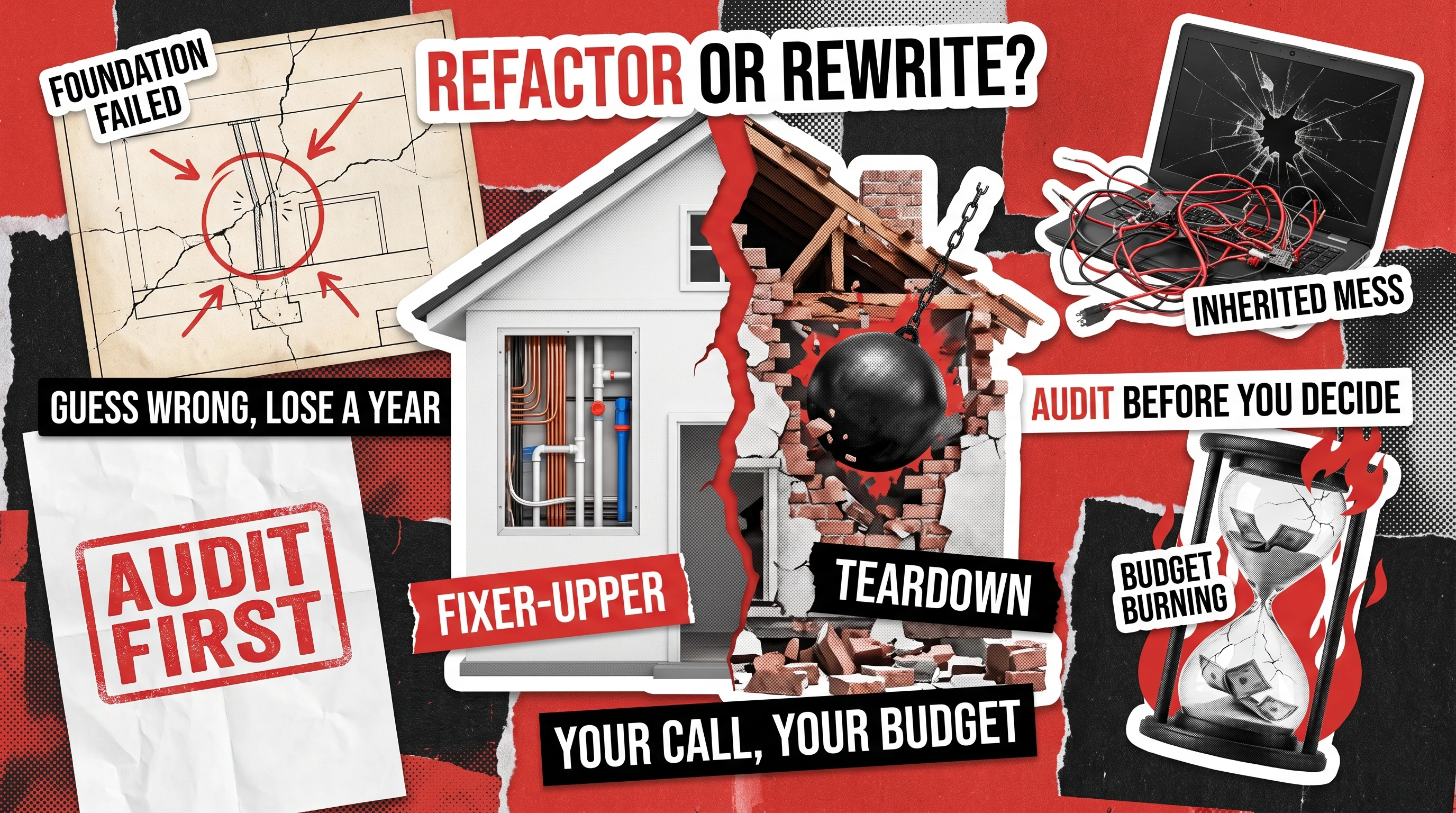
You’ve inherited a codebase, and one of the more expensive decisions you’ll make this year is now sitting on your desk. Do you keep the code and clean it up, or scrap it and start over? That’s the refactor vs rewrite question, and it lands on every owner who takes over software they didn’t build, whether the product arrived through an acquisition, an agency handoff, an offshore team that wrapped up, or a lead engineer who left with the whole system in their head.
Refactor when the architecture is sound and the mess sits in the details. Rewrite when the foundation itself cannot support what the business now needs. Refactoring is the right call in most inherited-code cases, because messy code is far more common than genuinely broken code, and a rewrite trades a known system for an unknown one.
Get the call wrong in either direction and you can burn a year and a budget with little to show for it. A short, independent software audit is the cheapest way to get it right, and this guide walks you through the same decision our auditors make when they open up code they’ve never seen.
Why Inherited Code Forces a Refactor vs Rewrite Decision
The hard part of inherited code is that you’re making a spending decision about something you didn’t design and can’t fully see yet. The people who understood why the code works the way it does are usually gone. What’s left is a system that runs, a set of business processes that depend on it, and a roadmap that expects you to keep adding features on top. Before you commit another dollar of development budget, you have to settle one thing: is this code worth building on, or is it cheaper over the life of the product to rebuild it?
The question usually shows up through one of the following issues:
- A small change takes three weeks.
- Every new feature breaks two old ones.
- The one developer who could navigate the system hands in their notice.
By then the budget pressure is already on, and the pull is to decide fast on instinct rather than evidence.
The code landing in owners’ laps is also getting harder to read at a glance, not easier. In Stack Overflow’s 2025 Developer Survey, 66% of developers named AI-generated solutions that are “almost right, but not quite” as their single biggest frustration, and 45% said debugging AI-written code takes more time than they expect. Plenty of inherited codebases now carry that kind of plausible-looking, quietly flawed code, which makes a careful assessment more valuable.
Rewrite vs Refactor vs Rebuild: What the Terms Actually Mean
People use these words loosely, which is part of why the decision becomes so hard. Here’s what each one really involves:
- Refactoring means improving the internal structure of the existing code without changing what it does for the user. You keep the system running and the features intact while you clean up the parts that make the code hard to maintain, much like fixing the wiring and plumbing of a house you still live in. It’s incremental and lower risk, because you’re working inside a system that already handles the awkward edge cases your business has piled up over the years.
- Rewriting means keeping the same product but building a fresh codebase to replace some or all of the old one. Your users still recognize the features, yet the code underneath is new. Teams choose a rewrite when the existing code is so tangled or outdated that cleaning it up would cost more than starting over. The trade is that a new team has to reproduce every quiet decision baked into the old system, including the ones nobody wrote down.
- Rebuilding goes a step further and rethinks the product itself, not just the code. You’re reconsidering what the software should do and how it should be shaped for where the business is heading. A rebuild is the biggest commitment of the three, and it makes sense when the original product no longer fits the market the business now serves.
The rewrite vs refactor choice usually comes down to how healthy the foundation is. When the architecture is sound and the code is merely messy, refactoring wins, and our guide to code refactoring techniques covers the specific moves that cleanup involves. Once the foundation itself is the problem, a rewrite or a rebuild starts to earn its cost. There’s also a fourth option people forget, and it belongs in the comparison too.
Rehost vs Refactor vs Rebuild: A Side by Side Comparison
That fourth option is rehosting, often called lift and shift. Rehosting moves your existing software onto new infrastructure, usually the cloud, without changing the code itself. It’s the lightest touch of all, the same application in a new home. However, while it solves hosting and cost problems, it does nothing for the code you inherited.
The comparison below lays out how the four paths stack up on the factors that hit your budget and your calendar.
Rehost
Low
Low
Days to weeks
Minimal, users barely notice
Refactor
Low to moderate
Low to moderate
Weeks to months, in stages
Low, you ship while you clean
Rewrite
High
High
Many months
Moderate to high, you run two systems at once
Rebuild
Highest
Highest
Months to over a year
High, the product itself changes
The table makes the trade clear. Rehosting and refactoring keep you moving with limited downside. Rewriting and rebuilding promise a cleaner future but ask you to carry real risk and cost to get there. Most inherited code decisions land on refactoring, because a messy codebase is far more common than a genuinely broken one. When the choice does tip toward replacement, our guide to legacy modernization best practices covers how to execute that path without the usual chaos.
When to Rebuild vs Refactor a Digital Product
Naming the approaches is the easy part. The real work is reading your own situation honestly. These are the signals we weigh when we help an owner decide whether to rebuild vs refactor a product they’ve inherited, and each one leans the call one way or the other:
- Is the architecture sound? If the overall structure is reasonable and the mess sits in the details, refactoring will get you there. However, if the foundation can’t support what you need, such as an architecture that won’t scale or a design that fights every change, replacement moves onto the table. Our article on scalable software architecture describes what a foundation built for growth looks like.
- Does the code still deliver business value? Working software that serves customers every day carries enormous hidden worth, because it already solves problems you’d otherwise have to rediscover. Code that no longer matches how the business runs is a weaker candidate for keeping.
- Is the original team gone? When the people who built the system have left and taken their knowledge with them, refactoring gets harder, because you’re partly reverse-engineering intent. That lost knowledge is expensive, and it can tip a borderline case toward a fresh start you fully control.
- Can you ship changes incrementally? If you can improve the system piece by piece while it keeps running, refactoring lets you spread cost and risk over time. However, if the code is so interdependent that touching one part breaks five others, a bigger intervention starts to look cheaper.
- Do tests exist? A codebase with a proper test suite is far safer to refactor, because you’ll know quickly when a change breaks something. With no tests at all, every edit is a small leap of faith, which raises the cost of both paths.
Held together, those signals point to a simple rule of thumb:
- Lean toward refactoring when the architecture is sound, the software still earns its keep, and you can improve it in stages.
- Lean toward a rewrite or rebuild when the foundation is the problem, the code has drifted from the business, and small fixes no longer stick.
- Get an outside read whenever the signals disagree, which happens more often than owners expect.
The mistake we see most is treating this as a gut call. The signals above can genuinely conflict, and the right answer usually needs someone to look at the code itself rather than the feelings around it. If you want to put a number on the mess before you decide, our guide on how to measure technical debt turns a vague sense that “this is bad” into figures you can budget against.
The Two Ways Owners Overpay When They Refactor or Rewrite
Once owners sit with the refactor or rewrite question, two expensive habits tend to creep in, and both come from emotion rather than evidence.
One is rewriting healthy code because it feels wrong. This usually happens because inheriting someone else’s work is uncomfortable. The code looks unfamiliar, the naming isn’t what you’d choose, and the instinct is to declare all of it garbage and start clean. That instinct runs up a big bill. Much of the code you inherit is perfectly functional and covers years of real-world cases you’d otherwise have to rebuild from memory. Replacing working software to satisfy a preference rather than a business need is one of the surest ways to burn a large budget and land roughly where you began.
The other habit is subtler, which is refactoring forever with no finish line. Cleaning up code feels productive, so it’s easy to keep going without ever defining what “done” means. With no target, the cleanup becomes a standing cost that never converts into value for the business. You can avoid this by deciding up front what the work is meant to achieve, whether that’s shipping a specific feature, hitting a performance goal, or making the system safe for a new team to work in, then stopping once you’re there.
Both traps grow from the same root, which is deciding without a clear read of the actual code. That’s exactly where an outside assessment earns its cost.
How a Software Audit Turns the Guess Into a Scoped Call
The cheapest step you can take with inherited code is buying certainty before the big decision. An independent assessment examines the architecture, code quality, test coverage, and any risks hiding in the corners. It then tells you in plain language whether you’re holding a fixer-upper or a teardown. Simply put, it converts a stressful guess into a scoped plan with a price attached to each path.
A code review gives you an honest read on maintainability, security, and the exact weak points a new team would trip over. The same discipline behind our code review checklist guides the whole assessment. With that in hand, the refactor vs rewrite question stops being a matter of opinion and becomes a matter of fact.
We’ve been on both sides of this call since 2005, across more than 250 delivered projects. For example, when Evolv inherited a legacy optimization platform after acquiring it, they didn’t gamble on a blind rebuild or settle for patching the old code. We already knew the platform’s business logic, assessed what was worth keeping, and re-architected it into a scalable, AI-driven SaaS product that now serves clients worldwide. That work earned Evolv a Frost & Sullivan Best Practices Award for technology innovation leadership. You can read the details in the Evolv case study.
If you’ve just taken over a codebase and you’re staring down a keep-or-redo decision, you don’t have to make it blind. We’ll audit what you’ve got, tell you plainly what’s worth saving and what isn’t, and hand you a costed plan for whichever path the evidence points to. Give us a call, and let’s turn your inherited code into a clear next step.
FAQ
Can you refactor and rewrite different parts of the same system at once?
Yes, and it is often the right call rather than a compromise. Large systems are rarely uniformly healthy or uniformly broken. A sound module can be refactored in place while a module that fights every change gets rewritten alongside it, on its own budget and timeline. The requirement is a clear boundary, usually an API or data contract, so the rewritten piece can be swapped in without disturbing the rest.
What is the strangler fig pattern, and does it change the refactor vs rewrite call?
The strangler fig pattern rewrites a system gradually instead of all at once. New functionality is built alongside the old system and traffic is routed to it feature by feature, the way a strangler fig grows around a host tree until the trunk is no longer load-bearing. It does not change whether you refactor or rewrite. It changes how you execute a rewrite once one is warranted, cutting over one workflow at a time instead of running two full systems side by side.
How does a technical debt score change the refactor vs rewrite math?
A technical debt score turns a vague sense that the code is bad into a number you can weigh against a rewrite’s price tag. A high score concentrated in a few modules usually points to refactoring, since you can target the expensive parts without touching the rest. A high score spread evenly across the whole codebase points the other way: the problem is the architecture itself, not a handful of bad files.
Who should make the refactor vs rewrite call, engineering or the business?
Neither side should make this call alone. Engineering sees the architecture and the tests, or the lack of them, but not always what revenue or customer trust rides on the system staying up during a transition. The business side sees the budget and the deadline, but not what is actually happening inside the code. The safest structure is a joint decision built on a shared, outside read of the code.
See how a Redwerk code review of a Python backend uncovered 40 critical issues and drove an 80% increase in maintainability for Project Science