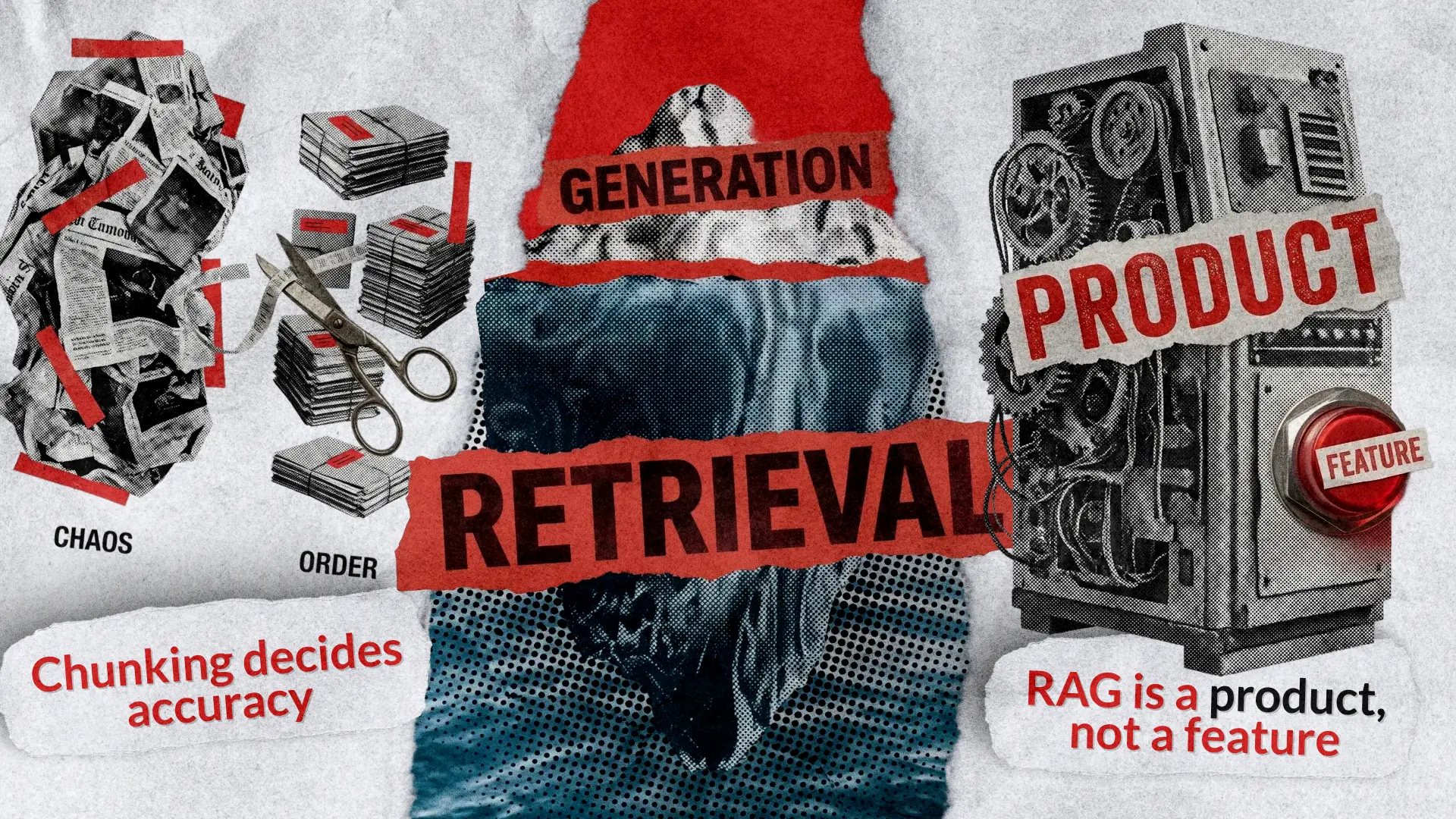
If you’re playing with RAG just to impress your board, skip this one. If you want retrieval augmented generation to power products your users trust at 2 a.m., let’s talk.
Over 70% of new LLM features quietly fail in production because the RAG architecture is bolted on rather than designed into the AI pipelines. Teams index a few PDFs into vector databases, wire a chat UI, and hope semantic search will magically fix hallucinations. Spoiler: it doesn’t. When we design retrieval augmented generation within broader LLM development services workstreams, we treat retrieval, orchestration, and observability as core parts of the product, not “one more integration.”
Below is a practical, founder-grade guide to RAG best practices — the stuff that actually moves accuracy, latency, and trust metrics, backed by fresh research, not hype.
What RAG Actually Fixes (and What It Doesn’t)
Retrieval augmented generation connects your large language models to a curated knowledge base so the model answers from your data rather than improvising. That’s the theory.
In practice, you get three core benefits if your RAG implementation is done right:
- Grounded answers instead of hallucinations. The model cites retrieved chunks from your knowledge base and uses them as prompt grounding context.
- Up-to-date and domain-specific knowledge. You can mix static docs, near real-time data, and sensitive internal systems without retraining the model every week.
- Controlled risk surface. You decide which sources are indexable, what gets filtered, and which RAG architecture patterns are allowed to answer which queries.
RAG will not fix:
- Bad product UX
- Non‑existent governance
- Completely messy, contradictory documentation
If your docs are chaotic, RAG just becomes a very confident chaos amplifier.
Principle #1: Treat Retrieval as a First‑Class System, Not a Helper
Most broken RAG workflows have one thing in common: retrieval was an afterthought tacked onto an LLM proof-of-concept (POC). Recent studies show that tuning retrieval alone can improve task accuracy by over 50%, even with the same base model.
So, step one: architect retrieval as a product component with its own evaluation metrics, SLOs, and budget.
Retrieval-First Checklist
Before diving into specific RAG techniques, align around three questions. They look simple. They’re not.
- What does a “good” answer mean for this use case — speed, precision, coverage, or explainability?
- What’s the cost of a wrong answer versus “no answer”?
- How often does your knowledge base change, and who owns its quality?
Once this is clear, you can design RAG workflows instead of random demos.
- Separate retrieval and generation metrics. Track retrieval accuracy (e.g., recall@k, precision@k) independently from answer quality (e.g., groundedness, completeness).
- Design retrieval SLOs. For example, “p95 retrieval latency under 300 ms, p95 recall@5 above 0.8 for top customer intents”.
- Budget for retrieval experiments. Reserve time to iterate on semantic search parameters, embedding models, and ranking, not just prompt templates.
Principle #2: Chunking and Indexing Decide Whether RAG Helps or Hurts
People love talking about models. Nowadays, most performance gains in RAG still come from boring work on chunking, indexing, and embedding models. Think of it as data modeling for your RAG architecture.
Bad chunking leads to two failure modes: context that’s too narrow to answer anything, or long blobs that dilute relevance and blow up context windows.
Chunking Strategies That Don’t Suck
Here’s where document chunking strategies move from slideware to practice.
API docs & config refs
Structure-aware chunks by heading/endpoint/configuration key.
Developer portals, integration docs.
Legal & policy docs
Paragraph chunks with sentence-level overlap for context.
Contracts, ToS, compliance policies.
Long reports/playbooks
Hierarchical chunks: sections → paragraphs, plus a “summary” embedding per section.
Handbooks, incident reports.
FAQ & ticket history
Short Q&A chunks per intent, with synthetic summaries if needed.
Support assistants, internal helpdesk.
You can use the table below when sketching your RAG implementation with your team.Three practical rules when designing indexing for RAG:
- Align chunk size with query granularity. If users ask for “step 3 in the onboarding checklist”, you need RAG chunks at the checklist item level, not 4‑page PDFs.
- Use overlap deliberately, not by default. Start with 10–20% token overlap for narrative content; disable overlap for rigid structures like API endpoint schemas.
- Build multiple indices when needed. Separate indices (or collections in your vector databases) for policies, FAQs, technical docs, and logs often outperform a single giant index.
Principle #3: Pick Vector Databases Like You Pick a Co‑Founder
Your LLM retrieval stack lives or dies on the database behind your semantic search. Today, vector databases are not just “fancy search”; they’re infra that defines latency, recall, and cost curves for your RAG implementation.
Teams that treat this choice as an afterthought end up with surprise cloud bills and mysterious latency spikes right when traffic grows.
What Matters in Vector Databases for RAG
There are dozens of benchmarks out there. For practical RAG best practices, focus on what actually affects your product.
- Indexing strategy, not brand name. HNSW, IVF, PQ — these decide how your semantic search trades precision vs. speed.
- Filtering and metadata support. Reliable metadata filters (tenant, language, version) are non‑negotiable for multi‑tenant RAG workflows.
- Hybrid search. Combining lexical search (BM25) with dense vectors can significantly improve retrieval accuracy for short or ambiguous queries.
A 2025 guide on vector databases shows that teams mixing keyword and vector search often see double‑digit gains in relevance without sacrificing latency. That’s low‑hanging fruit most teams still ignore.
Principle #4: Query Engineering Beats Prompt Tinkering
Everyone has a favorite prompt template. Fewer teams design robust query pipelines. Yet recent RAG papers continue to show that smart query processing can outperform larger models on the same data.
Think of this as the “front door” of your RAG architecture: you can’t fix a mis‑framed question later in the pipeline.
Query Processing Moves that Actually Work
Before showing a list, here’s the mindset: treat every user query as raw material. You normalize it, expand it, and sometimes reject it before touching the knowledge base.
- Query rewriting and expansion. Use the LLM to reformulate vague questions into structured search queries with explicit entities and constraints.
- Intent classification. Route “billing issues” to one index and “technical deep‑dives” to another to reduce retrieval noise.
- Clarification turns. For high‑risk use cases (finance, health), ask a follow‑up if the query is ambiguous instead of confidently guessing.
On top of that, prompt grounding matters: prepend retrieved snippets with explicit instructions like “Answer only using the context below. If the answer is not present, say you don’t know.” to keep large language models honest.
Principle #5: Use Evaluation Like a Product Owner, Not a Researcher
If your RAG implementation ships without a clear story for evaluation metrics, you’re flying blind. In 2026, there’s no excuse — the ecosystem around RAG evaluation matured a lot.
One meta‑analysis of RAG evaluation frameworks highlights a pattern: teams that evaluate retrieval and generation together, with task‑level metrics, catch failures earlier and iterate faster.
Minimal but Serious Evaluation Stack
This part is easy to overcomplicate. Keep it lean and tied to business outcomes.
- Retrieval-level metrics
- recall@k and precision@k on a labeled set of queries.
- corpus coverage (what fraction of key policies/flows are reachable through search).
- Generation-level metrics
- groundedness (is each claim supported by retrieved context).
- completeness (does the answer cover all user constraints).
- Task-level metrics
- ticket deflection rate, average handle time, or time‑to‑first‑draft for internal tools.
Microsoft’s 2025 RAG evaluators, for example, separate retrieval, groundedness, and answer quality, and rely on LLM‑based judges where ground truth is expensive. That pattern maps well to most production setups.
Principle #6: Design for Real-Time Data Without Breaking Everything
You probably want RAG because your domain changes fast — pricing, policies, release notes, regulations. The temptation is to hook RAG straight into live APIs and call it a day. That’s how you get brittle systems and late‑night incidents.
Research and case studies in 2025 push a different approach: layered knowledge base design with clear freshness policies. Instead of dumping everything into one index, you architect RAG workflows around how your domain changes, which teams own the data, and how risky wrong answers are. For many teams, this thinking starts earlier, at the discovery stage: mapping use cases, feasibility, and ROI of RAG implementation as part of broader AI development rather than experimenting in isolated POCs.
A Simple Layered Knowledge Base
Before the bullets, picture this: instead of one giant index, you maintain a “core” knowledge layer plus one or more real-time data layers with different SLAs.
- Core static layer. Versioned docs, manuals, SLAs, and legal texts. Updated through controlled releases, heavily tested.
- Frequent‑update layer. Changelogs, release notes, dynamic pricing rules; updated on a schedule, monitored for index drift.
- On‑demand live layer. For highly volatile data (e.g., current balance, shipment status), RAG retrieves structural context, then calls APIs at answer time.
This structure keeps your RAG architecture scalable while giving stakeholders clear answers to “where did this answer come from?” and “how fresh is it?”.
Principle #7: Guardrails Are Part of RAG, Not an Afterthought
When RAG goes wrong, it usually goes wrong loudly. Wrong medical guidance, non‑compliant financial answers, internal data leaking into public chats — the usual horror stories.
Modern RAG best practices treat governance and safety as baked into the pipeline, not a few regex checks after generation.
Guardrails That Actually Run in Production
Think less about generic “AI safety” and more about concrete, enforceable checks at each stage of your RAG workflow.
- Input filtering. Detect and block queries that request out‑of‑scope data (e.g., other tenants’ info) before retrieval.
- Source whitelisting. Index only vetted document collections; disallow direct indexing from random URLs or email replies.
- Post‑generation validation. Use rule engines or secondary LLM checks to detect ungrounded claims, missing disclaimers, or restricted topics.
A last year survey of retrieval augmented generation evaluation frameworks notes that many failures show up as policy breaches rather than pure accuracy issues. Guardrails are your only realistic way to catch those at scale.
Principle #8: Build RAG as a Product, Not a Feature
By this point, you probably see the pattern: RAG is not just “add retrieval,” but “rethink how your product uses text and knowledge.” That mindset shift separates companies with one cool demo from those scaling AI models into sustainable, high-leverage business assets.
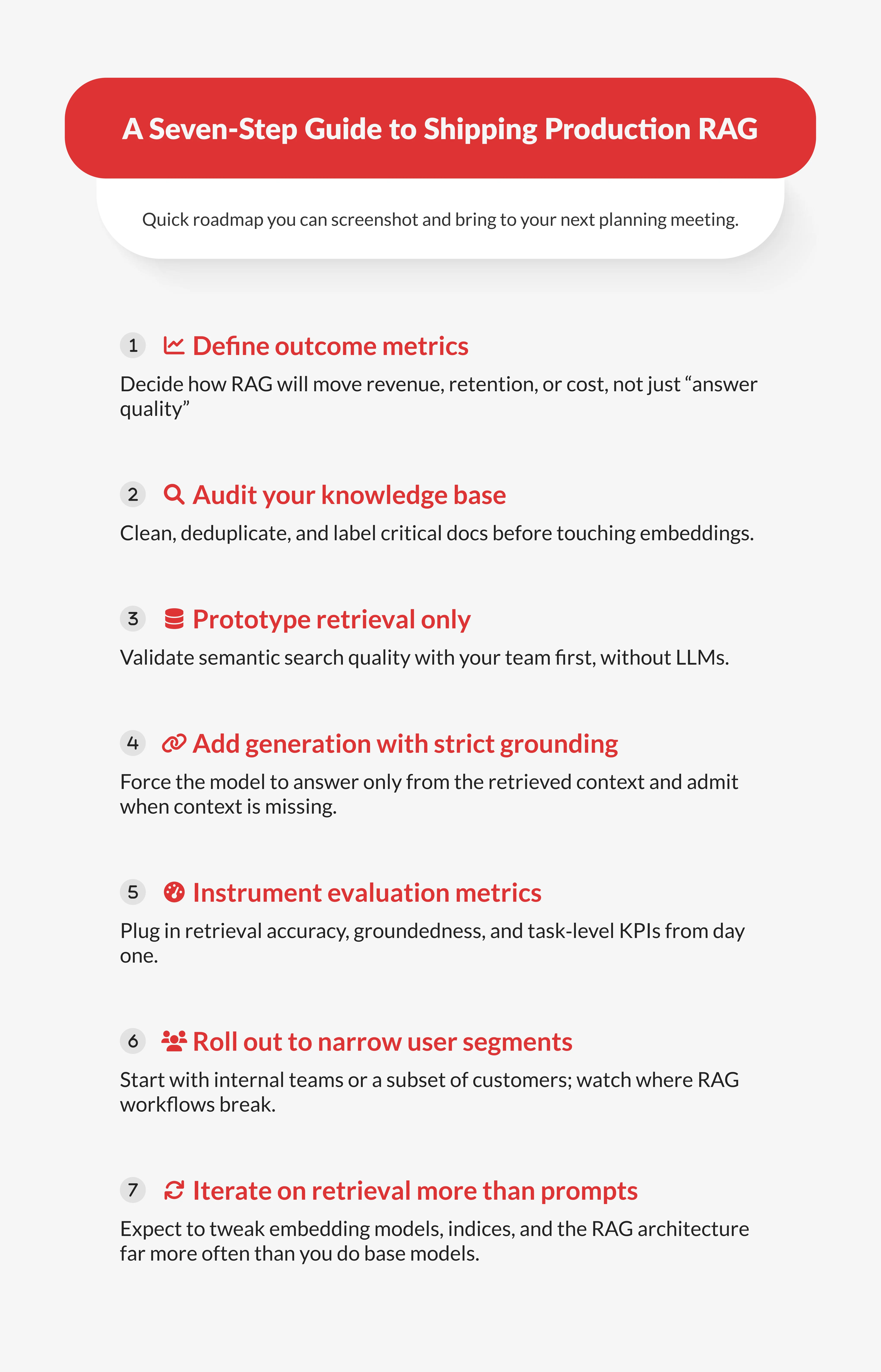
A practical way to keep your RAG implementation honest is to treat it like any other product initiative: roadmaps, owners, KPIs, and gradual rollout.
Wrapping Up RAG Best Practices Without the Fluff
If there’s one takeaway from all the retrieval augmented generation best practices above, it’s this: most teams don’t fail because RAG is too complex. They may fail because they treat it like a shortcut. The teams that win treat RAG architecture, LLM retrieval, evaluation metrics, and data governance as product decisions, not playground settings.
So when you plan your next RAG implementation, don’t start with “Which model should we use?” It’s better to start with “Which decisions do we want the system to help with, and what knowledge base and workflow does it need to get there?” Tight chunking, well‑chosen vector databases, solid semantic search, and honest measurement won’t look sexy in a slide deck, but they’re exactly what make your large language models feel like an unfair advantage instead of an expensive experiment. You don’t have to figure out the technical hurdles on your own — reach out and contact us if you want some friendly guidance on your RAG project.
See how we helped Evolv launch
AI-driven optimization platform, accelerate UX
experimentation, and ship new capabilities faster