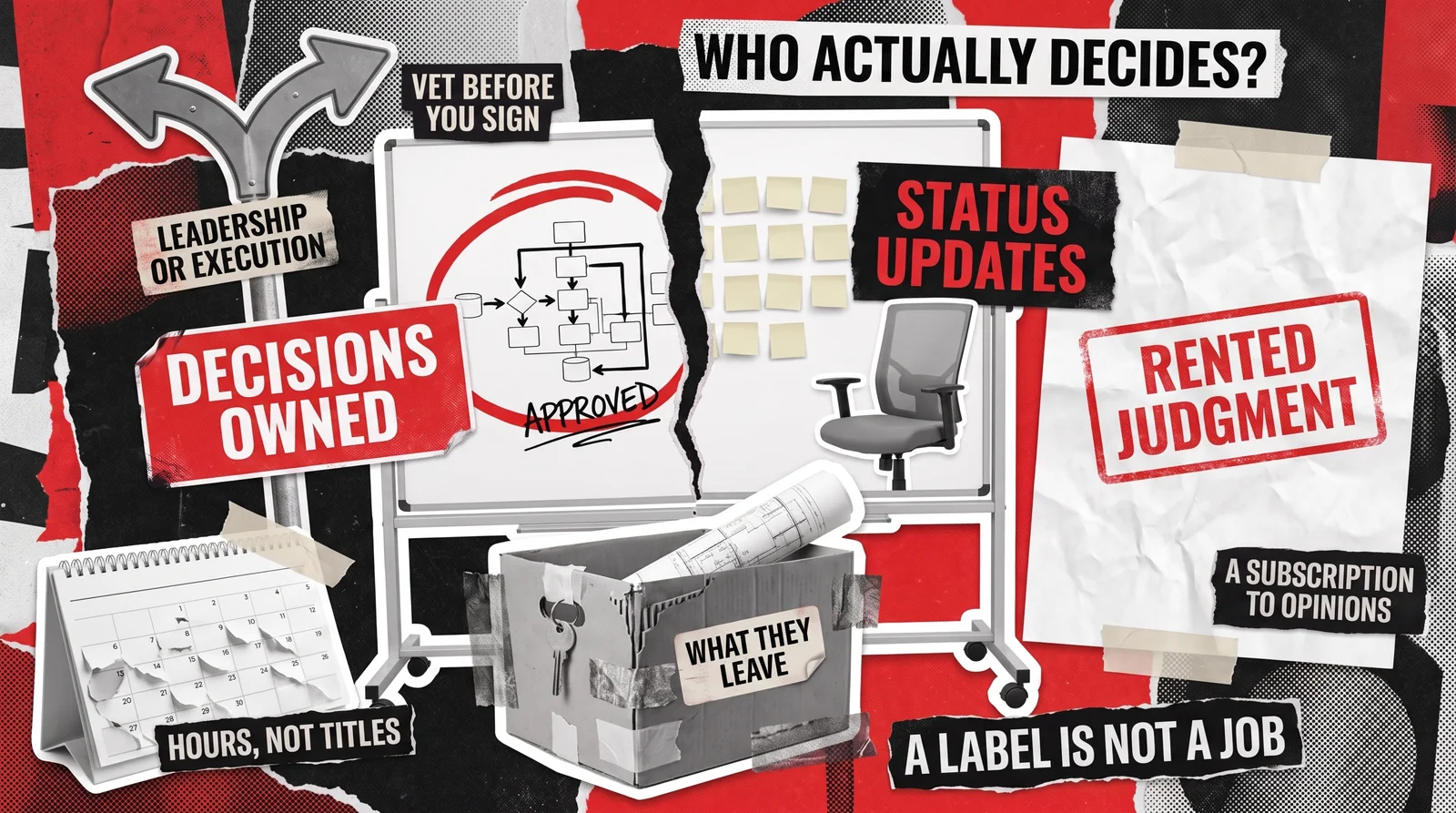
Founders are consistently overpaying for the wrong type of help. They hire a strategic leader when they need two senior developers, or they lean on a staffing agency when they need a fundamental architectural bet made. The right model depends entirely on your internal tech maturity, the volatility of your product scope, and your tolerance for accountability.
In this article, we’re cutting through the industry noise with a straightforward framework: three partnership models, three distinct traps to avoid, and one clear cheat sheet to help you make the right hire by this afternoon. You will also find what drives the cost and how to vet a candidate. Scoping and offboarding get their own sections, because that is where these arrangements usually go wrong. Everything here comes from a team that runs software development consulting engagements for founders in this position.
What Is a Fractional CTO?
A fractional Chief Technology Officer is a senior technology executive who splits their time across two or three companies, typically 10 to 25 hours per week with yours. They’re not a consultant presenting recommendations and leaving. They’re not a developer shipping code. They own the technology decisions that compound: architecture, hiring, vendor selection, roadmap, and the tech story you tell your board.
A true fractional CTO integrates directly into your leadership team to ensure that your technology supports your business outcomes without the fixed overhead of a permanent C-suite executive. Think of it as CTO-level accountability without the $400K-a-year cost structure.
The interim variant is a close cousin: interim CTO services usually cover a gap (a full-timer left, a merger is closing), while a fractional arrangement is ongoing and part-time by design. Some founders call the same model CTO as a service or outsourced CTO services: different labels, same underlying job.
What Does a Fractional CTO Do?
Short answer: whatever keeps your technology from becoming a liability. The responsibilities of this role go far beyond code reviews. A fractional CTO service typically covers technical strategy and roadmap, architecture decisions, engineering hiring, vendor selection, investor and board communication, and process review. They turn liabilities into assets by running your engineering team through a strict SDLC audit checklist right before you ask investors for money. Fractional CTOs catch the things a non-technical founder can’t see, like scaling dead-ends and the kind of technical debt that kills Series A due diligence.
Furthermore, they manage high-stakes vendor relationships and spearhead cybersecurity initiatives. When comparing a fractional CTO vs full-time CTO, the primary difference lies in time commitment and financial investment. The fractional executive provides the same tier of expertise but focuses strictly on high-impact strategic milestones rather than daily micro-management.
Knowing what the role leaves out matters just as much. A fractional CTO is not a senior developer with a better title, so expect architecture reviews rather than shipped production features. Delivery stays with your project manager or team lead. Hiring sits on a similar boundary: a good one designs the interview loop and joins panels, while sourcing belongs to a recruiter. Founders who want all three from one part-time engagement tend to get a thin version of each. Write the boundaries down before the first invoice.
What a Fractional CTO Does in the AI Era
The job description has shifted. Nowadays, Fractional CTO consulting engagements lean heavily on AI architecture decisions (RAG vs. fine-tuning, open-weight vs. API), inference cost management, and AI compliance (EU AI Act, SOC 2, and HIPAA).
If you’re building anything LLM-powered, RAG best practices and LLM inference optimization techniques are now standard board topics, not engineering details. A fractional CTO can break down complex choices, like evaluating LangChain vs LangGraph, and ensure you are making the right long-term bet.
A fractional CTO saves you from building what OpenAI or Anthropic will ship as a feature in three months. If your roadmap depends on specialized AI delivery, our AI automation agency and AI development services teams handle the delivery side.
When to Hire a Fractional CTO for a Tech Startup?
Timing is everything when bringing external leadership on board. When to hire a fractional CTO for a tech startup? The ideal moment is usually during a transitional growth phase, such as moving from Seed to Series A, when the technical complexity suddenly outpaces the founding team’s experience.
Another clear trigger is when non-technical founders need to translate a visionary idea into a concrete technical specification. If you are preparing for a merger or acquisition and need someone to clean up technical debt and present a solid technological narrative to investors, you need this level of leadership.
If your startup requires a temporary bridge between a departing leader and a new permanent hire, relying on interim CTO services is a brilliant move. This ensures stability and maintains momentum while the executive search is underway. Famous tech entities utilize this strategy successfully. For example, according to TechCrunch, even massive secure communications platforms like Signal leverage fractional leadership with executives like Umair Bashir guiding their technical strategy.
Every trigger above assumes the gap is leadership. Test that assumption before you shop: is the gap leadership or execution? A leadership gap means decisions are not getting made. Nobody owns the stack choice, the build-versus-buy call keeps sliding, and the board hears three different answers. An execution gap is the opposite. The work moves too slowly even though the roadmap is clear and the calls have been made. Founders often diagnose the second and shop for the first. Six months of advice later, nothing has shipped.
If your roadmap is agreed and capacity is the bottleneck, a dedicated development team costs less than senior advice you cannot act on. Teams that have not settled a roadmap need scoping first, which is where building an MVP in the right order earns its keep.
Fractional CTO vs. Software Development Consulting vs. Staff Augmentation
Three outside-talent models get conflated constantly because they overlap in who shows up: senior people, outside your company, on a contract. They diverge on what you’re actually buying, how they fail, and what good looks like once they’re in. Read each failure mode honestly. If your last engagement matches the description, you bought the wrong model.
Fractional CTO: Hiring a Decision Engine
Buying: judgment. Strategy, architecture, and hiring ownership at 10 to 25 hours per week.
Pay by: monthly retainer.
Failure mode: they show up for a weekly status meeting, give vague directional advice, and never decide anything. Three months in, you have a tidy Notion page and zero shipped architecture decisions.
What good looks like: a 10-to-15-hour-per-week fractional CTO should own four concrete things:
- a regular architecture review where decisions get made and documented, not “discussed”
- the senior engineering hiring loop end-to-end
- a monthly board or investor tech memo your founder can forward without rewriting
- decision authority on stack, vendor, and major build-vs-buy calls
If those four aren’t on their plate, you’re paying for status updates. Ask candidates to walk you through the last time they exercised each.
Software Development Consulting: Tactical Solutions
Buying: an answer. A focused engagement with a defined artifact: an architecture plan, a platform audit, a technology selection, a performance overhaul. Think functional specification services or a full discovery phase.
Pay by: Time and Materials, scoped.
Failure mode: a 60-page recommendation that dies in a Drive folder because the consultants who wrote it have moved on and your team can’t translate slides into shipped code. You paid for clarity and got a coffee-table book.
What good looks like: hire firms that ship as well as advise. Either the artifact is something your team can execute against in 30 days, or the same firm offers follow-on execution so the people who designed the plan are the ones delivering it. That single criterion eliminates most of the deck-only risk. Redwerk does both: when we run a software development consulting engagement, we can hand off a clean spec for your team to build, or roll the same team into the build with no rehiring lag.
Shape is negotiable. A consulting engagement does not have to end with the artifact. The same arrangement can run on a standing basis: recurring architecture reviews, hiring support, and named decision authority. That is what most founders actually want when they search for a fractional CTO. What changes is the label and the billing, not the work.
Staff Augmentation: Pure Muscle
Buying: velocity. Senior engineers who plug into your team, follow your tech lead, and ship.
Pay by: hourly per engineer.
Failure mode: augmented engineers slowly become the only people who understand your codebase. A year in, you can’t end the contract without breaking production, you can’t re-bid the work without losing tribal knowledge, and you’re not sure what’s inside the systems they wrote. That’s vendor lock-in, and it almost always traces back to one root cause: nobody required documentation up front.
What good looks like: require three things in the statement of work (SOW) before signing. One, written documentation standards (architecture diagrams, API specs, runbooks) maintained as code ships, not retrofitted at exit. Two, code review by your in-house lead on every meaningful PR, so knowledge transfer happens continuously. Three, a written off-boarding plan in the contract from day one. Ask the vendor for sample documentation from a past engagement. If they can’t produce any, walk away.
At Redwerk we document everything, write clean and maintainable code, and design engagements so the handoff is effortless. We’ve also been the team that cleans up after the opposite kind of vendor: we took over Adoorabelle after a previous partner left the founders with architectural problems they couldn’t see, and we stepped in for Pridefit to give the founders back control of a software stack that had drifted out of their hands. Both engagements started by rebuilding the documentation the previous vendor never wrote.
Primary goal
Strategy, leadership, and technical vision
Solving specific architectural or operational problems
Adding pure engineering capacity and velocity
Engagement length
6 to 24 months
4 to 16 weeks
3+ months
In-house tech maturity
Low to Medium. You lack a senior technical voice at the board level
Medium to High. You have leadership but lack niche expertise
High. You have strong leaders who can manage external devs.
Accountability for outcomes
High
Medium (for the artifact)
Low (you own the plan)
Best when scope is
Volatile, strategic
Defined, bounded
Clear, execution-heavy
Primary artifact
Board decks, hiring plans, tech roadmaps, vendor choices
Audit reports, architecture blueprints, security assessments
Pushed code, resolved tickets, closed pull requests
The Decision Tree: Which Model Fits Your Stage?
Three signals decide it for you: your in-house tech leadership maturity, how volatile your scope is, and how much accountability you want to offload. Most teams pick the right model once and then hold onto it past its expiration date.
Hire a fractional CTO if you have no technical founder, scope is volatile, and you need someone who will make calls rather than suggest options. Typical trigger: you’re preparing to raise and a VC tech diligence will surface things you can’t explain.
Hire software development consulting if scope is bounded and the deliverable is a specific artifact (audit, architecture, platform pick), and your team can execute once the plan is set, or the same firm can execute it for you.
Hire staff augmentation if the plan is sound, the architecture is stable, and the problem is pure execution velocity. Industry data shows 70% of companies cite cost reduction as their primary outsourcing driver.
The Three Transitions Where the Model Has to Change
Most teams miss the handoff between models. Here are the three moments it bites.
Pre-seed → Seed. You started with a fractional CTO to shape the stack and hire the first engineers. You’ve got funding, a roadmap, and product-market fit (PMF) signal. Time to hire full-time equivalents (FTEs) and drop the fractional to advisor mode.
Seed → Series A. Your full-time CTO can’t do strategy and scale the team and run DevOps and talk to the board. Targeted consulting earns its keep here: a defined architecture review or scaling audit, not an open-ended retainer that duplicates your CTO. Our scalable software architecture write-up is a useful pre-read.
Series A → Series B. Product is stable, growth is real, you need four senior engineers yesterday. Staff augmentation, not another consultant.

What Drives the Cost of a Fractional CTO
Nobody can quote you a rate for this from a blog post, and published averages are worse than useless. Seniority band, hours per month, scope breadth, and your compliance load all multiply together. Two engagements carrying the same job title can differ by an order of magnitude. An average across all of them describes nothing you would actually sign.
Every real engagement gets scoped on its own. Six factors move the total:
- Hours per month, and whether they are fixed or flex with your release calendar
- Whether the person has operated at your stage, rather than advised companies at it
- Scope breadth, from architecture reviews only through to hiring, vendor management, and board reporting
- The compliance load your industry carries, since regulated software adds review cycles to every decision
- How many other clients they carry at the same time
- Whether delivery is bundled or bought separately, which most founders forget to price
The arithmetic gets simple once you fix the shape. One day a month buys roughly a quarter of the oversight a weekly cadence does. Compare proposals on hours and owned decisions, not headline rates. A lower monthly total that buys half the time and none of the authority is not a saving.
Retainer, Time and Materials, or a Standing Engagement
Three billing shapes cover most of the market, and each fails in its own way.
What you are buying
Judgment on tap, plus decision authority
A defined artifact
Judgment on tap from a team that also builds
Who decides
The fractional CTO, inside agreed limits
You, advised
You, with a named technical owner on our side
Commitment shape
Fixed hours every month
Bounded by the artifact
Adjusted month to month
How it fails
Status updates instead of decisions
A plan nobody executes
Scope widens without a review rhythm
Put in writing
Which calls they own
What the artifact contains, and when
The review rhythm and who signs off
Pick the shape from how volatile your decisions are, not from the monthly total. Volatile strategic work suits a standing arrangement, because the value is in being there when a call lands. Bounded work with a clear finish line suits time and materials. If you want both, say so before signing, since retrofitting a review rhythm onto a fixed contract is how scope arguments start.
How to Vet a Fractional CTO
Most fractional CTO candidates interview well, because talking about architecture is easier than owning it. Four questions separate the operators from the advisors:
- A specific technical decision they reversed at a past company, and what admitting it cost them
- What they shipped rather than what they recommended, including whether they carried the pager for a system they designed
- How they would spend the first month, named down to the artifacts produced and the meetings attended
- A reference from a company at your stage, since running technology at 400 people teaches nothing about running it at 12
Then check the reverse. A candidate who leaves you less clear than when you started is telling you something useful. The role exists to reduce the calls you personally have to make. An interview that adds confusion is a preview of the engagement.
Red Flags Before You Sign
Some signals are strong enough to end a conversation early.
- Equity only, with no cash component, which usually means they cannot sell the work at a real rate
- Five or more concurrent clients, since your architecture review is the one that moves when someone else escalates
- Refusing a short paid trial, because anyone confident of the value will prove it on a bounded piece of work
- Offering to source candidates for you, a job that belongs to a recruiter
- No opinion on your existing stack after a technical conversation, which suggests they never read it closely
None of these disqualifies a candidate on its own. Two together usually do.
How to Scope the Engagement So It Does Not Drift
Misaligned expectations end more fractional CTO engagements than incompetence does. Scope is where that gets settled, and four things belong in writing before the first month starts.
Name the calls they own outright. Architecture, vendor selection, and build-versus-buy are the usual three, and leaving authority vague produces a well-paid observer. Set the cadence, meaning which meetings they attend, how fast they respond between them, and what happens when something cannot wait. Define the artifacts, because a monthly board memo and a maintained architecture decision record are checkable in a way that advice is not. Agree the review point, a fixed date to ask whether the shape still fits, rather than finding out nine months in.
Founders who skip this step usually get a weekly status call and a tidy Notion page. That is not a leadership arrangement, it is a subscription to opinions.
What a Fractional CTO Should Leave Behind
The most expensive failure in this model is not a bad hire, it is a good one who leaves nothing usable behind. We see the aftermath often, because the team that inherits the codebase is frequently the one asked to rebuild what was only ever explained out loud. Where that has already happened, a software development audit is the cheapest way to establish what you actually own.
A departing fractional CTO should hand over four things:
- A maintained record of architecture decisions, carrying the reasoning and not just the outcome
- A specification your next team can build from without re-interviewing anyone
- The hiring rubric and interview loop, so the standard outlives the person who set it
- A named internal owner who has been coached into the calls, rather than briefed on them
That last item is what prevents the dependency trap, where an arrangement continues because nobody else can decide anything. Ask every candidate how it ends and what you will be holding when it does. A good answer sounds like an offboarding plan. Where the reasoning lives only in one person’s head, you are renting judgment instead of building it. That is why a discovery phase or a functional specification keeps paying after the engagement closes.
The Label Matters Less Than the Shape You Need
Here is the part the search results rarely say out loud. Most founders typing fractional CTO into Google are not shopping for a job title. They want the four things this guide already named: documented decisions, a hiring loop that holds, a board memo worth forwarding, and accountability when a stack choice goes wrong.
No job title owns them. Earlier in this guide we separated an ongoing retainer from a bounded consulting engagement. That split describes how the market packages the work, not a limit on what you can buy. Software development consulting delivers those same outcomes on a standing cadence. One difference matters: the people making the architecture calls can also build against them.
That difference is the one worth weighing. A fractional CTO hands you a decision and leaves execution to whoever you manage to hire. Someone who advises and ships closes the gap between the call and the working software, which is usually where the months disappear. If you are still weighing delivery models, in-house and outsourced development compare differently once leadership is part of the package.
Why Partnering With Redwerk Makes Sense for All Three
Founded in 2005, Redwerk has spent 20 years in the middle of exactly this three-way choice. We provide all three models, so you can switch modes without switching vendors when your stage changes.
Fractional CTO and Technology Leadership
When a founder comes to us without a technical background, we don’t dump a 40-page architecture doc and disappear. We embed. We worked in-person at Recruit Media during their ideation phase, an engagement that ended in a successful acquisition. We handle the discovery phase, functional specifications, and the calls that set the next 18 months of engineering direction.
Software Development Consulting
When the problem is bounded, our consulting team delivers the artifact that moves you forward, and we can roll into execution with the same people. Site Compass came to us for technical direction on a platform that had accumulated debt; we reshaped it. Project Science engaged us early to build their backend API for the long term. We also run focused code review engagements that map directly to what VCs and acquirers look for during diligence.
Staff Augmentation
When you need senior engineers who ramp in a week and ship by the end of the sprint, we staff. We default to managed services, and every engagement is built so you can take it back in-house cleanly whenever you decide.
One vendor, three modes, and the honesty to tell you when your problem is actually a different model than the one you walked in asking for. We’ve been known to talk founders out of a full build and into a discovery phase first. It saves everyone time and money.
Summing Up
Making the right technical hire shouldn’t feel like a shot in the dark. Whether you need a fractional executive to steer the ship, a consultant to resolve a burning architectural issue, or augmented staff to accelerate your delivery, Redwerk has decades of hands-on experience to back you up. The technical decisions you make today will define your valuation tomorrow.
One line is worth carrying out of this guide: a fractional CTO fixes a leadership gap, not an execution gap. Work out which one you have before you start shopping, because the two problems carry different price tags and different fixes.
If you are ready to stop burning through your cash reserves and figure out exactly what your startup needs to win, contact us today.
FAQ
When to hire a fractional CTO for a tech startup?
When you’re making technology decisions without the context to make them. Triggers: you’re a non-technical founder, you’re preparing to raise, you’re starting an AI build, or you’re past 5 engineers with no senior tech leader.
How to find a fractional CTO for startups?
Three paths: your investor network, specialized platforms and fractional CTO consulting firms, and software development firms that offer fractional CTO services as part of an integrated offering. Screen for stage match, domain familiarity, and proven hiring ability.
What are the benefits of a fractional CTO?
Senior technology leadership at 30 to 40% the cost of a full-time CTO, faster onboarding (1 to 2 weeks vs. 3 to 6 months), cross-industry pattern recognition, and scalable engagement: more hours during a launch, fewer during maintenance.
What’s the difference between a fractional CTO, software consulting, and staff augmentation?
Fractional CTO owns decisions and ongoing strategy. Software consulting delivers a defined artifact (audit, architecture, plan), and the same arrangement can continue on a standing basis rather than exiting. Staff augmentation plugs engineers into your team to execute a plan you already have. One’s for judgment, one’s for a specific answer, one’s for velocity.
Why do startups win with a fractional CTO?
They reduce the rate at which founders make expensive, uninformed technology calls. The model doesn’t fix product-market fit; it stops you spending the engineering budget in the wrong direction while you’re still searching for it.
How much does a fractional CTO cost?
There is no single number, and anyone quoting one without asking questions is guessing. Cost is driven by hours per month, the seniority you need, how broad the scope runs, and the compliance load of your industry. Those factors multiply rather than add, so published averages describe engagements nobody actually buys. Scope one properly and compare proposals on owned decisions, not headline rates.
How do you vet a fractional CTO?
Ask for a technical decision they reversed and what admitting it cost them. Then find out what they shipped rather than what they recommended, and get a reference from a company at your stage. Watch for equity-only pricing, five or more concurrent clients, or a refusal to run a short paid trial. A candidate who leaves you less clear than before has answered the question already.
How should a fractional CTO engagement end?
It should end with a handover rather than a fade-out. Before signing, agree what you will be holding at the end: a maintained record of architecture decisions, a specification your team can build from, the hiring rubric, and a coached internal owner. Arrangements that drift on usually continue because nobody else can decide.
Discover how we developed new features and integrations for Pridefit, leading to a 45% increase in user subscriptions