Equifax. SolarWinds. Yahoo. MOVEit. These aren’t companies that got hacked by some sci-fi superweapon. They got breached because of preventable, well-documented gaps in how their software was built, tested, and maintained.
We’ve been in the trenches of the software development industry for over two decades. We’ve seen brilliant products scale to millions of users, and we’ve watched promising startups burn to the ground over a single, preventable vulnerability.
If you are a founder, a product manager, or a fellow tech leader, you need to understand what a secure software development life cycle is and why it’s no longer just an IT problem. It’s a massive business liability. The global average cost of a data breach hit $4.4 million in 2025. So, what are the SDLC best practices that actually prevent these disasters? Let’s walk through them phase by phase.
What Is a Secure Software Development Lifecycle?
A secure software development lifecycle is a structured approach where security isn’t an afterthought bolted on during QA week, but a design constraint baked into every phase, from requirements to post-deployment maintenance. The shift-left principle at the heart of this approach says that post-release security fixes cost 30–50× more than catching the same issue during design. Every dollar you spend on SDLC security early saves you a small fortune later.
Before we go further: what is a secure software development life cycle, exactly?
It’s a structured approach to building software where security isn’t an afterthought bolted on during QA week, but a design constraint baked into every phase — from the first requirements meeting to post-deployment maintenance. A secure software development lifecycle treats vulnerabilities the same way good engineering treats bugs: prevent them early, detect them fast, fix them permanently.
The shift-left paradigm is real: post-release security fixes cost 30 to 50 times more than design-phase fixes. In other words, every dollar you spend on SDLC security early saves you a small fortune later.
Finding Your Groove: Software Development Lifecycle Methodologies
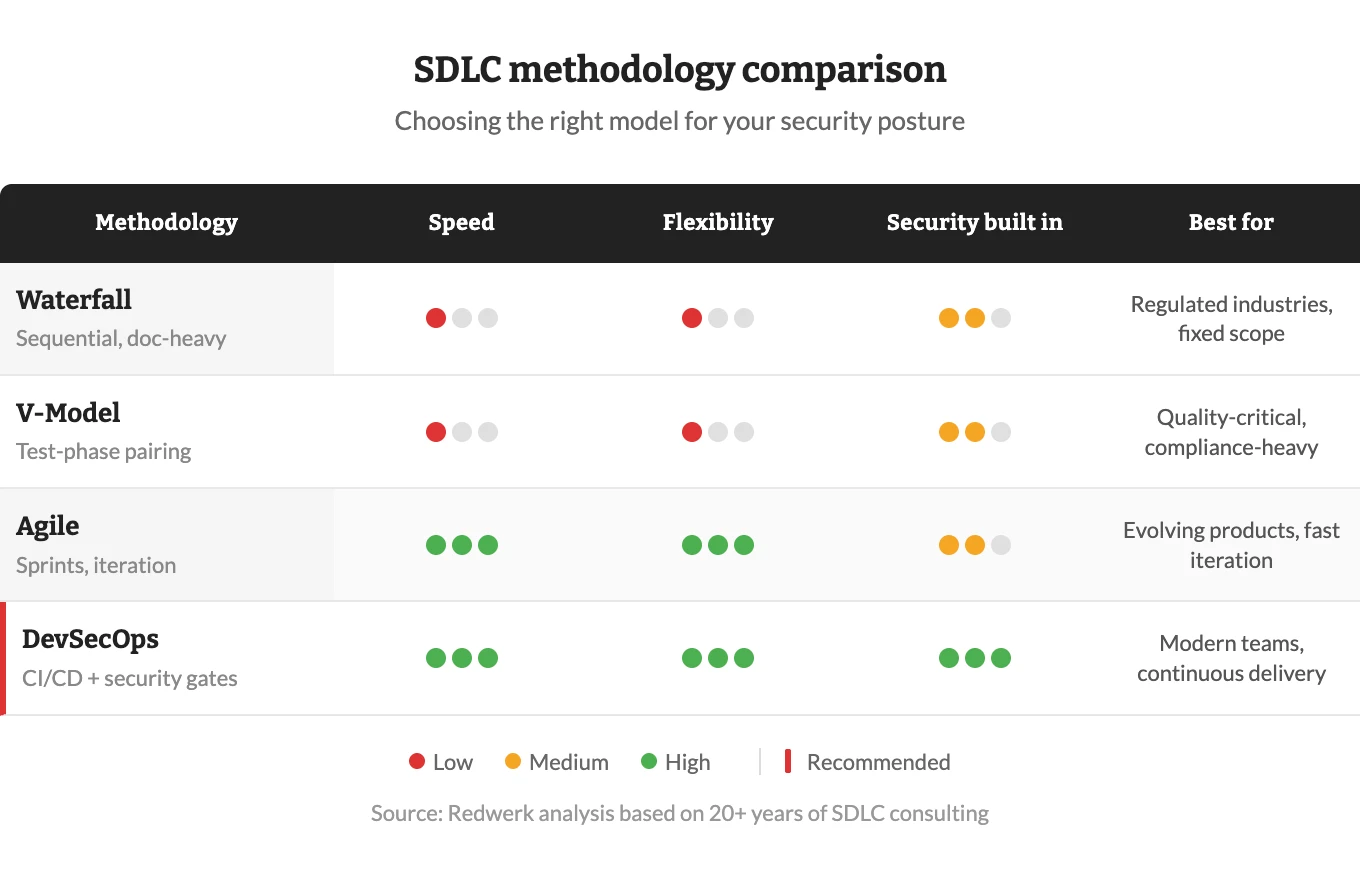
Every team uses some form of software development lifecycle methodologies, whether chosen deliberately or by accident. So, what is the best security software development life cycle methodology? The honest answer is: it depends.
Waterfall and V-Model work when requirements are locked and regulated. Think aerospace, medical devices, or government compliance. Their sequential nature helps with security documentation, but if a vulnerability shows up during testing, it’s expensive to loop back.
SDLC and agile development best practices have become the industry default. Agile delivers fast, adapts to change, and keeps users in the loop. But security gets deprioritized in the sprint-to-sprint rush. How do you fix it? Security acceptance criteria in every user story and a Security Champion embedded in each team. Early user involvement in software development helps catch not just usability issues but security blind spots that internal teams miss.
DevSecOps is the model we recommend for most modern teams. It unifies development, operations, and security into a continuous delivery pipeline. SAST, DAST, and SCA scanning run automatically.
Regardless of your chosen path, establishing a secure software development lifecycle policy is mandatory. If you don’t define the rules of the game, your developers will play on their own.
Baking Protection In: The Secure SDLC Phases
Security is not a testing phase you tack onto the end of a sprint. It must be engineered into every single step. These are the secure SDLC best practices for each phase, backed by what actually prevents breaches.
1. Requirements: Define Security Before You Write a Line of Code
Vague security requirements kill projects. Your secure SDLC policy must demand testable requirements from day one: “all database queries use parameterized statements” and “session tokens expire after 24 hours of inactivity.”
Build abuse cases alongside use cases. If your use case says “user can reset their password,” the abuse case should ask: “can an attacker enumerate valid email addresses through the reset flow?”
A secure software development lifecycle policy starts here by mapping compliance requirements (GDPR, HIPAA, PCI-DSS) to specific technical controls before anyone touches a keyboard.
2. Design: Threat Model or Regret It Later
This is where the magic (or the tragedy) happens. You need a structured approach to mapping out your attack surface. Frameworks like Microsoft’s STRIDE (Spoofing, Tampering, Repudiation, Information Disclosure, Denial of Service, Elevation of Privilege) are great for teams new to the concept. Your architecture must enforce zero trust, least privilege, and secure defaults. If your foundation is rotten, no amount of firewalling will save you.
Use PASTA (Process for Attack Simulation and Threat Analysis) for a more risk-centric approach. Architect for defense in depth, least privilege, and zero trust. Map every API endpoint, user interface, and third-party integration as a potential entry point.
3. Implementation: Automate What Humans Forget
The coding phase is where vulnerabilities are physically introduced. A solid secure development process here includes SAST tools (SonarQube, Semgrep, CodeQL) in your IDE and CI/CD pipeline, plus SCA tools scanning every dependency. Given that the Verizon 2025 DBIR found stolen or exposed credentials in 31% of all breaches, invest in secrets management like HashiCorp Vault or AWS Secrets Manager.
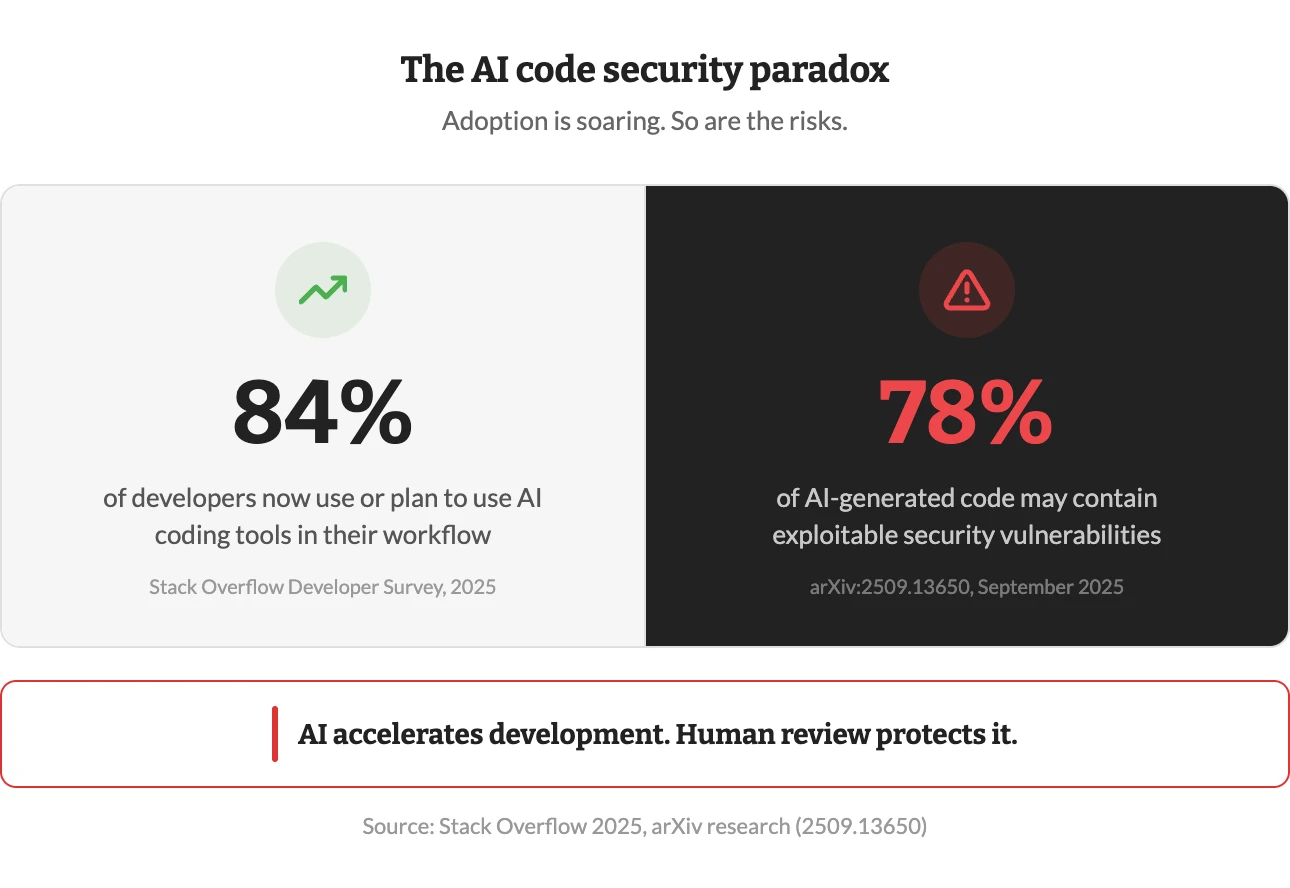
Now the elephant in the room: AI. A staggering 84% of developers use AI coding tools, according to the Stack Overflow 2025 survey. While these tools boost productivity, research shows 78% of AI-generated code may contain exploitable vulnerabilities. AI cannot replace human review. To maintain a secure application development process, rigorous code review and solid AI-augmented development security protocols are non-negotiable.
4. Testing: Think Like an Attacker
Automated scanning isn’t enough; you need human adversarial thinking. Dynamic Application Security Testing (DAST) probes running applications from the outside, while penetration testing finds the logical flaws that automated tools miss entirely.
Google’s OSS-Fuzz has found over 10,000 bugs across 1,000+ open-source projects, proving fuzz testing catches edge cases no human would write a test for. Integrating robust security in SDLC phases ensures you catch exploits before your adversaries do.
5. Deployment: Your Pipeline Is an Attack Surface
The SolarWinds breach proved that the CI/CD pipeline itself is a target. Attackers planted malware on build servers that swapped source code during compilation, and the backdoor was distributed to more than 18,000 organizations via a legitimate, signed software update.
Secure your build pipeline with integrity checks at every gate. Sign artifacts cryptographically. Generate Software Bills of Materials (SBOMs) — they’ve gone from optional to legally required under US Executive Order 14028 and the EU Cyber Resilience Act. A secure application development process doesn’t end when the code compiles; it extends to how that code reaches production.
6. Maintenance: The Endless Watch
A staggering 62% of organizations admit to knowingly releasing applications with security vulnerabilities to meet deadlines. This is professional malpractice.
Your secure software development process must include strict patch management SLAs, automated dependency updates, and continuous CVE monitoring. If you’re running aging systems, legacy modernization best practices should be on your roadmap. And as systems age, understanding how AI is reshaping software maintenance becomes a real competitive edge.
Consequences of Not Implementing Security in SDLC Phases
If you need ammo to convince your board to fund these software development lifecycle best practices, look at the consequences of not implementing security in SDLC phases. The 2025 US average breach cost hit an all-time high of $10.22 million.
- Requirements Failures: Meta received a record €1.2 billion GDPR fine because privacy and data residency requirements were absent from initial system architecture.
- Design Failures: The Heartbleed bug exposed private keys and session tokens on roughly 500,000 servers globally because a fundamental secure design principle (bounds checking) was ignored.
- Implementation Failures: The MOVEit Transfer SQL injection vulnerability compromised over 2,700 organizations, resulting in $9.93–$12.15 billion in estimated costs.
- Maintenance Failures: WannaCry caused $4 billion in global economic losses by exploiting systems that simply hadn’t applied a patch released two months prior.
None of these required exotic attack techniques. Every one was preventable with baseline SDLC security best practices.
Real-World Wins: The Adoorabelle Software Audit
We recently worked with Adoorabelle, a rapidly growing real estate platform that helps agents outsource property showings to a network of “runners.” As their user base scaled, they knew they couldn’t rely on guesswork.
They engaged Redwerk for a comprehensive software development audit. We evaluated their code as well as their entire SDLC cyber security posture. By analyzing their architecture and deployment pipelines, we identified critical bottlenecks and security vulnerabilities. We delivered a prioritized remediation roadmap, allowing Adoorabelle to protect sensitive client property data and confidently scale. The result: 24/7 system observability, 80+ bugs identified and fixed, and full technical transparency.
It is a textbook example of how adhering to a structured SDLC audit checklist yields a significant return on investment.
Stealing from the Greats: Frameworks You Should Adopt
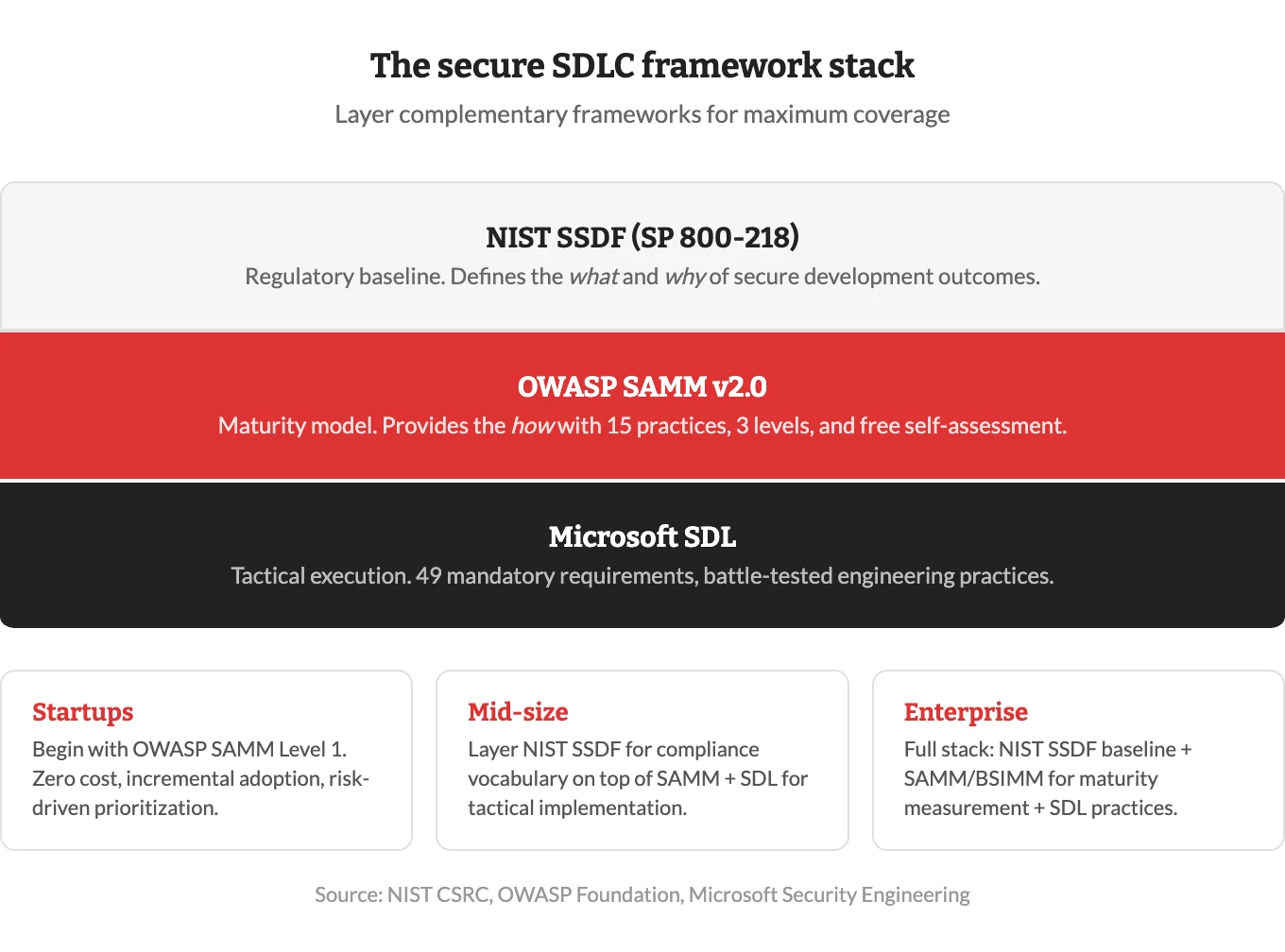
You don’t need to invent secure SDLC best practices from scratch. The most effective strategy layers established frameworks.
- NIST SSDF (Secure Software Development Framework): This is becoming the regulatory baseline. It defines the what and the why, making it essential for your overarching secure software development lifecycle.
- OWASP SAMM (Software Assurance Maturity Model): A highly accessible maturity model that provides the how. It’s free, risk-driven, and helps you measure your progress.
- Microsoft SDL: The industry standard that helped Microsoft reduce vulnerabilities by 61% from Windows Server 2000 to 2003. It offers battle-tested tactical practices.
For startups, we recommend beginning with OWASP SAMM Level 1. For mid-size to enterprise organizations, layer NIST SSDF for compliance with Microsoft SDL for ground-level engineering execution.
The Bottom Line
Building software is hard. Building secure software is a relentless discipline. But as we’ve seen, treating SDLC best practices as an optional “nice-to-have” is a gamble you will eventually lose.
Security must be a design constraint from project inception. Software supply chain security is now legally mandated. And while AI tools are accelerating development, they are simultaneously creating new, complex attack surfaces that require aggressive governance.
The companies that will dominate the next decade won’t view security as a roadblock. They will use a rigorous secure SDLC as a competitive advantage. If you want to find out where your product stands and what it takes to make it bulletproof, contact us. We’ve done this hundreds of times, and we’d love to help you get it right.
Grab your free software development audit sample