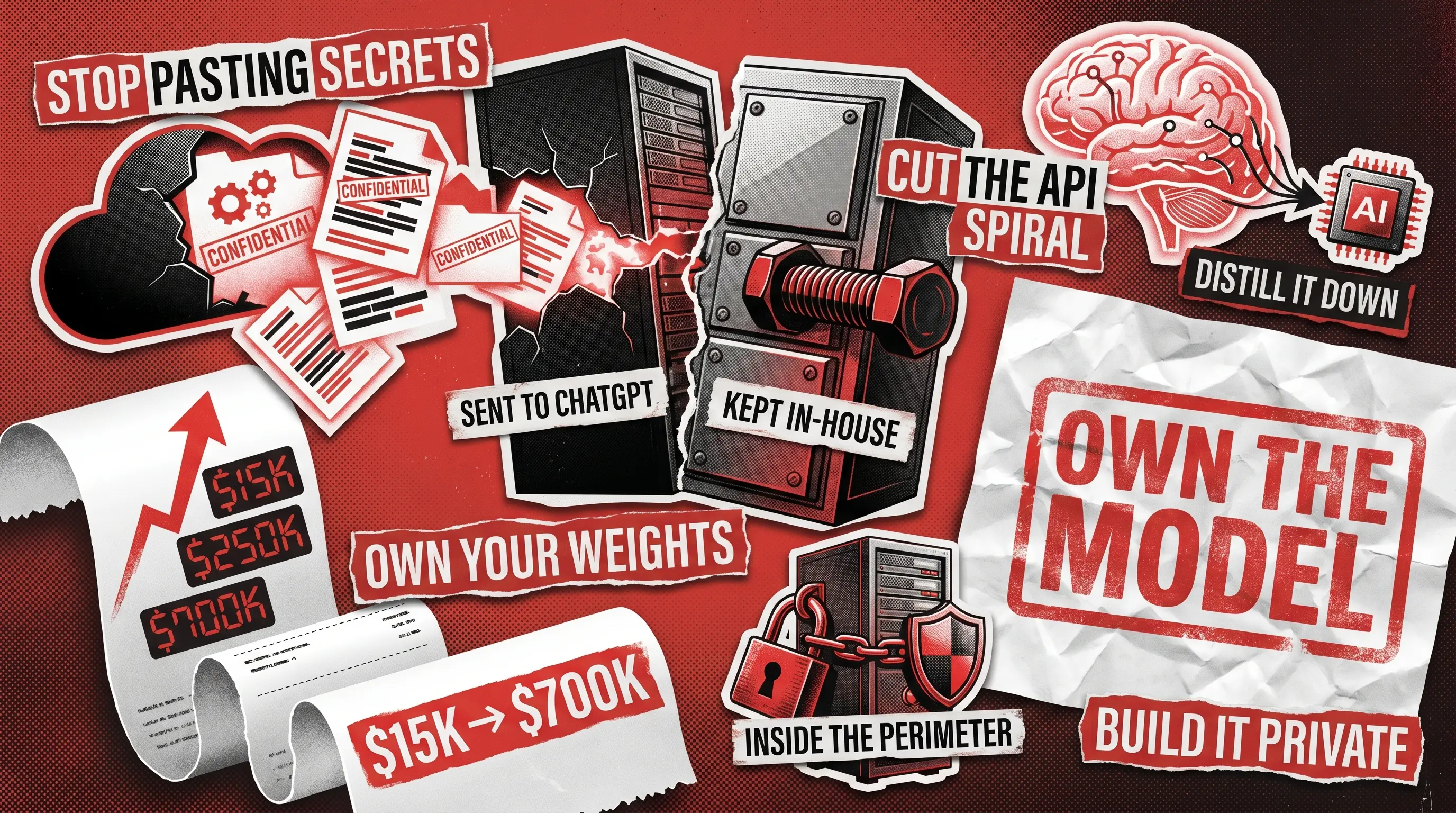
The road to adopting a private LLM usually starts with a quiet moment of sudden panic. Maybe your legal team suddenly realizes they’ve been casually pasting confidential client contracts into public ChatGPT windows, or your CTO opens the quarterly API bill and feels their soul briefly leave their body, realizing that usage tripled.
Boom. Just like that, you’ve arrived at the ‘Should we just build our own private AI model?’ conversation.
If you are sitting in that meeting right now, take a deep breath. You don’t need a PhD in data science, and you definitely don’t need a bottomless bank account to figure this out. Our team at Redwerk created our AI model distillation service specifically to help companies navigate this exact crossroads without losing their minds (or their budget).
Most guides on the internet will give you a generic, robotic checklist that leaves you with more questions than answers. We’re not going to do that to you. Instead, consider this article your honest, hype-free roadmap. We’re breaking down your actual options, what they really cost, how to pick the perfect fit for your specific situation, and where the hidden traps are waiting to trip you up. Let’s get you the answers you actually need.
What Is a Private LLM? (And What It Definitely Isn't)
A private LLM is a large language model deployed entirely within your own controlled environment, whether that means physical servers you own, a private cloud you control, or a hybrid of both. The defining feature is this: your data, your prompts, your model weights, and your inference logs all stay inside your security perimeter, and no third party ever processes your information.
One quick clarification, because searching for ‘private LLM’ surfaces a lot of content aimed at developers who want to run an open-source model on their laptop. Tools like Ollama and LM Studio are excellent for personal experimentation, but they are not what we’re talking about here. An enterprise-grade private LLM is an infrastructure decision, not a software download. If the goal is to power real business workflows across a team, serve thousands of users, and stay on the right side of HIPAA or GDPR, the ‘run it on a MacBook’ category isn’t relevant. What you need instead is a model that runs inside your boundary at scale, produces domain-accurate results, and generates a compliance audit trail.
Why Regulated Businesses Are Moving Fast on Private LLM Deployment
Three pressures are converging in 2026, with the sharpest impact on businesses in healthcare, finance, legal services, and government.
- The compliance wall is real and specific
Standard public LLM APIs operate outside your compliance perimeter by default. Under HIPAA, any vendor that receives, processes, or stores Protected Health Information (PHI) on your behalf must sign a Business Associate Agreement (BAA) before any data touches their infrastructure, and most standard API tiers don’t include one. GDPR data residency rules can go further: a European organization may be legally prohibited from routing personal data through US-based infrastructure without documented transfer mechanisms. As TrueFoundry’s compliance guide for regulated industries puts it, eligibility for a BAA-covered cloud deployment is not the same as compliance. - API costs don’t stay flat
According to CloudZero’s State of AI Costs report, the average monthly AI budget across organizations jumped from $62,964 in 2024 to $85,521 in 2025, a 36% increase, and the share of companies planning to spend over $100,000 per month more than doubled, from 20% to 45%. One widely cited enterprise pattern shows why: a team starts with a $15,000 monthly API bill at pilot scale, and by month three it’s $60,000, a trajectory that puts annual spend above $700,000 before hidden costs. Usage-based pricing is rational at proof-of-concept scale, and a liability once AI is embedded in production. - Generic models produce generic answers
Public LLMs are trained on broad internet data, so they sound confident but get unreliable when asked about your specific contracts, internal clinical protocols, or the precise terminology your field uses. Domain accuracy is not optional for businesses making decisions based on AI output, especially given the risks associated with shadow AI.
The Four Architecture Options for a Private Enterprise LLM: A Decision Framework
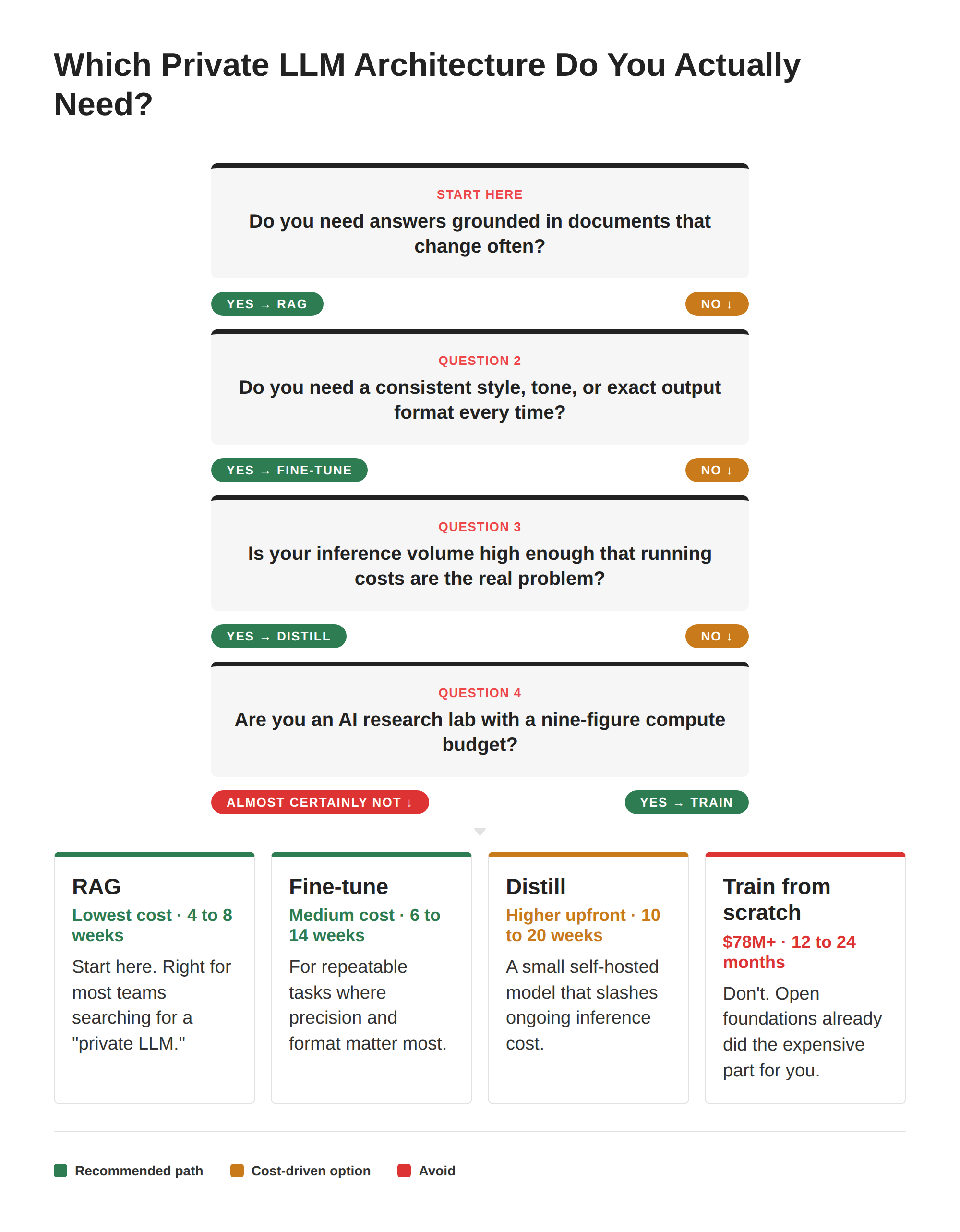
Here’s the part most guides skip: When someone says they want to ‘build a private LLM’, they might mean any of four meaningfully different things, each with a different cost profile, timeline, and fit. Understanding the differences is how you avoid spending six months on the wrong approach.
RAG on an open-source model
Retrieves from your documents at inference time
Low
4 to 8 weeks
Knowledge Q&A, document search, most enterprise use cases
Fine-tuned open-source model
Embeds domain knowledge directly into model weights
Medium
6 to 14 weeks
Repeatable structured tasks, specialized terminology, consistent tone
Distillation and self-hosting
Trains a smaller model using a larger one as teacher
Medium-high
10 to 20 weeks
High-volume workloads where ongoing inference cost is the problem
Training from scratch
Builds a model with no pre-existing weights
Extreme
12 to 24 months
AI research labs. Almost certainly not your situation.
Option 1: RAG (Retrieval-Augmented Generation) on an Open-Source Model
Choosing RAG over fine-tuning is the right starting point for most enterprises. Rather than changing the model itself, it connects a pre-trained open-source model (Llama, Mistral, and Falcon are common choices) to a private knowledge base at runtime. When a user asks a question, the system retrieves the most relevant internal documents and feeds them to the model as context, so the answer is grounded in your actual content rather than generic internet knowledge.
The practical advantages are significant:
- RAG is the fastest path from idea to pilot
- The knowledge base can be updated without retraining the model
- It can run inside a private Virtual Private Cloud (VPC) or on-premise environment to satisfy data residency requirements
For internal document Q&A, contract review support, HR knowledge assistants, or clinical documentation lookup, RAG on an open-source basis is usually the answer, and the answer most businesses looking for a ‘private LLM’ actually need, even if they don’t know it yet.
What RAG doesn’t solve is that if your task requires the model to reason in a fundamentally different style or produce structured outputs in a precise format every time, you’ll likely need to combine it with fine-tuning.
Option 2: Fine-Tuning an Open-Source Model
Fine-tuning takes a pre-trained model and retrains it on a smaller, curated dataset from your domain. The knowledge gets embedded into the model’s weights, so it internalizes your terminology, workflows, and required output formats. The result is more precise answers for repeatable, structured tasks than a RAG-only approach delivers, with no retrieval step at inference time, thereby reducing latency.
The tradeoff is cost and time. Fine-tuning requires computational resources and good-quality labeled training data, which is often the harder constraint. If your internal data is clean, labeled, and representative, fine-tuning is a powerful tool. However, if it’s scattered across formats and systems, you’ll spend more time on data preparation than on model training. Many production deployments combine both approaches: RAG for broad knowledge coverage and fine-tuning for tasks where precision matters most.
Option 3: Knowledge Distillation and Self-Hosting
Distillation is the cost-control lever that almost every ‘how to build a private LLM’ guide ignores, which is exactly why it’s worth understanding.
The idea is straightforward: You use a large, powerful model (the ‘teacher’) to generate training data, then train a smaller, faster model (the ‘student’) to replicate the teacher’s behavior on your specific tasks. You then self-host that compact student model on your own infrastructure, where it runs far cheaper than the teacher because it’s smaller and purpose-built for your workload rather than general use.
For businesses running high-volume AI workloads, distillation is often where the real return on investment (ROI) lives. The upfront cost is higher than RAG or fine-tuning alone, but ongoing inference cost drops dramatically, and the model runs entirely within your boundary. This architecture makes most sense once you’ve validated your use case and the volume justifies the investment.
Option 4: Training from Scratch
This option deserves a direct answer rather than a diplomatic one. To almost every business reading this, training a frontier model from scratch is neither realistic nor necessary.
The compute cost for GPT-4-scale training was approximately $78 million, according to Stanford’s 2025 AI Index, which collaborated with Epoch AI on these estimates, and Google’s Gemini Ultra came in at an estimated $191 million. Those are just the compute bills for a single training run, before infrastructure, staff, data acquisition, or iteration. Epoch AI’s research shows frontier training costs have grown at roughly 2.4x per year, so those numbers will look conservative soon enough.
Open-source foundation models like Llama and Mistral already encode years of large-scale training on vast datasets, so your business doesn’t need to replicate that. What you need is to adapt an existing foundation to your specific context, which is exactly what fine-tuning and RAG do, at a fraction of the cost and time. Unless you are running an AI research lab with nine-figure compute budgets and a dedicated research team, the decision tree ends here: pick one of the first three options.
Private LLM Deployment Paths: On-Premises, Private VPC, or Hybrid
Once you’ve chosen your architecture, you need to choose where it runs. Three deployment models map to different compliance requirements, infrastructure burdens, and costs.
- On-Premises Deployment
This means the model runs on hardware your organization owns and operates. This is the highest-compliance option because data never leaves your network, making it the standard choice for air-gapped environments such as defense contractors, certain government agencies, and the highest-sensitivity healthcare settings. The trade-off is infrastructure overhead: you own the hardware, manage maintenance, and your operations team bears the burden of keeping the system running. - Private VPC Deployment
It moves the infrastructure to an isolated cloud environment hosted by AWS, Azure, or Google Cloud, partitioned from shared infrastructure. Your data is processed only within your designated environment, and BAA-eligible configurations are available on all three major platforms. This option reaches production faster than on-premises, meets HIPAA and most GDPR requirements when configured correctly, and removes the hardware management burden. For most regulated enterprises, a properly configured private VPC is sufficient and practical. - Hybrid Deployment
This option keeps your most sensitive data and inference on-premises or in a private VPC, while routing less sensitive tasks through scalable cloud infrastructure. This is the pragmatic choice for mid-size organizations balancing compliance, cost, and flexibility. Whichever you choose, map your compliance requirements before making infrastructure decisions, not after.
What Building a Private LLM Actually Requires: Honest Resourcing
A private LLM deployment spans several disciplines most businesses don’t keep on staff at once: machine learning engineering for model selection and fine-tuning, data engineering to prepare training and retrieval data, MLOps (Machine Learning Operations) to manage deployment and monitoring, and domain expertise to confirm the model’s outputs are accurate for your context.
For the most common path, RAG plus a fine-tuned open-source model, a realistic timeline from kickoff to a functional pilot is 6 to 14 weeks, assuming clean data, defined success criteria, and access to the right skills. Any of those being absent extends the timeline considerably.
Most regulated-industry businesses aren’t running dedicated ML infrastructure teams, and that’s a rational staffing decision for organizations whose core competency is healthcare, finance, or law. Partnering with a team that has shipped production AI systems is usually faster and more cost-effective than assembling that capability in-house from scratch. Redwerk’s AI and machine learning development services cover the full delivery stack, from architecture design and data pipeline setup through model deployment and ongoing monitoring, including workflow automation for document-heavy operations, with the goal of eliminating manual bottlenecks without exposing sensitive process data to external vendors.
When Does a Private LLM Pay for Itself?
The cost calculation has two sides. First, the upfront investment: infrastructure setup, data preparation, model training or fine-tuning, and deployment. For a well-scoped RAG deployment or a fine-tuned model on a private VPC, that typically runs $40,000 to $100,000 depending on complexity, data maturity, and team composition. Second, the ongoing comparison. If your team is running significant AI workloads through a public API, the question isn’t whether owning the model is cheaper, it’s when. Given that enterprise AI spend grew 36% year over year in 2025, the crossover point for most production-scale deployments arrives within 12 to 18 months.
There’s also a cost that never appears on the invoice: a compliance incident. The average data breach now costs $4.88 million, according to IBM’s 2024 Cost of a Data Breach Report, and that figure excludes regulatory fines, which reach 4% of global annual revenue under GDPR and escalate into the millions under HIPAA. The architecture decision is a risk management decision too.
However, if we change the question to ‘Is a private LLM worth it for a smaller company?’, we must acknowledge that it depends on your data risk profile, not your company size. A 50-person healthtech company processing patient data every day has a stronger case for private deployment than a 500-person SaaS company whose AI use cases involve only public content.
Therefore, the question isn’t ‘are we big enough?’ but ‘can we afford a data incident, and what would a compliance audit of our current AI setup reveal?’ For smaller teams, a private VPC deployment with RAG on an open-source model is often the right entry point.
Your Private LLM Deployment Decision Doesn't Have to Be Made Alone
Most organizations that come to us with a ‘we need a private LLM’ brief actually have three questions bundled together:
- Which architecture fits our use case?
- How do we satisfy compliance?
- How do we escape the API cost spiral we’re already on?
The answers are specific to your data, your workflows, and your regulatory environment.
If you’re in that position, the most useful next step isn’t another article but a conversation with a team that has solved this in production. Get in touch with Redwerk and let’s map the right architecture for your situation.
FAQ
What is a private LLM?
A private LLM is a large language model deployed entirely within an organization’s controlled environment, on-premises or in a private cloud, so all data, prompts, and outputs stay inside the security perimeter with no third-party processing.
How do I run an LLM on my own infrastructure?
The most practical path for most enterprises is to use an open-source foundation model (such as Llama or Mistral), deploy it in a private VPC or on-premises environment, and connect it to their internal data via RAG. Fine-tuning can be added to improve precision for specific tasks.
How can I use AI without sending data to OpenAI or other public providers?
Deploy an open-source LLM on your own infrastructure, either on-premises or within a private cloud environment you control. This ensures your data never leaves your security boundary.
What is the difference between RAG and fine-tuning for a private LLM?
RAG connects a model to your documents at inference time, so answers are grounded in your content without changing the model itself. Fine-tuning modifies the model’s weights using your data, embedding domain knowledge directly into the model. RAG is faster and more flexible, while fine-tuning produces higher precision for structured, repeatable tasks. Many production systems use both.
How long does it take to build a private LLM?
A RAG-based deployment can reach a working pilot in 4 to 8 weeks. Adding fine-tuning typically extends this to 6-14 weeks. The timeline depends heavily on the quality and readiness of your internal data.
See how we delivered a custom IMS that transformed Mass Movement's workflows, culminating in their successful acquisition by J.B. Hunt