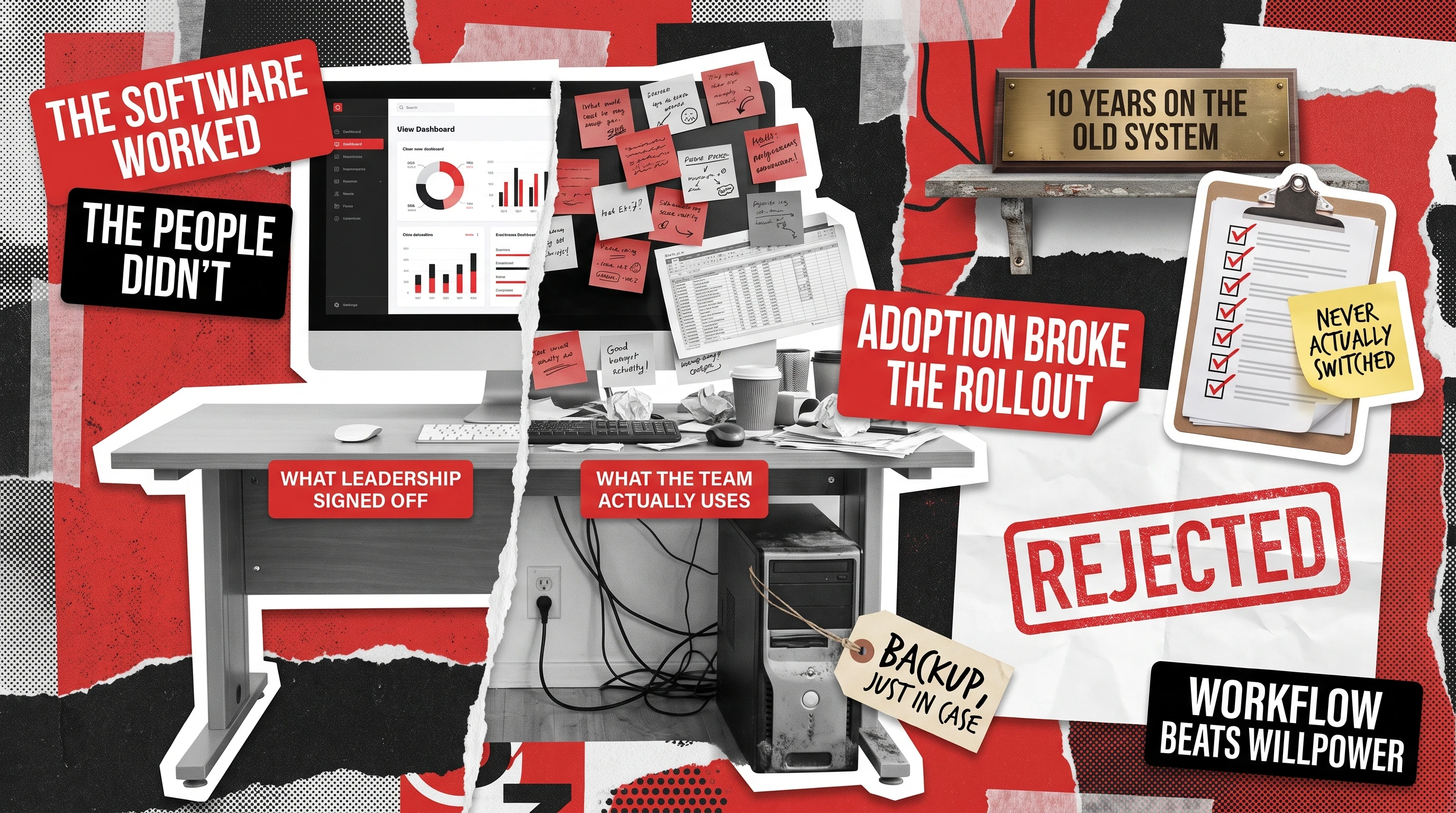
You approved the budget, the new platform is live, and the vendor demo went perfectly. Six months later, half your team is still working out of the old spreadsheet, and the executive who signed off wants to know why the numbers have not moved. That gap between a system that works and a system that gets used is where most transformations quietly stall, and it is almost never a coding problem. Digital transformation change management is the discipline of closing that gap, and it decides whether a six or seven figure investment pays back or becomes expensive shelfware.
Whatever the org chart says, the uncomfortable truth is that the software is the easy part. Servers provision, APIs connect, and features ship on schedule. The hard part is the digital transformation people problem: getting hundreds of humans with existing habits, incentives, and quiet workarounds to abandon something that already works for them and trust something new.
Adoption: the Real Breaking Point
Most transformation post mortems blame the technology. The evidence points somewhere else. In July 2025, Gartner reported that only 32% of business leaders felt they had achieved healthy change adoption among employees, which means roughly two in three change efforts land as something between friction and outright rejection.
The pattern shows up even where enthusiasm looks high. A January 2025 Harvard Business Review analysis noted that while 79% of corporate strategists said AI and automation would be critical to their success, only 20% were actually using those tools in their daily work. That 59 point spread between intent and habit is the real shape of a stalled rollout.
Digital transformation adoption behaves less like a launch event and more like the slow accumulation of daily use until the new way becomes the only way anyone reaches for. This is why measurement deserves as much attention as delivery, and why we treat how you actually measure a transformation as a first class deliverable rather than a report you assemble at the end. Enterprise digital transformation raises the stakes rather than changing their nature: a retail chain rolling a new inventory system across 300 stores faces 300 adoption problems, not one. Redwerk has shipped the technical half of this work for years, from on premise to cloud migrations to desktop applications rebuilt as modern SaaS, and the consistent lesson is that the digital transformation itself succeeds or fails on whether the frontline ever switches over.
The 4 Resistance Patterns Behind Failed Adoption
When a rollout stalls, leaders tend to picture a dramatic standoff. Real resistance is quieter and far more rational. The same Harvard Business Review research on why people resist new technology argues that rejection usually has little to do with the tool itself. It tracks what the tool threatens: someone’s expertise, status, autonomy, or private sense of being good at their job.
Employee resistance digital transformation efforts run into is usually a signal that the new system asks people to trade something they value for benefits they cannot yet feel. Fatigue makes it worse. HBR reported in June 2025 that the average employee absorbed 10 organizational changes in a single year, up from two a decade earlier, so your platform lands on people already carrying change scar tissue. Across 20 years of takeovers and rebuilds, we keep meeting the same four resistance patterns, and each one needs its own response.

The Shadow-IT Holdout
This is the operations lead who nods through every training session, then keeps running the business out of a private spreadsheet or a legacy desktop tool nobody remembered to switch off. Shadow IT rarely comes from laziness. For the person doing it, the old tool is a rational hedge, because it is fast, familiar, and has never once lost their data.
The real danger is that this pattern hides the true adoption number. Your dashboards show logins while the actual work happens somewhere you cannot see, so leadership believes the rollout landed until a quarter end reconciliation refuses to balance. The way out is to make the new system genuinely faster for their single most common task, then retire the old tool on an announced date instead of hoping people drift across.
The Compliance-Theater User
This user does exactly what the mandate requires and not one step more. They log into the new system, click through the required screen, and then do the real work the old way, which fills your database with hollow records that look like adoption but predict nothing. You can usually spot compliance theater by a few tells:
- activity that spikes right before a reporting deadline and flatlines the day after
- records that are technically complete but generic, full of copied notes and default values
- a support queue that stays suspiciously empty because nobody is pushing the system hard enough to hit a real edge case
More enforcement only sharpens the performance. The response that works is removing the parallel path, so the new system becomes the only route to the outcome the person actually needs, whether that is getting paid, closing a ticket, or releasing an order.
The Well-Meaning Saboteur
The hardest pattern to catch is the person who genuinely supports the change and still undermines it. They back the new platform in principle, yet a launch week is the worst possible moment to feel like a beginner, so under deadline pressure they revert to the method they can run without thinking. Every reversion quietly teaches the team around them that the old way is still acceptable once things get real.
The countermeasure is scheduling. Run the cutover during a low stakes window rather than a peak, pair your power users with the hesitant through the first hard deadline, and budget for a temporary dip in speed as the price of a permanent gain.
The Sunk-Cost Champion
Somewhere in the organization is the person who built, bought, or fought hard for the system you are now replacing. Their professional identity is bound up in it, so every rough edge on the new platform reads to them as evidence they were right all along. Left unmanaged, they become a center of gravity for everyone else’s doubts, quoting real limitations to justify staying put.
The move here is to hand them a visible role in the new build, ideally owning a piece that clearly improves on their original work, so the change extends their legacy instead of erasing it. This is where honest, specific communication earns its keep, because a sunk cost champion can smell spin from across the building.
The Audit Moment: Your Last Quiet Fix
There is a narrow window, usually just before or just after a pilot, when fixing an adoption problem is still cheap and still quiet. Miss it, and the same fix later means retraining hundreds of people, walking back a public mandate, and spending political capital you would much rather keep. That window is the audit moment, and it is the most underused lever in change management in digital transformation.
A focused audit at this stage is less about code quality and more about friction. Where does the new workflow take more clicks than the old one? Which integration fails silently and pushes people back to manual entry? Which report that leadership depends on does not exist yet, quietly guaranteeing a shadow spreadsheet? A software development audit that maps these friction points against real user behavior turns vague resistance into a punch list you can close. Redwerk often steps in exactly here, taking over a half finished rollout or a stalled build without a complete set of requirements, because to a senior team that has done this before the friction is usually visible within days.
The audit moment is also when you decide what to remove rather than teach. Some of the most durable wins come from deleting a task entirely instead of coaching people through a new way to perform it, which is why agentic AI workforce transformation now sits inside these conversations. An approval that an agent handles in the background is an approval nobody has to be trained to resist.
Workflow Beats Willpower
You cannot train your way out of a workflow that punishes the new behavior. If reaching the new system takes twelve clicks and the old spreadsheet takes two, willpower loses every time, and it should. The most reliable transformation management principle we know is to make the desired action the easiest action available, then let ordinary human laziness do the adoption work for you.
In practice that means designing around the moments that already hold the team’s attention. Wire the new system into the tools people open anyway, so the change meets them where they already work. Cut the new workflow to fewer steps than the thing it replaces, even if that means tucking advanced features behind a second screen. Instrument the real signal, which is completed tasks rather than logins, so you learn within a week whether the design is holding. Built this way, the four resistance patterns above lose their oxygen, because there is no faster old path to retreat to and no theater left to perform.
This is the part clients tell us they underestimated, and it is where a team that has run the cutover before pays for itself. Fast, specific communication carries the rest: a short weekly note that names what changed, what broke, and what comes next keeps a non technical leadership team confident and gives the skeptics far fewer shadows to hide in.
The teams that win at transformation stop treating go live as the finish line and start treating the first ninety days of real usage as the actual project. They design the work so the new way is the easy way, they name and manage the people who have the most to lose, and they measure whether anyone is truly switching over rather than whether the servers are up. Get that right and the technology, the part everyone feared, turns out to be the straightforward half. If you are planning a transformation and want a senior team that has run this cutover many times before, contact us to talk through where the friction is most likely to hide.
FAQ
What is change management in digital transformation?
It is the structured work of helping people actually adopt new systems and processes, as opposed to simply installing them. It spans communication, training, incentives, workflow design, and measurement, and it is the difference between a platform that goes live and one that genuinely changes how the work gets done.
Why do 70% of digital transformations fail?
The widely cited figure, restated by Harvard Business Review in 2025, is that roughly 70% of change initiatives fall short of their goals. The common thread is human rather than technical. The code usually runs fine, but the intended users never fully switch over, defeated by unclear purpose, change fatigue, and systems that ask people to work harder before they ever work smarter.
What are the main causes of employee resistance to new technology?
Resistance usually traces to perceived threat: fear of looking incompetent, loss of status or control, extra workload during the transition, and no clear answer to why the change benefits the individual being asked to change. Change fatigue amplifies all of it, since each new rollout lands on people who are already absorbing several others at the same time.
Is low software adoption a training problem?
Training helps, but treating adoption as a pure training problem is the most common and expensive mistake. If the new workflow is slower or clumsier than the one it replaces, no amount of training will hold, because people optimize for finishing their work. Fix the workflow first so the correct action is also the easy one, then train people on a system that already rewards them for using it.
See how we got Mass Movement's workforce to actually adopt new workflows, not just install them, ahead of its acquisition by J.B. Hunt