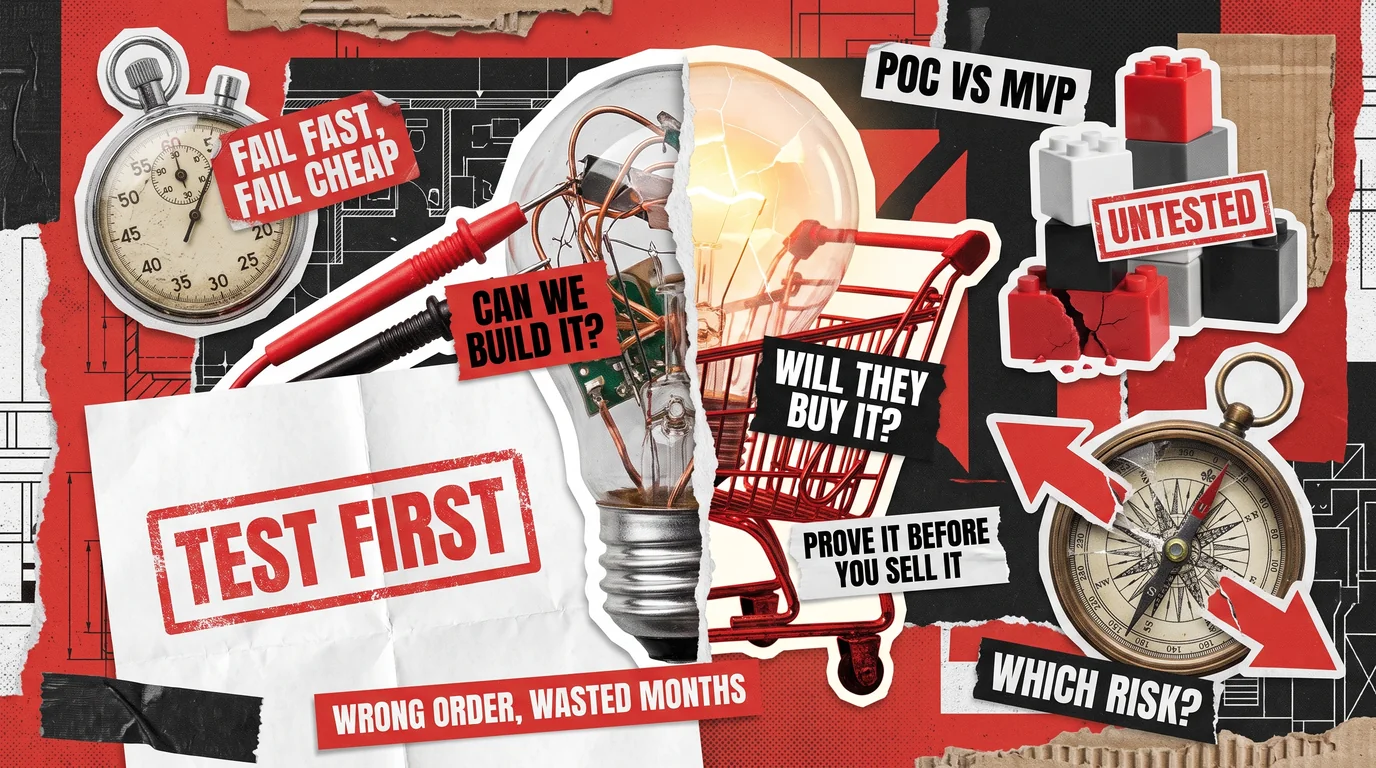
The PoC vs MVP choice depends on what you’re unsure about. Choose a proof of concept (PoC) when you doubt that a key piece of technology can work, and a minimum viable product (MVP) when you doubt that customers want the product. If you doubt both, run the PoC first, since a technical question is cheaper to answer.
Picking the wrong option is expensive either way. Build an MVP around a technical idea that later proves impossible, and you lose months of design and development. Run a PoC when the technology was never in doubt, and you spend weeks confirming what you already knew while the bigger question, whether anyone will buy, stays open.
This guide compares the time and effort each option takes and what it can prove, then gives you a quick way to decide. The advice draws on what we’ve learned delivering MVP development services and running the technical tests that come first.
PoC vs MVP: What's the Difference in Cost and Purpose?
In a proof of concept vs MVP comparison, the key difference is the type of risk each test removes. A PoC answers a technical question: can this specific feature, connection, or calculation be built and work reliably? An MVP answers a business question: once the product exists, will customers keep using and paying for it?
Neither option has a fixed price, because cost depends on the scope, how many other systems the software must connect to, and rules such as data privacy laws. What differs is the scale of effort and the price of a wrong guess, compared in the table below.
Risk it removes
Building on technology that doesn’t work
Building a product people won’t use or pay for
Team needed
One or two developers
Developers, a designer, a tester, and someone setting priorities
How long it usually runs
Days, sometimes a few weeks
About 8 to 12 weeks to build, then a period of real use
What remains afterward
A tested answer and notes for planning
Working software and data on how people use it
What a wrong guess costs
A short test
Months of rework
Not the right first step if
The technology has already worked in similar products
A key technical part hasn’t been tested yet
If you’re comparing quotes for minimum viable product development services, check whether each quote includes design, testing, and launch, or only the coding. For the basics, we explain how a proof of concept works and what makes a product an MVP in separate articles.
What Risks Can a Proof of Concept Settle Early?
A PoC is worth the cost when a product’s main promise rests on technology nobody has proven. Skipping the test in that situation means a failure may only show up in the middle of MVP development. At that point, fixing it involves rewriting code and redesigning screens the team has already built.
Tingl, a private messaging app that Redwerk created as its own product, depended on exactly this kind of untested technology. Privacy was the entire selling point, so the method for moving messages between users had to be secure before anything else was designed. Our team built BAMM, a custom protocol (a set of rules for how data travels between devices), at the concept stage so that security would never have to be added afterward. With the protocol in place, we built the MVP in Flutter, a toolkit for making software that runs on both iPhone and Android. The beta earned strong feedback on Product Hunt, and another company later acquired the app. You can read how our discovery phase deliverables shortened Tingl’s timeline.
Older technology can carry the same kind of risk. 1Amped, an e-learning company based in London, wanted a circuit simulator that runs in the browser. The product would rely on SPICE, a long-established engine for modeling electronics. The big unknown was whether this older tool could run smoothly behind a modern web interface. In our discovery phase, a plan for how the system would be built and a close analysis of the engine confirmed that the combination would work. As the case study notes, settling the question early potentially saved the client months of costly trial and error.
What Does an MVP Prove That a PoC Can't?
A successful PoC tells you the product can be built, but not whether anyone will use it. That answer comes from real customers, and an MVP is how you reach them. This version of the product works but is kept to the features that matter most. Customers start working with it, and how they use it shows the team what to build or change next.
Of our MVP clients, 82% went on to scale the first version into a full project.
For example, Quandoo, a German table booking platform, asked us to build an iOS app for restaurant owners and managers. Before development began, our team created an interactive prototype, a clickable model of the app’s screens. We showed it internally first and then to a group of early users. Feedback from both rounds shaped a clean, simple interface. The first release was an MVP with only the essential tools, such as statistics on reservations and overall attendance. Today, the app helps manage more than 18,000 restaurants.
Can a Project Need Both a PoC and an MVP?
Some projects carry both kinds of risk: the technology is new, and nobody knows yet whether customers want the result. In that case, the PoC vs MVP answer is to use them in sequence. Run the PoC first to settle the technical question, then build the MVP on technology you now know works. Some teams start building the MVP while the PoC is still running, using a temporary placeholder for the technology being tested. That can save time, but if the test fails, the screens and features built around that stand-in may have to be redone.
AI products are a common example of projects with both kinds of risk. An AI feature can look impressive in a demo and still fail on your real data. In a survey of more than 1,000 respondents, S&P Global Market Intelligence found that the average organization scrapped 46% of its AI proof-of-concept projects before the software went live for real users.
AI coding tools have also made a PoC much cheaper to build. In Stack Overflow’s 2025 Developer Survey, 84% said they use or plan to use them in their work. The same results show the limits: 66% named AI solutions that are “almost right, but not quite” as their top frustration. Small flaws like these are acceptable in a PoC, which only needs to answer a technical question. However, an MVP that customers rely on needs proper engineering, and our checklist for scaling a Claude prototype covers that step.
PoC or MVP: How to Decide for Your Project
For most products, demand is the bigger unknown. In CB Insights’ 2026 review of venture-backed startup shutdowns, 43% of the failed companies had poor product-market fit: not enough customers needed what they sold. Technical or clinical issues came up in only 3%. So in most cases, the answer to PoC vs MVP is an MVP, unless one specific technical part is still untested.
Use these three rules to decide:
- You doubt the technology: Run a PoC when neither your team nor another company has made it work in a similar product. Test the one part that might fail, and keep the rest of the plan on hold until you have an answer.
- You doubt the demand: Build an MVP when the technology is already in use elsewhere but you have no proof yet that people want the product. Customers asking for it or joining a waitlist would count as early evidence.
- You doubt both: Start with the PoC, then build the MVP once the technology passes.
You can come to us with an early idea and a list of the parts you’re unsure about. Whichever test you choose, our team runs it and keeps you updated at every stage. To plan a PoC or an MVP for your product, talk to our engineers.
FAQ
Which comes first, a PoC or an MVP?
When a project needs both, the proof of concept comes first, and that order is the key point in any PoC vs MVP plan. A PoC takes days or weeks and checks one technical risk, while an MVP is a full build that runs for months. Running the cheaper test first means the MVP is never built on a component that later turns out not to work.
Can a PoC turn into the MVP?
Usually not. A proof of concept is quick, rough code written to answer one technical question, often without security checks, automated tests, or room to grow. An MVP is software that paying customers depend on every day. Teams normally keep what the PoC taught them, such as what tools and approach work, and write the MVP’s code from scratch.
Can I skip the PoC and go straight to an MVP?
Yes, as long as the product relies only on well-proven technology. Most business apps, online stores, and booking systems fall into this group, since their building blocks are widely used. However, if a single feature depends on an untested connection to another system or a new AI model, test that part on its own first. The rest of the work can still move straight to the MVP.
Is a pilot the same as a PoC?
No. A PoC tests whether something can work, usually in a controlled setting with sample data. A pilot puts finished or nearly finished software in front of a limited group of real users, often one team or one location, before a wider rollout. Many companies run a PoC, then a pilot, then the full launch, especially for AI tools.
See how we took Searchturbo from concept to a shipped Android MVP with 500K+ installs and growing