AI coding assistants are shipping code at a speed nobody planned for. Engineering managers see acceptance rates of 80–90% and assume the productivity story is real. The data says otherwise. After the post-merge churn settles, the real-world acceptance rate lands closer to 10–30% of the AI-generated code that originally got merged. The other 70–90% gets rewritten, refactored, or quietly carried as AI-driven technical debt until somebody flags it.
If you’ve adopted AI tools and now wonder whether the velocity is real or borrowed against the future, this article walks you through it, mechanism by mechanism. Below are seven specific ways AI assistants accumulate technical debt in AI coding workflows, paired with strategies your team can apply this week. Already suspect your codebase is carrying more AI technical debt than it admits? Our software development audit services exist for exactly that case. Otherwise, read on.
How AI Contributes to Technical Debt: 7 Mechanisms and 7 Fixes
The speed of modern development tools creates a false sense of security for engineering teams rushing to meet deadlines. When you dig beneath the surface of a seemingly perfect pull request, you will often find structural rot masquerading as idiomatic code. Understanding exactly how AI contributes to technical debt requires looking past typos and focusing heavily on architectural integrity.
1. Pattern Duplication Across Files
AI tools excel at local optimization but frequently fail at global architecture. Instead of recognizing an opportunity to extract a reusable utility function, an AI assistant will often implement the exact same logic pattern three different ways across multiple files. It solves the immediate problem directly in front of it without considering the broader ecosystem of your application.
The fix. Make “Do we already have this?” a five-second habit before generating new code. Engineering teams can also turn on tools that automatically flag near-duplicate code in pull requests (jscpd and SonarQube are common ones) and reject anything above a similarity threshold. Better yet, give your AI a tour of the existing utilities at the start of each session. AI assistants are happy to reuse code, but only when they can see it. This is the lowest-effort lever for managing AI-related technical debt in week one.
2. Hallucinated Abstractions and AI Bias
AI coding tools learn from huge piles of public code. So they reach for the patterns they’ve seen most often, not the patterns that actually fit your project. You’ll see things like Repository wrappers, Factory classes, and dependency-injection scaffolding showing up because they’re common in the training data, not because your codebase needs them. They look professional, but they might not add value.
This is the impact of AI bias on technical debt: structural decisions inherited from someone else’s codebase, applied to yours without translation. A CodeRabbit study of 153 million lines of code found AI co-authored code carries 2.74× more security vulnerabilities and 75% more logic and correctness defects than human-written code. Combating this requires a fundamental shift in how teams approach AI-augmented development security, prioritizing rigorous manual checks on anything the AI assumes is safe.
The fix. When an AI-authored change introduces a new layer or wrapper, ask one question in the pull request: “What concrete problem does this solve, and where does it pay back?” If the answer is fuzzy, the abstraction is also fuzzy. Cut it.
3. AI Technical Debt Hides in the Test Suite
AI absolutely loves testing the “happy path” because it is the most predictable and straightforward outcome. It enthusiastically generates massive test suites that successfully assert a variable is not null, but completely misses crucial elements like token expiration rules, complex race conditions, and actively hostile inputs. The tests look comprehensive on paper but test almost nothing of actual value.
This creates a highly dangerous layer of technical debt in AI systems where test coverage metrics look fantastic to management. In reality, the actual reliability of the application is highly brittle. When a real user interacts with the system in an unexpected way, these shallow tests provide zero protection against catastrophic failures.
The fix. Behavior-first review. Add one line to every pull request template: “What real bug would this test catch?” If the answer is “none,” the test goes back. For higher-risk modules, run mutation testing periodically (tools that deliberately break small parts of the code to see if the tests notice). If the tests don’t notice, they aren’t tests. Our SDLC best practices guide goes into this in more detail.
4. Dependency Sprawl, Or AI Loves a Library
To solve a remarkably simple problem like a date formatting issue, an AI might eagerly import a heavy, deprecated, or overly complex third-party library rather than writing three lines of native code. It prioritizes the fastest path to a working snippet, completely ignoring the long-term cost of maintaining that dependency.
This habit severely bloats the application payload and introduces unnecessary supply chain risks. Every new dependency is a potential vulnerability and an additional piece of code your team must monitor for updates. This technical debt AI introduces can slowly degrade application performance and increase deployment times until it becomes a massive bottleneck.
The fix. Set a budget for new dependencies per module. Block pull requests that add new ones without explicit sign-off. Use bundlephobia or npm-why to see what each new library actually costs you in size and risk before merging. And when you prompt the AI, tell it to prefer the standard tools your language already includes.
5. The Prompt Was the Spec, and the Prompt Is Gone
When human engineers write software, they leave a trail of architectural decisions, commit messages, and collaborative discussions. When an AI generates an entire complex module from a single prompt, the underlying logic, tradeoffs, and constraints remain permanently trapped in a single developer’s chat history. The codebase suddenly has a black box of logic that nobody fully understands.
This AI-driven technical debt creates a profound knowledge gap when the original developer eventually leaves the team or even just goes on vacation. Future maintainers are left staring at hundreds of lines of code without any context regarding why certain architectural choices were made, making future iterations incredibly risky and time-consuming.
The fix. Commit the prompt. Treat it as part of the source code: paste it into the pull request description or the docstring. If a piece of code came from a prompt, that prompt is the specification of record. This is one of the simplest moves for AI-driven technical debt analysis later, when somebody has to figure out what the original intent was.
6. Refactors That Pass the Tests and Break Things Anyway
AI is great at cleaning up code. It renames, restructures, and reorganizes confidently. The trouble is that automated tests only check what was written into them. They don’t check the unstated assumptions: that this thing has to happen before that thing, that this list has to stay in a specific order, that this function relies on running one piece at a time. None of that shows up in a green build because none of it was ever in a test.
Recent research on technical debt evolution consistently flags this kind of erosion as one of the most expensive debt categories to recover from, because by the time anyone notices, the refactor is months old.
The fix. Treat any large AI refactor (say, anything over 200 lines changed) as a real architectural change, not as housekeeping. Before merging, ask the engineer to write down what must stay true after the change — the invariants. Then test the new code against real production-shaped data, not just the simple test fixtures. For more on the review-cadence side of this, see our piece on how AI is reshaping software maintenance.
7. Nobody Knows Which Code Came From the AI
A year from now, you’ll need to figure out why a specific module keeps breaking. You’ll want to know whether a senior engineer wrote it carefully or whether it was autocompleted at 11 PM and approved on autopilot. Your git history won’t tell you. Every commit looks the same. You can’t measure what you can’t see.
The fix. Tag AI-generated work in your commit history. It can be a label, a pull-request template field, or a single line in the commit message. Then track the share of AI-written code per module as a warning signal. Set a kill criterion: if a mostly-AI module accumulates more than X bug reports or hotfixes in Y weeks, rewrite it from spec instead of patching it. Untagged AI code is the foundation problem behind most AI-driven technical debt analysis efforts. Tagging it costs nothing and pays back the first time you have to investigate a regression.
Managing AI-Related Technical Debt at the Team Level
Individual mechanisms get fixed at the PR level. The structural problem is harder, because AI technical debt doesn’t live in any single file. It lives in the gap between how fast you ship and how fast you can verify what you shipped. Three habits separate the teams handling this well from the teams quietly drowning.
First, instrument the debt. Track AI-authored line share per module, mutation test scores on AI-generated tests, dependency growth, and post-merge churn rate. None of these metrics are exotic; they’re just rarely connected to AI tooling decisions.
Second, set review cadence by risk, not by author. AI-authored architectural code, AI-authored security boundaries, and AI-authored test files all deserve more scrutiny per line than human-authored equivalents, because the failure modes are different.
Third, build a kill switch into the workflow. If a module’s AI-debt signal crosses a threshold, the team rewrites instead of patches. Most teams skip this step, then spend a quarter learning why they shouldn’t have.
How Redwerk Helps You Tackle AI Technical Debt
If your team has shipped fast with AI assistants and you’re now staring at the codebase wondering what’s actually under the hood, that’s our most common starting conversation in 2026.
Vibe Code Cleanup. Our vibe code cleanup engagement is built for codebases that grew from AI generation faster than anyone could review them. We audit what’s there, name the debt by mechanism (often most of the seven above), and rebuild the modules that aren’t worth saving.
Untangling messy codebases and salvaging projects from previous vendors is something we’ve been doing long before AI made the problem worse.
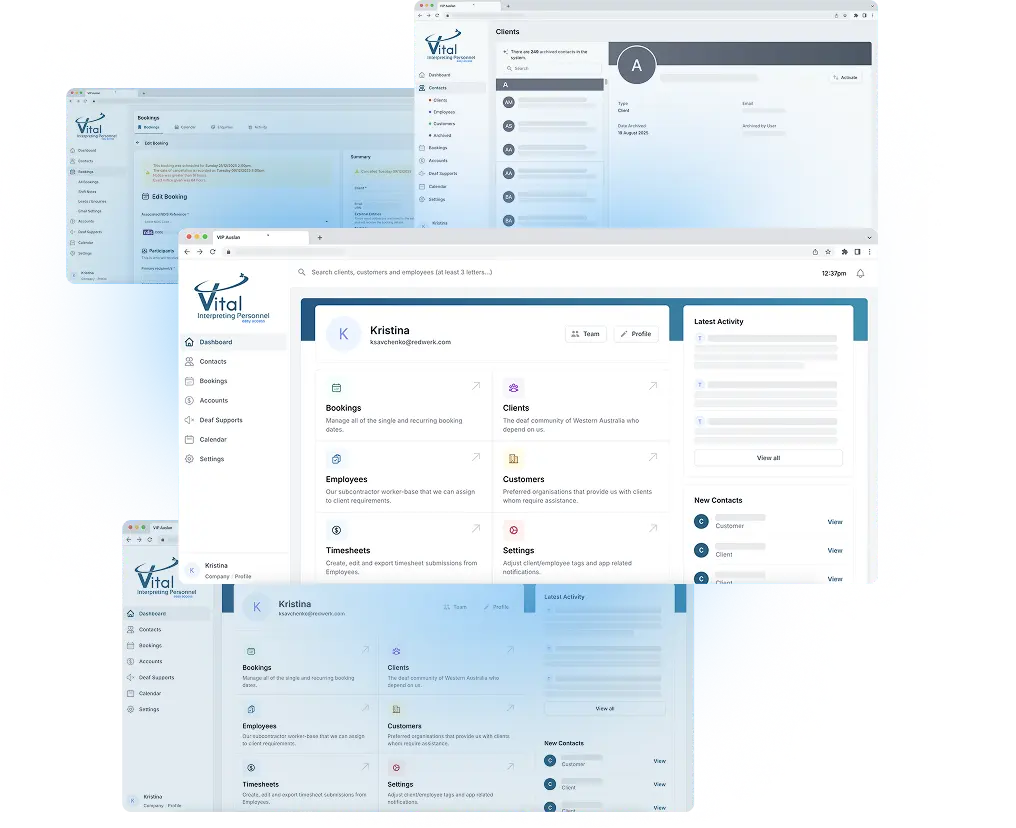
We did it for Adoorabelle, where a code review and AWS migration produced an 80-item prioritized backlog and got the platform investor-ready. We did it again for Pridefit, stabilizing a stack the founders had inherited from a previous vendor and lifting subscriptions 45% in the process. Similar work shows up in our engagement on a sign language interpreter booking platform, where the inherited codebase needed substantial rework before it could carry production load. AI-generated codebases need exactly the same playbook, just applied earlier and more often.
Consulting on AI-Assisted Development. If you’re early in your AI adoption and want to set the rails before the debt accumulates, our AI-assisted software development consulting helps engineering teams design PR workflows, review checklists, and CI guardrails specifically for AI-generated code.
When the work calls for purpose-built AI engineering, our artificial intelligence development services and software development consulting teams handle the build side.
Redwerk has been around since 2005, with 250+ shipped projects and a team that builds, audits, and cleans code every day. If your AI productivity story is starting to feel borrowed against the future, contact us today for a free project estimation, and we’ll tell you what’s worth saving and what’s worth rewriting.
Frequently Asked Questions
How does AI contribute to technical debt?
AI contributes to technical debt through specific, repeatable mechanisms: pattern duplication across files, hallucinated abstractions inherited from training data, shallow test assertions that boost coverage without catching bugs, dependency sprawl, undocumented prompts as de facto specs, refactors that break uncovered invariants, and untagged AI commits that make future debugging harder.
How do you prevent technical debt when using AI coding tools?
Pair every mechanism with a workflow change: AST-based duplicate detection in CI, senior review on new abstractions, behavior-first test discipline with mutation testing, dependency budgets, prompt commits as documentation, invariant lists for large AI refactors, and AI-author tagging in git metadata.
What are the signs of AI-driven technical debt in a codebase?
Rising post-merge code churn, climbing test coverage with stagnant or rising bug rates, dependency graph growth that outpaces feature growth, near-duplicate utilities scattered across modules, and engineers who can’t explain why a function does what it does. Any two of these together usually mean it’s time for a deliberate AI-driven technical debt analysis before you scale further.
Can AI tools perform an AI-driven technical debt analysis?
Yes, AI can be used as a debt scanner to map out complex dependencies and find duplicate patterns, but human oversight is required to execute the actual refactoring securely.
See how clearing technical debt and shipping new features helped VIP Auslan cut manual admin tasks by 40%