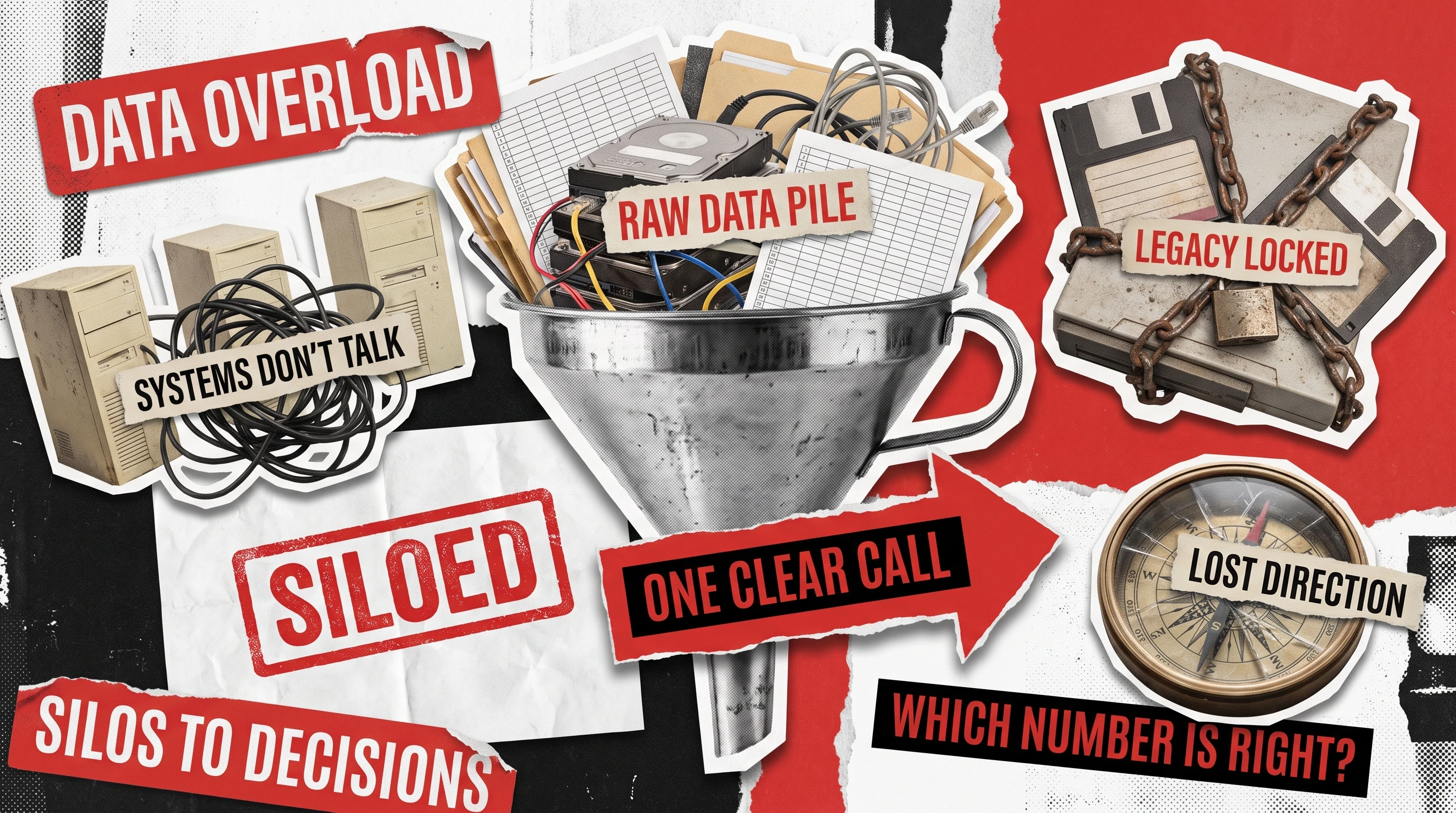
Enterprise data management (EDM) is the discipline of consolidating, governing, and making an organization’s data usable across every department, so the people who run the business can act on it. Most mid-market companies already hold more data than they can use, spread across CRMs, ERPs, spreadsheets, and legacy databases that each define a customer or an order in their own way.
The real decision is where to start, and getting it wrong has a price. Gartner predicts that through 2026, organizations will abandon 60% of AI projects unsupported by AI-ready data.
That is why data management is one of the core capabilities inside Redwerk’s enterprise software development services, built around a simple promise: turn raw data overload into clear, actionable insights for spotting trends and making better decisions. This guide covers what EDM involves, its core components, real examples of enterprise data, and how it fits a wider enterprise software strategy.
What Is Enterprise Data Management
Enterprise data management covers everything an organization does to make its data trustworthy and usable at scale. A working EDM program answers four questions for every important dataset: where it comes from, who owns it, whether it is accurate, and how it reaches the people and systems that need it.
In practice, that work breaks down into a handful of recurring activities:
- Inventorying data sources across departments and legacy systems
- Assigning an owner and access rules to each core dataset
- Agreeing on one definition of core entities such as customer, product, and supplier (master data)
- Cleaning, deduplicating, and validating records
- Connecting systems through integrations and data pipelines
- Delivering the result to reports, dashboards, applications, and AI models
EDM is often confused with the tools that support it. The table below separates the discipline from its building blocks.
Enterprise data management (EDM)
The overall discipline of governing, integrating, and delivering an organization’s data
Making data trustworthy and usable across the whole business
Enterprise data warehouse (EDW)
A central, structured store of cleaned historical data from many systems
Reporting, business intelligence, trend analysis across departments
Data lake
A store for large volumes of raw data in any format
Data science, machine learning, and keeping raw data for later processing
Master data management (MDM)
The process and tooling that keep one consistent record of core entities
Making sure “customer” or “product” means the same thing in every system
Data governance
The rules, roles, and policies for owning and accessing data
Accountability, compliance, and controlled access
From Data Overload to Actionable Insight
The problem most organizations describe is too much data they cannot use. In Oracle’s Decision Dilemma study of 14,250 people across 17 countries, 78% said they are bombarded with more data from more sources than ever, and 72% admitted the sheer volume of data and their lack of trust in it had stopped them from making any decision.
Trust is the other half of the problem. In Precisely’s 2025 Outlook survey of 565 data and analytics professionals, run with Drexel University’s LeBow College of Business, 76% of organizations named data-driven decision-making a top goal, yet 67% still don’t completely trust the data they rely on for those decisions, up from 55% in 2023. Salesforce’s State of Data and Analytics research found that data leaders estimate 19% of company data is siloed or inaccessible, and 70% of them believe their most valuable business insights sit in that trapped data.
The fastest way out is to start from a decision and work backward to the data. A practical first phase follows five steps:
- Name the decision the business needs to make better or faster.
- List the data that decision depends on.
- Trace each piece back to its source system and owner.
- Fix quality and definitions for that data first.
- Deliver it in the form the decision-maker actually uses, whether that is a report, a dashboard, or a feature inside an application.
This approach does not need a complete data specification up front. The first decision exposes which sources matter and which definitions conflict, and the client’s domain experts and Redwerk’s engineers work out the rest together as the data reveals itself.
MarketBee shows the pattern. The New Zealand consultancy assesses aggregates markets for construction materials producers: supply, demand, reserves, market shares, and competitive position. That analysis used to live in spreadsheets. Redwerk’s five-person team built a web platform on .NET, Vue.js, Microsoft Azure, and Microsoft SQL, integrated Microsoft Power BI for visualization and Mapbox for mapping, and wrote custom data processors for the graphs Power BI could not produce on its own. The solution we built produces 60+ granular market reports, and its results include 6.2% average revenue growth and a 4.7/5 user satisfaction rate.
Core Components of an Enterprise Data Management Strategy
An enterprise data management strategy is the plan that decides who is accountable for each dataset, what good data looks like, and how that data moves between systems. It rests on three pillars: governance, quality, and architecture. Each pillar answers a different question, has a different owner, and fails in a recognizable way.
Most companies already do a little of all three without calling it a strategy: someone owns the CRM, someone runs a quarterly cleanup, someone maintains the nightly export. A strategy turns those scattered habits into explicit rules, starting with the data behind the decisions that matter most. The table below shows what each pillar covers and the symptoms that tell you it is missing.
Governance
Who owns this data, and who may use it?
Data owners in each business unit, coordinated by a data lead
Two departments report different revenue figures and nobody can say which is right
Quality
Is this data accurate, complete, and current?
Data stewards plus engineering
Duplicate customers, stale prices, reports nobody trusts
Architecture
How does data move between systems?
Engineering and IT
Manual exports, nightly spreadsheet merges, integrations that break silently
Data Governance in the Enterprise
Data governance in the enterprise defines ownership, access rules, and shared definitions. Every core dataset gets a named owner who decides what “correct” means, and every role gets access only to what it needs. In the Precisely survey, a lack of data governance was the primary data challenge holding back AI initiatives, cited by 62% of organizations. Salesforce’s research found only 43% of organizations have established formal data governance frameworks. Governance matters even more once AI agents start reading and writing business data, because each agent needs scoped permissions and a supervision layer, as covered in Redwerk’s guide to enterprise AI governance.
Data Quality
Data quality covers accuracy, completeness, deduplication, and timeliness. The same Precisely 2025 Outlook survey found 64% of respondents named data quality their top data integrity challenge, up from 50% in 2023. Quality is also the gate for AI: the enterprise AI use cases that reach production all run on governed production data. Gartner’s survey of 1,203 data management leaders found 63% of organizations either do not have, or are unsure whether they have, the right data management practices for AI.
Data Architecture
Architecture decides how data moves: integrations through APIs, extract-transform-load (ETL) pipelines, a warehouse or lake for storage, and a delivery layer for business intelligence (BI) and applications. Moving data out of an old system is one of the riskiest steps, and Redwerk’s data migration best practices playbook breaks it into six phases, from discovery to cutover. Connecting siloed sources so they stay in sync afterward is the job of enterprise system integration.
Examples of Enterprise Data in Practice
Enterprise data is any information the business depends on across more than one team. The common categories:
- Customer records across departments. The same client appears in the CRM, the billing system, and the support desk, often with three different spellings and two addresses.
- Operational and IoT data. Warehouse scans, truck schedules, machine sensors, and field service logs.
- Financial systems. General ledger, invoices, and pricing in the ERP and accounting tools.
- Siloed legacy databases. On-premises SQL servers, old desktop apps, and spreadsheets that hold years of history no one has migrated.
- Market and external data. Competitor prices, market shares, and supply and demand figures bought or gathered from outside sources.

Two Redwerk projects show how these categories get connected. For KillerBee, a smart pricing SaaS for concrete, aggregates, cement, and asphalt producers, Redwerk built data import and export, competitor mapping, heat maps, and Power BI reporting on ASP.NET Core and Azure SQL, and integrated the platform with legacy systems that had little documentation. Quote generation became 90% faster. For Mass Movement, a US fitness equipment distributor, the team built a custom inventory management system and resource planner, plus a Windows service for data extraction and Excel macros that pull data straight from SQL.
ERP systems are where data quality problems pile up fastest. Redwerk’s guide to custom ERP software consulting walks through master data harmonization and the three data migration tracks that must run in parallel when a 15-year-old ERP gets modernized.
Where Enterprise Data Management Fits in a Broader Enterprise Software Strategy
EDM rarely works as a standalone project. It connects to the systems that produce data (custom applications, ERP, CRM), the integrations that move it, and the analytics and AI that consume it. That is why Redwerk treats data management as one part of its enterprise software practice alongside integration, custom development, and long-term maintenance.
The execution layer, meaning pipelines, governed integrations, warehouses, and data models, sits within Redwerk’s data engineering services. The payoff layer is increasingly AI: governed, well-defined data is the precondition for the custom models and agents built through Redwerk’s artificial intelligence development services.
When a Full EDM Program Is the Wrong Call
A company with two or three core systems and one reporting team rarely needs an enterprise-wide program, a governance council, or a dedicated MDM platform. A shared reporting layer, a named owner per dataset, and one clean integration will deliver most of the value. Off-the-shelf data platforms fit well when your data maps to standard entities such as customers, invoices, and products. Custom work earns its cost when the data is domain-specific, as with MarketBee’s aggregates reserves and market shares, where the data model itself encodes the client’s expertise.
Judge Enterprise Data Management by the Decisions It Enables
Enterprise data management succeeds when leaders can make a decision faster and trust the numbers behind it. Start with one decision, fix the data it depends on, and expand from there. At Redwerk, data management is a core, integrated part of enterprise software development, delivered by specialists in .NET, Azure, Power BI, agentic AI, and machine learning who build the applications that produce and consume the data.
If your teams are buried in data they cannot act on, tell us which decision you want to make better.
FAQ
What is enterprise data management (EDM)?
Enterprise data management is the discipline of consolidating, governing, and delivering an organization’s data so it is accurate and usable across every department. It combines data governance, data quality, and data architecture, and it is measured by how well the business can make decisions with its data.
What is an EDW used for?
An enterprise data warehouse (EDW) stores cleaned, structured, historical data from many source systems in one place. Companies use it for reporting, business intelligence, and trend analysis across departments, because every team queries the same consistent numbers instead of exporting from separate systems.
What are some examples of enterprise data?
Common examples include customer records shared across CRM, billing, and support; operational and IoT data such as warehouse scans and sensor readings; financial data in ERP and accounting systems; siloed legacy databases and spreadsheets; and external market data such as competitor prices and market shares.
What is an enterprise data management strategy?
An enterprise data management strategy is the plan for how an organization will govern, clean, integrate, and deliver its data. A practical strategy starts with the business decisions that matter most, identifies the data those decisions depend on, and fixes governance, quality, and architecture for that data first.
Who owns data governance in an enterprise?
Data governance is shared. Business units own their core datasets and decide what correct data means, a data lead or governance group sets common rules and definitions, and engineering and IT enforce access controls and data quality checks in the systems themselves.
See how a market assessment SaaS was built from scratch, validated, and scaled across 12 countries without the founder writing a line of code.