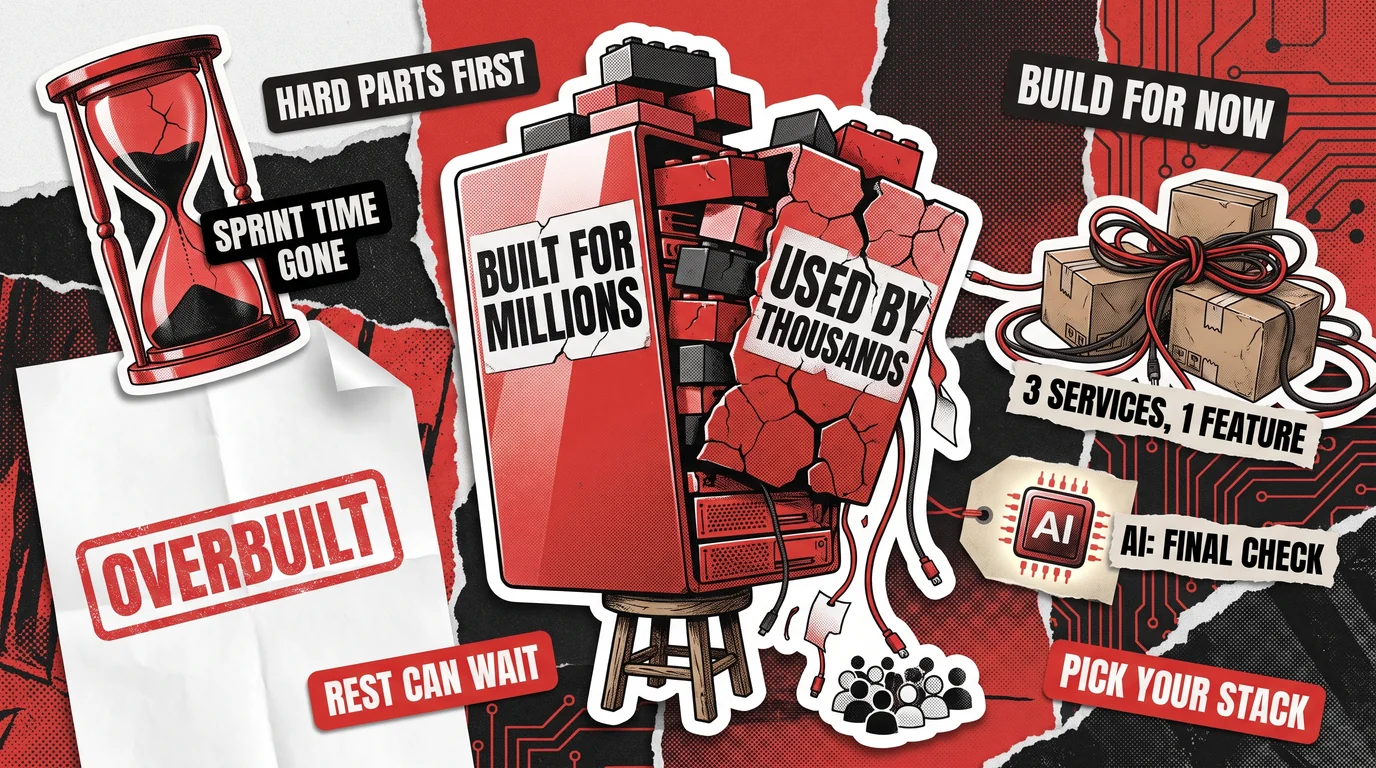
To choose a tech stack, match it to what the product needs to do and how many people will use it in the next 12 months, then confirm your team can build and maintain it. The most expensive mistake is choosing a tech stack built for a scale the project may not reach for years.
A tech stack is the set of technologies your software runs on: the programming language, frameworks, database, and overall architecture. Each of those choices shapes how fast your team can ship for years. In one product we reviewed, four developers spent roughly 40% of their sprint time keeping an oversized architecture running for fewer than 5,000 users.
In this article, we’ll explain how to avoid a costly mistake like that and how to choose a tech stack for a project with one team or several. We’ll also discuss the impact of AI coding tools on modern development approaches. By the end, you’ll know exactly where to start planning your own project. Or you can take a shortcut and look into Redwerk’s software product engineering services directly.
What to Consider When Choosing a Tech Stack
Three decisions deserve the most attention before development starts, because they’re the hardest to change later:
- Programming language and main framework: A framework gives developers a ready-made structure for common features, so switching it or the language usually means rewriting large parts of the product.
- Monolith or microservices architecture: A monolith keeps the whole product in a single application, while microservices split it into separate programs that talk to each other over a network. Moving from one model to the other changes how every feature is built, tested, and released.
- Database and data model: The database holds every customer account, order, and setting. Moving years of live data to a different kind of storage is a project of its own, with a real risk of losing or damaging records.
A practical way to judge the risk of any technical option is to ask how long a mistake would take to undo. The three decisions above usually take six months or more to reverse, so they need a careful review before anyone writes code.
What Happens If You Choose the Wrong Tech Stack?
Let’s look at an example from our own code reviews, first described in our article about the best SaaS tech stack. Several of those products had fewer than 5,000 active users yet were built as a full set of microservices. In one of them, shipping even a small feature meant changing three separate services, agreeing on how the pieces would exchange data, and running special tracking tools just to find bugs. The team of four developers spent roughly 40% of their sprint time on keeping that setup working instead of improving the product.
The team picked microservices so the system could handle future growth, which was a reasonable aim. However, the product didn’t need that structure yet, so the architecture created extra work that brought no benefit to users. We classed the case as premature optimization, which means solving problems that don’t exist yet. Fortunately, the solution was clear: merge the services back into fewer pieces.
If you suspect your current stack is already slowing the team down, measure the problem before replacing anything. A software audit shows the source of the trouble and how serious it is. From there, the choice between cleaning up existing code and starting over depends on a handful of signals, which our comparison of refactoring vs rewriting explains. Fixing products in this state is a regular part of our work.
How to Choose a Tech Stack for a Project with One Team
For a single team, the right tech stack covers the product’s first year of needs and relies on technologies the developers already know well. On the other hand, planning around hoped-for growth is risky, because a product with 2,000 users needs something very different from a platform serving two million.
These questions help keep the decision realistic:
- What does the product need to do in the next 12 months, and for how many users?
- Which languages and frameworks does the team already use with confidence?
- How easy is it to hire developers for this technology in your market?
- Is there an active community with well-maintained libraries?
- What would be expensive to rework if the product doubled in size?
Hiring deserves extra weight, because a stack your developers love becomes a risk when few people in the job market know it. Our React vs Angular comparison makes the same point: “The stack decision is a hiring decision with a code side effect.”
Planning ahead and overbuilding are separate things, as one of our own projects shows. 1Amped, an interactive circuit simulator for engineering students, had one unusually heavy job: running complex circuit calculations while students drag components around the screen. Handling that math alongside everything else would have made the screen lag with every simulation. So we gave the calculations a separate layer and kept the rest of the business logic in a single back end. A split like this is worth making early, because it solves a problem the product has from its first release.
Revisit the decision when something real changes rather than on a fixed schedule, for example when a second team joins, usage jumps, or a large client brings new security requirements.
How to Choose Tech Stack for Multi-Team Projects
When several teams work on the same product, the question shifts from what one team can build fastest to how the groups avoid blocking each other. In 1968, programmer Melvin Conway observed that software mirrors how its builders communicate, so a multi-team project needs an architecture that matches how the teams are split.
Three factors matter more in a multi-team setup:
- Coordination: When every release needs sign-off from several teams, delivery slows. A common warning sign is a production deployment that requires four or more people to coordinate, with nobody sure how the services interact.
- Shared code: Teams often reuse the same libraries, internal tools, and design components. Every shared piece needs a named owner and clear rules for changes, or an update from one team breaks a feature built by another.
- Ownership boundaries: Each team should own a clear part of the product, such as billing or user accounts, and release changes to it without waiting for the others.
With several teams involved, splitting the product into separate services makes sense, because each service can have a single owner. Clear boundaries between parts matter just as much. We saw this when upgrading the EUGI platform used by the European Parliament. Our developers in Ukraine coordinated with people in Italy and Belgium to move one part of the system to a new stack within a month. That component exchanged data with outside services under fixed agreements, so the new version had to keep them all intact. Code written in Ukraine was tested in Brussels the same day, and the project met its deadline.
Multi-team projects also benefit from keeping the stack small. Every extra language means another hiring process, another set of tools to maintain, and fewer people to handle the work when a colleague is away.
Tech Stack in the AI Era: Should AI Coding Tools Affect Your Choice?
In the 2025 Stack Overflow Developer Survey, 84% of developers said they use AI tools or plan to. However, only 33% trust the accuracy of what these tools produce, while 46% actively distrust it. Quality also varies with the programming language, which makes AI tool performance a real factor in your tech stack decision.
SWE-bench Multilingual, a public test that measures how well AI agents fix real bugs in open-source projects, shows the gap. The same agent solved 58% of Rust tasks and 53% of Java tasks but only 35% of JavaScript and TypeScript tasks. The test used a single 2025 model, so expect the numbers to shift as the technology improves. JavaScript and TypeScript are among the most widely used languages, so popularity alone doesn’t determine AI performance.
Typed languages also help, since they make developers state what kind of data each piece of code expects. As a result, errors surface before the software runs, including mistakes an AI assistant introduces.
AI tools change every few months, while a stack stays with the product for years. For example, a popular AI agent platform is already being replaced by a newer option, as our OpenFang vs OpenClaw breakdown explains. Therefore, choosing a language because today’s assistants handle it well would make a long-term decision depend on short-lived products. Instead, treat AI performance as a final check: if two languages fit your team, product, and hiring market equally well, pick the one AI tools handle better.
What Tech Stack Decisions Can Wait Until Later?
Plenty of decisions don’t need an answer before the first line of code. Making them later, with real usage data, leads to better results. The following can safely wait:
- Developer tools for testing, monitoring, and deployment
- Smaller libraries and plugins that each handle one task
- AI model or provider behind a feature
- Performance tuning for traffic you don’t have yet
Keeping the AI model swappable is easier than it sounds. With a framework like LangChain, switching between GPT, Claude, and Gemini becomes a settings change instead of a rewrite. Once the product grows, the next questions are about handling more users, which the principles of scalable software architecture address.
The table below lists common tech stack decisions, when each one needs an answer, and what a mistake costs.
Programming language and main framework
Before development starts
Rewriting large parts of the product
Monolith or microservices architecture
Before development starts
Changing how every feature is built and released
Database and data model
Before development starts
A risky migration of live data
Cloud provider
Before launch
A migration project and new tools to learn
Developer tools
When the need appears
A few days of setup
Smaller libraries and plugins
When the need appears
Replacing one component
AI model or provider
Once real usage data exists
A settings change, if the code allows it
Performance tuning
When real traffic reveals a bottleneck
Little, if the rest of the stack fits the product
How Redwerk Helps You Choose a Tech Stack
A tech stack that fits your project lets your team spend its time improving the product. To get there, make the hard-to-reverse decisions carefully and leave everything else until you have real information.
Advising on those decisions is a large part of our software product engineering consulting, which draws on code we’ve built and reviewed across 250+ projects. Some clients come to us before development starts, while others contact us once a stack has begun to slow them down. In both situations, they work with engineers who already know the technologies in question.
For an expert view on your tech stack, talk to our engineers.
FAQ
How to choose a tech stack for a project?
To choose a tech stack for a project, run three checks. First, size it for the users and features you expect within a year. Next, favor technologies your developers already know and your local job market can supply. Finally, spend most of your review time on the programming language, the architecture, and the database, since those parts cost the most to replace.
What is a tech stack?
A tech stack is every technology a software product relies on, from what users see to where the data lives. A typical web app combines a front-end framework such as React, a server-side language such as .NET or Python, a database such as PostgreSQL, and a cloud platform that hosts everything. The name comes from these layers sitting on top of one another.
Can you change your tech stack later?
You can, and many products eventually do. Small parts, such as a testing tool or a code library, can be replaced in a few days. Core parts take far longer: moving to another programming language, splitting one application into separate services, or migrating years of data to a new database can mean months of rework. The core choices therefore deserve extra care before development begins.
When to use microservices instead of a monolith?
Use microservices when several teams need to release their work independently or when one part of the product has a much heavier workload than the rest. Until then, most products are easier to build, test, and change as one well-organized application, often called a monolith. Adopting microservices too early means a small team spends a large share of its time coordinating services instead of building features.
How does AI affect choosing a programming language?
AI affects the choice, but only a little. Coding assistants handle some programming languages much better than others, according to public benchmarks, so AI performance is a reasonable factor to consider. Team skills, hiring, and product needs matter more, because a language usually remains in use for many years, while AI tools get updated or replaced within months. If two languages are otherwise equal, let that difference decide.
See how we helped AWE Learning build e-learning SaaS used by 50% of US public libraries