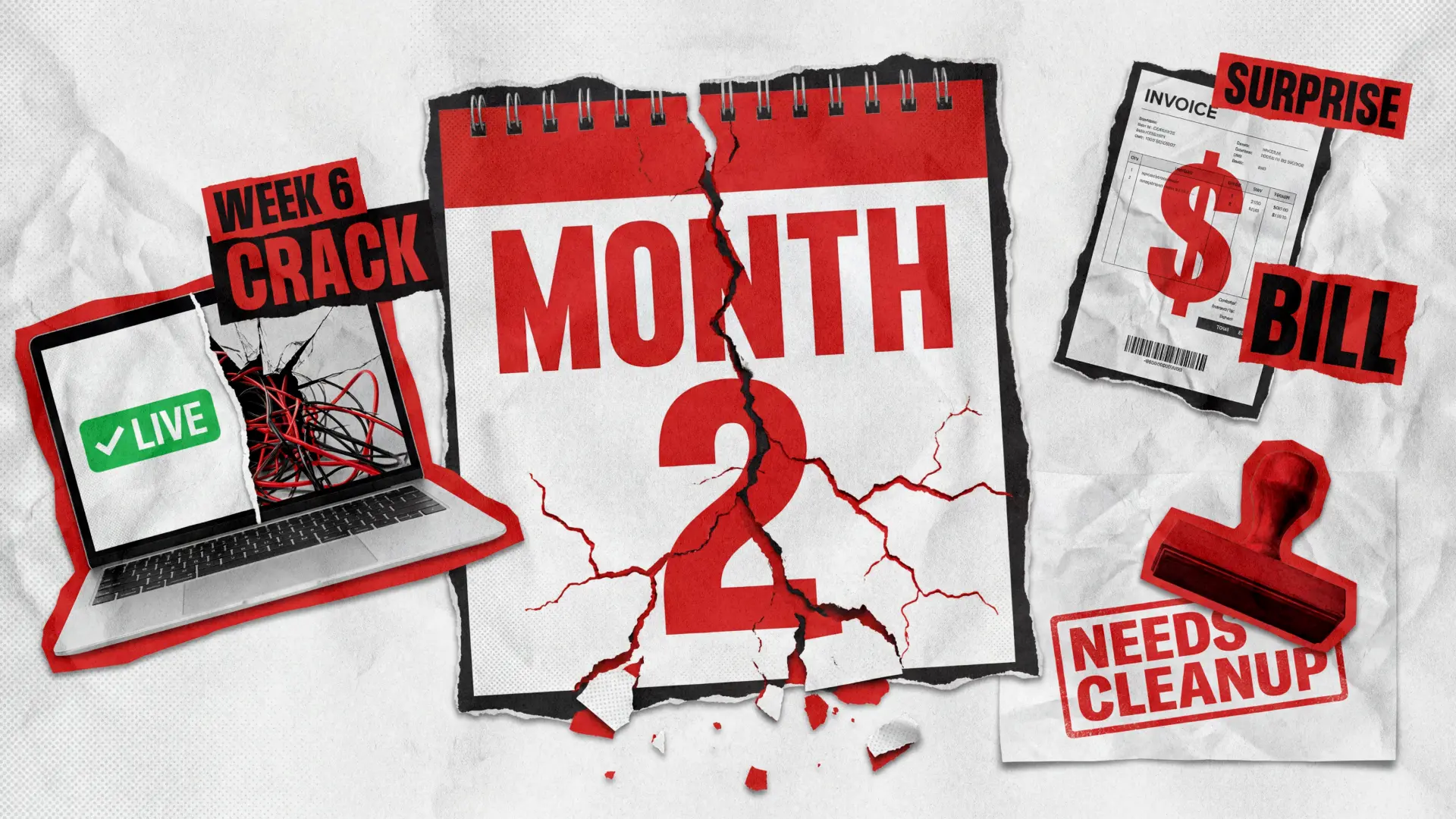
You shipped your MVP in a weekend. Three weeks in, a few hundred users have signed up, and the dashboard you built with Cursor or Lovable is still standing. By week six, support requests start piling up: a login that breaks for one customer, a Stripe webhook that silently drops a payment, and a Vercel bill that looks nothing like the free tier you signed up for.
This pattern is now common. According to TechCrunch, roughly a quarter of those startups had codebases that were 95% or more AI-generated. Vibe coding for startups is no longer experimental; it’s the default. Like any default, it carries assumptions that don’t survive contact with real users.
The first month of a vibe-coded app belongs to friends and family. The second month belongs to actual customers, billing thresholds, and edge cases the AI never trained on. This is where vibe coding technical debt finally shows up on the surface, and it usually shows up all at once. If you want a sense of the kinds of products being built this way, the best-known vibe-coded apps now ship in production.
Below are the twelve things almost no tutorial mentions about month two. The faster you recognize the pattern, the cheaper a vibe code cleanup becomes.
Why Month Two Surfaces Vibe Coding Technical Debt
Three forces compound around weeks four to eight. Each is survivable alone. Together they create the cliff the founders describe as “everything broke at the same time.”
First, real users replace early adopters. People who didn’t help you build the product probe inputs nobody anticipated, and AI-generated code is famously thin on edge cases. The MIT Sloan Management Review’s 2025 analysis found that productivity gains often resurface as compounding technical debt within the first quarter of deployment, especially when junior or non-engineering builders ship without review.
Second, free tiers hit their walls. Vercel, Supabase, OpenAI, and the rest are generous up to a quiet threshold. The metering keeps running even when your features don’t.
Third, the AI handoff gap appears. You ask the model to add a small feature, it makes the change, and three unrelated things break. Nobody, neither you nor the AI, was holding the full architecture in their head, so nobody noticed the dependency. The twelve items below map cleanly back to one of these three forces.

Where Vibe-Coded Apps Break First
The list is divided into four themes. Three items are security-related, three are pure architectural debt, three involve quiet expiry, and three reveal the process gaps that month two finally exposes.
Security risks you can’t see.
1–3
AI generates happy-path auth and skips defensive layers.
Architectural debt under “it works”.
4–6
Code looks modular while hiding shared state.
Things that quietly expire.
7–9
No AI prompt says “renew this in 90 days”.
Process gaps month two reveals.
10–12
Generation outpaced documentation and tests.
The First Real User Finds Your Authentication Bug
AI tools generate login flows that work for happy paths. They rarely volunteer rate limiting, session expiry, or role-based access control. The Veracode 2025 GenAI Code Security Report found that around 45% of AI-generated code samples contained exploitable vulnerabilities, and authentication consistently topped the list. Common vibe coding security risks show up here first because auth is the first endpoint real users actively try. A structured security code review catches these patterns before they reach production.
The Password Reset Quietly Stopped Working
Password reset is the most-shipped, least-tested flow in vibe-coded apps. The AI builds the form, generates the token, and emits the email. What it rarely handles cleanly:
- Token expiry edge cases (a token meant to expire in an hour silently lives forever).
- SMTP misconfiguration in production (works locally, fails behind a proxy).
- Rate limiting on the reset endpoint (turning it into a free email-bombing vector).
This is one of the most common silent vibe coding errors. Users assume the system is unreliable and churn without telling you.
The Stripe Webhook Silently Drops Events
Stripe and other payment webhooks need idempotency keys, retry handling, and a queue for failed events. AI-generated webhook handlers usually skip all three. Payments succeed, but your database thinks they didn’t, or the same payment registers twice. Both versions cost you money.
You won’t notice this until a customer emails about a missing receipt or a duplicate charge. By that point the problem has been running for two weeks, and reconciling it takes longer than catching it would have.
Your Database Crawls at 10,000 Rows
The same query that returned in 80 milliseconds on launch day takes seven seconds at 10,000 rows. The cause is almost always identical: AI-generated code defaults to ORM patterns that issue one query per record instead of one batched query.
Compounding this, vibe-coded apps rarely have database indexes on the columns they query. Building for scalable architecture from the start prevents this; fixing it after the fact takes someone who can read the actual query plan.
Touch One Feature, Three Others Break
This is the signature vibe coding bug. You ask Claude or Cursor to update one form, and a feature you haven’t thought about in weeks stops working. The root cause is hidden coupling. AI tools generate code that looks modular but shares state, database tables, or global variables under the hood.
The pattern compounds with every sprint. The longer it goes unaddressed, the harder it gets to predict which file change will break which user flow.
The "Modular" Architecture Is a Costumed Monolith
Your file structure looks clean. There’s a components folder, an api folder, a lib folder. Each file is reasonably short. None of this means anything on its own. Vibe-coded apps frequently look like microservices on the outside while behaving like a single tightly coupled monolith inside.
The test is simple: pick any one file and try to explain what would break if you deleted it. If the answer requires opening four other files, your architecture is theatrical rather than structural. Real modularity passes a deletion test.
An Unpinned Dependency Ships a Breaking Change
When the AI scaffolds your package.json, it usually lists dependencies with caret or tilde version ranges. That means npm pulls the latest patch or minor release every install. When one of those upstream packages ships a breaking change, your build stops working. You did nothing wrong; you just didn’t pin.
Three weeks into production is a typical window for this to surface. Lock the versions explicitly the first day you have paying customers.
SSL, Domain, or API Key Just Expired
This is the silliest item on the list, and the one founders refuse to take it seriously until it happens. Your SSL certificate renews on a schedule you forgot about, your domain registration is up in 60 days, and your OpenAI key was provisioned with a 90-day expiry your former cofounder set up.
There is no AI prompt for “and please remember to renew this in three months.” Calendar reminders are unglamorous, and they prevent more outages than any framework choice.
The Free Tier Bill Lands in Your Inbox
You crossed a Vercel function-invocation limit, a Supabase row threshold, or an OpenAI token budget. None of these vendors warns you in advance with anything that looks like a warning. They send a status email that reads like routine billing.
The first surprise bill is usually three to five times what a paid plan would have cost upfront. The lesson is to set alerts, not budgets. Budgets stop services when you cross them; alerts give you a chance to react before the page goes down.
No Tests, No Safety Net for the Next Prompt
Vibe-coded apps almost never include automated tests. AI tools generate features, not the safety net around them. Each subsequent prompt has no way to verify that previously working flows still work, so every change is a coin flip.
The minimum useful coverage is small. Three tests cover most of the surface that matters:
- Signup and login
- The primary action that pays you (checkout, subscription, upload, generation)
- One end-to-end happy path
Those three tests prevent more vibe coding failures than any other single intervention you can make this month.
The AI Renames Your Public Endpoint
While fixing an unrelated bug, your AI assistant decided the endpoint should be /api/v1/user-profile instead of /api/user. The frontend updated, any local tests updated, and the change merged. Your mobile app, the third-party integration partner, and the documentation page on your website all still call the old endpoint.
This is a vibe coding risk that is invisible during development and catastrophic in production. Every public API endpoint needs an explicit “do not rename” comment that the AI reads alongside the file.
Investor Diligence Asks for the Architecture Diagram
You raised a small round, and the investor’s technical advisor sent a polite email asking for the architecture diagram, dependency map, and security review. You don’t have any of those things, and the AI cannot retroactively write them because the decisions were never decisions, just outputs.
Keeping a hand-drawn architecture diagram from the first week saves you a frantic Sunday before the diligence call. So does following a few vibe coding best practices from day one, like writing one sentence per merge about what changed and why.
What Month Two Is Really Telling You
The twelve items share one root cause. AI coding tools optimize for code that runs right now, not code that survives real users, real data, and real time. Month two is the first moment your app has all three at once.
This is the moment when the prototype phase ended and the product phase began. Every team that gets past month three treats this transition as a planned event. The faster you accept that a vibe-coded MVP is now a candidate for legacy code modernization, the cheaper the next quarter becomes.
What a proper vibe code cleanup looks like depends on how much runway you have, but the order rarely changes. You audit what’s structurally sound, fix the critical vibe coding security issues first, refactor the architectural patterns that block scaling, and add test coverage around the flows that pay you. AI code refactoring tools accelerate the routine parts, while a senior engineer owns the judgment calls about where to refactor and where to rewrite from a clean slate.
Following a handful of vibe coding best practices going forward pays back faster than any framework choice. Pin dependencies. Test the three flows that matter. Keep one architecture diagram updated. Set billing alerts. The discipline costs hours; not having it costs weeks. If your team isn’t equipped to handle the work directly, that’s exactly when a structured vibe coding cleanup engagement pays back fastest, often inside the same quarter you start it.
For teams building from scratch instead of cleaning up, the same logic applies in reverse. Bringing senior engineering into artificial intelligence development from the first sprint prevents most of the items on this list from ever appearing. Whether you handle this in-house or through ongoing software maintenance with an external team, the cost curve for fixing vibe coding bugs climbs with every week you delay.
Wrapping Up
Month two doesn’t have to be a crisis. The twelve problems above are predictable, which means they’re plannable. Most can be prevented with a few days of work at the start, and all can be fixed once they appear, usually faster than founders expect. The teams that get past month three with their runway intact spot the patterns early and act on them deliberately, not reactively. If the items in this list match what you’re seeing on your dashboard right now, contact us and we’ll help you triage the worst of it before the next billing cycle hits.
FAQ
What is vibe coding technical debt?
It’s the maintenance burden that accumulates in AI-generated codebases shipped without architectural review, automated tests, or security hardening. It surfaces around weeks four to eight as authentication bugs, scaling issues, and breaking dependencies. The pattern grows faster than traditional technical debt because the original author (the AI) doesn’t remember the decisions it made, which means nobody can explain why the code is shaped the way it is.
Is vibe coding production-ready?
Yes for prototypes and internal tools, no for apps handling user data, payments, or real traffic without a security and architecture review first. Industry research shows that close to half of AI-generated code contains exploitable security flaws. AI-built software can become production-ready, but only after structured cleanup that adds tests, fixes authentication, and decouples tangled logic.
Can a vibe-coded app be fixed without rewriting it from scratch?
Almost always, yes. A full rewrite is rarely the right starting point. A targeted refactor audits what is structurally sound, fixes critical security and database issues, and adds test coverage around the flows that pay you. This approach preserves the parts that work and is significantly faster and cheaper than rebuilding from zero.
How do you know when a vibe-coded app needs a cleanup?
Watch for four signals: changes that break unrelated features, performance that degrades under real traffic, recurring errors at login or checkout, and the inability to ship new features confidently. Any one of these is a warning sign. All four mean the codebase is actively losing value every week it stays unchanged.
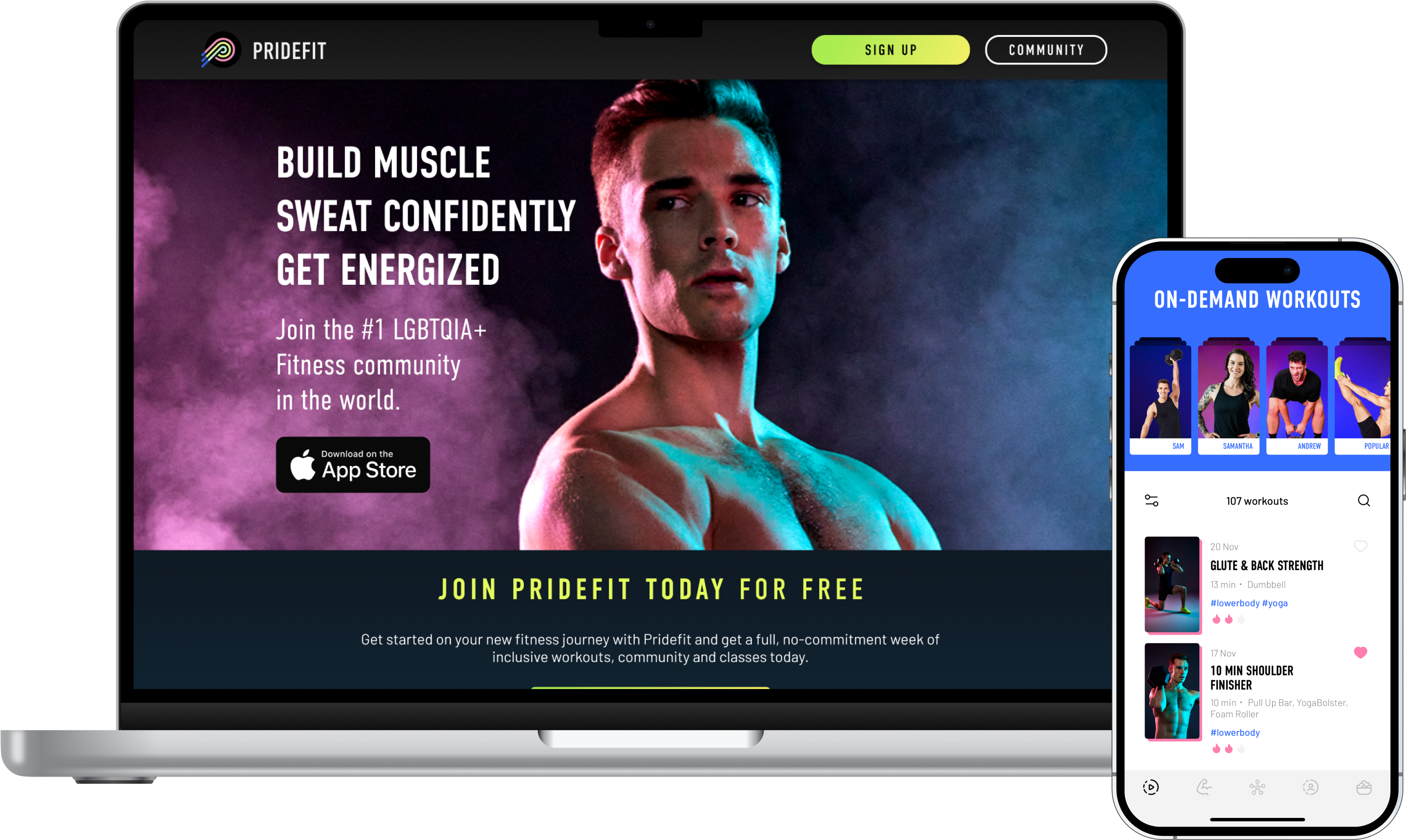
See how Redwerk took over a struggling fitness app from another vendor, cleaned up the inherited technical debt, and helped Pridefit grow subscriptions by 45%