Vibe coding is a trending word now, but did you know that it was just coined this year, 2025, by Andrej Karpathy, one of OpenAI’s research scientists and founding members? This is an entirely new way of coding that is quickly changing the way software development works. Most importantly, vibe coded apps are so easy to create that even people with no tech background can build their own simple tools.
The existence of AI tools that allow people with no tech knowledge to create small programs for personal use is already changing society. With such tools at our disposal, consumers of software development services are adjusting their expectations. Moreover, AI code generators also create new niches within the development industry, such as vibe code cleanup services.
What Are Vibe Coded Apps and Why Do They Rock?
Vibe coding is quite simple and straightforward, which is the main reason for its popularity. In essence, you are just using a large language model (LLM) to do all the coding job for you through prompts. Just like you are communicating with ChatGPT, it can answer your questions. However, the final product you get is vibe coded apps.
The best thing about it is that you don’t even need any specialized technical knowledge to build adequate prompts. You only need to describe what you want to achieve in the natural language you use every day. The LLM will interpret it, select the proper libraries and frameworks, and develop vibe-coded applications that do exactly that.
It’s going to take a few tries to achieve the desired results. However, every time you provide the AI model with feedback, it refines the app, bringing it closer to your goal.
The typical vibe coding process goes like this:
- Build the prompt: Simply state your goal in plain language. Be very detailed to help the AI understand your exact needs. Remember that natural language is non-deterministic, unlike code, so specificity matters.
- Run the AI app generator: The AI agent of your choice will generate files, dependencies, and boilerplate. The most popular vibe coding tools right now are Cursor, Replit, Lovable, and Bolt.
- Run the app: Execute the AI-generated solution and observe the results. If you see any errors, paste them back into the AI model and request appropriate fixes.
- Iterate through conversation: Refine your vibe-coded applications by talking to the model. Note that you should address one change at a time to achieve the best results.
- Finalize with additional tools: Today, you can use specialized AI-powered tools and APIs to add linters, generate tests, catch regressions, and unsafe changes. Also, improve the app through AI debugging with tools like Cursor’s Bugbot.
7 Best Vibe Coded Apps in 2025
If you’re looking for inspiration for vibe coding your own app, be sure to check out the article on 9 unusual MVPs you can vibe code today, shared by Redwerk’s founder. But if you’re still skeptical and want to see first-hand examples of vibe coded apps, this curated list is for you.
Bitchat
Bitchat is, probably, the most well-known vibe coded app. Created by a Twitter cofounder, Jack Dorsey, it’s a Bluetooth-based, peer-to-peer messaging app. The solution offers secure messaging that relies on low-energy Bluetooth mesh networks. It’s a new step toward secure and private communication, offering handy features such as instantly clearing all data in ‘Panic Mode’.
Dorsey isn’t lacking in tech expertise. However, according to him, he vibecoded the tool over a single weekend using Goose (Block’s AI assistant). Implementing rapid iteration allowed him to fine-tune the tool quickly and ensure it’s functional and launch-ready. This type of messaging might be limited in many ways. However, it’s one of the examples of vibe coded apps that prove their versatility and ability to compete with some of the popular tools created by expert dev teams. However, if you’d like to launch a large-scale product right away, we would be happy to help. The Redwerk team has expertise in building P2P messaging apps, such as Tingl. We can help you either build a product in a traditional way or provide code review for a vibe-coded application.
MenuGen
MenuGen is among the best examples of vibe-coded apps. It was actually created by an AI researcher Andrej Karpathy, not a complete novice. However, as he used vibe coding only, the tool showcases exactly what you can do with code generation from scratch.
This is a straightforward tool that boosts the quality of life in seconds. You snap a picture of the restaurant’s menu, and it generates a browsable list with images of the dishes based on it. Karpathy details the process of vibe coding MenuGen, explaining how he used cursor, Claude 3.7, OpenAI API, Replicate API, and a few additional tools to build it.
This example illustrates how you can combine several AI code-generating tools to create versatile and multi-functional vibe coded apps.
Chorus

Chorus is another example of the best vibe coded apps made with a contribution from Jack Dorsey. It’s a Nostr-based social community for fundraising. It allows users to create groups and easily share both content and money.
Presented at the Oslo Freedom Forum, this application was created by a small group of developers. However, regardless of their technical background, they used only vibe coding to build it.
At the moment, the application is more of an experiment that explores the capabilities of AI-powered coding. However, if it’s refined, it could become not only one of the most popular vibe-coded apps but also revolutionize online fundraising as a whole.
Crash Out Diary
Crash Out Diary is a tool developed by a stressed-out mother to help others like her offload without snapping at those closest to them. Karima Williams, an account director at a marketing agency, 34, created this app with no coding expertise whatsoever.
All she needed was her own experience of resolving her issues using the Claude AI chatbot by Anthropic. Williams’ little ‘AI helper’ is among the simplest apps built with vibe coding. However, it just goes to prove that sometimes tools that make a great impact don’t need to be expensive and complex.
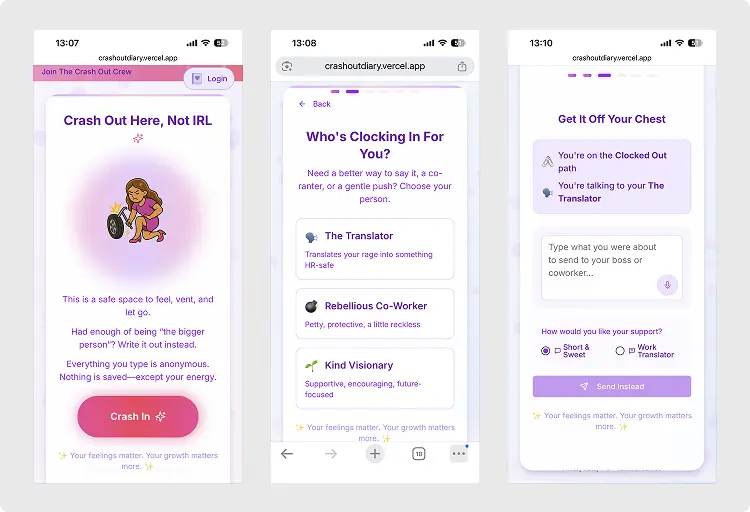
The Crash Out Diary is free and completely anonymous. It doesn’t store information and only focuses on single interactions. You write your message to the app, venting your frustrations or anything else you feel boiling out of you at the time. The AI responds with a short personalized pep talk and suggests some relaxing or focusing activity that can help reduce the acute stress. For example, those activities can be breathing exercises, meditation techniques, or even simple finger games.
Family Meal Planner
Laura Zaccaria, an HR professional from Singapore, tried her hand at apps built with vibe coding during her maternity leave. She created Family Meal Planner, a simple AI-powered helper to prep meals for her family.
Laura used Cursor and ChatGPT to generate the tool, and she has no experience in coding. She learned about vibe coding from her husband and decided to give it a try. They went to a class called ‘Code with AI’ together and applied their new knowledge, creating simple tools to assist with daily tasks for their family and business.
LunchBox Buddy
LunchBox Buddy is one of the best vibe coded apps created by journalist Kevin Roose. He is certainly no coding expert, but he admits that he did build a few websites in his youth. Now he is exploring AI coding tools and has already built simple applications for podcast transcribing and summarizing, organizing social media bookmarks, and a site that helps determine which piece of furniture would fit in a car’s trunk.
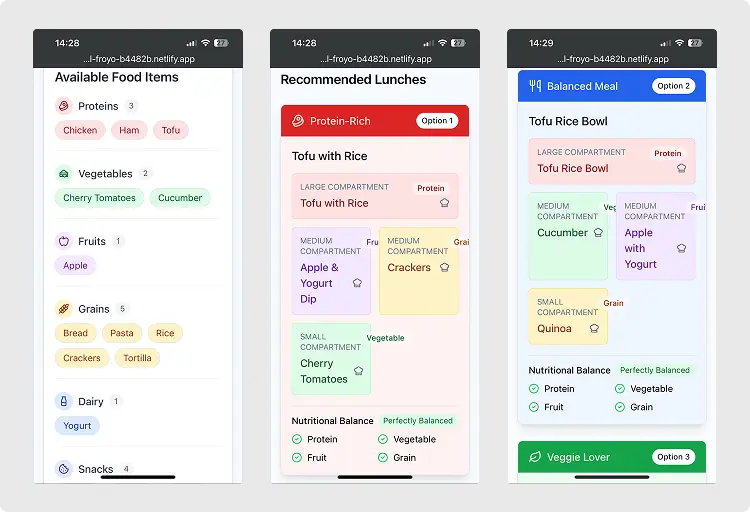
LunchBox Buddy stands out from Kevin’s vibe-coded applications because it’s more advanced. The idea was to make an app that would help him prepare lunch boxes for his son. The tool analyzes fridge content based on the photo and offers meal suggestions based on this data. He built it using Bolt, and AI itself selected the image recognition tool to analyze the uploaded image. Kevin also shares that the AI provided him with a few options during app generation, allowing him to choose additional features, such as listing the nutritional value of the meal options. He says that the ‘software for one’, as Kevin calls these vibe coded apps, was ready to use in about ten minutes.
Dog-e-dex

Not all popular vibe-coded apps aim to deliver some significant functionality. Dog-e-dex by Cynthia Chen, a product designer at Block, is a great example of how to make a tool that’s simple and fun. It’s an iOS product available on the App Store that can identify dog breeds.
You upload a dog’s picture, and the application will tell you what breed it is. Moreover, to make the experience more fun, you can ‘collect’ your dog encounters. For all its simplicity, it’s an entertaining tool for dog enthusiasts and can be a useful product for people who work with animals, such as groomers.
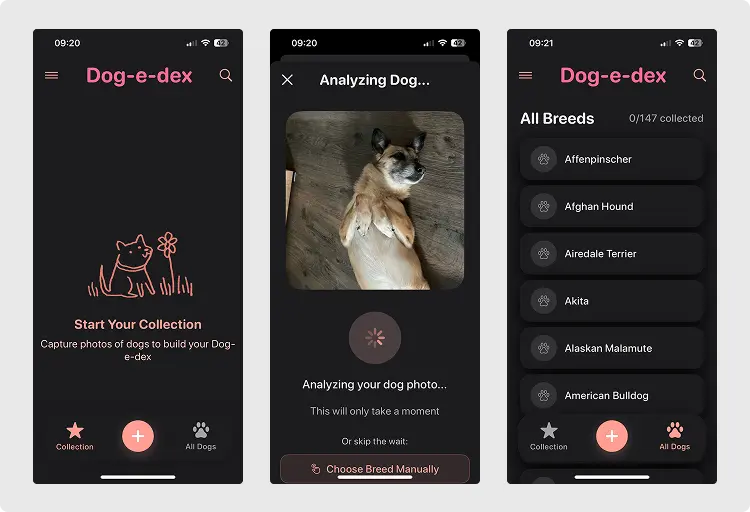
Chen says it took her about two months to create what is one of the more popular vibe coded apps. She used Claude/Replit, and she has no training or previous experience in coding at all.
What’s the Bottom Line?
As you can see from a single look at the best vibe coded apps available today, they are useful and easy to create. However, they are also limited in many ways. As the situation stands right now, their place in the world is clear. It’s another way to make the benefits of AI more accessible to people.
Meanwhile, it’s also essential to understand what vibe coded apps are not. They aren’t a replacement for comprehensive software product development services. In fact, they are even limited as far as mobile app development goes. It’s because apps built with vibe coding cannot be architecturally complex due to their very nature.
Anyone can develop a simple solution to help them handle daily tasks, like meal planning or summarizing a podcast. In essence, these tools just provide a way to access generative AI functionality faster. However, if you need a solution that provides a wide range of services, vibe coded apps may not meet this need.
That said, vibe coding can be integrated into more complex solutions. The easiest step toward this is to have an expert code review of your AI-generated app. Want to see where this can lead your ambition? Book a call with us today.
See how we built an AI-powered recruitment app acquired by a US staffing giant