
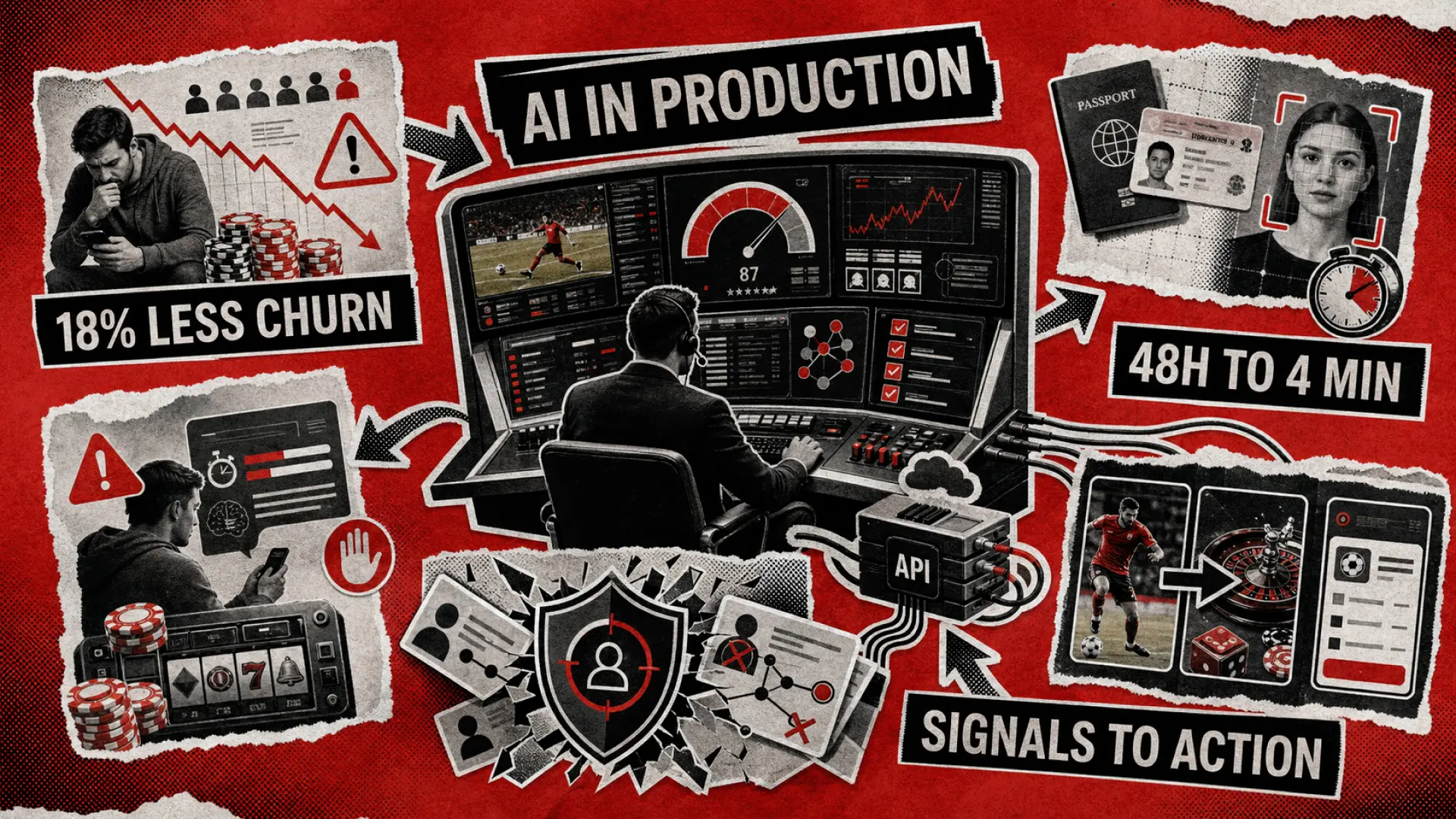
You’ve seen the vendor decks, so you know what AI in iGaming could do. The real question is: what’s actually running, and how to implement it with maximum efficiency in real life? In these five use cases, we skip the potential and go straight to production, showing that the operators who built the system have the numbers to back it up.
AI development is a vast field, but not all forms of automation are equally efficient or valuable in the long term. To build a strategy that brings immediate benefits, such as attracting more players, you need to not only understand the general benefits and uses of AI but also see exactly how it can be applied to benefit iGaming practices. From using machine learning models to building specialized data pipelines and developing dynamic anti-fraud systems, AI has immense potential. Keep reading to see how you can use it best to counter everyday iGaming business challenges.
AI in iGaming: 5 Production Use Cases at a Glance
Today, we’ll talk not about abstractions and general trivialities of what AI can do for business. We will focus on use cases already implemented by leading iGaming operators and analyze the value they deliver based on existing data, including specialized AI and ML research. Understanding how technology solves the problems this industry faces daily should help guide your strategy for AI implementation that will gradually transform your business and make it more competitive.
Real-time churn prediction
Players churn before you can act
Behavioral micro-patterns
15–20% reduction in 30-day churn
CRM API + ML feature store
AI-assisted KYC
Verification friction kills withdrawal conversion
Document + identity data
48h → under 4 min verification
Compliance middleware
Responsible gambling triggers
Problem gambling detected after the damage
Session anomaly signals
Intervention before self-exclusion
Event stream + scoring layer
AI fraud detection
Rule-based systems are predictable and exploitable
Transaction + behavioral graph
Significant fraud reduction vs. static rules
Hybrid rules + ML decision engine
Personalized recommendations
Players see irrelevant content, disengage
In-session behavioral data
Higher session depth, faster bet slip conversion
Recommendation API at lobby layer
1. Real-Time Churn Prediction: 18% Less Churn in 30 Days
Standard churn metrics, such as no login for 7 days and lower deposit frequency, are lagging indicators. By the time they fire, the player has already decided to leave. The machine learning (ML)-powered approach watches for the signals that come before that decision:
- Sessions getting shorter over 5+ consecutive visits
- Login times shifting from peak hours to late night
- No response to two or more push notifications in a row
- Bets getting smaller even when the player is still active
These patterns show up 7 to 14 days before any traditional metric would flag the account. One sportsbook trained a model on 18 months of behavioral data, connected it to its customer relationship management (CRM) system, and saw an 18% reduction in 30-day churn. It’s achieved by reaching players earlier with the right message before they mentally check out.
The case for acting early is strong: acquiring a new player costs 6–7x more than retaining an existing one. A peer-reviewed study in Applied Sciences (MDPI) confirmed that ML classifiers built on player event data achieved prediction accuracy with AUC (area under the curve) above 0.92 on real gaming datasets, reliable enough to act on.
In plain terms, you need:
- A stream of player events from your platform (every login, bet, session, and deposit)
- A system that processes those events in real time, not overnight
- A model that scores each player’s churn risk and updates continuously
- A connection to your CRM system so the right intervention fires at the right moment
The model itself isn’t the hard part, the trick is to build a data pipeline that keeps it fed with fresh, accurate signals.
2. AI-Assisted KYC: From 48-Hour Queues to 4-Minute Verification
A player deposits, plays, then tries to withdraw for the first time. They hit a 48-hour document review queue. That’s when friction does the most damage, and they don’t come back.
Operators who’ve fixed this don’t treat KYC (Know Your Customer verification) as a compliance cost. They treat it as a conversion layer. With an AI-assisted pipeline, standard verifications are complete in under 4 minutes. Here’s what the automated flow looks like:
- Player uploads their identity document (ID)
- Computer vision scans for tampering or forgery
- A liveness check matches their face to the document photo
- The system screens the name against global anti-money laundering (AML) watchlists
- A risk score is generated, and a decision is made automatically
Clean cases never reach a human reviewer. Edge cases, such as mismatched name formats or documents from higher-risk regions, get escalated with a pre-filled risk summary, not a raw pile of files.
The pressure to upgrade is real, as global KYC-related regulatory penalties hit $1.23 billion in the first half of 2025, a 417% year-over-year increase. According to Sumsub’s 2025–2026 Identity Fraud Report, 1 in 5 first-party frauds now involves a synthetic identity, a fake person built from a mix of real and fabricated data that easily fools static document checks.
AI-augmented verification catches what documents alone can’t. Meanwhile, Sumsub’s iGaming research shows a consistent pattern: fraudsters register between 4–8 a.m., while legitimate players register between 4–6 p.m. This behavioral signal is invisible to a document queue, but immediately detectable when you are implementing AI in iGaming pipeline management.
3. Responsible Gambling AI: Catching Problem Play Before Self-Exclusion
Deposit limits and self-exclusion links are the standard, but they’re also reactive and activate after a player already knows they have a problem. The operators pulling ahead are running models that flag the warning signs before that point.
Using AI in iGaming lets you train a model that doesn’t rely on a single trigger. It watches for a pattern of shifts that, together, produce a risk score:
- Sessions running significantly longer than the player’s usual baseline, especially late at night
- Re-deposits made within minutes of a big loss
- Bet sizes spiking erratically beyond the player’s normal range
- Consistently hitting a self-set weekly limit for three or more weeks in a row
- Switching from varied play to grinding one product at high intensity
When enough signals align, the system triggers an early intervention, for example, sending a support message, a deposit-limit nudge, or a cool-down prompt, before the player reaches a crisis.
A machine learning study on iGaming behavioral data, cited by the Responsible Gambling research community, found that ML models achieved an average precision of 84.2% in identifying harmful play patterns. The same research found that an active-learning AML (anti-money laundering) model improved detection by 50%, halved costs, and continued to improve, doubling its precision in about 10 days as it learned from new data.
The UK Gambling Commission (UKGC), the Malta Gaming Authority (MGA), and emerging regulated markets are moving toward requiring demonstrable harm prevention, not just the availability of self-exclusion. Operators who build this now aren’t just maintaining compliance but getting ahead of the next wave of requirements. And the infrastructure they build here is the same one powering churn prediction and fraud detection: one foundation, multiple use cases.
4. AI Fraud Detection in iGaming: Why Static Rules Are Losing
Rule-based fraud systems work like this: define what fraud looks like, write rules to catch it, and flag the matches. However, there is a major problem with this, because fraud rings figure out the rules and work around them. Bonus abuse networks, multi-account schemes, and money laundering operations all adapt to known thresholds. Therefore, a static anti-fraud system is inherently exploitable.
The solution from AI in iGaming is ML-based fraud detection. Instead of matching against a fixed list of bad patterns, models learn what legitimate player behavior looks like and then flag anything that deviates. New fraud tactics get caught not because someone wrote a rule for them, but because they look wrong.
The strongest implementations don’t hand everything to the model, but use the following approaches to ensure maximum defense:
- Rules for patterns that are known and certain
- ML models for detecting new and evolving behavior
- Human reviewers for the genuinely ambiguous cases
- A feedback loop where reviewer decisions feed back into model retraining
The result is that AI fraud systems prevented an estimated $25.5 billion in global losses in 2025, achieving 90–98% detection accuracy. Human reviewers, for comparison, correctly identify high-quality deepfakes only 24.5% of the time.
5. AI Personalization in iGaming: The Recommendation Engine That Moves Players from Homepage to Bet Slip Faster
When it comes to using AI in iGaming for personalization, think of it less like Netflix and more like a lobby that knows the player. When someone logs in, the games, events, and bet types they see are no longer the same as for everyone else. The platform surfaces what’s most relevant to that person, based on their history and current session behavior.
For sportsbooks, this means showing the right events, markets, and stake sizes upfront. For gaming platforms, it means organizing the game lobby around what a player actually plays, not what yields the highest aggregate margin.
Two models handle this in practice:
- For returning players: a personalized model trained on their betting history, preferred sports or game types, and past response to offers. It adapts to recent behavior, not just historical averages.
- For new players: a collaborative filtering approach that groups players by early session patterns and surfaces what similar players engaged with, so there is no cold-start problem.
Research from a production deployment at NetEase Games showed meaningful improvements in engagement and marketing precision when individual behavioral models replaced broad-segment targeting. DraftKings has publicly adopted generative AI (GenAI)-powered messaging personalization for the same reason — it converts better.
The recommendation layer isn’t a platform rebuild, but an application programming interface (API) that sits between your data store and your lobby content management system (CMS), reranking content at session start. Our API development services cover it end-to-end, including AI elements in model training, integration, and ongoing optimization.
What All 5 AI in iGaming Use Cases Have in Common
Strip back each of these use cases, and you find the same thing: player behavior generates signals, a model turns those signals into a score, and that score triggers an operator action, such as sending a retention message, making a verification decision, or initiating a fraud hold.
The model is rarely the hard part. What separates operators who ship this from those who don’t is the infrastructure around it:
- A reliable, real-time event pipeline
- A feature store that keeps model inputs fresh
- Clear policies mapping model output to platform action
- Feedback loops so the model keeps improving over time
The right question in 2025 isn’t “should we use AI?”, it’s: Do we have the data foundation to run it well? That’s where most builds win or lose.
Redwerk has been building software for digital products in regulated industries since 2005, including AI and machine learning services, production-grade data pipelines, and the layers that connect model output to operator action. Got one of these on your roadmap? Contact us and let’s bring them to life!
See the AI-powered recruitment app we built, bought by a US staffing giant

