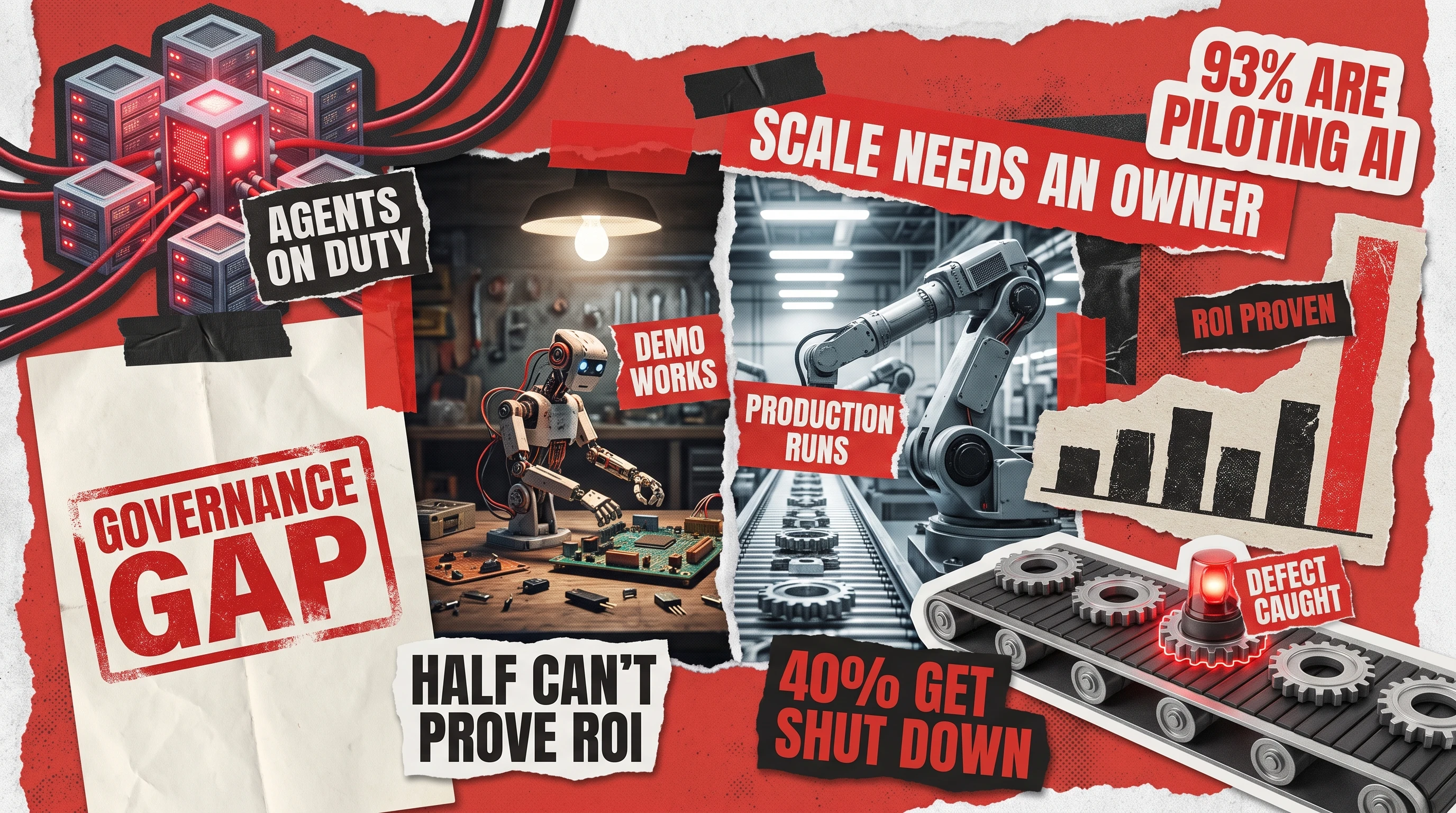
Most enterprise AI use cases stall for reasons unrelated to model quality. Plug and Play’s 2026 Enterprise AI Strategy Pulse Survey found 74% of the world’s largest enterprises run at least one AI solution in production and 93% are piloting or further along, while half of those production-stage companies cannot consistently measure ROI.
An enterprise AI deployment runs on governed production data, serves more than one department or workflow, has a named owner accountable for its output, and repeats reliably at volume. A pilot shows a model can work once. An enterprise deployment shows the organization around it can absorb it.
If you are evaluating a partner, the useful question is narrower. You need to know which AI use cases have a record in companies your size, what each costs in data preparation, and which trigger a compliance review nobody scheduled.
From Pilot to Production: What Makes AI Enterprise-Grade
Four conditions turn a prototype into something a company can run. The data has to be governed, with a system of record, a retention policy, and someone who can say where a field came from. The workflow needs an owner accountable when output is wrong, plus a path for a person to intervene.
Third is measurement against a baseline captured before launch, exactly what the Plug and Play respondents skipped. Without it, ROI is unprovable by construction, so that 50% figure describes a measurement failure more than a technology failure.
Fourth is repeatability, and it breaks most internal projects. A model tuned by one analyst on one CSV export is a study; a system means scheduled retraining, monitored inputs, and a rollback path. Teams that succeed at moving AI from demo to production treat that plumbing as the deliverable. If your data sits across three systems with no owner, expect the first six to eight weeks to look like integration work.

Enterprise AI Use Cases by Business Function
Sorting by function beats sorting by technology, because budget and accountability sit with functions. The AI business use cases that survive production cluster where three conditions coincide: high transaction volume, an answer checkable against a record, and work that is already digital. Where one is missing, you need a process redesign first.
Customer and Employee Support
Support is the common entry point because volume is high and ground truth already sits in a ticket system. The realistic version is retrieval over your own documentation with a confidence threshold and a handoff to a person. Internal IT and HR helpdesks often beat customer-facing support as a first target, since a wrong answer to an employee costs an apology while one to a customer can cost a contract. The trap is scope: a bot fielding anything asked across forty systems is an integration program wearing a chat interface.
Finance, HR, and Revenue Operations
Back-office functions produce the cleanest wins because their documents are structured and their errors are auditable. These are the enterprise software AI use cases that most often clear a finance review:
- Invoice and document extraction. Line items pulled from supplier PDFs into an ERP, low-confidence fields routed to a human queue. Accuracy is measurable per field, so the case argues itself.
- Candidate screening and matching. Ranking applicants against structured requirements, the pattern behind the ML-powered recruiting tools Redwerk has built. Auditability is harder than accuracy, since a ranking you cannot explain is a legal exposure.
- Revenue forecasting and churn scoring. Predictive models over CRM and billing history, wanting two years of consistent data. A company that changed CRM last year cannot support them yet.
- Contract review. Clause extraction and deviation flagging against a standard template, strong where your paper is standardized and weak where every deal is bespoke.
Supply Chain and IT Operations
Operations is where predictive models earn more than generative ones. Demand forecasting, inventory optimization, and log anomaly detection are statistical problems with decades of prior art, calling for ML and data science engineering rather than a language model. Redwerk builds demand forecasting engines on that footing, where the accuracy ceiling comes from the data rather than the algorithm.
IT operations has the easiest starting point of any function. Alert correlation and capacity prediction reduce noise against a baseline already in your monitoring stack, so nobody has to invent a metric to justify it.
Agentic AI Use Cases in the Enterprise
An agent differs from a chatbot in one respect that changes the risk profile: it takes actions in other systems. It can issue a refund, move a record, or call an API for you, so a mistake writes to your systems instead of merely misinforming someone. Governance therefore arrives before capability.
Gartner attached a number to that in May 2026, predicting by 2027, 40% of enterprises will demote or decommission autonomous AI agents over governance gaps found only after production incidents. The failure mode it names is uniform governance applied regardless of an agent’s autonomy level, which either strangles low-risk agents in approvals or under-supervises the ones with real reach.
The agentic AI use cases enterprise teams get into production share a narrow shape: bounded permitted actions, a reversible outcome, a checkable record. Fraud-detection agents that flag and hold a transaction for review fit it, as do property-matching agents assembling a broker’s shortlist and retail or travel recommendation agents ranking inventory a customer still picks from. Redwerk’s AI agent development work covers those three patterns, and in each a person keeps the last signature on anything expensive.
Enterprise AI agent use cases go wrong at the write boundary. Give an agent unattended authority to issue payments or email customers and you need the controls you would give a junior employee with production credentials: a scoped access grant, an audit log, and a tested way to stop it mid-task. Most teams find the third missing during the incident that needs it.
Generative AI and Custom LLM Use Cases
Generative models produce text, code, images, and structured drafts, and their value concentrates where a competent first draft saves more time than a perfect answer would. The strongest generative AI enterprise use cases therefore sit upstream of a human reviewer rather than in place of one. Two families account for most enterprise use cases for generative AI that reach production, and their cost profiles differ sharply.
Content and Code Generation
Code generation has the clearest measurement story here, because engineering output is already instrumented with pull request throughput, review turnaround, and defect escape rates. Copilot-style assistants reliably speed up boilerplate, test scaffolding, and migration work, and do nothing for architecture. Redwerk delivers AI-assisted software development on that basis, including copilots run on-premise where source code cannot leave the building.
Content generation follows the same logic with a weaker measurement story. Volume rises fast and quality control becomes the bottleneck, so the honest trade is writing time for editing time.
Domain-Specific Knowledge and On-Prem LLMs
The second family is retrieval over proprietary material: contracts, engineering documentation, claims history, clinical protocols, a decade of support tickets. A general model knows none of it, so the engineering lives in the retrieval layer, the chunking strategy, the permissions model, and the evaluation set. That is what custom LLM development consists of in practice, built around a company’s own domain and data.
Confidentiality decides the architecture. A company under GDPR, HIPAA, or a contract forbidding third-party processing cannot ship that corpus to a public API, which puts on-premise or private-cloud deployment on the table with its costs: GPU capacity, model upgrades, an evaluation harness you maintain. The trade is higher fixed cost against a data-residency guarantee you can put in writing.
Enterprise AI Use Cases by Industry
Industry changes the sequencing more than the technology. The same document-extraction model serves an insurer and a manufacturer, and the difference is who approves it, how long that takes, and what evidence they want first. Regulatory weight predicts timeline better than sector does.
Regulated Verticals: Financial Services and Healthcare
In financial services, fraud and AML detection, credit and risk scoring, and document-heavy onboarding are the established applications, and all three carry an explainability requirement. A model producing decisions nobody can reconstruct fails a supervisory review even when accurate, which is why interpretable models beat stronger opaque ones here.
Healthcare stacks a second constraint on top: patient data largely cannot leave a controlled environment. Clinical documentation support, prior-authorization processing, and imaging triage are all viable, each needing private deployment, an audit trail per inference, and clinician sign-off on a validation set. Budget that approval cycle as a line item, because it often runs longer than the build.
Physical Operations: Manufacturing and Retail
Where the output is physical, the AI is usually predictive rather than generative. The payback is also easier to calculate, because downtime and stockouts already carry a price:
- Predictive maintenance. Vibration, temperature, and cycle data read against failure history. It needs sensor coverage and a few genuine failures to learn from, so plants running new equipment cannot start here.
- Visual quality inspection. Defect detection on a line, where the binding constraint is a labeled dataset of real defects rather than model availability.
- Demand forecasting and assortment planning. The retail counterpart, sensitive to promotions and dependent on clean point-of-sale history.
- Recommendation and personalization. Ranking inventory for a shopper, measurable through basket size and conversion.
Retail is where digital transformation and AI arrive as one program. A recommendation engine on a catalog with inconsistent product data returns confident nonsense, so the data cleanup nobody wants to fund is the real prerequisite.
Build vs. Buy: Where Custom AI Development Fits
Buy the commodity and build the differentiator. General transcription, a mainstream coding assistant, or a standard chat interface costs less off the shelf than anything you would build. Custom development earns its cost where the value depends on something only you hold: your data, your process, your regulatory position.
Sequencing is where budgets disappear, and the ROI data shows why. KPMG‘s Global AI Pulse for Q2 2026, covering 2,145 C-suite and business leaders across 20 countries, found only 7% of organizations report established ROI from AI, while leaders with strong cost visibility were five times likelier to reach it.
Buy off the shelf
The capability is generic and your data gives no edge: transcription, translation, a coding assistant.
Licensing per seat or token, plus integration into an existing workflow.
Configure a platform
A vendor serves your vertical and your process sits close to their default, as in support desks and CRM add-ons.
Configuration and change management, climbing as your process drifts from the vendor’s assumptions.
Build custom
Value sits in proprietary data, a regulated deployment, or an integration no vendor offers.
Data preparation and pipeline engineering, which outweigh model work, plus ongoing evaluation.
The build case is strongest under two conditions. First is proprietary data: when the asset making the answer good is your own claims history, sensor archive, or contract library, then custom AI software built around your own data is the only way to capture that advantage, because a shared vendor model cannot see it. Second is compliance, where private deployment and an audit trail are contractual obligations.
The question worth asking any partner is what they do in month one. Redwerk has shipped over 250 projects since 2005 with more than 90 senior engineers, and on AI work the opening weeks go to data lineage, access boundaries, and an evaluation baseline before a model is picked. Two things matter for mid-market teams: a half-built AI project can be taken over and finished by engineers who already know the stack, and the work needs no complete specification up front.
The pattern across every category above is that the model is the cheap part. What decides whether a deployment survives its first year is whether the data underneath is governed, a named person owns the output, results are measured against a pre-launch baseline, and it can be switched off cleanly.
Practically, pick one function with high volume and a checkable record, instrument it before building anything, and treat the first engagement as proof your organization can absorb a production system. The second gets far easier once that plumbing exists. If you are weighing which to start with, contact us and we will walk through the sequencing for your stack.
FAQ
What is an enterprise AI use case?
It is an AI deployment that runs on governed production data, serves more than one team or workflow, has an accountable owner for its output, and repeats reliably at volume. The distinction from a pilot is organizational rather than technical: a pilot shows a model can work once, while an enterprise deployment shows the surrounding process, permissions, and monitoring can sustain it.
What is the difference between generative AI and agentic AI?
Generative AI produces content such as text, code, or images, and a person decides what to do with it. Agentic AI takes actions in other systems, calling APIs, updating records, or triggering transactions, so its mistakes write to your systems instead of appearing on a screen. That difference in blast radius is why agents need permission boundaries, audit logs, and a tested way to halt them mid-task.
Which industries use enterprise AI the most?
Financial services, healthcare, manufacturing, retail, and technology lead adoption, since each combines high transaction volume with long digital records to learn from. The more useful split is by regulatory weight: regulated sectors move slower because explainability rules add approval cycles, while retail and manufacturing move faster since payback shows up in stockouts and downtime.
See how we turned a legacy product into an AI-driven growth platform: the Evolv build, 20+ production releases with a 9-person team