The car you buy today ships with a roadmap, and it’s all software one. The feature set that comes with delivery is version 1.0, but the real product is what it becomes over the next five years of updates. That shift reframes automotive software development from a one-time engineering task into an ongoing product discipline, closer to SaaS than to manufacturing.
AI has also become a crucial part of the stack: models running inference at the edge, assistants managing in-cabin interactions, or systems predicting a failing component before the driver notices anything wrong.
If you are scoping an automotive AI project right now, or evaluating whether your current team can deliver it, this article covers what the work actually involves, from architecture to standards, to tech stack, and where most projects run into trouble.
From Hardware to Software: Software-Defined Vehicles
The term ‘software-defined vehicle’ (SDV) is used loosely, but its engineering meaning is specific. A traditional vehicle distributes functions across dozens of isolated electronic control units (ECUs), each running proprietary firmware with minimal cross-communication. Meanwhile, a software-defined vehicle consolidates those functions on centralized compute platforms. There, software controls vehicle behavior, and new capabilities can be deployed over the air (OTA) without touching the hardware.
That architectural shift matters enormously for automotive software development services because it means that:
- Vehicle functions that once required a physical ECU swap can now be updated remotely.
- Features can be monetized post-sale through subscription or feature-on-demand models.
- A single software team can manage the full vehicle lifecycle, not just the pre-production phase.
- OTA rollback logic becomes as critical as the update itself.
The software-defined vehicle market reflects how fast this transition is moving. According to Fortune Business Insights, the global automotive software market was valued at $36 billion in 2025 and is projected to reach $113 billion by 2034. The SDV sector is growing at 25-30% annually, which is roughly 8x the pace of the broader automotive market.
The next stage of this evolution has a name: the AI-defined vehicle, or AIDV. Where the SDV provides the architectural foundation (centralized compute, OTA delivery, modular software layers), the AIDV introduces AI not as an application feature but as a foundational platform layer. The vehicle interprets context, learns from driving patterns, and adapts behavior in real time. The distinction matters for teams building today, because designing for an AIDV architecture from the start is a completely different project than bolting AI features onto an
The 5 Core Components of AI Automotive Software
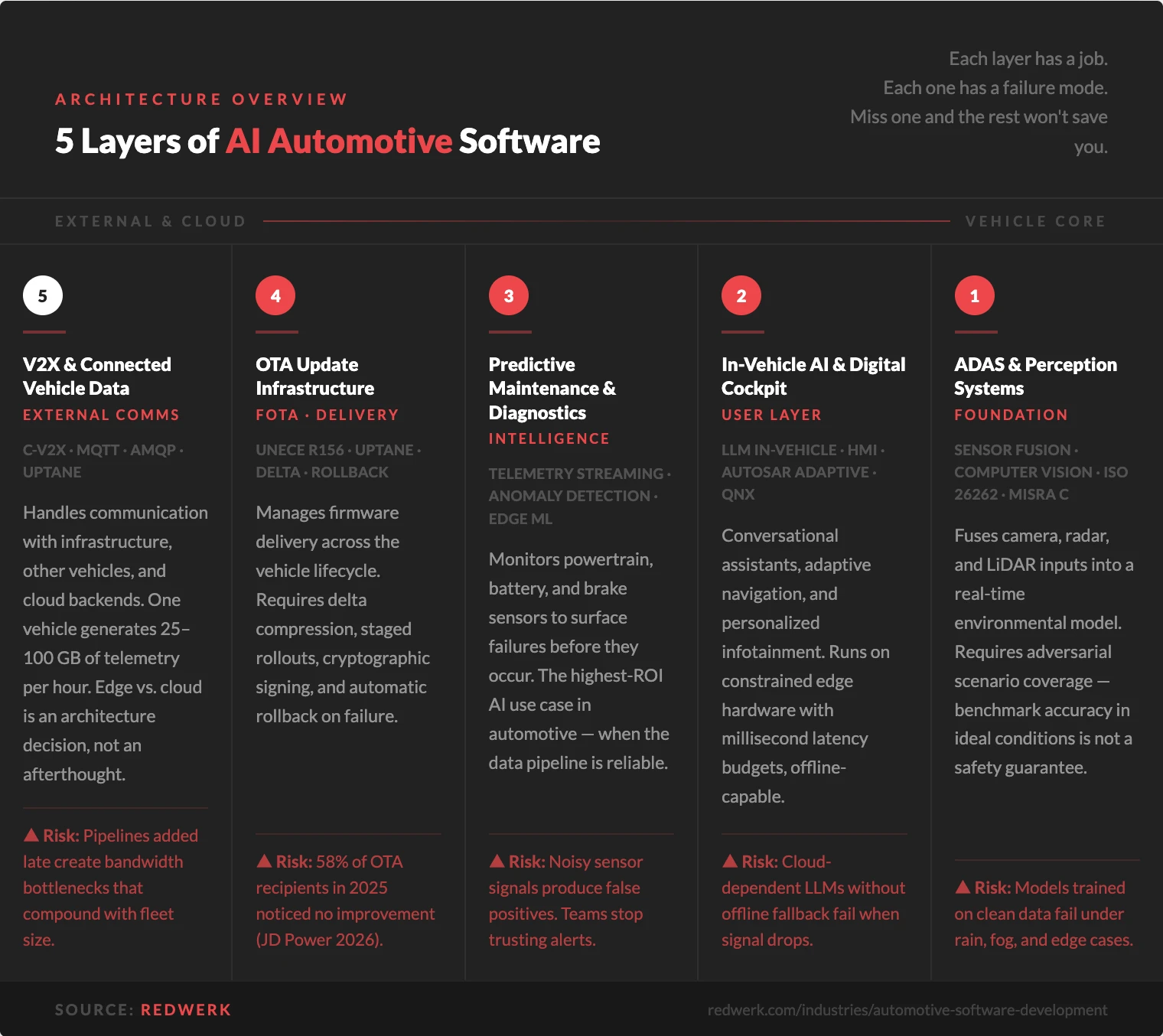
Automotive software development for AI-enabled vehicles involves five distinct functional layers. Each of them has its own engineering discipline that we break down below.
ADAS and Perception Systems
Advanced Driver Assistance Systems, or ADAS software development, is where most of the compute-intensive work happens. Perception pipelines ingest data from cameras, radar, LiDAR, and ultrasonic sensors simultaneously, and sensor fusion algorithms reconcile those inputs into a coherent real-time model of the vehicle’s environment.
The engineering challenge is not just accuracy, but accuracy under conditions the training data did not include. Rain at night, a partially occluded stop sign, and a pedestrian stepping out between parked trucks are all obstacles that the systems learn from random, rare encounters. Production-grade ADAS software development requires adversarial scenario coverage, not just benchmark performance.
At CES 2026, KPIT Technologies demonstrated an agentic AI suite built on generative AI specifically designed to accelerate ADAS development cycles and reduce defects in safety-critical systems. The direction is clear: AI is now being used to build better AI for vehicles.
In-Vehicle AI and the Digital Cockpit
The digital cockpit is the user-facing layer of the AI stack. This is where in-vehicle AI shows up as conversational assistants, personalized settings, predictive navigation, and context-aware infotainment. It is also one of the fastest-moving areas of the stack, driven by LLM integration and the shift toward LLM in-vehicle architectures that can handle natural language commands across multiple vehicle functions simultaneously.
Getting in-vehicle AI right requires more than plugging in a large language model. Latency requirements for driver interaction are measured in milliseconds. Therefore, models need to run reliably on constrained edge hardware. In addition, the system must gracefully degrade when connectivity is lost because the driver is still in the car, regardless of whether the cloud is reachable.
Predictive Maintenance and Diagnostics
Predictive maintenance automotive software monitors sensor data across the powertrain, battery, brake, and suspension systems to flag anomalies before they lead to failures. For fleet operators and OEMs running connected vehicle programs, this is one of the highest-ROI AI applications available, as the cost of an unplanned breakdown is almost always higher than the cost of a proactive repair.
Building this well means more than training a classification model on fault codes. You need to design a data pipeline that streams telemetry reliably from the vehicle to the inference layer, handles missing or noisy signals, and surfaces actionable alerts rather than probability scores that a maintenance team cannot use.
OTA Update Infrastructure
FOTA (firmware-over-the-air) is one of the less glamorous parts of automotive software architecture, but it is operationally critical. A poorly designed OTA system can brick vehicles at scale, create compliance exposure, or fail silently, which is worse in some ways.
Production OTA infrastructure for automotive software needs to handle:
- Delta update compression to minimize bandwidth over cellular
- Cryptographic signing and verification at every layer
- Staged rollouts with automatic rollback on failure
- Compliance with UNECE R156, the international regulatory standard for OTA software updates in vehicles
58% of drivers who received OTA updates in 2025 reported no noticeable improvement, according to the JD Power Vehicle Dependability Study. That number tells you something important about the gap between shipping an update and shipping a good one.
V2X and Connected Vehicle Data Pipelines
Connected vehicle software handles communication between the vehicle and external systems, such as infrastructure, other vehicles, fleet management platforms, and cloud backends. V2X (vehicle-to-everything) protocols enable use cases ranging from traffic signal optimization to collision-avoidance coordination.
The data engineering challenge here is significant. A single vehicle generates between 25 and 100 GB of sensor and telemetry data per hour. Deciding what to process at the edge, what to transmit, and what to store requires careful architectural work up front, not as a performance optimization after the fact.
Why This Is Actually Hard: The Real Automotive Software Development Challenges
Software-defined vehicle development challenges are not covered enough in the marketing content surrounding this space. Here, we list real issues that teams actually run into, based on our own development experience.
Functional Safety Is Not Documentation
ISO 26262 is the international standard for functional safety in automotive software. MISRA C is the coding guideline set that governs C and C++ development in safety-critical systems. AUTOSAR is the software architecture framework that most OEM supply chains require compliance with.
The mistake most non-automotive software teams make is treating these as compliance checkboxes, meaning something the QA team handles at the end. In reality, functional safety requirements shape how you architect the system, how you write and review code, how you test, and how you document every design decision.
It is not a layer you add on top of finished software, but a constraint that runs through every engineering decision from day one. The automotive software development process for a safety-critical component involves hazard analysis and risk assessment (HARA) during the design phase, software-in-the-loop and hardware-in-the-loop testing, and extensive traceability from requirements through to test cases. This is not optional, and you cannot accelerate past a certain point.
Edge Compute Constraints Are Real
Large AI models run comfortably on cloud GPUs. They do not run comfortably on the embedded compute hardware inside most production vehicles. Embedded automotive software for AI applications requires model compression, quantization, and, in many cases, purpose-built inference runtimes such as ONNX or TensorFlow Lite, optimized for the specific SoC in the vehicle.
The tradeoff between model accuracy and inference latency on constrained hardware is one of the defining engineering challenges in automotive AI development. Getting it wrong produces systems that are either too slow to be safe or too inaccurate to be useful.
Data Labeling at Automotive Scale
Training a perception model for ADAS is not a weekend project. Production datasets for ADAS software development comprise millions of labeled frames across diverse lighting conditions, geographies, weather conditions, and edge cases. The labeling pipeline itself is an engineering challenge of consistency, quality control, and the tooling to manage annotation at scale, all of which require dedicated investment.
Many companies start an automotive AI project without understanding this, discover the data problem six months in, and either compromise on model quality or blow the timeline.
Regulatory Divergence Across Markets
Compliance for software development for the automotive industry varies by region in ways that matter for architecture. The EU’s UNECE regulations (R155 for cybersecurity, R156 for OTA updates) set requirements that differ from US NHTSA guidelines and from emerging Chinese GB standards.
If you are building software for a vehicle that will be sold in multiple markets, that has to be designed into the system because retrofitting multi-market compliance is expensive.
The Automotive AI Tech Stack
Automotive AI tech stack choices are more constrained than in general software development. Here is what the actual landscape looks like in 2026.
Operating system layer:
- Automotive Grade Linux (AGL) for infotainment and non-safety domains
- BlackBerry QNX for safety-critical real-time systems (QNX and Vector Informatik signed an MOU in June 2025 to jointly develop a foundational SDV platform)
- AUTOSAR Adaptive for service-oriented middleware on high-performance compute units
- AUTOSAR Classic for traditional ECU-based domains, where it remains embedded
AI and inference:
- PyTorch and TensorFlow for model training
- TensorFlow Lite and ONNX Runtime for edge inference on vehicle SoCs
- CUDA for GPU-accelerated inference, where compute budgets allow
- Domain-specific LLMs fine-tuned on automotive interaction data for in-vehicle assistants
Communication:
- SOME/IP and DDS for intra-vehicle service communication
- MQTT and AMQP for cloud telemetry pipelines
- Dedicated V2X stacks (DSRC, C-V2X) for infrastructure communication
Cloud and backend:
- AWS and Azure both offer automotive-specific SDKs and connected vehicle services
- OTA management platforms, including Uptane (the security framework used by most production OTA systems)
Languages:
- C and C++ for embedded and safety-critical domains (with MISRA compliance tooling)
- Rust is gaining ground for embedded work where memory safety matters and C overhead is acceptable
- Python for ML pipelines and tooling (not in the vehicle runtime)
What a Capable AI Automotive Software Development Team Actually Looks Like
Hiring automotive software developers is where projects most often go wrong because people do this without understanding the domain gap. That’s how you end up six months in with a team that writes excellent Python but has never worked under ISO 26262 and has no idea what AUTOSAR is.
An automotive AI development partner capable of delivering production-grade work needs:
- Embedded software engineers who have worked with real-time operating systems
- AI and ML engineers with experience deploying models on edge hardware, not just training them
- Functional safety engineers who understand ISO 26262 at the architecture level
- A QA software testing team that knows the difference between software testing and automotive software validation
How to Start Building Automotive AI Software Without Wasting Six Months
How to build AI-powered automotive software is often framed as a grand architecture question. In practice, the most effective starting point is narrower: pick one well-scoped problem, build it to production quality, and use it to develop the tooling, processes, and team understanding that a larger program requires.
For example, predictive maintenance automotive software is often a good first project. The data exists (vehicle telemetry is already being collected on most modern vehicles), the ROI is measurable (reduced unplanned downtime), and the safety implications are lower than perception or ADAS systems, which means you can move faster while building the organizational muscle for functional safety processes.
A few things worth deciding in the first two weeks, not month six:
- Edge or cloud inference?
This shapes hardware requirements, latency architecture, and connectivity assumptions for the entire project. - Which safety classification applies?
ISO 26262 has ASIL levels from A to D. Understanding where your use case sits determines how much of the safety process you need and which tools are non-negotiable. - OTA from day one?
Retrofitting OTA capability into a vehicle software stack that was not designed for it is expensive. If the product roadmap includes post-deployment updates, they must be included in the initial architecture.
This is where a discovery phase earns its cost. In automotive AI, the wrong architecture decision in week two is a six-month correction in month eight.
Scoping something in automotive AI? We’ve been in this space long enough to know which decisions matter in week one and which ones feel urgent but aren’t. Contact Redwerk today and let’s talk about how to build your product.
FAQ
What is a software defined vehicle?
A software defined vehicle (SDV) is a vehicle where core functions, such as driving dynamics, infotainment, safety systems, and power management, are controlled, updated, and extended through software rather than fixed hardware. The key characteristic is that the vehicle can receive meaningful capability updates over the air throughout its lifecycle.
How is automotive AI software different from regular software development?
Three things set it apart:
- Functional safety standards (ISO 26262 requires specific development processes, documentation, and validation methods)
- Real-time embedded constraints (AI models must run within strict latency budgets on specialized hardware)
- Regulatory compliance across vehicle markets
A web or SaaS development process does not map onto any of these.
What standards apply to AI automotive software?
- ISO 26262 for functional safety, MISRA C for coding standards
- ISO 21434 for cybersecurity
- UNECE R155/R156 for cybersecurity management and OTA updates
- AUTOSAR provides the software architecture framework that most OEM supply chains require
How long does it take to build automotive AI software?
A well-scoped initial module, for example, predictive maintenance or an in-vehicle AI assistant, typically takes 6 to 12 months to reach production quality with the right team. Full ADAS or autonomous driving systems are multi-year programs. The functional safety process is a significant contributor to the timeline and cannot be compressed beyond a certain point without creating compliance risk.
What tech stack is used for AI automotive software development?
- At the vehicle layer: AUTOSAR (Classic and Adaptive), QNX or Automotive Grade Linux, C and C++ with MISRA compliance tooling.
- For AI: PyTorch for training, TensorFlow Lite and ONNX Runtime for edge inference.
- For connectivity: SOME/IP, DDS, MQTT, and C-V2X for V2X communication.
- Cloud backends run on AWS or Azure automotive SDKs with Uptane-compliant OTA management.
See how we helped Mass Movement join assets with J.B Hunt, resulting in $2.74 billion revenue growth