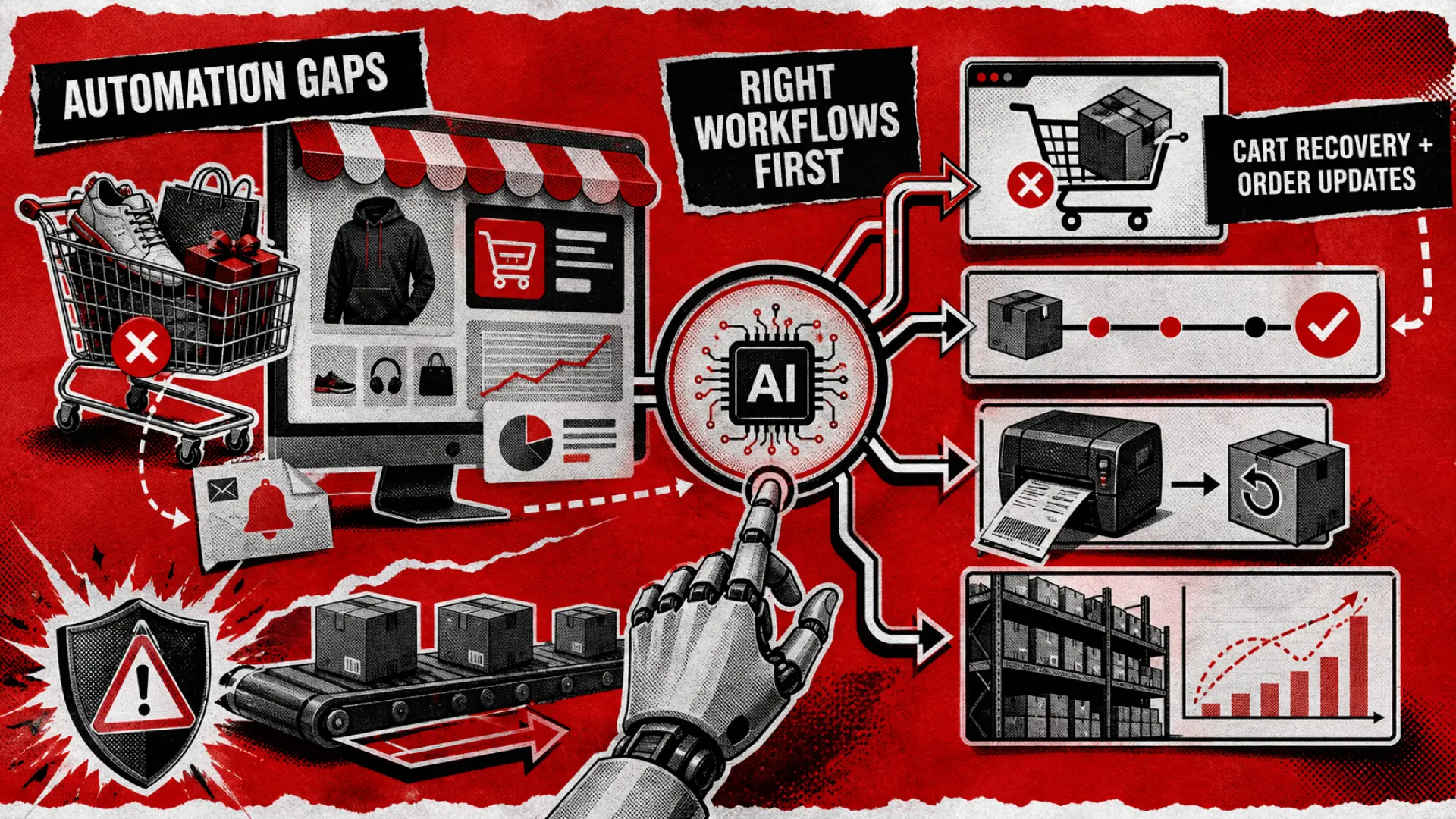
E-commerce AI automation is a tool that gives you the opportunity to fight and win against the challenges of intense competition, economic volatility, and ever-shifting trends. But it can just as easily become a waste of money and time that could bury your business. The distinction lies in whether you automate the right processes in the right order and with the right tools. That’s what we’ll be discussing today.
Your store already has revenue leaks you can put a number on: 76.8% of carts abandoned globally, $16.92 spent processing each return manually, and 30% of support tickets asking about order status that could have been sent automatically. None of these are technology problems, instead they are automation gaps. And in 2026, the e-commerce AI automation implementations that close them are well-tested, consistently measurable, and within reach of businesses that have never run an AI project before.
This guide skips the theory and focuses on practical use cases of e-commerce software development and AI integrations. It covers proven implementation areas, what each requires to work, and the AI technologies that power each.
3 Necessary Things Before You Start E-Commerce AI Automation
The most common reason AI automation tools for e-commerce businesses underdeliver is not a bad tool choice but a broken data foundation. Therefore, before scoping anything, confirm you have:
- Unified Customer Profiles
Personalization and predictive systems need a single view of each customer: purchase history, browsing behavior, support interactions, and email engagement, all joined under a single ID. Fragmented profiles produce fragmented results. - Clean Product Catalog Data
Recommendation engines and dynamic pricing systems continuously ingest your catalog. Inconsistent category tags, missing attributes, and unreliable stock counts get amplified at scale. Therefore, a model confidently recommending out-of-stock products damages trust faster than no recommendation engine at all. - Documented Critical Workflows
You cannot automate a process nobody has mapped. Walk through order fulfillment, returns, and escalations step by step before scoping. Every manual handoff and judgment call is a design requirement, and those are usually where integration complexity lives.
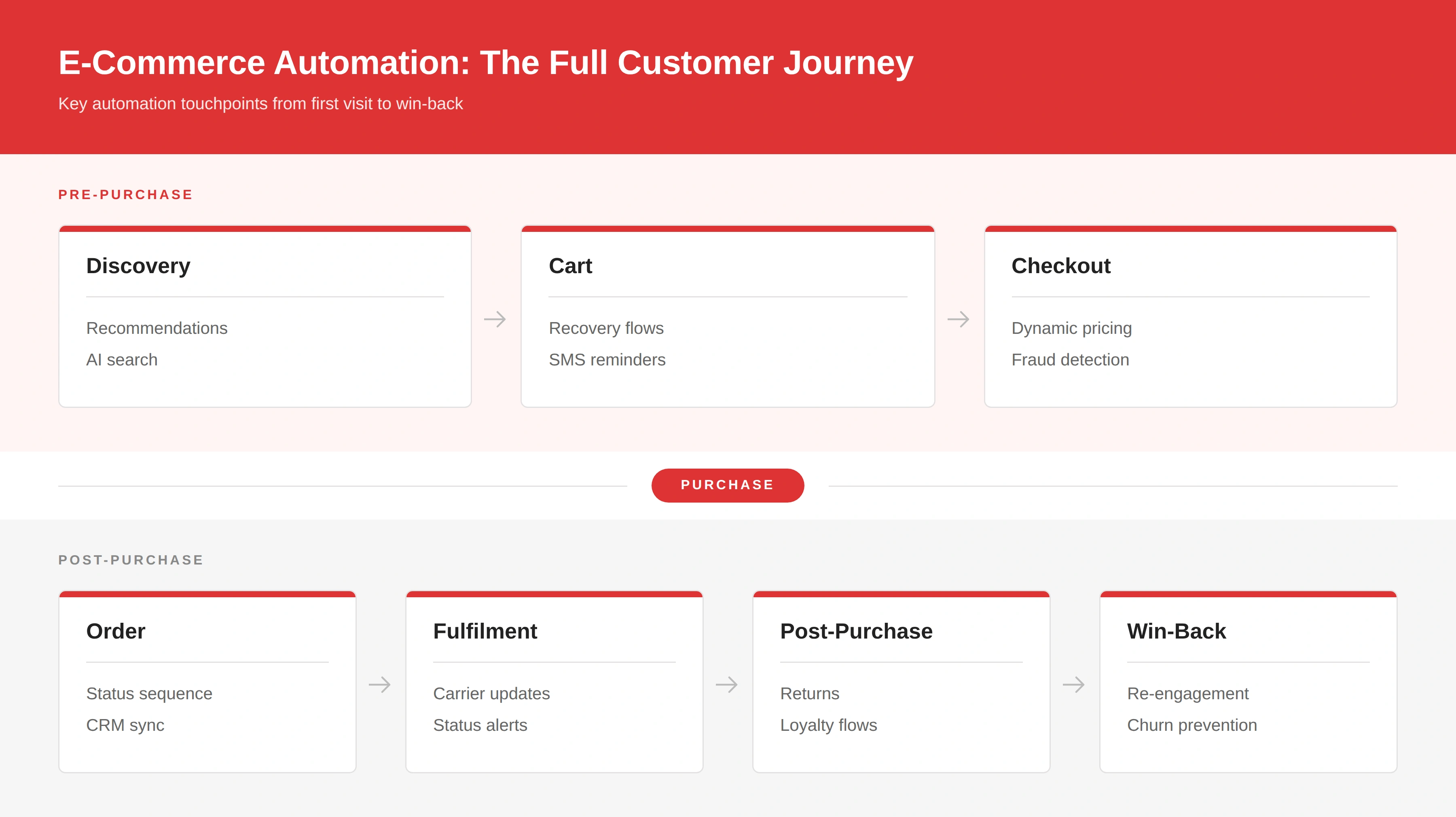
AI Automation: E-Commerce Front-of-Store
There are hundreds of tools and strategies for e-commerce AI automation you can choose from. They can be roughly divided into pre- and post-purchase process automation and back-office management. We’ll start by explaining the best practices to ensure a regular web browser converts buyers for your store.
Personalized Product Recommendations
Amazon attributes 35% of its revenue to its recommendation engine. The underlying principle scales to any catalog size, but the implementation detail most businesses miss is placement: recommendations at the cart and checkout stage consistently outperform those on the homepage, because the customer’s intent is already declared.
A practical recommendation engine e-commerce system does the following:
- Surfaces products based on real-time session signals, such as hover time, filter selections, and search queries, not just purchase history.
- Triggers contextually relevant upsell and cross-sell suggestions at checkout.
- Adapts email product recommendations to each individual’s browsing and purchase patterns.
- Re-ranks category pages for returning visitors based on prior engagement.
Abandoned Cart Recovery
A generic “you forgot something” email sent hours after abandonment converts at roughly a third the rate of a personalized sequence. Therefore, a well-built recovery automation flow should:
- Fire within one hour for high-intent abandoners, identified by multiple product page views and time-on-page signals.
- Branche by customer type, for example, first-time visitors versus returning loyalty members, with different incentives and messaging for each.
- Include an SMS touchpoint for high-value carts.
- Stop the sequence the moment the customer converts, regardless of which message triggered it.
Post-Purchase AI Automation for Online Stores
Acquiring a customer costs five to seven times as much as retaining one, yet most e-commerce business automation discussions focus almost entirely on the pre-purchase journey. Post-purchase is where the real competitive gap lies, as most businesses have weak or entirely manual processes here, making the bar to outperform low.
Automated Order Communications
Customers who receive proactive order status updates contact support 30% less often than those who have to ask. Building an automated order fulfillment communication sequence (confirmation → dispatch → in-transit update → delivery confirmation) reduces support volume measurably and requires minimal data infrastructure. Most businesses can deploy this within days or take the next step with CRM software development services. This way, you can cover the custom integration layer connecting your order management system, logistics providers, and communication channels into a single automated pipeline.
An efficient pipeline requires several components working together:
- Triggered messaging logic that fires the right notification at each order status change without manual intervention.
- Multi-channel delivery across email, SMS, and push, with the channel selected based on the customer’s prior engagement behavior.
- Real-time carrier data integration to pull accurate tracking information directly into customer-facing messages.
- CRM synchronization so every communication is logged against the customer profile, giving your support team full context when escalations do happen.
- Suppression and frequency rules to prevent duplicate sends when status updates arrive in quick succession.
Returns Automation
Manual returns processing costs an average of $16.92 per item, per Appriss Retail. An AI-driven returns system handles the repeatable decisions:
- Assesses requests against policy rules and automatically approves standard cases.
- Routes borderline cases, such as high-value items, suspicious patterns, and policy edge cases for human review.
- Generates return labels and initiates refunds without requiring a team member to touch the record.
- Flags repeat returners for account-level review.
For fashion and electronics businesses with high return volumes, automating the approval and label-generation steps alone typically recovers the development cost within months.
Loyalty and Win-Back Automation
Customers who make a second purchase within 90 days of their first have a 47% higher lifetime value than those who don’t, so the window immediately after acquisition is critical. Automated post-purchase sequences drive that second purchase without manual campaign management:
- A review request timed to the expected delivery
- A product pairing or care guide sent 48 hours later
- A replenishment or complementary product recommendation timed to the expected usage period
Win-back sequences for lapsing customers work the same way. An AI model monitoring purchase recency and email engagement can identify customers drifting toward churn and trigger the right intervention, such as a personalized offer, a loyalty point top-up, or a reintroduction to a new product category before they are gone.
Back-Office AI Tools for E-Commerce Automation: Inventory, Pricing, and Fraud
On the back-office side, AI can boost your e-commerce business’s productivity immensely. It’s also the go-to solution for cutting costs and generally reducing losses associated with delays and human error. The trick is to implement the right AI automation e-commerce tools for every workflow.
Automated Inventory Management and Demand Forecasting
Automated inventory management e-commerce systems replace reactive reordering with predictive replenishment. A demand forecasting model processes sales history, seasonal patterns, web traffic, and external variables (weather data, social media trends, and competitor stock levels) to calculate optimal order quantities and timing in advance.
McKinsey reports that AI-enabled supply chain planning reduces inventory levels by up to 20% and supply chain costs by up to 10%. For a business with $500,000 in inventory, a 20% reduction frees up $100,000 in working capital without affecting revenue.
Dynamic Pricing
Dynamic pricing AI e-commerce systems adjust prices within predefined guardrails based on demand signals, competitor pricing, and inventory velocity. Industry benchmarks show 2% to 5% sales growth and 5% to 10% margin improvement from well-implemented deployments. The guardrails are not optional, as a fully autonomous pricing model without floor prices and category constraints will eventually surface prices that erode customer trust.
Fraud Detection
AI fraud-detection e-commerce models build a behavioral profile for every transaction and flag anomalies in milliseconds. Production AI models achieve 87% to 96.8% detection accuracy with false positive rates below 2%, compared to 37.8% accuracy for traditional rule-based systems (ResearchGate, 2025). The false positive rate is not a secondary concern: 33% of customers will never return after a legitimate transaction is declined.
AI Marketing Automation for E-Commerce
48.9% of retail companies already use AI marketing automation e-commerce tools, making it the most widely adopted AI application in the sector. A mature implementation in this area should be able to handle:
- Behavioral email and SMS sequences triggered by browse events, wishlist additions, post-purchase milestones, and engagement drop-off, each personalized to individual signals rather than demographic segments.
- Send-time and channel optimization based on each customer’s open and click history.
- AI-generated product descriptions and ad copy for large or frequently updated catalogs, with human editorial review before publication.
- Continuous bid and budget management in paid media based on real-time cost-per-acquisition data.
McKinsey reports that personalization leaders improve marketing spend efficiency by 10% to 30%. Adobe Digital Insights found that generative AI traffic to U.S. retail sites grew 4,700% year-over-year by July 2025, with those visitors showing 32% longer sessions and a 27% lower bounce rate.
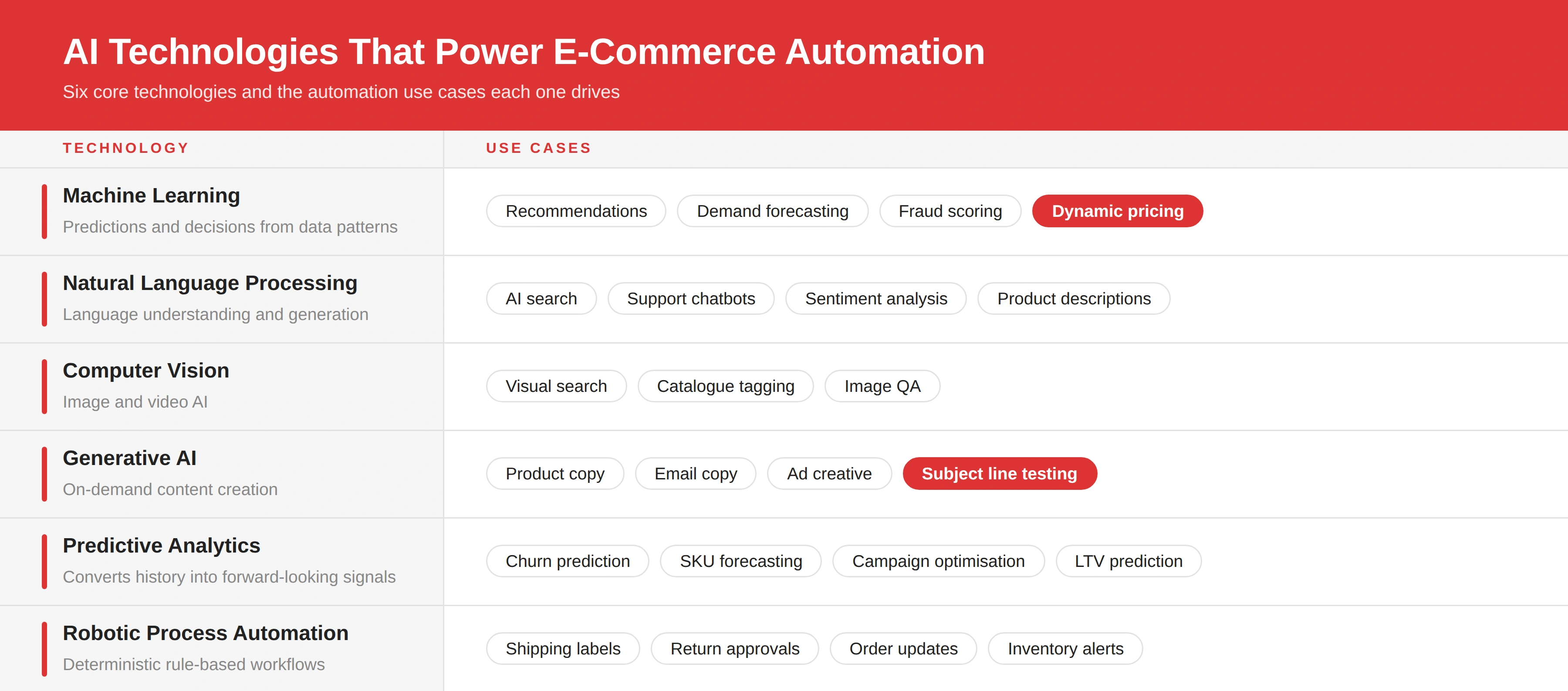
Technologies That Power E-Commerce AI Automation
Six core AI-powered e-commerce tools and technologies underpin the automation implementations described in this guide. Understanding what each one does helps you scope any project accurately.
- Machine learning drives the decision-heavy use cases: product recommendations, demand forecasting, fraud scoring, and dynamic pricing. Models are trained on your historical data and continuously updated as new signals arrive.
- Natural language processing (NLP) handles everything language-related: AI-powered search that understands conversational queries, chatbots that resolve support tickets, sentiment analysis on customer reviews, and automated product description generation.
- Computer vision enables visual search: shoppers upload a photo to find matching products, as well as automated catalog tagging and product image quality checks at scale.
- Generative AI produces on-demand content: product copy, email subject lines, and ad creative variations trained on a brand’s voice and catalog taxonomy. Human editorial review before publication remains essential.
- Predictive analytics converts historical data into forward-looking signals: which customers will churn, which SKUs will spike, and which campaigns will convert. It is the intelligence layer that makes every other system sharper.
- Robotic process automation (RPA) handles deterministic, rule-based workflows: generating shipping labels, processing return approvals, and updating order statuses, without requiring a model to make decisions.
It’s crucial to understand that these technologies rarely run in isolation. For example, a returns system combines RPA with machine learning, while a recommendation engine combines machine learning with NLP. The value comes from how they are connected, not from any single layer on its own.
Where to Start Your AI Automation E-Commerce Journey
The fastest ROI path for most e-commerce businesses: deploy automated order status communications first (low data dependency, immediate support volume reduction), then abandoned cart recovery, then inventory management. Build unified customer data in parallel as it unlocks every advanced use case. That’s enough to get you going with process optimization and revenue increase while your ROI keeps improving, so you can grow your tech investments further.
If you are mapping out an automation roadmap for your e-commerce business, contact us. The Redwerk team of 90+ software engineers and AI specialists will identify the highest-value automation opportunities in your current stack and design an implementation path that delivers measurable results.
See how we built
an AI-powered recruitment app
acquired by a US staffing giant