You piloted GPT-5 on a narrow internal task. The demo went well. Then the math hit. Per-call pricing scales against you, compliance won’t sign off on data leaving the VPC, and accuracy on your jargon plateaus somewhere between “promising” and “production-ready”.
You’re not alone. Gartner‘s 2026 strategic technology trends report names domain-specific language models as a top enterprise priority precisely because generic large language models often fall short for specialized tasks, while DSLMs deliver higher accuracy, reliability, and compliance for targeted business needs.
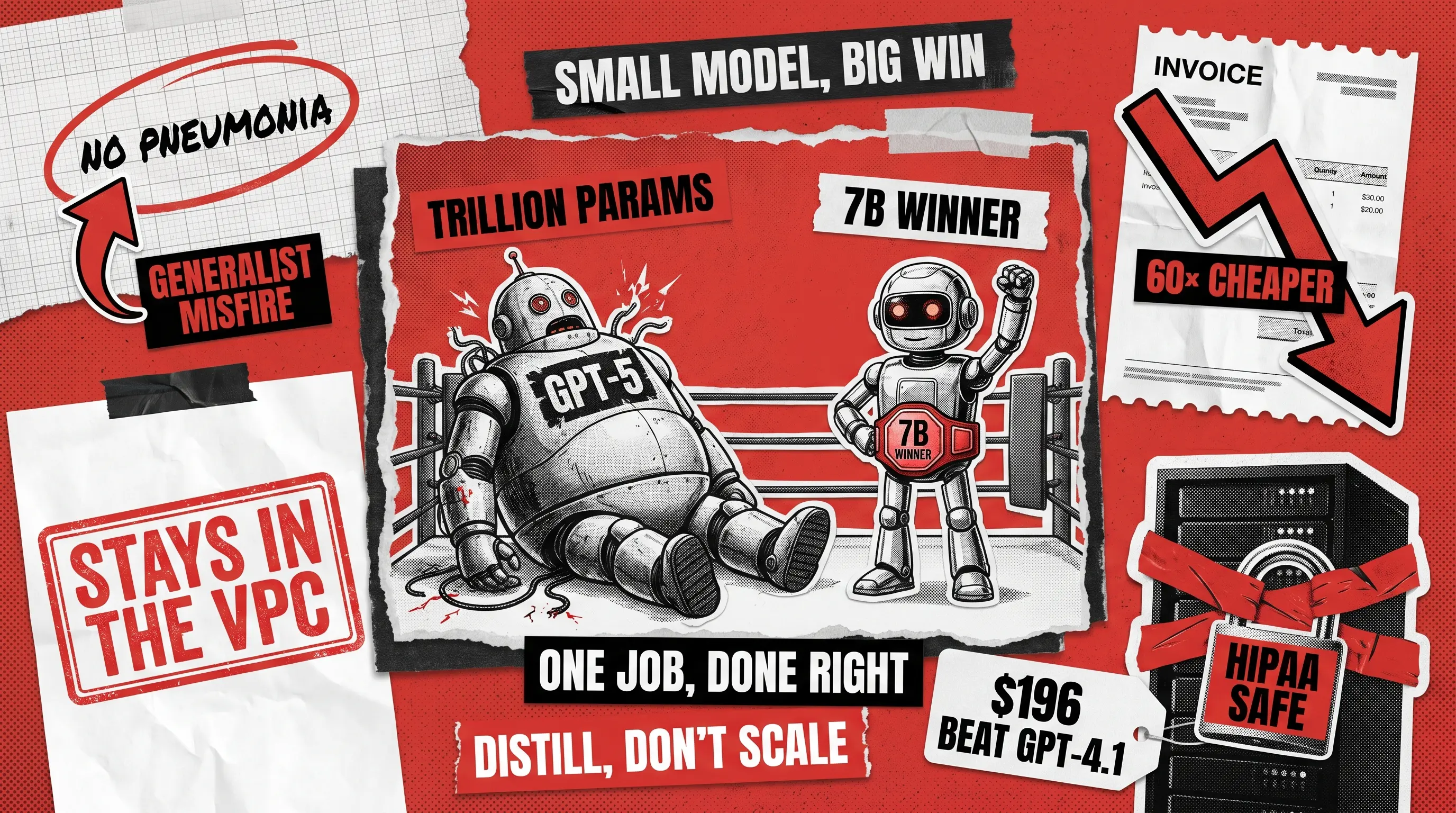
The counter-intuitive fix: go smaller, not bigger. On a narrow, well-defined task, a distilled LLM can match or beat a giant generalist while running cheaper, faster, and entirely on your own infrastructure. That’s exactly the premise behind AI model distillation as a delivery approach: take a large teacher model, train a smaller specialist on it, and ship something production-ready that fits inside your cost, latency, and compliance envelope. One published example sets the tone: Extract-0, a 7B-parameter specialist, outscored GPT-4.1 on document extraction with a training bill of $196. Let’s jump into why this works, three vertical wins that prove the pattern, and what it takes to build one.
Why Frontier LLMs Lose Ground on Narrow Tasks
Frontier models are built to be good at everything. That’s exactly the problem when your job is one thing. A generalist trained on the entire internet brings too much baggage to a narrow task. It knows fifty adjacent topics and second-guesses the one convention your team actually uses every day.
A few numbers that show how big the gap gets. Extract-0, a small 7-billion-parameter model trained specifically for document extraction, scored 0.573 on the task while GPT-4.1 managed 0.457. BioBERT, a biomedical specialist, beats GPT-3 on medical text tasks while being roughly 500 times smaller. LEGAL-BERT hits 92% accuracy on legal classification work where general models stall in the high 60s.
The mechanism is unflashy. A specialist learns the vocabulary, abbreviations, negation patterns, and reasoning shortcuts of one world deeply. A generalist averages them out. Gartner now puts a number on the shift, predicting that by 2027, organizations will use small, task-specific AI models three times more than general-purpose LLMs. The small language model vs LLM decision used to default to the bigger option. In 2026, on a narrow task, that default is the expensive path to a worse result. This is the case for a domain specific LLM.

Accuracy, Cost, and Data Sovereignty: Where a Domain-Specific LLM Flips the Math
Three tradeoffs change shape the moment your task gets narrow enough. On a broad, exploratory workload, frontier APIs win on convenience and breadth. On a single, repeating, jargon-heavy job done thousands of times a day, the same three factors that made the frontier model attractive in the demo start working against you in production.
Accuracy plateaus where your work gets specific. Costs scale linearly with usage instead of flattening out. And sensitive data has to travel to a third-party endpoint every single time, which is exactly the conversation your compliance team doesn’t want to keep having. Here’s how each one looks up close.
Hitting the Jargon Other Models Miss
Generalists hallucinate on the edges that matter most. ICD-10 modifiers. GAAP versus IFRS. Clause taxonomies. Jurisdiction-specific phrasing. The negation in “no evidence of pneumonia” that frontier models occasionally flip to its opposite.
A specialist trained on your corpus stops missing those. At production volume, a 2-point accuracy gap is the difference between a tool people use daily and one that quietly gets routed around. The research backs this up cleanly: a 2024 study covering BioBERT and LEGAL-BERT found domain-tuned models scored 92–94% on specialized tasks while a 175B-parameter generalist landed around 89% on the same benchmarks, despite being orders of magnitude larger.
Cost That Doesn't Punish Your Roadmap
API pricing scales linearly with volume. A self-hosted 7B model on a single GPU is a fixed monthly cost. The break-even point usually lands somewhere between 100K and 500K calls per month, and once you’re past it, the curves diverge fast.
There’s a second-order effect that gets less airtime. When every call has a price, every product decision becomes a margin question. “Should we add this to the workflow?” turns into a spreadsheet exercise. Owned models remove that drag. Inference is also where the bleeding happens at scale: industry analysts now estimate inference accounts for roughly 85% of enterprise AI budgets in 2026, with always-on agentic workflows multiplying that exposure.
Data That Never Leaves the Perimeter
This is the tradeoff that gets the project funded. HIPAA, GDPR, the EU AI Act, SOC 2, financial residency rules, attorney-client privilege. All of them share one constraint: sensitive content can’t touch a third-party endpoint. A vertical LLM running inside your VPC removes the BAA negotiation, shortens the audit trail to one boundary, and turns “what happens if there’s a data leak” into a non-question.
The European Commission adopted its Cloud and AI Development Act on June 3, 2026, introducing the first EU-wide four-tier sovereignty assurance framework for cloud and AI services. Enterprises with EU public-sector exposure or obligations under DORA, NIS2, or the EU AI Act can no longer treat “where does my data get processed” as a procurement footnote. A model that runs inside your own infrastructure answers that question once, for every audit, every contract, every regulator.
On a narrow task in a regulated vertical, all three tradeoffs point the same direction.
Specialist LLMs in Healthcare, Finance, and Legal: Three Wins That Prove the Pattern
The argument lands when you put it next to real verticals. Healthcare, finance, and legal share the same operating constraints: narrow, repeatable work, jargon that doesn’t forgive a generalist’s guesswork, and data that can’t casually leave the building. They’re also the three sectors where the cost of a wrong AI output isn’t a polite regenerate-and-retry, but a regulatory finding, a misfiled claim, or a privileged document in the wrong hands. Three short cases, same shape: the task, where the generalist breaks, the specialist approach, the outcome.
Healthcare: Medical Coding and Clinical Summarization
The task is high-volume, jargon-dense, and PHI-bound. Generalists confuse ICD-10 modifiers, miss negation (“no evidence of pneumonia” read as “pneumonia”), and force a HIPAA conversation no one on your team wants to have.
Specialist medical LLMs trained on clinical notes and EHR data run on a single GPU inside the hospital network. They beat GPT-5-class models on clinical NLP benchmarks like NER, medical reasoning, and hallucination detection. The accuracy gain is measurable. The per-patient cost stops scaling with hospital volume. PHI never leaves the building. The HIPAA conversation gets shorter.
Finance: Document Extraction and Regulatory Review
BloombergGPT proved the pattern at the high end. The production playbook now runs smaller. A specialist tuned on your filings reads them the way an analyst does, doesn’t fabricate line items, and keeps your proprietary corpus inside your own infrastructure. Faster than rerunning a frontier model on every page, and the per-document cost is predictable enough to put in a board deck. For comparison-shoppers weighing SLM vs LLM for this kind of work, the calculus rarely favors the generalist once volume crosses six figures per month.
Legal: Clause Review and Contract Analysis
Legal teams spend enormous time on a handful of repetitive tasks: redlining contracts, surfacing non-standard clauses buried inside long agreements, and flagging regulatory exposure across portfolios of thousands of documents. These are exactly the kinds of narrow, pattern-driven jobs where a domain-tuned model pulls ahead, and the research bears it out. LEGAL-BERT hit 92% on legal classification benchmarks where general models scored in the 60s. Modern legal specialists handle this work at scale without ever sending privileged documents through a third-party API, which keeps the privilege intact and the audit trail short.
The accuracy story is strong. The privilege story is what gets the contract signed. No partner wants to explain to a client why their NDA got vectorized in someone else’s data center.
What It Takes to Build an Industry-Specific AI Model in Production
If you’re at this point in the article, you’ve stopped asking whether the approach works and started asking what it costs. Here’s the honest version.
Three real paths, picked by constraint:
- Fine-tuning an open base model (Llama, Mistral, Qwen) on 10,000–30,000 labeled domain examples. LoRA or QLoRA on a single GPU. The default starting point for most teams, and the most flexible base to build on.
- Distillation from a frontier model. Use GPT-5 or Claude to generate training data, then train your small model on it. It inherits the teacher’s reasoning and costs a fraction to run. It keeps the production model under your control. According to public 2026 pricing benchmarks, inference on a fine-tuned 8B open model can run roughly 60x cheaper than the equivalent fine-tuned GPT-4o at 10K requests per day.
- RAG plus fine-tuning combo. The combined approach uses fine-tuning to teach the model your domain’s patterns, then layers retrieval on top for facts that change too often to bake into the weights. Most production stacks end up here because it solves both problems at once. When conversational access matters on top of that foundation, the same architecture extends naturally into a domain-tuned chatbot layer that inherits the specialist’s accuracy.
The practical numbers:
- Timeline: 6–12 weeks to a production-ready first version, depending on data readiness.
- Team: an ML engineer, a domain expert for annotation review, a DevOps person for deployment. Not a research lab.
- Data: quality beats quantity. 10K well-annotated examples consistently outperform 100K noisy ones.
- Infrastructure: a single A100 or equivalent runs most 7B–13B specialists in production. The hardware bill is smaller than most teams expect when they first look.
For teams already running broader LLM development work, a domain specific large language model is usually an extension of the existing stack rather than a parallel project. The same is true when the next step is wiring the specialist into autonomous workflows, where a purpose-built AI agent inherits the specialist’s accuracy and runs it inside the same controlled environment.
The build pattern matters because IBM Research‘s 2026 benchmarks show what specialized fine-tuning actually delivers: its Granite 4.1 8B instruct model consistently matches or outperforms a 32B Mixture-of-Experts model on enterprise tasks, at a quarter the parameter count, when fine-tuned for the downstream job. The lesson: parameter count isn’t the lever. Task focus is.
An industry specific AI model is not a research artifact. It’s an asset you own, deployed against one job that pays for itself.
When a frontier API still beats a custom LLM
Honesty section. The specialist path is wrong for some teams.
The task is genuinely broad or creative
Frontier API with prompt engineering
Volume is under 10K calls per month
API economics still win
Requirements change weekly
RAG over a frontier model
No proprietary data exists to fine-tune on
Frontier API; revisit when you have data
For narrow, high-volume, regulated, jargon-heavy work, which is most of what gets quoted in healthcare, finance, and legal, a custom approach is the rational choice. Naming the exceptions makes the rule sharper.
Narrow Wins
On a narrow, well-defined, high-volume job in a regulated vertical, a distilled specialist matches or beats GPT-5 while running cheaper, faster, and inside the firewall. The “bigger model = better” reflex was true in 2023. In 2026, on your task, it isn’t.
If you’ve got one narrow job you’d hand to AI tomorrow if cost and compliance weren’t in the way, that’s the brief we like. Tell us the task, the volume, and the data rules, and we’ll tell you whether a specialist makes sense and what it’d take to build. Contact us when you’re ready.
See how decades of niche domain expertise became the #1 automated pricing solution used worldwide.