Most teams pick between fine-tuning and RAG based on the last article they read. Three months later, they’ve shipped the wrong technique and are quietly rebuilding. The tech isn’t the hard part. The decision gets made before the criteria do.
The stakes aren’t abstract. A 2025 MIT Sloan Management Review and BCG study of 2,102 respondents across 116 countries found agentic AI adoption outpacing both traditional and generative AI, with most organizations still wrestling to turn pilots into production. The 2026 Stanford AI Index Report recorded 362 documented AI incidents in 2025, up from 233 the year before, and noted that improving one dimension of model performance often degrades another. Pick the wrong technique and your LLM ships anyway. The problems just show up in user-facing ways.
If you’re weighing fine tuning vs RAG, you’re past the “what is it” stage. That belongs in the discovery phase. What follows is the framework we use on every LLM project. Six questions, a scoreable table, three scenarios where the framework points in different directions, and the mistakes that eat weeks of schedule.
The Decision Framework for RAG vs Fine Tuning
Six questions, one sentence of reasoning each. Score them against your project, then check the summary table. The goal isn’t to crown a winner. It’s to make the one or two decisions that should be obvious actually become obvious.
- How fast does your knowledge change? Daily or weekly updates kill fine-tuning. A fine-tuned model is a snapshot, and the moment your docs shift, the snapshot is stale. RAG trades freshness for a retrieval hop. If your data moves faster than your retraining cadence, RAG is the honest answer.
- Do you need to cite sources or pass an audit? RAG returns the document it used to answer. Fine-tuning bakes facts into weights you cannot inspect. Regulated industries almost always need the receipt, and fine-tuning without RAG rarely survives a compliance review.
- Is your knowledge base large or proprietary? Internal documentation, customer data, niche industry corpora, anything that wasn’t part of the model’s training: this is RAG territory. Stuffing it all into a fine-tune is wasteful, brittle, and doesn’t scale beyond a single team’s content.
- Do you need a strict tone, voice, or output format? Brand voice, fixed JSON schemas, legal drafting style, niche domain language: these are behavior problems, not knowledge problems. Prompting gets you most of the way, and fine-tuning closes the gap that prompting and RAG alone cannot.
- Do you have at least 1,000 clean labeled examples ready to go? If not, the decision makes itself: RAG first, hybrid later. Fine-tuning without a real dataset is how teams ship broken models and blame the wrong technology.
- What’s your latency budget? RAG adds a retrieval hop, typically 100 to 400 milliseconds. For most apps, that’s invisible. For voice interfaces, real-time gaming, or high-frequency trading copilots, it’s disqualifying.

Here’s the same logic condensed into a scorecard. It’s the format we use in every AI development project kickoff, because it turns a philosophical argument into a 10-minute exercise.
Knowledge changes weekly or faster
✓
Source attribution or audit trail required
✓
Knowledge base is large or proprietary
✓
Strict tone, voice, or output format required
✓
1,000+ high-quality training examples on hand
✓
Sub-500 ms latency at scale required
✓
Tally the checks. More RAG marks, start with RAG. More fine-tune marks, start with fine-tuning. A three-three split almost always means hybrid, which we come back to below.
Three Projects, Three Different Answers
Same framework, three scenarios, three different outcomes. The questions don’t change, but the relative weight of each one does. What follows is how the rag vs fine tuning decision plays out when you apply it to real-world constraints.
FinTech: A Regulatory-Change Assistant for Compliance Teams
A regional bank wants an internal tool that answers “has this regulation changed, and what do we need to update?” Regulations move monthly. Compliance teams need to see the source.
Run the framework. Knowledge freshness tilts hard toward RAG. Attribution tilts harder. Tone and format are neutral, because an internal tool doesn’t need a personality. Domain language is niche but manageable with retrieval context. There is no labeled training dataset, because the bank has policies, not examples. Latency is relaxed.
Score: RAG wins decisively.
Fine-tuning fails here for two reasons. Retraining a model every time the European Banking Authority issues guidance is operationally impossible. Auditors expect a citation, not a confident paraphrase they can’t verify. The retrieval layer is where these systems win or lose, and solid data engineering does more for accuracy than any model swap.
Teams in financial products carry the extra weight of AI compliance in finance: the EU AI Act, MiCA, and whatever your regulator layers on top.
HealthTech: A Clinical Decision-Support Assistant
A medical device company builds a triage assistant for clinicians. The tool should reason like a junior doctor, cite up-to-date guidelines, and respond in the hospital’s structured format.
Run the framework. Freshness leans RAG, because drug interactions and guidelines update. Attribution leans RAG, because clinicians won’t act without a source. Tone, output structure, and domain language all lean fine-tune. The team has a corpus of historical case notes, so labeled examples exist. Latency is moderate.
Score: hybrid, by design.
This is where RAFT (retrieval-augmented fine-tuning) earns its acronym. Fine-tune the base model on medical reasoning and clinical tone. Use RAG at query time to pull current guidelines, drug-drug interactions, and local protocols. You get the voice of a doctor with the working memory of a well-indexed pharmacy.
Picking the model approach is only half the job. The other half is the agent framework, where the LangChain vs LangGraph comparison is the one most teams land on.
eCommerce: An AI Customer Support Agent with Brand Voice
A direct-to-consumer brand wants a support bot that sounds like their team, knows the current catalog, and handles refund logic per their policy. Brand voice is the product, and the inventory changes daily.
Run the framework. Freshness, attribution, and policy accuracy lean RAG. Tone, format, and consistency lean fine-tune. Domain language is neutral. Dataset is strong, because support tickets are a goldmine of labeled examples. Latency sits under one second.
Score: hybrid, weighted toward fine-tune plus RAG.
Fine-tune for voice, tone, and response format. Use RAG for catalog, pricing, policy, and customer order history. This is the default architecture for most serious consumer-facing AI customer support agent projects, and it’s the stack we use in most chatbot development work.
Why Production Usually Ends Up Hybrid
Hybrid often gets dismissed as a compromise. In production, it’s the rule, and serious LLM deployments usually follow a three-stage path that keeps risk, cost, and learning speed in sensible proportion.
- Ship RAG first, because it’s faster, cheaper to iterate, and reveals which parts of model behavior actually break under real traffic.
- Measure for a couple of weeks, looking for tone mistakes, wrong output formats, and reasoning gaps that no amount of prompting fixes.
- Fine-tune only what RAG can’t reach, which is usually voice, structured outputs, and narrow reasoning patterns.
That staged path also matches the real LLM RAG vs fine tuning tradeoff. You don’t pick forever on day one. You pick the cheaper, faster entry point, learn where it hurts, and invest in the expensive option only where it earns its keep.
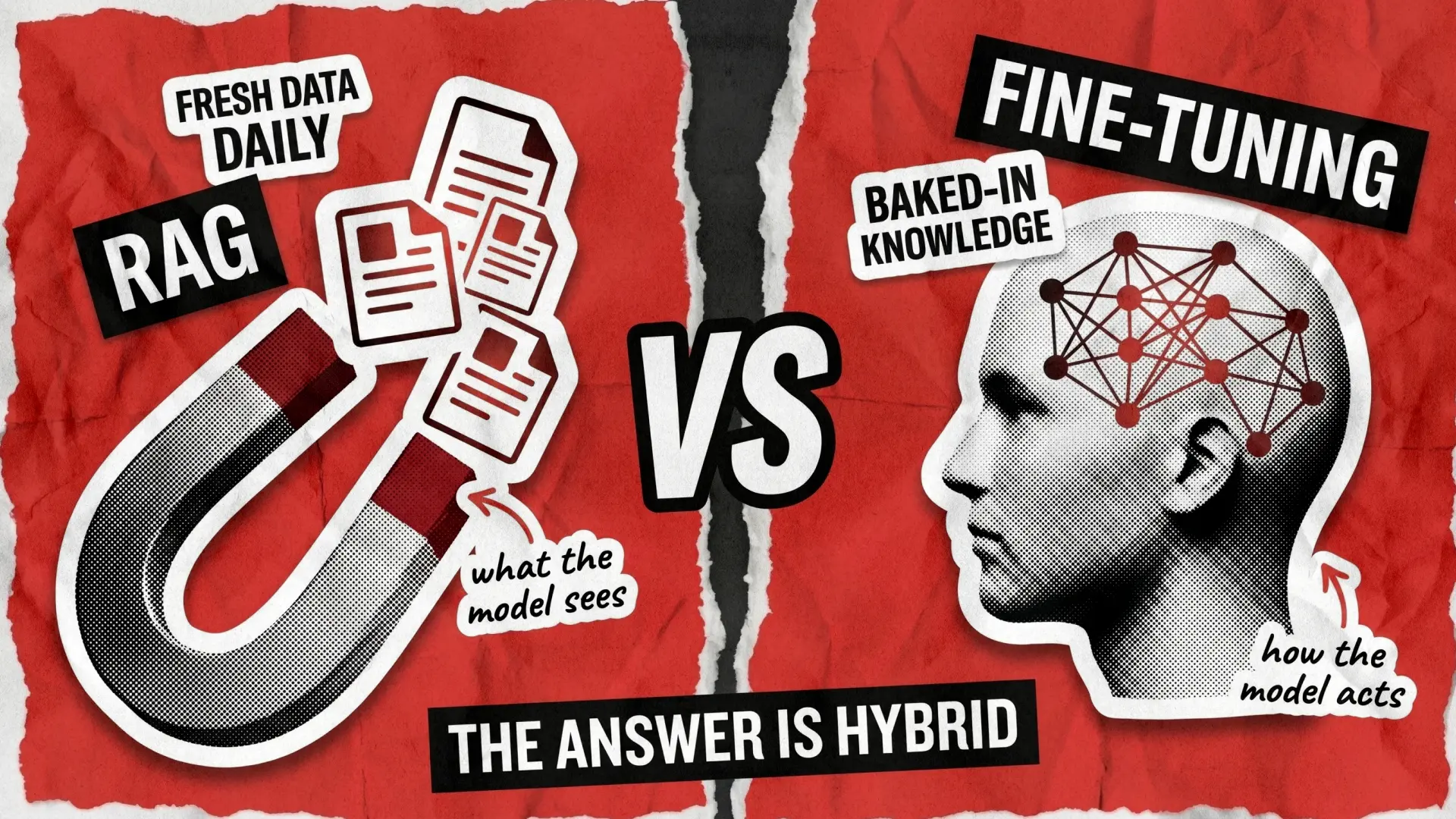
This is why the RAG vs fine-tuning argument is often a trick question. The real question is which one first, and most of the time that’s RAG.
Three Mistakes That Waste Weeks
Some mistakes come from misunderstanding the tech. These come from misunderstanding your own constraints. Catch them before the technique gets locked in and you save weeks of rework.
Fine-Tuning a Model to Teach It Facts
Fine-tuning shifts behavior, not knowledge. Teams who fine-tune on a product catalog routinely watch the model hallucinate SKUs that don’t exist, confidently citing specs from a generation ago. For facts, use RAG. Full stop.
Building RAG Before Trying Long Context
If your full knowledge base fits in 200,000 tokens, modern models can hold all of it in prompt with caching. No vector store, no retrieval hop, no pipeline to maintain. Cases where long context quietly replaces RAG:
- Product catalogs under 500 SKUs with stable metadata.
- Internal policy handbooks and employee documentation.
- Research corpora you query but rarely extend.
- Onboarding and FAQ content that changes quarterly, not daily.
Test this before you build anything. It’s the fastest way to end the retrieval augmented generation vs fine tuning debate for your project before it starts.
Most AI project failures trace back to inadequate measurement, not model choice. If you can’t measure retrieval precision and groundedness, you aren’t shipping, you’re hoping. A 30-prompt evaluation set, run weekly, catches most regressions before users do.
Making the Call
The right answer isn’t RAG or fine-tuning. It’s knowing which to start with, when to layer the other on top, and which question to stop debating.
For most teams, that means RAG first. Add fine-tuning when RAG hits its ceiling on tone, format, or specialized reasoning. Measure everything, ship in stages, and don’t retrain a model to teach it a fact.
If you’d like a second opinion on your approach before the first line of code gets written, contact us. Twenty minutes, no deck, straight to the decision.
FAQ
Can you use RAG and fine-tuning together?
Yes, and in production you usually should. The hybrid pattern, sometimes called RAFT (retrieval-augmented fine-tuning), has fine-tuning handle tone and format while retrieval handles facts. Most non-trivial LLM systems end up there.
Is RAG better than fine-tuning?
It’s the wrong question. RAG handles knowledge that changes. Fine-tuning handles behavior that shouldn’t. They solve different problems, and the two often belong in the same architecture.
Which is easier to maintain long term?
RAG, as long as retrieval quality holds. Fine-tuned models need a retraining cadence, while RAG needs index upkeep and query tuning. Pick the ongoing workload your team can realistically own.
See how Evolv turned a legacy SaaS into the #1 AI-driven digital growth solution, stabilized the model pipeline, and scaled to enterprise customers.