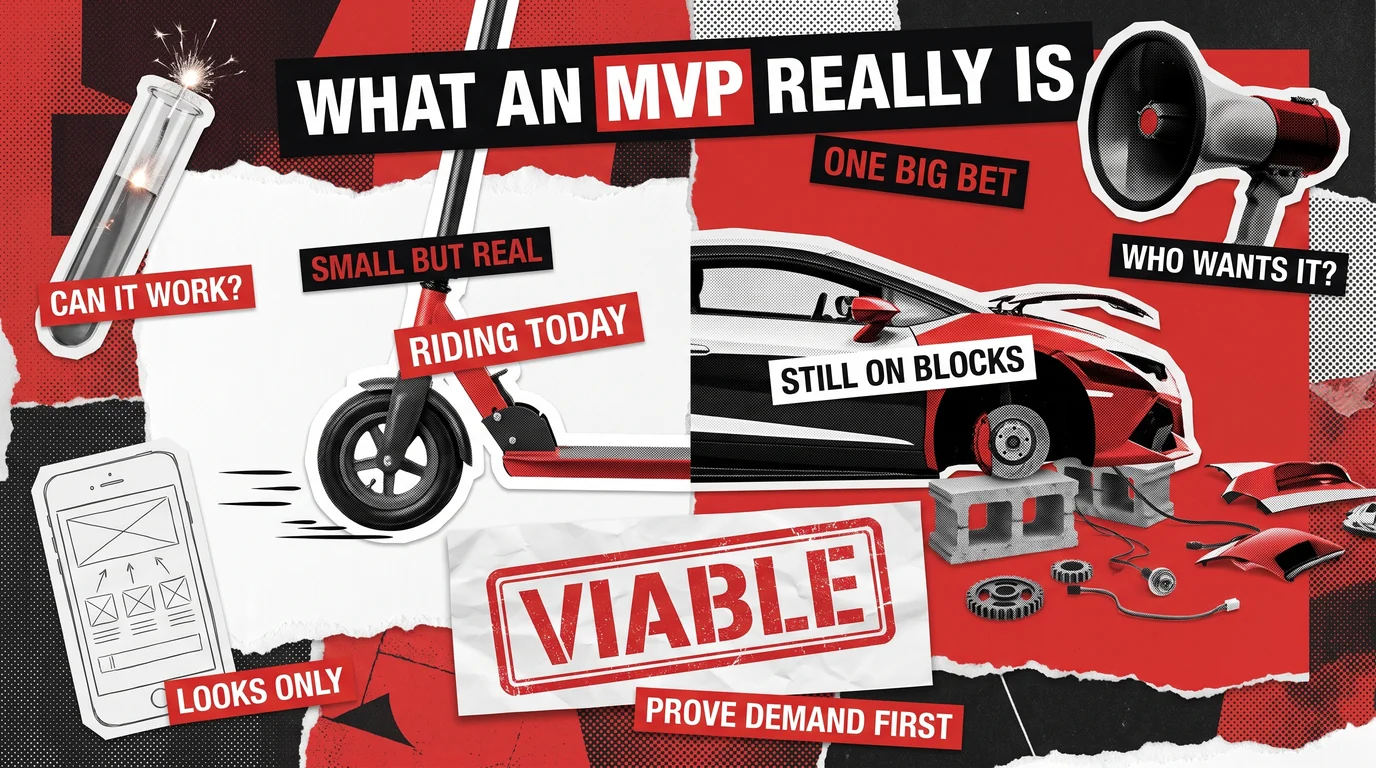
An MVP in software development is the smallest working version of a product that real customers can use. Teams build an MVP to check whether enough people want the idea before spending the full budget.
In practice, the term covers anything from a rough app sketch to the full product minus a few features. As a result, some teams build too little to learn from, and others spend a year on the “minimum” version. When delivering MVP development services, we follow your decisions on what the product must prove, which sets the scope, budget, and timeline.
In plain terms, this guide answers the question “What is MVP software?” You’ll learn how an MVP differs from a proof of concept (PoC) and a prototype, and how to choose among the five main types.
What an MVP in Software Development Actually Is
MVP stands for minimum viable product, a name that describes a balance between two goals. The software should include only the features needed to test the main assumption, meaning the belief your whole plan depends on, such as “small clinics will pay a monthly fee for online booking.” Those features must still work well enough for people to use them for a real task. Missing that balance in either direction is costly, because a version that barely works teaches the team nothing, while a complete build takes too long to reach customers.
Frank Robinson coined the term in 2001, and Eric Ries later popularized it in his book The Lean Startup. Since then, testing demand early has remained the main job of an MVP in software development, as building something nobody needs is one of the most common reasons projects don’t succeed. In a 2026 analysis of 431 venture-backed startups that shut down, CB Insights found that 43% failed because of poor product-market fit, meaning the product didn’t match what enough customers wanted.
With the term stretched in so many directions, knowing what an MVP isn’t is just as useful:
- A rough draft: An MVP offers only a few features, but all of them must work reliably for real people.
- A demo: A demo shows an idea to an audience, whereas an MVP lets customers use the product while you watch what works and what doesn’t.
- Version 1.0 with random features removed: Every feature in an MVP helps test the main assumption, and everything else waits for a later release.
- Only for startups: Mid-sized and large companies use MVPs to check demand for new products, internal tools, and unfamiliar markets before a full rollout.
- Throwaway code: A code-based MVP usually becomes the foundation of the full product, so the code needs a sound structure from the start.
MVP vs Proof of Concept vs Prototype
People often compare MVP vs prototype vs PoC because the three steps happen early in a project and are all small, but each stage answers a different question:
- PoC: Can this be built? A PoC is a quick technical trial of the riskiest part of the idea, such as an unfamiliar technology or a link to a third-party system, and customers never see it.
- Prototype: Will people understand the design? A prototype maps out the screens and the steps a user takes, usually as a clickable draft with no working code underneath.
- MVP: Do people want the product? An MVP in software development is a real, working version that customers use, so you find out whether the market will pay for what you built.
Our guide to proof of concept in software development covers the first stage in depth, including a side-by-side comparison of all three. Software prototyping usually comes next, and it’s the cheapest point to fix a confusing screen, because changing a design costs far less than rewriting working code. For that reason, Redwerk’s UI/UX design services often produce clickable mockups before development starts.
Projects usually move from PoC to prototype to MVP, although many skip a stage. Well-known technology rarely needs a PoC first, and an app with a handful of simple screens may only need a quick round of design feedback before development begins.
Our work with 1Amped, a London e-learning company building a web-based circuit simulator, shows the stages in action. During a discovery phase, our team confirmed the idea was technically possible, designed more than 15 detailed screens, and planned the underlying system to support over 100,000 users. 1Amped came away with a visual demo to show investors and an estimate of 1,000 hours to build the MVP.
Five Types of MVPs and What Each One Tests
An MVP in software development doesn’t have to be a full app, and the right type depends on what you need to learn and how much you want to spend finding out. The lightest types test demand before a real product exists, while the heavier ones put working software in customers’ hands. The table below compares the five main types.
Landing page MVP
A web page describing the product, with a sign-up or pre-order button
Whether people are interested enough to register or pay
Lowest
Concierge MVP
The service, delivered manually by your team
Whether the result is worth paying for
Low
Single-feature MVP
Working software that does one job
Whether the core feature solves the problem
Medium
No-code MVP
A working product assembled from ready-made tools
Whether people keep using the product
Low to medium
Full code-based MVP
Custom software with a few core features
Demand, plus whether the product can grow
Highest
Landing Page MVP
A landing page MVP is a single-page website that describes the product as if it already exists, with a sign-up, waitlist, or pre-order button that leads only to a form. If enough of the right visitors click, you have early evidence of demand, and if few do, you’ve learned something important for the price of a web page and some ads. Either way, a sign-up shows interest, which tells you less than people using a product.
Concierge MVP
In a concierge MVP, your team delivers the service personally to a few early customers, with little or no technology involved. For example, a business preparing to launch a meal-planning app might first put together weekly menus and shopping lists by hand for five households to see whether they would pay for the result. That manual work shows what people value before you spend money automating the service.
A variation gives customers a simple screen, such as an online order form, while staff handle each request themselves. Both approaches are cheap in code but expensive in staff time, so they suit tests with a handful of early users.
Single-Feature MVP
A single-feature MVP does only one job, but does it well. It means that you pick the feature that solves the customer’s main problem, build it as real software, and leave everything else for later. For example, a scheduling tool might launch with booking only and add billing, reminders, and reports once users show they rely on booking.
No-Code MVP
A no-code MVP is a working product built from ready-made tools, such as website builders, online forms, spreadsheets, and payment services, instead of custom code. For example, a home repair company could take bookings through a shared calendar and a checkout link for a few months before deciding whether a dedicated app is worth the money. Today, AI app builders also let people without programming skills create software by describing it in plain English, an approach known as vibe coding. Our roundup of vibe-coded apps shows what these tools can produce.
Don’t confuse a no-code MVP with a no-code mockup, though. A mockup is a prototype that only shows the planned screens, whereas a no-code MVP is software that real customers use, so it has to work every time.
AI app builders are fast, but that speed can make the software less safe. Such tools run on large language models, the AI systems that do the programming. When Veracode checked the output of more than 100 of these models in 2025, AI-generated code introduced security flaws in 45% of tests. A quick AI-built MVP is fine for learning, but before it handles payments or personal data, it usually needs the same careful review as any MVP in software development, or a rebuild. If your MVP was vibe-coded, our vibe code cleanup team can handle that review and fix the weak spots.
Full Code-Based MVP
A full code-based MVP is the most traditional form of MVP in software development: a custom build with a small set of core features, designed to grow into the complete product. This type costs the most of the five, but it’s the right choice when the product depends on unique business rules, handles sensitive data, or needs to connect with other systems from the start.
The school observation app we created for The Education Partners, part of the GEMS Education family, followed this path. The client first described the basic concept, and our developers outlined the features and drew rough screen layouts. Once the prototype was approved, we built a first version and then worked with the client’s team to decide what to add next. That approach took the app from four planned screens to 20, and the project went from zero to launch in 3 months.
If you’re unsure which type fits, start with the cheapest option that can answer your question. A lighter test that shows real demand gives you a much stronger case for investing in a code-based MVP.
What Comes Next After You Define Your MVP
Getting the definition of an MVP in software development right, plus knowing when you need a PoC or a prototype first, saves months of work on the wrong thing. Before you start building, make sure your team can answer these questions:
- What single assumption does the MVP need to test?
- Who are the first users, and how will you reach them?
- What result would count as success, and what would make you stop?
- Which features does the test need, and which can wait?
With those answers in hand, you’re ready for the build itself, which our guide on how to build an MVP the right way walks through step by step. If you want to move faster, MVP development with AI explains where the tools save time and where they add risk. Budget deserves a close look as well, since the hidden costs of MVP development, such as post-launch maintenance, third-party integrations, and skipped testing, rarely appear in a first quote.
Whether you arrive with a detailed plan or just the assumption you want to test, we typically deliver a working MVP in 8 to 12 weeks. We keep you informed at every stage, so you always know what’s done and what’s coming. To find out what your MVP should prove and which type fits your idea, talk to our team.
FAQ
What is an MVP in software development?
An MVP in software development, short for minimum viable product, is a first release built to answer one business question with real users, usually whether demand is strong enough to justify the full investment. It includes the fewest features that can answer that question, each working properly, and later versions grow from what users actually do with it.
Is an MVP only for startups?
No. Mid-sized and large companies use MVPs too, often to secure internal approval for a bigger investment. A small working release gives leadership real usage data instead of forecasts. Offering it to a limited group of customers also keeps early problems away from the main brand and the existing client base.
How long does it take to build an MVP?
A code-based MVP usually takes about 2 to 3 months. At Redwerk, a typical project runs 8 to 12 weeks: roughly 2 weeks of discovery, 6 to 8 weeks of core development, then final polish and launch. Enterprise MVPs take 10 to 14 weeks, complex software-as-a-service (SaaS) products 14 to 16, and lighter tests such as a landing page can go live within days.
What's the difference between an MVP and a beta version?
An MVP tests whether a product idea is worth developing further, so it has only the core features and may change a lot after launch. A beta version is a nearly finished product released to a limited group of users to find bugs and polish details before the full release.
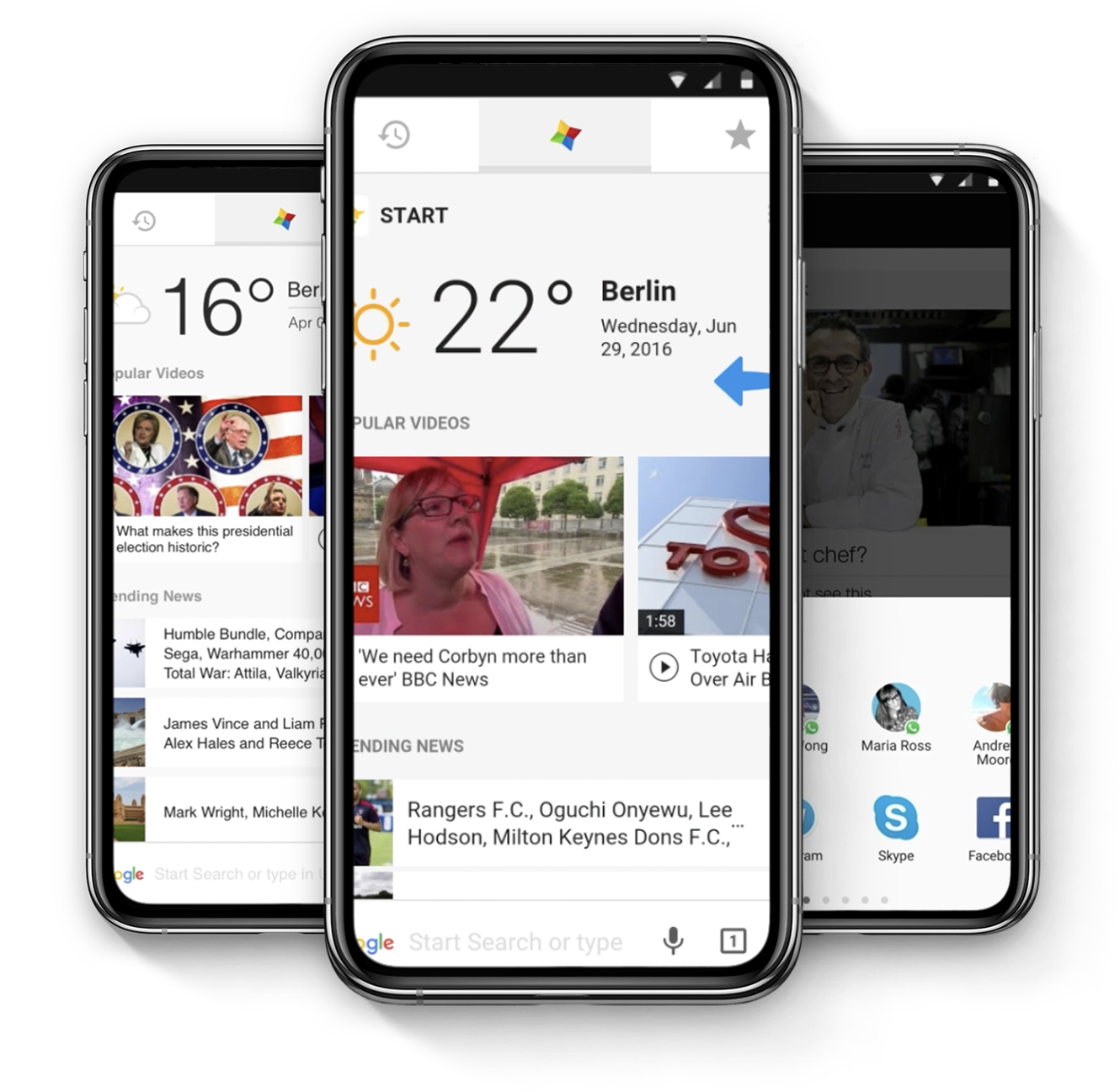
See how we took Searchturbo from concept to a shipped Android MVP with 500K+ installs and growing