AI in software development now touches every stage of delivery. It drafts requirements during discovery, writes and refactors code, pre-screens pull requests, generates tests, and flags vulnerabilities in maintenance. The gains are real and uneven: speed rises fastest in coding and prototyping, while review, security, and governance decide whether that speed survives production.
For a founder or engineering manager, this turns the build decision into a governance decision. Which stages get AI, which tools are sanctioned, who reviews the output, and how much budget goes to cleanup a year later? Redwerk has shipped software since 2005 and runs AI-assisted software development across client teams, so this guide walks through each stage the way we handle it on real projects, trade-offs included.
AI in Software Development: Planning and Discovery
Discovery is where AI saves the most money per hour spent, because every assumption fixed here costs nothing to rewrite in code. The work has shifted from long specification documents toward structured requirements and clickable demos produced in days. Judgment stays with people: which feature drives revenue, which stakeholder has the final word, and which risk no dataset can predict.
Requirements and Estimation
Meeting transcripts, legacy documentation, and support tickets can now go into a language model that returns draft user stories, a prioritized feature list, and flagged contradictions between stakeholders. Estimation follows the same pattern. The model compares the scope against patterns from comparable builds and produces a first range the team can challenge. That is the core of how AI is changing the discovery phase: faster first drafts, with human validation as the gate before any budget is signed.
Faster Prototyping
The biggest change in planning is the move from static wireframes to working prototypes during discovery itself. A clickable build in the first weeks gives stakeholders something to react to, and reactions surface missing requirements earlier than any document. Prototypes built this way do three jobs:
- Validation. Users and investors test a flow before production budget is committed.
- Scope control. Disputed features get settled by showing them, which shortens sign-off.
- Architecture checks. The prototype exposes integration and data questions while they are still cheap to answer.
The catch is that prototype code is written for speed. It needs a rebuild or a hard review before it becomes the product’s foundation.
This approach also suits teams that start without full specifications, which is common among the clients who come to Redwerk. AI turns early conversations into structured requirements and a working demo, and engineers then validate the estimate line by line before a budget is approved.
AI-Assisted Coding
Coding is where adoption moved fastest and where the distance between a demo and production is widest. Tools have evolved from autocomplete in the editor to agents that read a repository, plan a change across files, run tests, and open a pull request. That shifts a senior engineer’s day toward specifying, reviewing, and correcting, and it changes what a client should ask a vendor about process.
Coding Assistant Capabilities
Today’s AI coding assistants fall into two groups. In-editor assistants complete and edit code as the developer types, while agents take a task description and work across the repository on their own. Both are strong on repetitive work and weaker the more a task depends on context that lives outside the code.
Boilerplate, CRUD endpoints, config
Well, with minor edits
Naming, structure, team conventions
Refactoring and framework upgrades
Well on scoped modules
Choosing the scope, regression checks
Multi-file features through agents
Mixed, depends on repo quality and task spec
Task breakdown, review of every diff
Architecture and domain logic
Weak
Trade-offs, data model, business rules
Coding Assistants by Use Case
The right assistant depends on the repository, the IDE, and the security rules in place, so a tool-agnostic setup works better than one company-wide standard. These options cover most delivery scenarios:
- Claude Code and OpenAI Codex for agent-driven tasks, including setups wired into GitHub, Jira, and CI pipelines.
- Cursor for mixed-skill teams and frontend-heavy work, where it has had the lowest onboarding friction in Redwerk deployments.
- GitHub Copilot, Amazon Q Developer (the successor to CodeWhisperer), and Gemini Code Assist inside VS Code and IntelliJ, picked to fit the cloud provider and repository host.
Proprietary codebases call for assistants running against private cloud or on-premises models, so client code stays inside the client’s environment. Usage dashboards belong in week one, because per-seat and per-credit costs grow quietly once a whole team adopts the tools.
Wins and Trade-offs
The productivity gain is measurable at scale. A 2026 study of tens of thousands of Microsoft engineers found that adopters of command-line coding agents merged roughly 24% more pull requests than they would have otherwise. Clients of our AI-assisted delivery report up to 2x faster delivery in early sprints.
The trade-off arrives later. More merged code means more code to review, and assistants tend to repeat logic instead of reusing it, so duplication is the first issue our engineers expect when they audit an AI-heavy codebase. Teams that skip review turn their speed into technical debt, which is why cleaning up AI-written codebases has become a standard Redwerk engagement.
Code Review and Testing
Review and testing are the stages where AI output meets quality gates, and they absorb most of the extra volume that coding agents produce. Both have useful automation today, with limits that show up in merge rates, brittle tests, and bugs that pass every check. The practical goal is a pipeline where machines handle the first pass and engineers make the final call.
AI in Code Review
AI reviewers such as SonarQube and DeepCode AI comment on a pull request within minutes, catching style issues, common bug patterns, missing null checks, and known vulnerability signatures. That first pass frees senior reviewers for design, data flow, and business rules. Fully automated review is a different story. A 2026 study of 3,109 pull requests found that PRs reviewed only by code review agents reached a 45.20% merge rate, against 68.37% for human-reviewed PRs, with significantly higher abandonment.
The strongest setup pairs AI-powered code reviews for the first pass with a senior engineer for approval. Used this way, clients of our AI-assisted delivery report up to 60% less time spent on code review.
Test Generation Limits
AI test generation is good at volume. It drafts unit tests for existing functions, fills coverage gaps, and produces edge-case inputs faster than any engineer. It struggles in four places:
- Tests that mirror the code. Generated from the implementation, they confirm what the code does, bugs included.
- Coverage theater. The coverage percentage climbs while critical business paths stay untested.
- Brittle end-to-end suites. Generated UI tests break on minor layout changes and add maintenance work.
- Missing intent. The model only knows the acceptance criteria someone wrote down.
We treat generated tests as drafts. A QA engineer checks each one against the requirements before it joins the suite.

Maintenance and Security
Most of a product’s cost arrives after launch, so maintenance is where AI savings compound. The same tools that speed up delivery also widen the attack surface, because every assistant, plugin, and agent becomes part of the software supply chain. That is why the two belong in one conversation: each gain on one side creates a new obligation on the other.
Lighter Maintenance Load
AI now handles much of the routine upkeep: dependency upgrades, log analysis, bug triage, and documentation for code nobody remembers writing. Codebase indexing is the underrated win. New engineers can question a repository directly instead of waiting for a senior colleague, which is one reason we can onboard onto an inherited product in days. This is how AI software maintenance is reshaping businesses that run products for years: routine upkeep gets cheaper, and senior time moves to incident root causes, release decisions, and regulated data.
New Security Risks
Attackers use the same tools. IBM’s 2026 Cost of a Data Breach research found that one in four malicious breaches were AI-enabled, a 56% increase over the previous year, and more than 20% of organizations reported a breach targeting AI models or applications. Inside the codebase, these are the risks we check for most often:
- Insecure suggestions: injection flaws, weak input validation, and hardcoded secrets that look correct in review.
- Hallucinated packages: imports of invented dependencies that attackers later register under the same name.
- Prompt leakage: API keys and customer data pasted into chat tools.
- Over-privileged agents: write access to repositories, CI, or production granted for convenience.
Every AI-generated change on our projects goes through the same OWASP-aligned checks as human code. The honest answer to is AI-augmented development secure depends on exactly these controls being in place before agents scale across a team.
Shadow AI and Governance
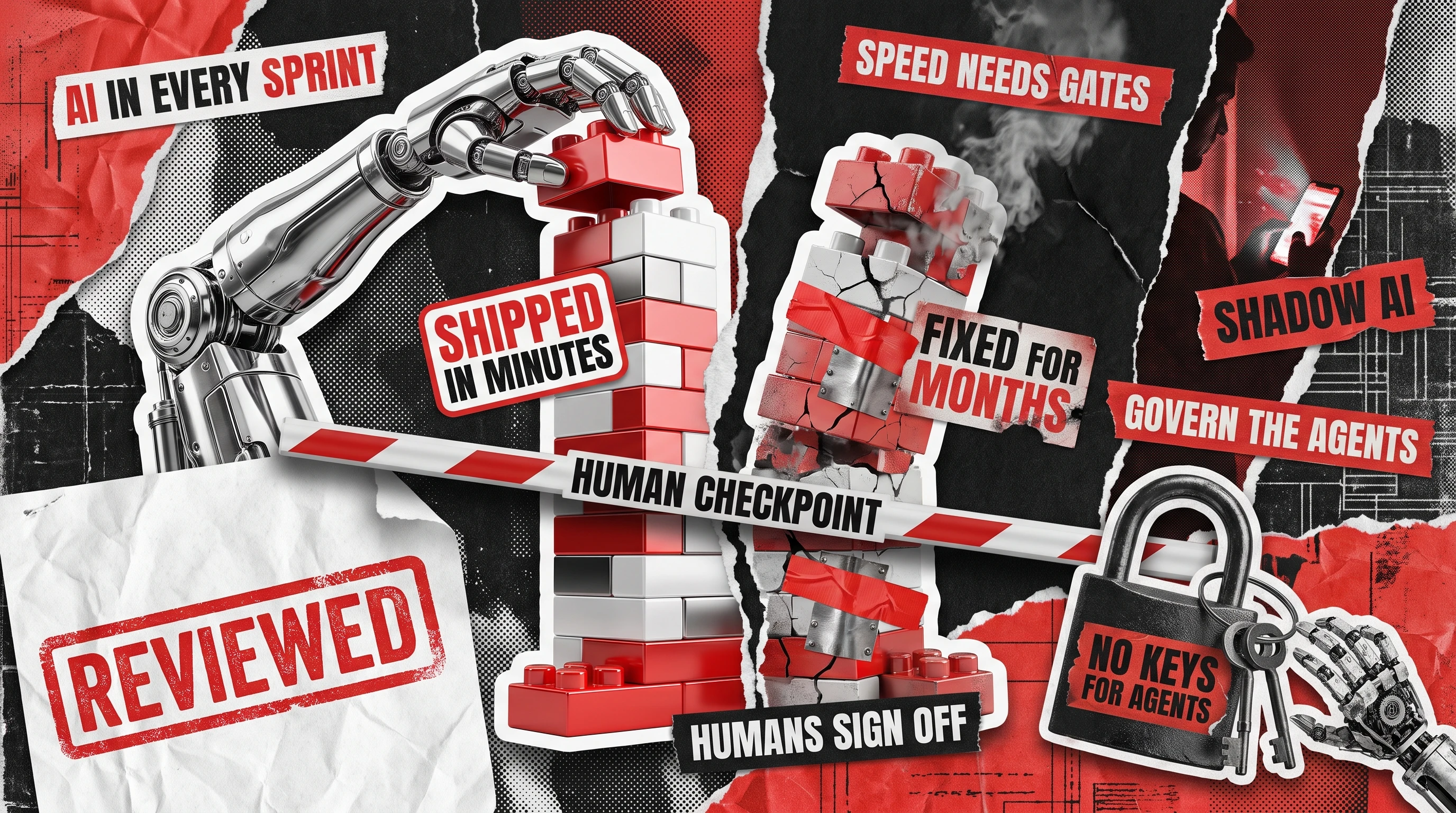
Governance is the stage most teams add last and need first. Developers adopt new tools every week, and every unsanctioned assistant is a place where code, credentials, or customer data can leave the company. Oversight has to cover the whole AI software development lifecycle, from the prompt a product manager types during discovery to the agent that opens a pull request overnight.
Common Forms of Shadow AI
Shadow AI is the use of AI tools without approval or monitoring from engineering or security leadership. In software teams it looks ordinary: a personal-tier assistant paid for on a developer’s own card, a browser chatbot used to debug a production stack trace, a local agent connected to an internal database, or a SaaS feature that switched on AI processing in an update. Each one creates an exposure nobody is tracking, from licensed code copied into a proprietary repository to secrets stored on a third party’s servers. Shadow AI detection in the SDLC starts with network traffic, SaaS logs, and repository signals, since written policies alone miss most real activity.
Practical Oversight Stack
Governance works when the sanctioned path is the easiest one. This is the six-part control set we set up in the first weeks of an engagement:
- An approved tool list with enterprise accounts, so the sanctioned option is as easy to use as a personal one.
- Private or zero-retention model endpoints for any repository with proprietary or regulated code.
- Pull request labels or commit trailers that mark AI-generated changes, so reviews and audits stay traceable.
- Human review and automated security scanning on every AI-authored change, small diffs included.
- Scoped agent permissions: read access by default, write access per task, and production credentials kept out of reach.
- Usage and cost dashboards reviewed monthly, plus a one-page policy on which data can go into which tool.
Each control takes days to set up. Together they make AI usage visible and auditable for the client’s own team.
Governance as the Competitive Edge
The last two years settled the adoption question for most engineering teams, so owning the tools is now the baseline. The open question is control: which stages are automated, which are gated, and how quickly problems in AI output get caught. A year later, two teams with the same assistants can own a clean, extensible codebase or one slowed by review debt and rework, and process makes that difference.
Redwerk has delivered software since 2005 and has run 30+ AI-assisted projects, with Claude Code, Codex, Cursor, and Copilot deployed across client teams. We bring the tooling, the review discipline, and the governance setup as one package, and we keep clients in the loop at every step. That mix fits teams without full specifications, teams with an in-house skills gap, and teams inheriting an AI-written codebase that needs rescue. If you want AI speed with production-grade control, contact us and we will map where it fits your product.
FAQ
Which SDLC stages benefit most?
Coding and discovery show the fastest gains, because AI drafts code, requirements, and prototypes in a fraction of the usual time. Code review and maintenance come next, with AI handling the first pass and routine upkeep. Architecture, security sign-off, and release decisions benefit least and stay with senior engineers.
Is AI-generated code production-safe?
It can be, once it passes the same gates as human code: peer review, automated security scanning, and tests written against real requirements. Unreviewed AI output often carries duplicated logic, weak input validation, or invented dependencies, so safety comes from the process around the tool.
How should a development partner use AI?
A reliable partner uses AI across discovery, coding, code review, testing, and maintenance, and keeps a human checkpoint at each stage. At Redwerk, that means tools such as Claude Code, OpenAI Codex, Cursor, and GitHub Copilot, with every AI-authored change going through human review and security checks. Proprietary code runs on private or on-premises models when the client requires it.
See how we helped Evolv, an AI-led platform, rearchitect its core product and power 20+ successful releases