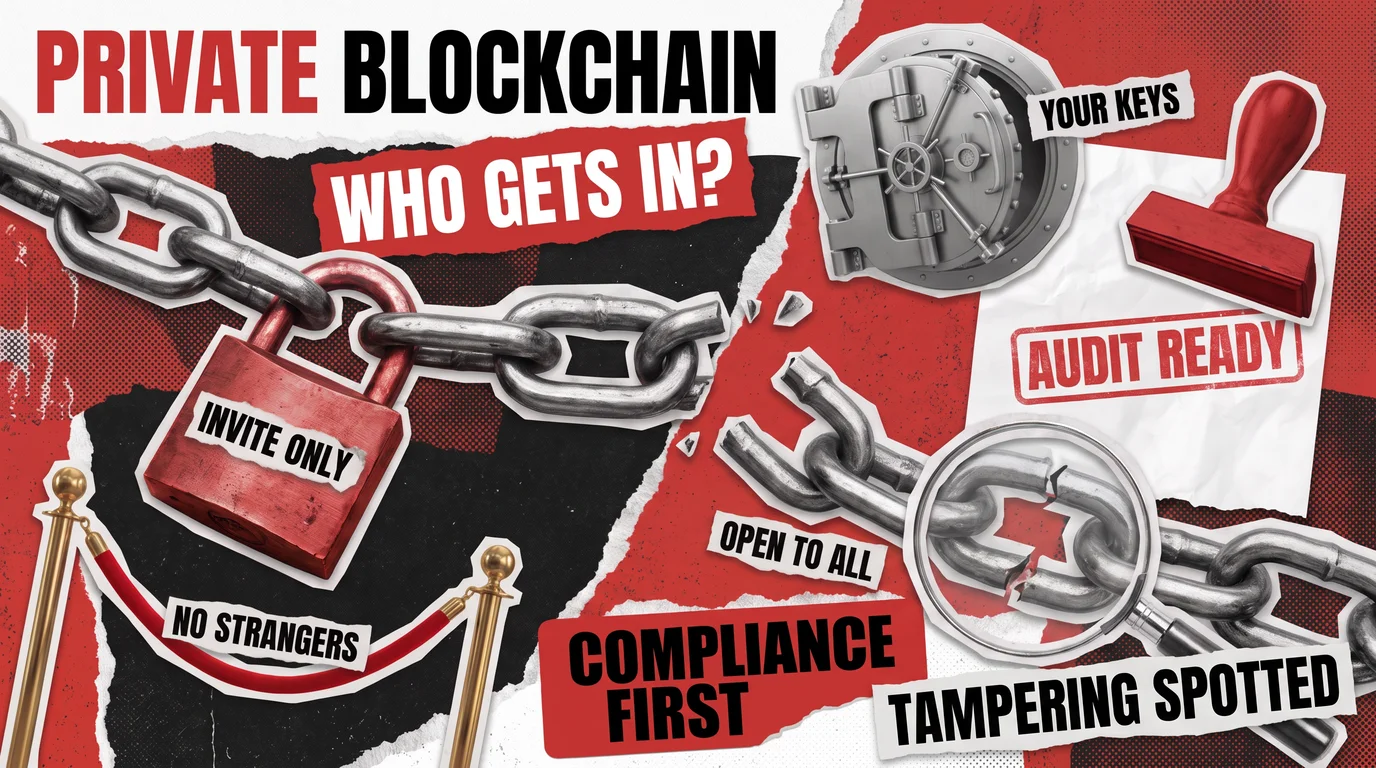
Private blockchain development means building a blockchain network that only approved members can join. Your company gives up full decentralization in exchange for control over who joins, faster transactions, and an access model that regulators recognize. The trade-off makes sense when your partners or suppliers need one shared ledger that nobody can secretly change, and you must decide who sees what.
If customers or other outsiders need to check your records for themselves, a public network fits better. And if the data never leaves your own organization, you may not need a blockchain at all.
Private, public, and consortium networks are the three main models, and the best choice depends on who needs access to your records. If you’d rather discuss your project with engineers right away, see our blockchain development services.
What Makes a Blockchain Private
A blockchain is a shared record of transactions copied across several computers, called nodes. New entries are grouped into blocks, and every block is linked to the one before it. Changing an old entry would break all the links that follow, so any tampering is easy to spot.
Permissioned access is what makes a blockchain private. On a public network such as Bitcoin or Ethereum, anyone can download the record, send transactions, and help confirm new blocks. In a private network, an administrator approves who joins and gives every member specific rights:
- Reading entries
- Adding transactions
- Confirming new blocks, a job done by members called validators
Because everyone on the network is known, there’s no need for heavy defenses against anonymous attackers. As a result, validators confirm new entries in seconds, nobody pays per-transaction fees, and each member sees only the data their role allows.
Private vs Public vs Consortium Blockchain
The private vs public blockchain debate often leaves out a third option: the consortium model, where several organizations share control. Each model puts a different group in charge:
- Private: One organization runs the network and decides who joins.
- Consortium: Banks, insurers, or other partner companies run the network together under shared rules.
- Public: Anyone can join, read the record, and take part in confirming transactions.
Public networks power most of the open financial tools associated with blockchain. Decentralized finance (DeFi) apps, which let people lend and trade without a bank in the middle, need a public record that anyone can check. The same applies to many forms of blockchain payment processing, where customers pay straight from their own crypto wallets. Our DeFi development services cover that open side of the market.
On the downside, every transaction on a public network requires a fee paid to validators, and the amount rises at busy times. Along with wallet support and security reviews, these charges are among the factors that shape crypto exchange development cost.
Here’s how the three models compare on the points that matter most when choosing:
Who can join
Members approved by one organization
Members approved by the group
Anyone
Who confirms transactions
A few validators chosen by the owner
Validators from each member organization
Many independent participants
Who sees the data
Only members with access rights
Members, according to shared rules
Everyone
Speed and fees
Fast, no per-transaction fees
Fast, running costs shared by members
Slower at busy times, a fee on every transaction
Who sets the rules
The owner
Members agree together
Changes need wide community support
Main weakness
Everyone relying on the record must trust the owner
Members must agree, which takes time
Hard to control who sees what
Typical uses
Records shared with partners, suppliers, or auditors
Settlement between banks, trade finance
DeFi apps, public tokens, open payments
Why Compliance Often Drives This Decision
Public networks make privacy laws hard to follow: the data is visible to anyone, and copies sit on computers you don’t control. A private network lets you decide who sees each record, where nodes are hosted, and what goes on the chain. For companies in regulated industries, that control is often the first reason to look into private blockchain development.
EU privacy regulators agree. In its 2026 guidelines on blockchain, the European Data Protection Board (EDPB) says organizations should favor permissioned blockchains, because that setup makes it clearer who is responsible for the data.
Regulations such as the EU’s General Data Protection Regulation (GDPR), the US health privacy law HIPAA, and the Sarbanes-Oxley Act (SOX) for financial records all call for control over who sees data and a clear record of who changed what. A private network provides both. The exception is GDPR’s right to deletion, since blockchain entries can’t be erased. The usual design keeps personal data in a regular database and puts only a digital fingerprint of each record on the chain, as the EDPB guidelines recommend.
Health and finance face the strictest rules, so compliance planning comes first in banking software development and healthcare IT projects. Privacy laws also govern how businesses record customer opt-ins, and a consent log that nobody can alter is one of the more practical blockchain marketing use cases. No two companies face the same mix of regulations, so we tailor the service package to each project’s requirements.
How Private Blockchain Development Actually Works
Private blockchain development starts with business questions: who needs to share the record, what each party should see, and what must be provable later. The answers shape the technical steps:
- Define who joins and what each member can do. These access rules are the core of any permissioned blockchain and often mirror the roles that already exist in your company or partner network.
- Choose a platform. Most private blockchains run on existing software, such as Hyperledger Fabric, Hyperledger Besu, or Corda, and each product handles privacy and membership differently.
- Set the rules for agreeing on new entries. The process is called consensus. Public blockchains need slow, costly methods because their participants are anonymous, while a private network’s known validators can approve blocks by voting, which is much faster. Our team works at this foundation level, often called Layer 1, where consensus and data storage are designed.
- Write and audit the smart contracts. A smart contract is a small program on the blockchain that runs a business rule automatically, for example releasing a payment once both sides confirm delivery. A live contract is difficult to change, so the code needs a security review before launch. Our smart contract audit checklist shows what to test.
- Connect the network to your existing systems. The blockchain has to exchange data with your accounting, inventory, or sales software. Every node also needs monitoring and backups. If customers will use the network through an app, plan the app at the same time. Crypto banking app features such as wallets and transaction history depend on the data the blockchain provides.
When Public or Consortium Makes More Sense Instead
A private blockchain serves a different set of priorities than a public one. Control over the network means everyone who relies on the record has to trust whoever runs it. If your partners or customers won’t accept that, a private setup can’t help.
A public network is the better fit for projects like these:
- Product origin tracking that shoppers check themselves, for example by scanning a code on a bag of coffee or a designer handbag
- Crypto lending and trading apps that anyone can use
- Event tickets, loyalty points, or digital collectibles that customers can resell or move to other platforms
A consortium works best when several companies run one process together and none of them should own it alone. For this reason, trade finance is one of the best-known blockchain fintech use cases: banks, exporters, and shippers all follow the same shipment. Similarly, pooling claims data across insurers to spot fraud is among the most common blockchain insurance use cases. However, a consortium only works if members agree on rules, costs, and who runs each node before launch. In practice, Maersk and IBM shut down their TradeLens shipping platform in 2023, and the Marco Polo trade finance network closed the same year, because neither became commercially viable.
Some projects are better served by another technology, and the EDPB guidelines ask organizations to consider that option. If one company controls all the data and only needs proof that records weren’t altered, digital signatures and timestamps can do the job with less effort. That’s how we built evidence-grade archiving for PageFreezer: every captured web page is signed with a trusted timestamp, so clients can prove what the site showed at a given moment.
Pick the Model That Matches What You Need to Prove
A blockchain project can start before your requirements are final. Most engagements begin with a short discovery phase, where we map your participants, data, and rules, and then you decide which model to build. Throughout development, our engineers report progress in plain language, so non-technical stakeholders know where things stand.
To find out which model suits your project, talk to our blockchain team.
FAQ
What is private blockchain development?
Private blockchain development is the work of building a shared digital ledger that only invited members can read or update. A typical project defines who gets which access rights, sets up a platform such as Hyperledger Fabric or Corda, and connects the network to existing business software. Companies invest in private blockchain development when partners or suppliers need one record that nobody can alter unnoticed.
What is the difference between a private and a public blockchain?
A public blockchain, such as Bitcoin or Ethereum, lets anyone read the ledger, add transactions, and help confirm new entries. A private blockchain restricts those rights to members that one organization has approved. In practice, a manufacturer sharing quality records with its suppliers would choose a private network for control and confidentiality, while an app where strangers must check each other’s transactions needs a public one.
Is a permissioned blockchain the same as a private blockchain?
Not exactly. A permissioned blockchain is any network where an authority decides who can join and what each member can do. A private blockchain is a permissioned network run by one organization. A consortium blockchain is permissioned too, but a group of organizations shares control. In everyday use, people often call both models “private,” so check who actually controls the network.
What regulations does a blockchain project need to meet?
Blockchain regulations depend on industry and location. Privacy laws such as the EU’s General Data Protection Regulation (GDPR) and the California Consumer Privacy Act (CCPA) cover personal data. Healthcare falls under HIPAA, and US public companies under the Sarbanes-Oxley Act (SOX). Financial firms may also answer to the US Securities and Exchange Commission (SEC), the New York State Department of Financial Services (NYDFS), and the Saudi Central Bank (SAMA).
Do I need a blockchain or just a database?
A regular database is enough when one company manages the data and its users trust the operator. Access controls, audit logs, and digital signatures then cover most needs at a lower cost. A blockchain is worth the extra effort when several organizations write to the same record and each needs proof that nobody, including the operator, changed past entries.
See how an iterative, user-tested build turned an anonymous web3 messenger into a product acquired within months