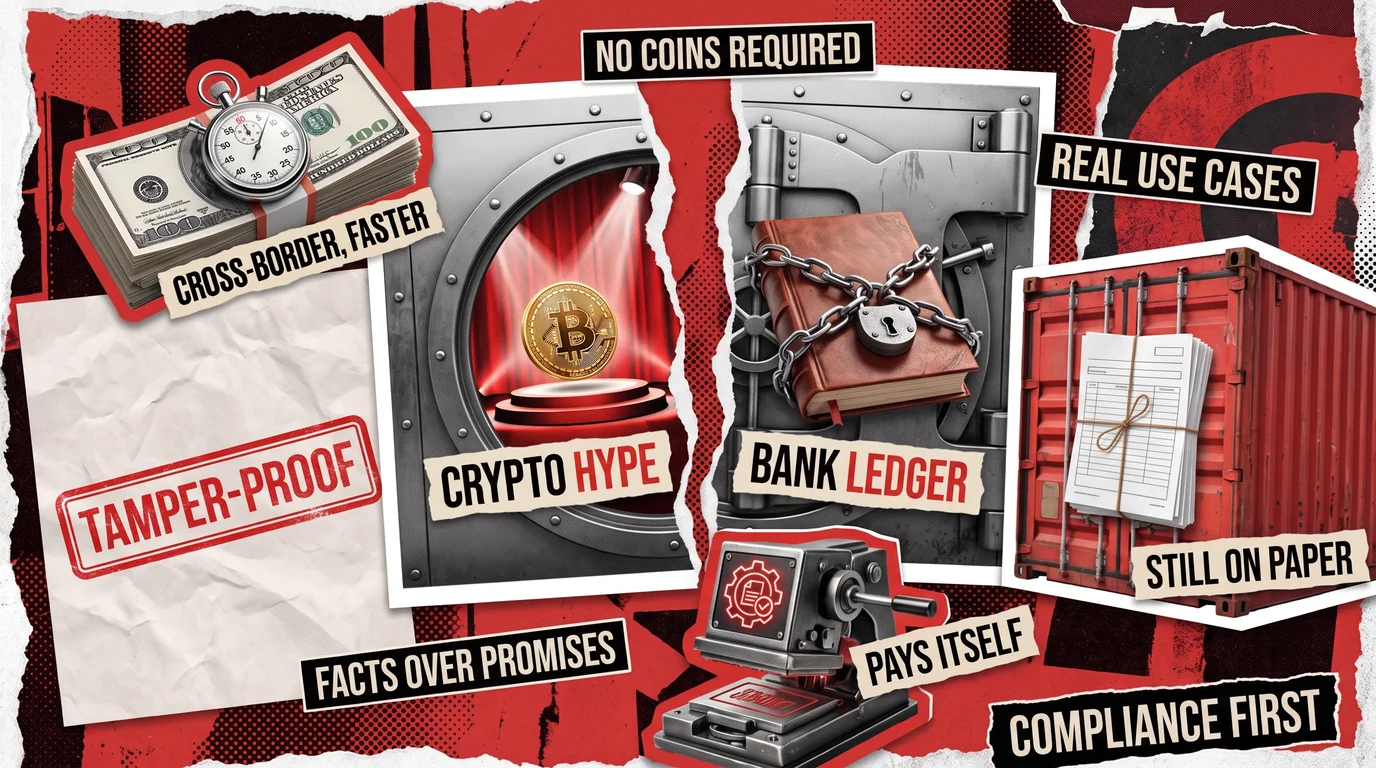
Blockchain in fintech is often reduced to cryptocurrency, but its most practical uses don’t require anyone to buy or hold coins. Banks and financial companies already use the technology to keep records that are hard to falsify and to settle securities deals automatically. Faster cross-border payments are now in live testing, while trade finance and identity checks remain less proven.
All of these applications have one requirement in common: several organizations work from one shared record, and no single member may edit past entries alone.
Decentralized finance (DeFi) and crypto trading are real markets too, but they’re only one part of blockchain’s role in finance. For teams already planning a build, we offer blockchain development services for payment, settlement, and record-keeping systems.
Where Does Blockchain in Fintech Deliver Real Value Today?
A blockchain is a ledger that several organizations keep in identical copies. New entries are added only when the members’ computers agree on them, so no single party can change the history unnoticed. In finance, that property answers the question behind every audit, dispute, and fraud case: who recorded what, and when?
Here’s how the main blockchain fintech use cases compare:
Audit trails and fraud-resistant records
Every party holds the same record, and nobody can quietly rewrite past entries
Well established
Doesn’t stop fraud as it happens
Automated settlement
Cash and assets change hands at the same moment, with no manual matching
Daily use at large scale
Code errors are hard to fix after launch
Cross-border payments
Banks update one shared record instead of passing messages along a chain
Live tests with real money
Every bank on the route must join the ledger
Trade finance
Every bank, seller, and carrier in a deal sees the same shipping documents
Early networks closed
Most trade documents are still on paper
Identity checks (KYC)
One institution’s completed check can be reused by others
Mostly pilots
Customer consent and local law
Why Are Blockchain Audit Trails So Hard to Falsify?
Two features protect the ledger:
- Linked fingerprints: Each block stores a digital fingerprint of the previous one, so a single altered record breaks the chain from that point on.
- Shared copies: Every member keeps a copy of the ledger, and an edited version no longer matches the others.
Unlike in a regular database, an administrator can’t quietly edit an invoice, backdate a transaction, or delete a log entry. Because past records stay fixed, auditors get a complete history, with the author and time of every change. That reliability has made tamper-proof logs one of the most established uses of blockchain in fintech. Insurers use the same protection against fraud, a common argument for blockchain in insurance. When several companies log every claim in one shared record, a second payout request for the same accident stands out right away.
Financial institutions are also testing the technology for Know Your Customer (KYC) checks, the identity verification required before opening an account or moving money. Today, each new bank repeats the whole process, even when another lender has already completed it. A shared ledger can record which institution carried out the KYC review and when, while the documents stay in each firm’s own database. Other banks can then rely on that entry if the customer agrees and the law allows such reuse.

Platforms for buying and selling digital coins face these record-keeping demands too. Regulators expect a full trade history and KYC file for every customer. As a result, compliance features make up a large part of white label crypto exchange cost, even when the platform itself is bought ready-made and rebranded. Records alone won’t stop a fraudulent transfer as it happens, though. That job belongs to real-time payment fraud prevention tools that score each transaction before it goes through.
How Do Smart Contracts Automate Payment Settlement?
A smart contract is a piece of code on the ledger that executes the agreed terms of a deal automatically. In settlement, the program releases the cash and the securities at the same moment, or releases neither. No back office then has to check and match records by hand. That matters because in traditional finance, money and assets can take a day or more to change hands after a deal is agreed.
Settlement is where blockchain in fintech shows its biggest numbers. Broadridge runs a ledger-based platform for repos, short-term loans in which one bank sells securities to another and agrees to buy them back later. In July 2026, that service processed $8.0 trillion in repo transactions, an average of $365 billion a day.
Smart contracts have one serious weakness: after launch, the code is very hard to change. An error can send real money to the wrong place, and the transfer usually can’t be reversed. Before release, a security specialist should review every contract against a smart contract audit checklist, testing for problems such as a payment that can be triggered twice.
Can Blockchain Make Cross-Border Payments Faster?
Blockchain can shorten the time a payment takes to reach its destination abroad, at least in tests so far. Today, an international transfer usually passes through several correspondent banks, partners that hold accounts for each other in different countries. Every intermediary checks the payment, updates its own records, and sends a message to the next institution in line. Each stop adds time and fees, and the sender often can’t see where the money is.
On a shared ledger, all the banks update one record together instead. Project Agorá, led by the Bank for International Settlements (BIS), tested this idea with real money in July 2026. In total, 28 financial institutions and central banks across Asia, Europe, and North America completed payments worth about 800,000 Swiss francs (roughly $1 million). The money moved as tokenized deposits, digital units that represent funds held in an ordinary customer account. The BIS calls the platform a prototype rather than a finished product, and testing continues.
Bank-led networks like Agorá are one way to speed up money transfers between countries. Decentralized finance takes another, where payments, lending, and currency exchange run on open blockchains without any bank involved. For companies building in this space, we offer DeFi development services, from crypto wallets to cross-chain bridges that move assets between networks.
Either way, customers rarely see the technology itself. On a phone, money sent over a shared ledger looks like any other transfer, so crypto banking app development focuses on wallets, transaction history, and clear fee information. For merchants, blockchain for payment processing can shorten the wait for funds, although refunds and currency conversion need extra planning.
Why Do Banks Share Consortium Blockchains for Trade Finance?
Trade finance covers the loans and guarantees that let exporters ship goods before the buyer pays, and each deal involves several competing banks. Every lender needs one shared record of the shipment, but none wants a rival to control it. A consortium blockchain resolves that conflict, because the member banks run the network jointly and decide together who gets access. The private vs public blockchain choice is a question of who holds control, and the group-run model sits between those two options.
A shared shipment record is valuable because trade finance depends on documents. A typical deal relies on a letter of credit, the buyer’s bank’s promise to pay once the seller proves the goods were shipped. That proof travels between banks, carriers, insurers, and customs as a stack of documents, and most of it is still on paper.
The first blockchain consortiums built for trade finance struggled to survive. In 2023, the Contour network shut down after its bank shareholders stopped funding it. By then, the platform was handling only a few dozen transactions a month, and we.trade had already closed the year before for the same reason.
What Rules Apply to Blockchain Financial Services?
A payment doesn’t escape regulation because it runs on a shared ledger. Blockchain financial services follow the same rules as traditional products, plus a few written for digital assets:
- SOX: The Sarbanes-Oxley Act requires US public companies to control and document changes to their accounting records, and a tamper-evident ledger makes that audit trail easier to prove.
- SEC rules: The US Securities and Exchange Commission decides when a token counts as a security and falls under securities law.
- MiCA: The EU’s Markets in Crypto-Assets regulation requires a license for crypto services offered to European customers, and the transition period for existing providers ended on July 1, 2026.
- GENIUS Act: This 2025 US law covers stablecoins, digital tokens tied to a currency such as the dollar.
- AML and KYC: Anti-money laundering (AML) rules require identity checks and transaction monitoring for every customer.
Consumer features aren’t exempt either. For example, in blockchain loyalty programs, points that customers can sell or transfer may count as crypto-assets.
Your legal advisors decide which of these rules cover your product and the regions you serve. We tailor the service package to each client’s specific requirements, including MiCA compliance services for companies entering the EU market. For the wider set of rules behind payment, banking, and lending products, see our fintech software development guide.
Which Blockchain Fintech Use Cases Are Worth Building Now?
Build where a shared ledger solves a specific settlement, compliance, or fraud problem that several organizations have in common. Blockchain fintech use cases that start with the technology and look for a purpose later tend to stall at the pilot stage.
Your project may have only an idea and a list of regulatory questions so far, rather than detailed requirements. Our engineers begin with a discovery phase that maps your transaction flows, the institutions involved, and the authorities you report to. If a pilot has already stalled, we can also take over the existing code, fix what blocks production, and finish the build.
Have a settlement or compliance problem in mind? Describe it to our engineers, and we’ll tell you whether a shared ledger will help.
FAQ
What is blockchain in fintech?
Blockchain in fintech means using a shared, tamper-evident ledger to record financial transactions that several organizations rely on. Banks, payment companies, and insurers choose it when no single party should control the data, for example when settling securities trades or funding a shipment through a group of lenders. The technology usually runs behind banking apps and back-office systems, so customers rarely see it.
Do you need cryptocurrency to use blockchain in financial services?
No. Many bank projects on blockchain move ordinary money, not cryptocurrency. The ledger records dollars, euros, bonds, or shipping documents as digital entries, while the value behind them stays in regulated accounts. Crypto only becomes relevant when a product connects to public networks, such as a trading app, and such apps need extra licenses, for example under the EU’s MiCA rules.
What is the difference between DeFi and blockchain in fintech?
DeFi is a subset of blockchain in fintech. Decentralized apps offer lending, trading, and payments on public networks that anyone with a crypto wallet can use, and software rules replace the bank as the middleman. Most other financial blockchain projects run on permissioned ledgers, where only vetted banks and companies take part and every operator remains a regulated institution.
How does blockchain help with KYC checks?
Blockchain can save customers from proving their identity again at every bank. When one institution completes a KYC check, a shared ledger records that the verification happened, while passports and other documents stay in that bank’s own systems. Other members can accept the result with the customer’s consent, where the law permits. Most projects of this kind are still pilots.
Is blockchain in fintech secure?
At the ledger level, yes: altering a past entry would mean changing every member’s copy at once. The real risks lie elsewhere: coding errors in smart contracts, stolen private keys that let criminals sign transactions, and vulnerable connections to banking systems. Independent code audits, dedicated storage hardware for credentials, and regular tests that simulate break-ins cover most of those gaps.
See how an iterative, user-tested build turned an anonymous web3 messenger into a product acquired within months