
1Amped
 1Amped




1Amped is set to transform how electrical engineering is taught and practiced. They are developing a web-based interactive circuit simulator designed to bridge the gap between abstract theory and practical application.
All CustomersMVP Development
Redwerk guided 1Amped from a high-level vision to an execution-ready roadmap. Through a rigorous discovery phase, we delivered comprehensive requirements, high-fidelity UX/UI prototypes, and a scalable cloud architecture.
Learn moreE-Learning
Redwerk helped 1Amped democratize access to complex technical education. Together, we designed a solution that replaces intimidating formulas with interactive visualizations, allowing learners to see invisible phenomena like current flow and voltage changes.
Learn moreIntroduction
Before an engineer builds a physical circuit board, which involves soldering real components and costs time and money, they build a digital version in SPICE (Simulation Program with Integrated Circuit Emphasis). SPICE is the industry-standard software used to test and analyze electronic circuits virtually. The software uses complex mathematical models to predict exactly how electricity will behave in that design.
How it works:
- Input: You draw the circuit schematic (connecting resistors, capacitors, chips, and other components)
- Processing: SPICE calculates the physics (using laws like Ohm’s Law) for every component
- Output: It produces graphs showing exactly what the voltage and current are doing at any point in time
It allows engineers to catch mistakes, optimize performance, and stress-test designs (such as checking what happens when the temperature gets too high) without destroying expensive hardware.
However, these industry-standard tools are often notoriously complex, presenting learners with abstract data rather than intuitive insights. They may be too overwhelming, especially for beginners. Our client, 1Amped, aimed to change this by building an accessible, web-based simulator that bridges the gap between dry theory and practical understanding.
Challenge
1Amped approached us with an ambitious vision: to transform how electrical engineering is taught and practiced. They wanted to build a web-based interactive circuit simulator that combined the professional power of industry-standard engineering software with the intuitive, visual nature of educational learning platforms.
1Amped aimed for a solution that would provide universities, colleges, and hobbyists with a safe virtual lab where they can experiment without consequences, transforming complex physics from intimidating formulas into interactive, visual experiences.
However, moving from a high-level concept to a functional software product requires more than just good ideas. 1Amped turned to us because of our deep expertise in end-to-end product development and business analysis. They wanted first to scrutinize the concept, identify risks, and map out a clear path to market.
Our primary engagement began with a rigorous discovery phase. 1Amped needed a detailed strategy before writing a single line of code to ensure the product would be viable, scalable, and competitive. Our scope included:
- Requirements Engineering: Creating a comprehensive Requirements Specification Document, including user stories, scope definitions, and risk assessments.
- UX/UI Prototyping: Delivering initial sketches and wireframes to visualize the interface. We had to design a UX/UI that was intuitive enough for a beginner to drag-and-drop components without getting overwhelmed, yet powerful enough to support complex schematic designs, context menus, and keyboard shortcuts for power users.
- System Architecture: Designing a secure, scalable technical architecture and selecting the appropriate tech stack. We needed to architect the database and back-end logic today to support complex user roles, permission hierarchies, and content management features tomorrow, avoiding the need for a total rewrite when the client is ready to scale.
Solution
To tackle the complexities of 1Amped’s vision, we executed a structured discovery phase. We created a concrete plan for development, ensuring every technical decision was aligned with business goals and user needs.
Requirements Specification
Our first step was to centralize all project knowledge. We utilized Confluence to create and share a comprehensive Requirements Specification Document. This served as the project’s source of truth, detailing the product’s vision and mission, the specific goals we aimed to achieve, and a full list of functional requirements broken down into user stories.
We also provided a clear Scope Definition to outline exactly what would be included (and excluded) to prevent scope creep, alongside a Risk Assessment to identify potential pitfalls early.
A critical part of this phase was our comprehensive benchmark analysis. We knew that to build a superior product, we had to understand the landscape.
- Competitive Gap Analysis: We shortlisted the 8 strongest competitors and analyzed their pros and cons. We looked at factors like the learning curve, the level of maintenance (such as sporadic or regular development), and whether they offered a freemium model and what exactly it entailed, among other considerations.
- Feature Deep-Dive: We examined their simulation capabilities, such as whether they offered advanced features like noise analysis or Monte-Carlo simulations, or if they were limited to basics.
- Interactivity: We assessed the user experience. For example, we noted that while some competitors force users to write circuits in difficult text formats (console mode), a graphical interface is far superior. We also looked for interactive elements, such as switches that users can actually click to open/close, or LEDs that light up.
UX/UI Design
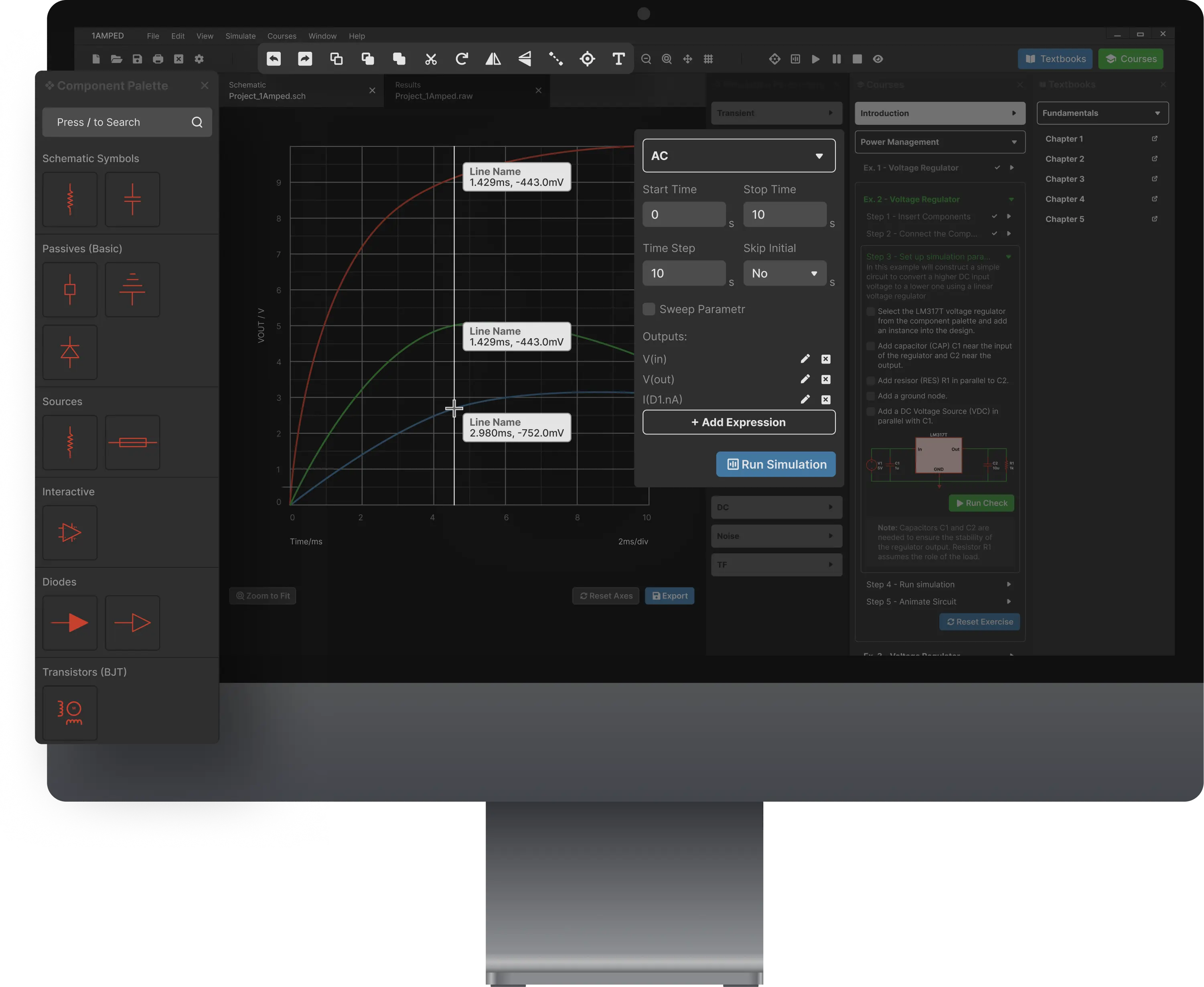
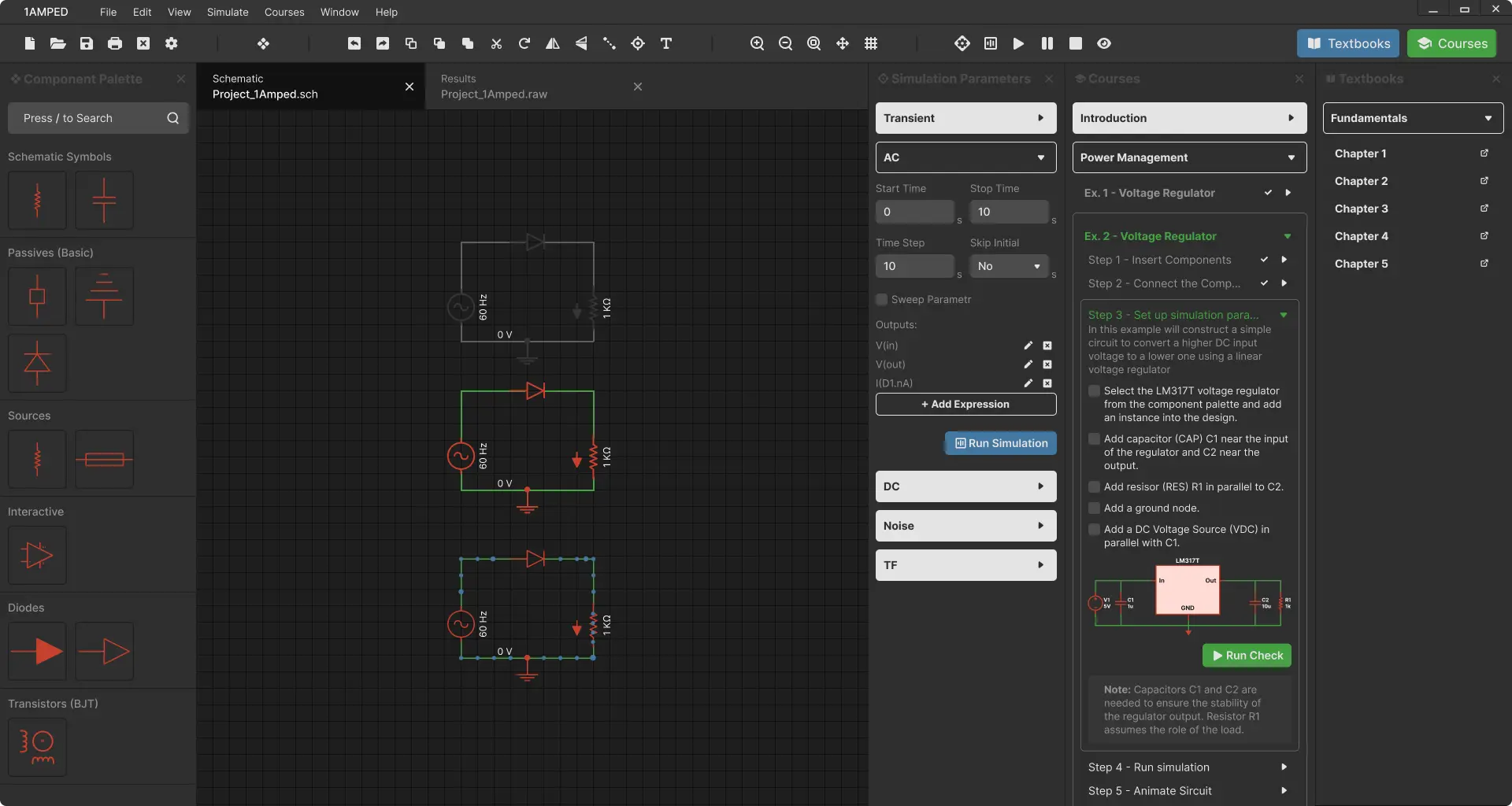
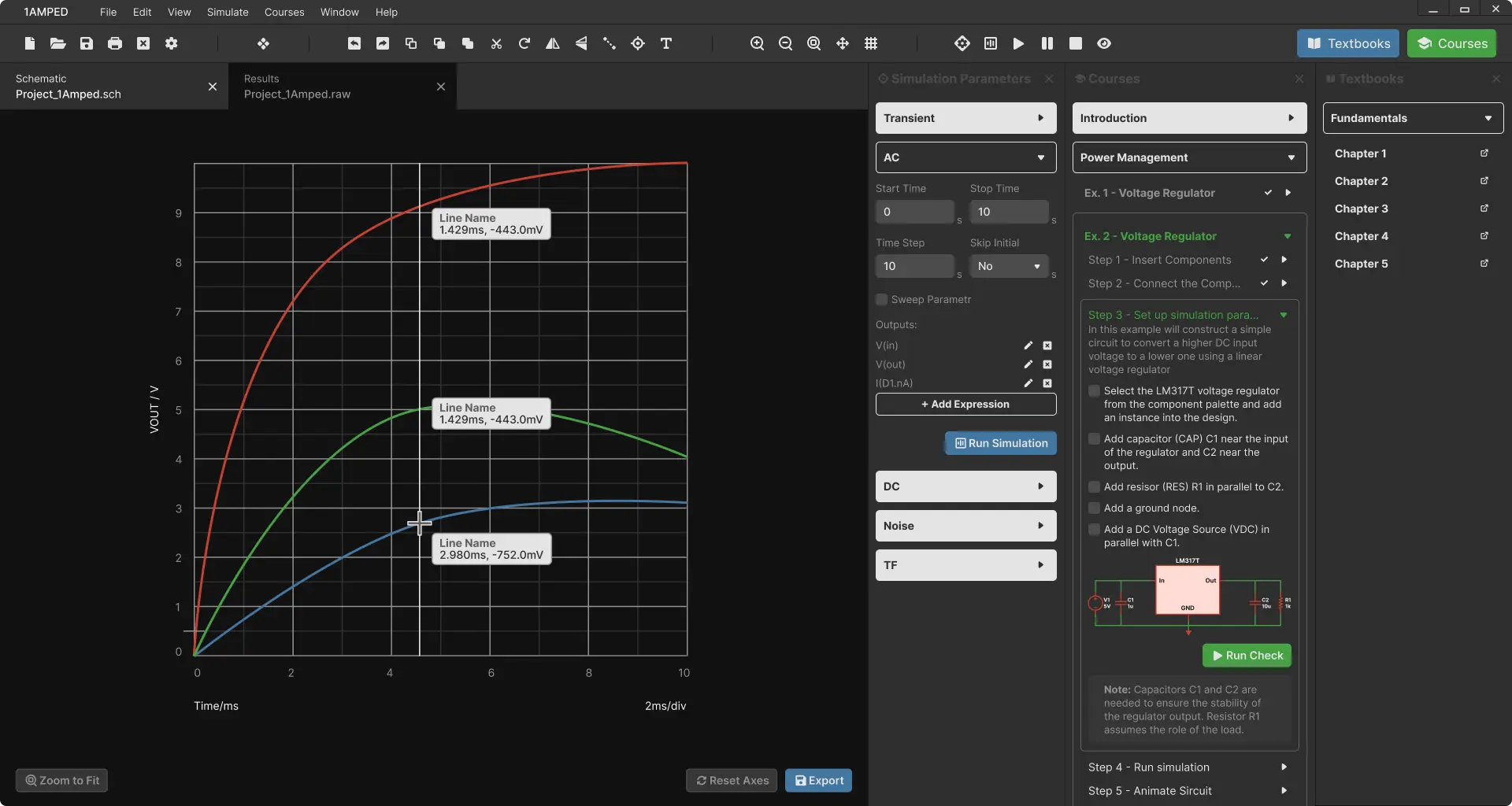
Our design philosophy was to blend the precision of professional engineering tools with the engagement of a modern creative app. The UX/UI design was inspired by the sleek, dark interfaces of software like Adobe Photoshop and Altium Designer. We created a look that is strictly professional yet accessible to students.
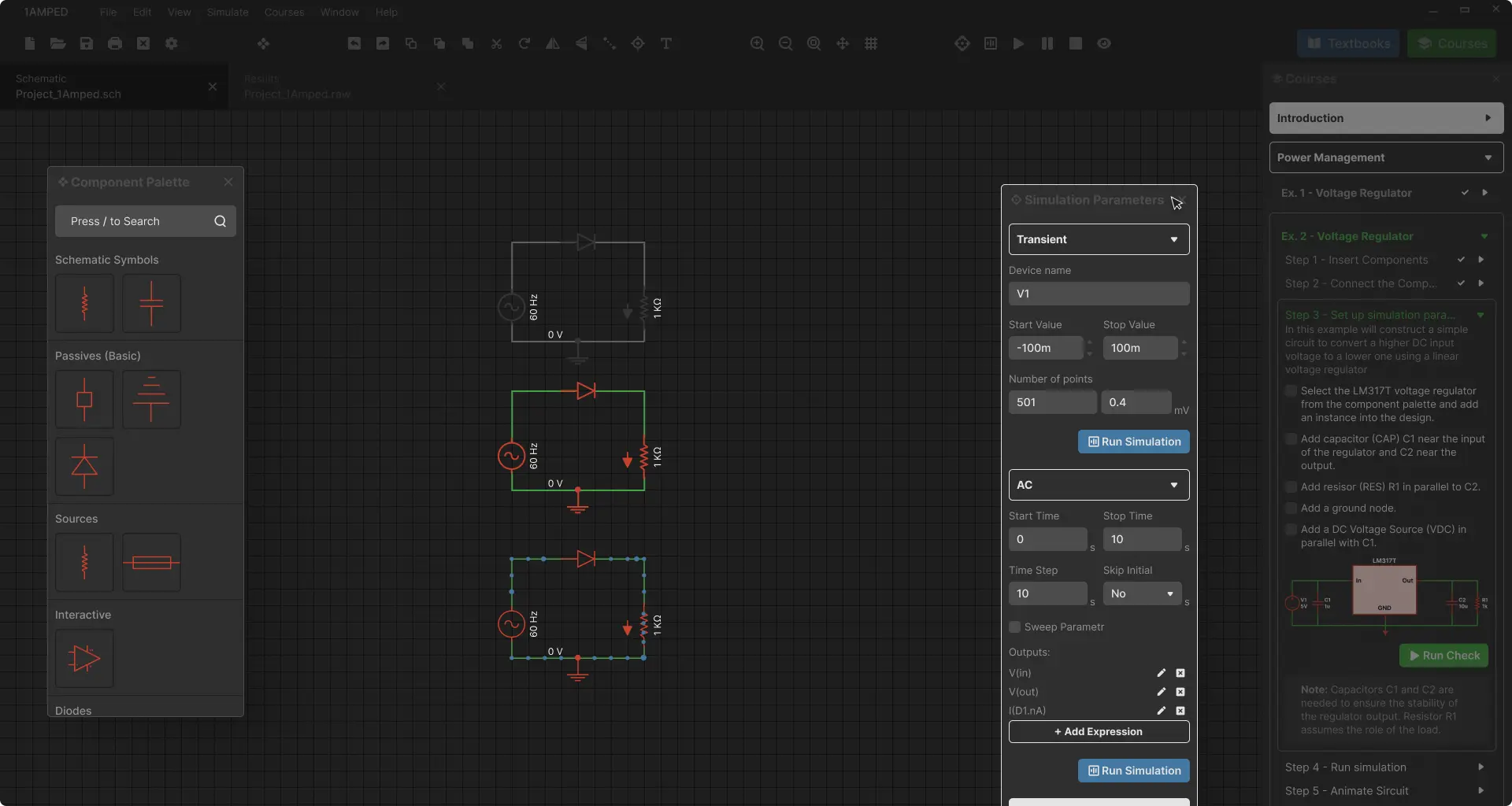
To prevent cognitive overload, we established a clear, intuitive spatial logic. The screen is divided into three distinct zones:
- Component Palette on the left (what I need)
- Active Workspace in the center (where I build)
- Context Panels on the right (what I do next)
This structure naturally guides the user’s eye through the engineering workflow, ensuring that tools are always exactly where they are expected to be. We utilized the clean Inter font family to reduce eye strain during long study sessions.
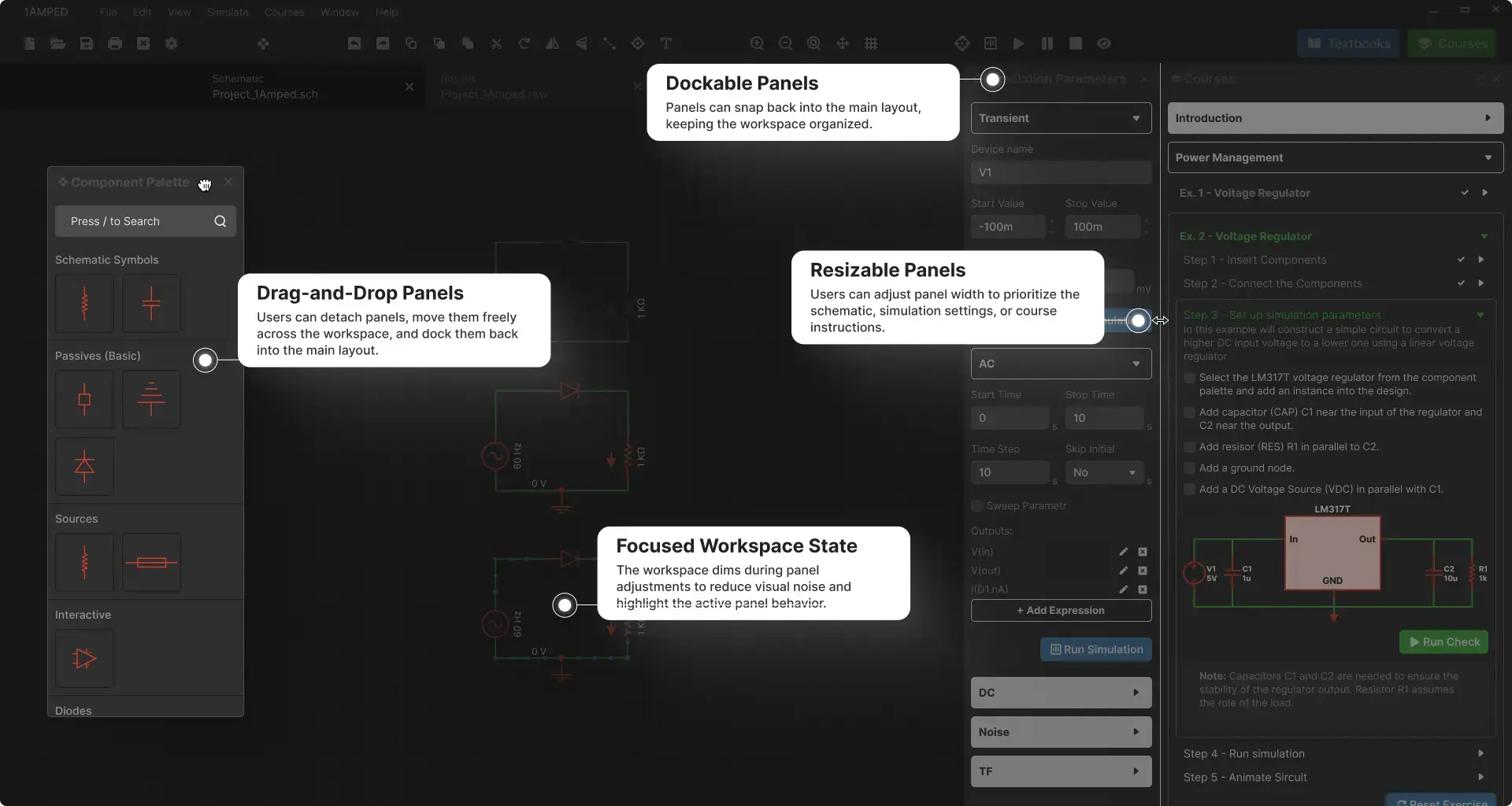
We handled the complexity of multiple views with a flexible, modular system. Users can toggle between the Schematic and Results tabs to focus on either circuit design or graph analysis. Panels are collapsible, resizable, and movable. Experienced engineers can clear the screen to maximize workspace. Students can keep the Course Panel open to follow step-by-step instructions next to their live simulation.
Finally, we optimized our workflow for both speed and future growth. We augmented our design process with artificial intelligence to rapidly prototype multiple interface scenarios, allowing us to quickly filter out weak options and focus on the solutions that truly worked for the user. We also ensured the interface architecture was scalable, reserving capacity for future features like Printed Circuit Board (PCB) Layout and 3D Views to avoid the need for costly redesigns later.
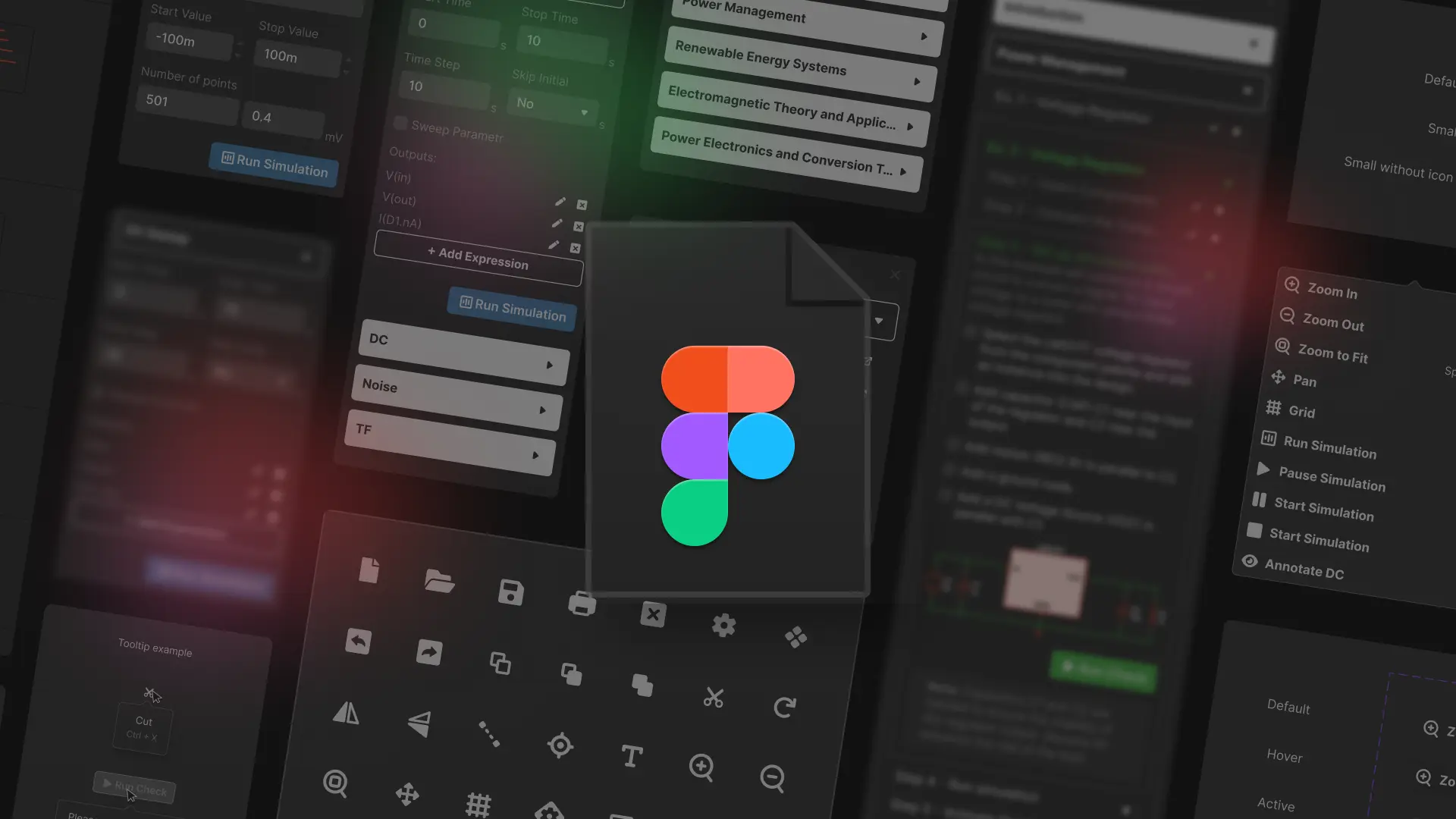
We created and organized everything in Figma to keep the design visually consistent. This makes it easy for everyone to review the designs today, and ensures developers will have exactly what they need when it’s time to build.
Architecture Design
To support 1Amped’s vision of a professional-grade browser simulator, we designed a scalable, four-tier architecture blueprint based on Microsoft Azure. We proposed decoupling the system into logical layers:
- React.js frontend for a responsive user interface
- .NET 8.0 backend for business logic
- Dedicated Python-based simulator layer utilizing NGSpice for complex calculations, and Azure SQL for secure data storage
This separation was designed so that heavy simulation math would never slow down the user experience.
For infrastructure, we selected Azure Kubernetes Service (AKS) to ensure high elasticity. Our design includes auto-scaling configurations that would automatically add server resources during traffic spikes and scale down during quiet hours to save costs.
To prevent browser freezes during intensive simulations, we specified the use of asynchronous processing with message queues, effectively decoupling complex computations from real-time interactions.
Security and data integrity were central to our architectural planning. We defined a security framework utilizing OAuth 2.0 and JSON Web Token (JWT) for secure, role-based access control, protecting user data via HTTPS encryption. For data resilience, we mapped out a geo-redundant backup strategy. This plan includes transaction logs saved regularly, ensuring that even in the event of a regional outage, 1Amped’s data would remain safe and recoverable.
Finally, we outlined a robust CI/CD strategy to ensure future reliability. We recommended a blue/green deployment strategy, which allows new features or bug fixes to be released without any downtime. Beyond simple automation, we defined a rigorous pipeline for code quality and security, incorporating static analysis and dependency scanning to detect vulnerabilities early. This roadmap provides the future development team with a clear path to push updates confidently, ensuring the platform remains stable for users around the clock.
Result
By concluding the discovery phase, we successfully transformed 1Amped’s high-level concept into a tangible, execution-ready product roadmap. Our partnership provided the client with the clarity and technical validation needed to move confidently into full-scale development.
Here are the specific outcomes of our collaboration:
- Validated Technical Feasibility: The core risk of the project was the integration of the legacy SPICE engine with a modern web interface. Our architectural design and SPICE analysis proved the technical feasibility of the solution, saving the client potentially months of expensive trial-and-error development.
- Investor-Ready Assets: With high-fidelity wireframes and a polished UI design inspired by industry standards, 1Amped can now present a visual proof of concept to stakeholders and potential investors.
- Strategic Market Positioning: Through our comprehensive benchmark analysis, we identified exactly where competitors fall short — in user experience and support reliability. This allowed 1Amped to refine their value proposition to target those specific gaps, ensuring a stronger market entry.
- Precise Budget and Timeline: Instead of entering development with a vague estimate, the client now possesses a detailed breakdown of the MVP versus future features. This granularity allows for accurate budget allocation, ensuring that the freemium features can be built first to generate a user base, while the architecture remains ready for future monetization modules.
1Amped now stands ready to build a market-leading educational tool, armed with a solid architectural foundation, a verified user experience, and a clear strategic path forward.
Need to turn your concept into a working prototype fast?
Talk to expertsTechnologies
 .NET
.NET SpiceLib
 NGSpice
 Azure SQL
 Azure Kubernetes Service
 Oauth2
 Figma
Figma MidJourney
 Krea
Krea Confluence
Redwerk Team Comments

Dmytro
Developer & Team Lead
My priority was designing a system that is not just powerful, but commercially scalable from day one. We mapped out a cloud-native architecture on Azure that auto-scales with traffic, ensuring the platform remains stable whether it’s used by a few hobbyists or thousands of university students. I’m proud that we could provide a technical strategy that makes professional-grade engineering tools accessible to anyone with a browser.

Mykhailo
UX/UI Designer
The biggest design hurdle was merging the raw power of a professional simulator with the ease of a learning app. We wanted students to feel like they were mastering a serious industry tool, not just playing a game. That’s why we rejected the “educational toy” aesthetic in favor of a sleek, Adobe-style dark theme. It was rewarding to create a workspace that grows with the user — offering guidance for beginners while staying out of the way for experts.
Related in Blog

Building Smart Onboarding Flows with AI: What’s Possible and What Still Requires Humans
A mountain of paperwork, confusing system logins, and a general feeling of being overwhelmed. This rough start could be a real driver of early employee churn, resulting in massive costs for companies....
Read More
10 Key Principles for Building Scalable Software Architecture and Long-Term Growth
The saying's true: What got you here won't get you there! Scaling is more than adding servers; it's about designing for sustainable growth from day one. While MVPs often get away with patchy architecture, real traction demands a system that performs under pressure....
Read More
The Pros and Cons of Python Programming Language
Python has become the go-to language for everything from web development to complex data analysis. According to the PYPL (Popularity of Programming Language Index), it is currently the most popular language worldwide. Its simplicity and versatility have made it a cornerstone of t...
Read More
Front-End Style Guides: Components, Specifications, Definition
Have you ever built a website that looked amazing in your head but somehow ended up looking like Frankenstein’s monster when you put it all together? Yeah, we’ve all been there. And it happens to mature businesses, too. Over time, your website or app evolves, but with each update...
Read MoreImpressed?
Hire usOther Case Studies
ProZorro Marketplace
Prepared clear-cut spec for ProZorro-based platform simplifying public procurement through intuitive GUI
Taskly
Performed major UX/UI overhaul of Taskly’s mobile app, enabling successful UAE market entry
Kooky
Implemented an innovative software ecosystem for the #1 digital green-solution in Switzerland