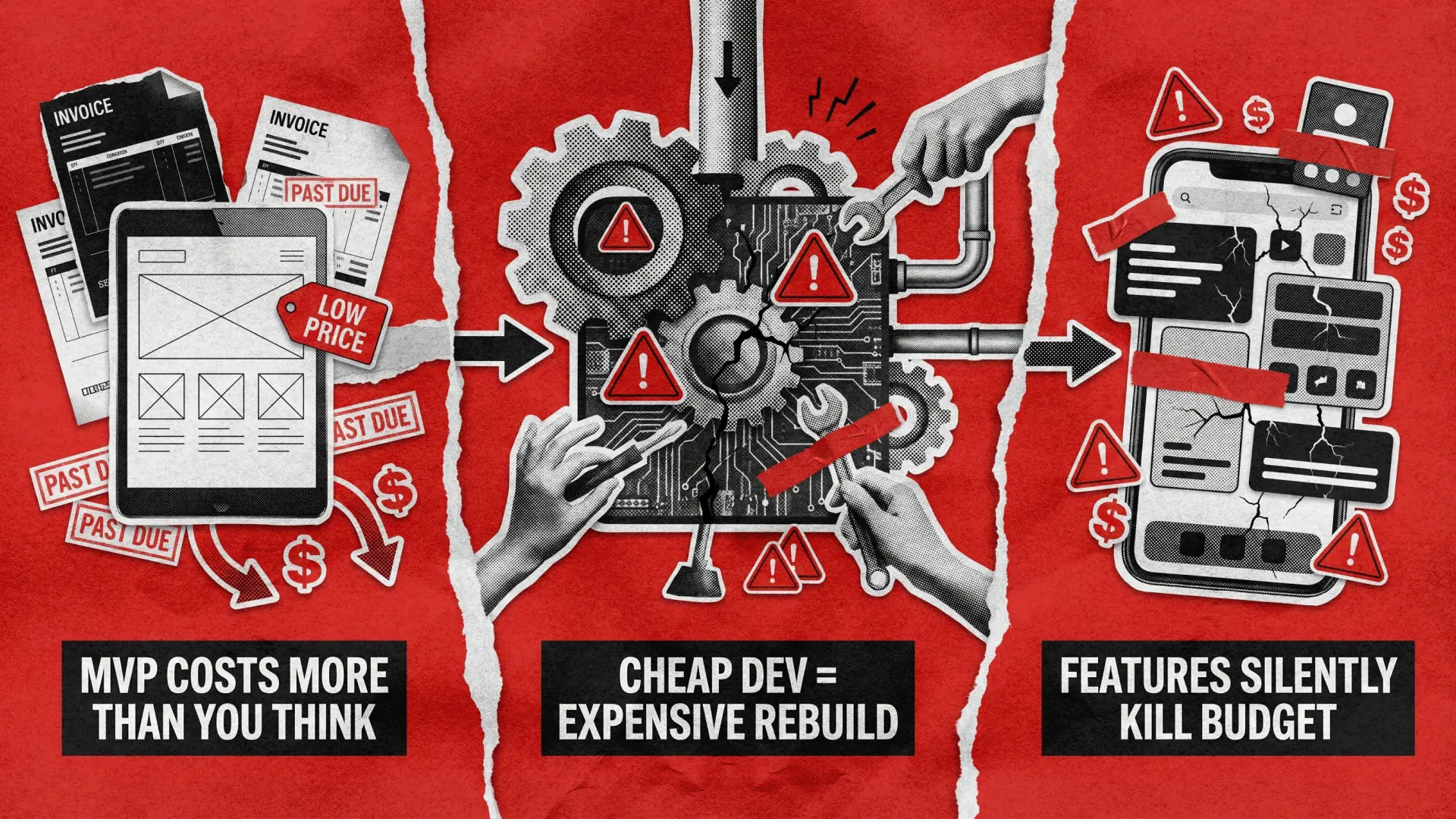
According to CB Insights, 70% of failed startups list running out of capital as the final cause of death. But it’s almost never the root problem, but the symptom of poor planning underneath. Not because the idea was bad. Not because the team was weak. They simply didn’t see where the money was actually going.
Here’s the thing: when you ask how much does it cost to build an MVP, most founders think about design + development + maybe hosting. That’s the visible part. Below the surface, there’s a set of costs that don’t show up in any initial quote but they absolutely show up in your burn rate.
We’ve built over 250 products since 2005 — from scrappy startups to enterprise SaaS. The pattern is consistent: founders who plan only for the build end up paying 30–50% more than they expected. Founders who plan for what comes after the build stay in control.
This is that second kind of guide.
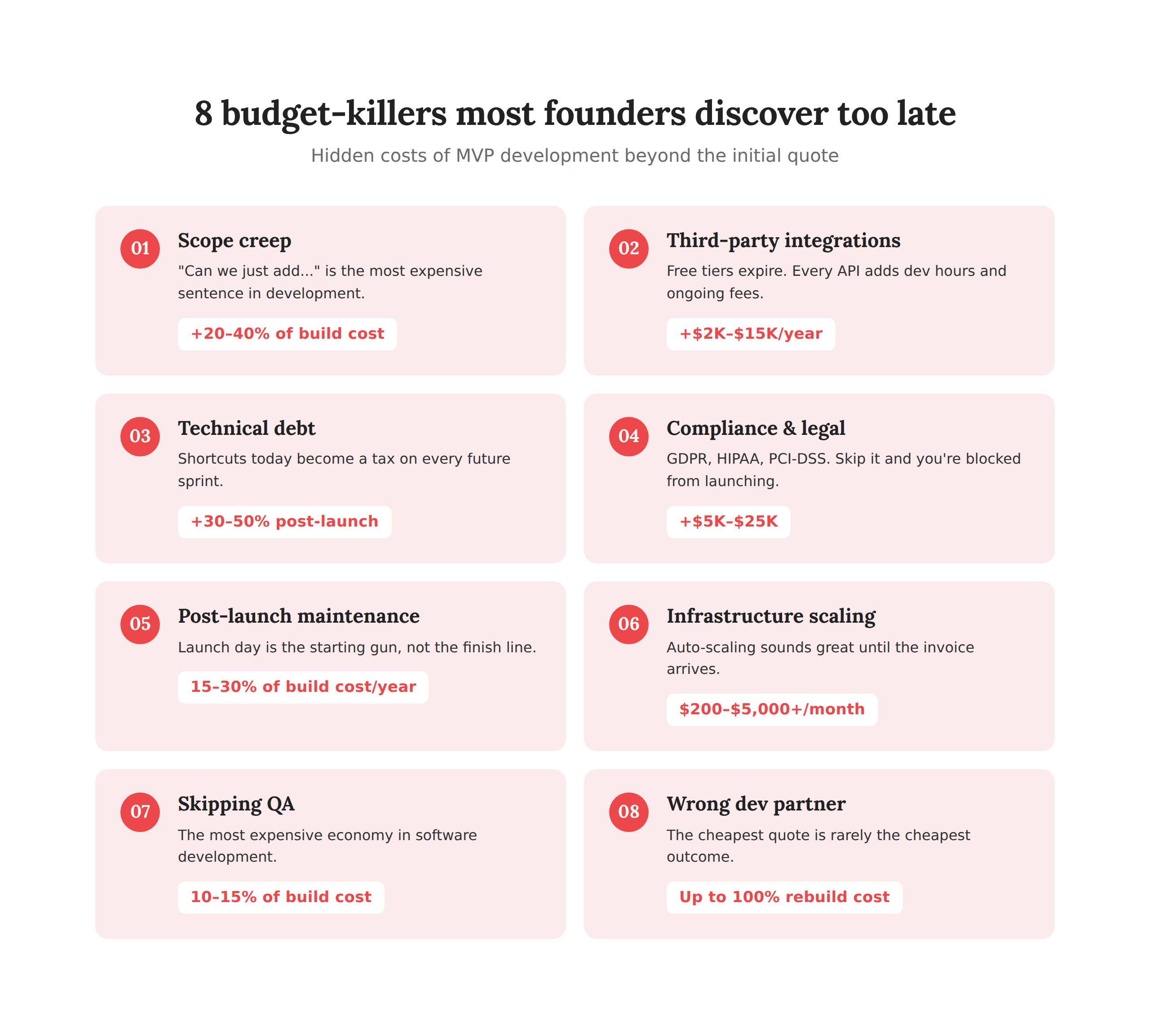
1. Scope Creep Disguised as “Quick Tweaks”
“Can we just add…” is the most expensive sentence in software development. One extra filter here, a “simple” dashboard there, and suddenly, your 12-week timeline is 18 weeks.
Scope creep hits MVPs especially hard because the whole point is to iterate. But iteration without a written scope document turns into feature bloat. Every addition means more design, more development, more testing, and more time.
Typical damage: 20–40% budget increase. The fix isn’t saying “no” to everything. It’s having a formal change request process. Write down what’s in, what’s out, and what moves to v2. A solid discovery phase does exactly that — it turns assumptions into a spec before anyone opens an IDE.
2. Third-Party Integrations That Aren’t Free
Payment gateways, maps, messaging APIs, analytics tools all come with free tiers that quietly expire. Stripe charges per transaction. Twilio charges per message. Google Maps charges per load after a threshold.
And it’s not just the subscription fees. Every integration adds development hours for setup, testing, error handling, and ongoing maintenance when the provider pushes an API update.
A typical MVP with three integrations, say, payment processing, identity verification, and transactional email, can easily rack up $5K–$15K/year in API and licensing fees alone, before a single user signs up. These costs don’t appear in any development quote.
When calculating your MVP development cost, list every third-party service and model three scenarios: free tier, moderate usage, and scale. The numbers will surprise you.
3. Technical Debt That Compounds Silently
Speed-first shortcuts, including hardcoded values, messy architecture, skipping documentation, feel smart during the sprint. They stop feeling smart when your next feature takes three weeks instead of three days.
Deloitte’s 2026 Global Technology Leadership Study estimates that technical debt accounts for 21–40% of an organization’s IT spending. For startups, the ratio is worse because there are fewer engineers to absorb the overhead.
The most dangerous kind is architectural debt. If your database schema, API structure, or authentication flow was built for a prototype rather than a product, you’ll hit a wall the moment you try to scale. At that point, you’re looking at a partial or full rewrite.
Before technical debt spirals, a professional code review can identify weak spots early — when fixing them costs hours, not months.
4. Compliance and Legal Nobody Budgeted For
GDPR, HIPAA, PCI-DSS — depending on your industry, compliance isn’t optional. And it isn’t cheap. Privacy policies, terms of service, cookie consent flows, data encryption, security audits aren’t features your users see, but they’re features regulators require. Skip them, and you’re either blocked from launching (Apple and Google both reject apps with missing privacy policies) or exposed to fines that can end a startup overnight.
Fintech and healthtech MVPs cost significantly more than a standard consumer app because of compliance requirements: encrypted storage, audit logging, consent management, and security testing all add development scope that a typical B2C product doesn’t need. Even if full certification isn’t needed at MVP stage, the underlying architecture must support it. Retrofitting compliance later costs 3–5x more than building it in from the start. The real minimum viable product cost always includes legal and compliance. If your estimate doesn’t, it’s incomplete.
5. Post-Launch Maintenance: The MVP Isn’t “Done”
Launch day is only the starting gun. Real users find bugs your testing didn’t. OS updates break things. Devices you didn’t test on render your UI incorrectly.
Industry benchmark: plan for 15–30% of the initial build cost annually for software maintenance. That covers bug fixes, security patches, dependency updates, and performance monitoring.
Most founders budget for the build and stop there. But the build is month one. Months two through twelve include bug fixes, security patches, compatibility updates, performance tuning, and it’s where the real spend begins. If your financial model doesn’t include a maintenance line item, you’re planning for a launch, not a product.
“Launch and forget” is a myth. Budget for ongoing support from day one, or your MVP budget will blow up within the first quarter post-launch.
6. Infrastructure Costs That Scale With Users
Cloud hosting starts cheap. A small instance on AWS or Azure for $50–200/month covers your beta just fine. But if your MVP actually gains traction — and that’s the goal, right? — costs spike fast.
A startup going from 100 to 10,000 active users can see hosting jump from $200/month to $3,000+/month. Add CDN, monitoring, automated backups, SSL certificates, and staging environments, and you’re looking at a meaningful operational expense.
Auto-scaling sounds great until the invoice arrives.
Plan for three scenarios: slow growth, expected growth, and viral spike. The difference between these scenarios can be $50K+ per year, and none of it shows up in a development quote.
7. Skipping QA — and Paying in User Trust
Cutting QA to save budget is the most expensive economy in software. A bug caught during testing costs hours to fix. The same bug in production costs users, app store ratings, and reputation.
For MVPs, first impressions are everything. Early adopters are your most valuable audience, and your least forgiving. A broken checkout flow, a crash on Android 14, or a security vulnerability discovered by users instead of testers can kill momentum that took months to build.
At minimum, invest in functional testing, compatibility testing across target devices, and a basic security audit before launch. This is where MVP development services earn their value by catching what’s wrong before your users do.
8. Choosing the Wrong Development Partner
The cheapest quote is rarely the cheapest outcome. We’ve seen it too many times: a founder picks the lowest bidder, gets a product with architectural problems, and comes to us for a rebuild, spending more in total than if they’d chosen the right team from the start.
Poor communication, missed deadlines, wrong tech stack decisions, and no documentation — these aren’t just annoyances. They’re compounding costs.
When we built Recruit Media, a patent-pending recruitment SaaS, from scratch, the first thing we did was spend three days whiteboarding architecture with the founders before writing a single line of code. That product was later acquired by HireQuest (200+ franchise offices across the US). The reason it worked: we invested in planning, not just execution.
What to look for in a partner: startup experience, transparent process, and a team that challenges your scope, not just accepts it.
The Budget-Killer Nobody Talks About: Opportunity Cost
Every month your MVP is delayed and costs more than developer hours. It costs you users, revenue, competitive positioning, and fundraising leverage.
If a competitor launches while you’re stuck fixing avoidable issues, that loss won’t appear on your invoice, but it’s the most expensive line item of all. Speed to market is a financial asset. The real MVP cost is what you lose by not launching. And the question isn’t just how much does an MVP cost in dollars, but how much does a delayed MVP cost you in everything else.
Your MVP Budget Planning Checklist
Before you sign any development agreement, make sure your budget accounts for these:
Scope changes & feature additions
+20–40% of build cost
☐
Third-party integrations & APIs
+$2K–$15K/year
☐
Technical debt remediation
+30–50% post-launch
☐
Compliance & legal (GDPR, HIPAA, etc.)
+$5K–$25K
☐
Annual maintenance & support
15–30% of build cost/year
☐
Infrastructure & cloud scaling
$200–$5,000+/month
☐
QA & testing
10–15% of build cost
☐
Partner rework risk
Up to 100% rebuild cost
☐
The cost to build an MVP is never just the build. It’s the build + everything that keeps it alive, compliant, and competitive.
Build It Right, or Build It Twice
We’ve seen the pattern over 250+ projects: the founders who plan for hidden costs launch faster, iterate smarter, and burn less cash. The ones who don’t end up paying the same costs anyway — just later, and at a premium.
If you’re planning MVP development for tech startup projects and want to skip the expensive surprises, AI-assisted development can cut 30–40% of dev hours when done right. And if you want a team that’s seen every budget-killer on this list (and knows how to prevent them), you know how to contact us.
FAQ
What hidden costs should I expect beyond MVP development?
The most common surprises are post-launch maintenance (15–30% of build cost annually), third-party API fees, compliance and legal expenses, and infrastructure scaling costs. Plan for at least 30–40% on top of your development quote to cover these.
How can I reduce the overall cost of my MVP?
Start with a thorough discovery phase to lock your scope. Prioritize only the features that validate your core hypothesis. Use cross-platform frameworks when possible. And invest in QA early, as catching bugs in testing is 10x cheaper than fixing them in production.
Does choosing a cheaper development team save money long-term?
Rarely. Low-cost teams often produce technical debt that requires expensive rework. Startups that rebuild after a failed first attempt typically spend more in total than those who chose an experienced partner from the start. We’ve written about similar cost patterns in AI integration projects.
See how we built a patent-pending recruitment SaaS from scratch — from whiteboard to acquisition by HireQuest (200+ offices across the US).