
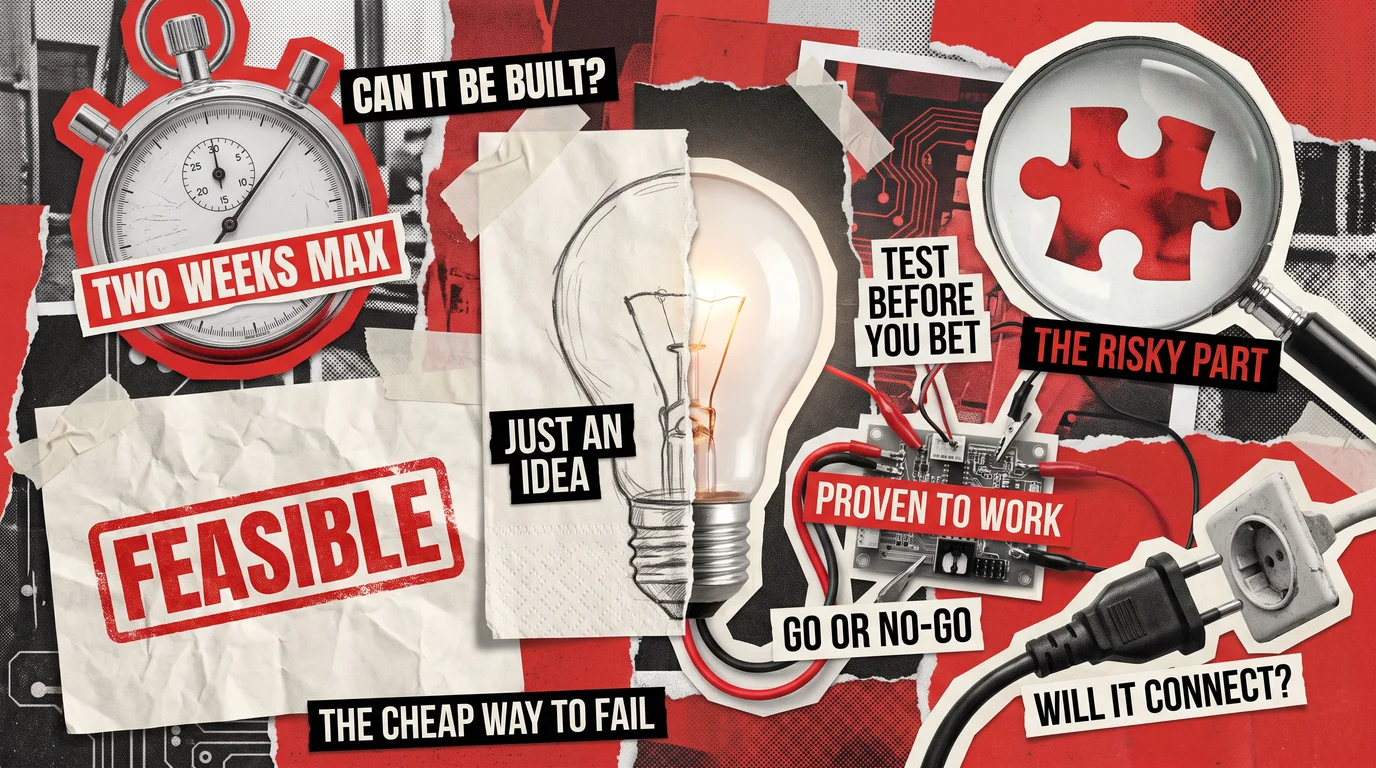
A proof of concept in software development is a small, time-boxed test that answers one question: can this actually be built? It checks a single risky idea, such as a new technology or a tricky connection between two systems, before you pay for the full product. The result is a clear decision, not something customers use.
Running this check early is a regular part of our discovery phase services, where we confirm an idea can work before anyone commits to building it. That step matters more than it sounds. Gartner found that by the end of 2025, at least 50% of generative AI projects were abandoned after proof of concept due to poor data quality, weak risk controls, rising costs, or unclear business value. That’s a lot of shelved projects, but ending one at the proof of concept is the cheap way to fail. The expensive version is finding the same problem after a year of development.
This guide explains what a proof of concept is, how it differs from a prototype and a minimum viable product (MVP), and when you actually need one. It also walks through how to build one and where it sits in a project.
What Is a Proof of Concept in Software Development?
Think of a proof of concept, or PoC, as a small experiment. Before a team spends months on a product, it isolates the one part nobody is sure about and tests whether it works. That part might be a new piece of technology, an unusual calculation, or a connection to another company’s software. Everything else waits until the answer is in.
Engineers call this testing for feasibility, which simply means checking whether something can be done with the tools, time, and budget you have. A PoC doesn’t ask whether customers will like the product or whether the screens are easy to use. It asks one technical question and answers it with working evidence rather than opinions.
Three traits set a PoC apart from other early work:
- It’s narrow. It tests one risky assumption, not the whole product.
- It’s time-boxed. It runs for a fixed, short period, often days or a few weeks, so it can’t quietly grow into a project of its own.
- It ends in a decision. The outcome is go, change course, or stop.
What a PoC produces is usually rough and meant to be thrown away. It might be a short script, a bare screen with no design, or a test that connects two systems and prints the result. Nobody outside the team is meant to see it. Its value lies in the answer it gives, which is what makes a proof of concept in software development worth the small cost.
PoC vs MVP vs Prototype: What Each One Tests
These three terms get mixed up constantly, since each one is an early, unfinished version of a product. Picture someone planning a restaurant. Before signing a lease, they check that their kitchen can cook the signature dish. Next, they sketch the dining room and walk a few friends through a draft menu. Only then do they serve paying guests a short list of dishes a few nights a week, to see who returns. The table below shows the software version of each step.
Question it answers
Can we build this?
Will people understand how to use it?
Do people want it enough to use or pay for it?
What it tests
Technical feasibility
Design and user experience
Market demand
Who sees it
The project team
Stakeholders and test users
Real customers
Does the software work?
Only the part being tested
Often not, since it may be clickable screens only
Yes, with a small set of core features
Typical length
Days to a few weeks
A few weeks
Usually a few months
What you get at the end
A decision to go ahead, adjust, or stop
Feedback on the design
Real usage data and early customers
A prototype is a model of what the product will look like and how people will move through it. It’s often a set of clickable screens with nothing working behind them, which is fine, because its job is to reveal confusing layouts before any code is written.
An MVP, by contrast, is real software. It’s the smallest version of the product that customers can use, built to learn whether the market wants it. Our guide on how to build an MVP covers that stage in detail, from choosing features to measuring results.
The order usually runs PoC, then prototype, then MVP, though not every project needs all three. Well-known technology lets you skip the PoC, and a simple design may need only a quick prototype. What matters is that each question gets answered before you spend serious money on the next stage.
When Do You Actually Need a PoC?
Not every project needs a PoC, because many use familiar technology that’s already been used to create similar products. The proof of concept earns its place when you want to use something untested, most often in three situations:
- Unproven technology: Your plan relies on a tool or platform your team hasn’t used, or one that’s new to the market.
- A new or unusual approach: The project hinges on logic nobody has written before. Here’s an example: a client asked us to automate their manual search for sports tournaments, and our research for this sports events crawler showed that reading randomly structured web pages would be complex and costly. So we used a fixed set of sources, which was much easier to build and maintain.
- A connection to someone else’s software: Many products rely on plugins or payment services and exchange data with them through an API, a set of rules one program offers so others can talk to it. Its documentation won’t always tell you whether it holds up in practice. When we built an online store for Breukelen Cellars, a Brooklyn wine shop, the most popular WordPress e-commerce plugin had many user complaints about bugs. Before committing, the team ran a small test as a PoC to verify technical feasibility, checking whether the plugins could do the job and choosing the one that passed.
Adding AI to an existing product fits this pattern too, and it’s the situation behind Gartner’s finding. A model that impresses in a demo can struggle with your real data. Our guide on how AI is changing the discovery phase covers how teams now scope these projects.
To find out whether your own project needs a PoC, ask your team one question: “If this part doesn’t work, does the whole project fail?” If the answer is yes and nobody can prove it will, run a PoC before anything else.

How to Build a PoC in Five Steps
The hardest part of a PoC isn’t writing the code but keeping the test focused, so it answers your question instead of drifting into early product development. These five steps show how to build a PoC that ends in a decision you can trust.
- Define the question the PoC must answer. Phrase it so the only possible answers are yes or no, for example, “Can our app get live stock levels from our supplier?” If you have three questions, plan three small tests.
- Agree on what success looks like. Set measurable targets before anyone starts, such as a response time, an accuracy rate, or a cost per transaction.
- Set a time limit and a budget. Fix both up front, for example two weeks and one developer, and stop the test when either one runs out.
- Build only what the test needs. Skip the design, the login screen, and anything not tied to the question. Use sample data if real data isn’t ready, but say so clearly when you report the results.
- Record the result and decide. Write a short summary of what worked, what didn’t, and what surprised the team. Then choose one of three paths: go ahead, change the plan, or stop. Stopping isn’t a failure, since it’s the outcome the PoC was built to allow.
A passing result has limits too. It proves the idea works in a controlled test, not that it will cope with thousands of users. Moving from a successful test to a live product is its own stage of work. We cover what that takes for AI tools in turning a Claude proof of concept into production. It’s also why many AI rollouts stall at the pilot stage even after a promising start.
Where Does a PoC Fit in the Development Process?
A PoC comes at the very start, before the team commits to a plan. Until the team knows the risky parts work, it can’t settle the requirements, a detailed list of what the software must do, or the architecture, a blueprint for how its pieces fit together.
In practice, this early work happens during product discovery, the planning stage where a team studies the idea, the users, and the technical risks before development starts. A PoC answers the “can we build it?” question. The rest of discovery turns that answer into a plan. The findings then shape the written specification, the document developers build from. That’s the job of our functional specification services.
Our own project, Tingl, shows why the riskiest technology has to be settled before anything else. Tingl is a privacy-first messaging app that Redwerk conceived and built from scratch. To deliver on that, our blockchain developers created BAMM, a custom way of moving messages that keeps both what’s said and who’s saying it anonymous. The app’s privacy promise rests on that layer, so it’s the kind of component a team must be sure of before designing around it. We also picked Flutter, a framework known for fast prototyping, to build the MVP quickly. After launching the beta on Product Hunt to strong reviews, Tingl was acquired. Our article on discovery phase deliverables walks through how that early planning helped the product ship on schedule.
A PoC doesn’t require a finished specification. Many projects begin with a rough idea and a few open technical questions. That’s normal, and it’s often a good time to test, since changing course early usually costs less than changing it later.
Is a Proof of Concept Worth It for Your Project?
A proof of concept in software development is cheap insurance against building on an assumption that turns out to be false. It costs days or weeks rather than months, and it replaces a hopeful guess with evidence. Skip it when the technology is proven and your team has done similar work before. Run one when a single unknown could sink the whole project.
The key is keeping it small and ending it with a decision. One question, clear success criteria, and a fixed time limit will tell you more than a large, open-ended build ever could.
That’s how our discovery work is set up: we test the risky parts first, then plan the full build around what we learned. Open questions at the outset don’t hold us back, because answering them is what this stage is for. If your idea depends on something nobody has proven yet, book a call. Let’s put it to the test together.
FAQ
What is a proof of concept in software development?
A proof of concept in software development is a quick, low-cost way to find out whether a key technical idea works before you fund the whole product. The team builds only the uncertain piece, for example a new payment integration, and measures it against agreed targets. The result decides whether the project goes ahead, changes direction, or stops.
What is the difference between a PoC and an MVP?
A PoC comes before an MVP and answers a narrower question. The PoC checks that one risky part can be built, and its code is rarely kept. An MVP is the first version meant to last: working software with a few core features that real customers use, so the team can keep improving it based on how they respond.
How long does a proof of concept take?
Most proofs of concept take from a few days to a few weeks. The length depends on how complex the question is and whether the team can test against real data and systems. If a PoC reaches its deadline without an answer, treat that as a finding too, since it often means the problem is harder than expected and the full build may be as well.
Do I always need a proof of concept?
No, a proof of concept is only worth it when part of the project hasn’t been done before. If your team or vendor has built something similar, that experience already shows it can be done. When a vendor suggests a PoC, ask which question it will answer and what result would change the plan. A clear answer means the test is worth paying for.
What happens after a successful proof of concept?
After a successful proof of concept, the project moves into full planning. The team shares its findings and confirms the decision to go ahead. It then writes the requirements and plans the architecture around what the test proved. Next, the team builds a prototype to check the design, or goes straight to an MVP if the screens are simple.
See how we developed an anonymous web3 messenger with unmatched chat privacy that was acquired within months

