iGaming operators rarely win or lose on game design or marketing. The real story plays out in the payments layer. One failed compliance audit, one chargeback threshold crossed, one PSP walking away on thirty days’ notice, and the platform that took two years to build can stall overnight.
The numbers back it up. The 2026 INTERPOL Global Financial Fraud Threat Assessment found that AI-enhanced fraud is now 4.5 times more profitable than traditional methods, with “agentic” AI systems capable of running complete fraud campaigns from reconnaissance through ransom demand. Nasdaq Verafin’s 2026 Global Financial Crime Report pegged global losses to bank fraud and scams at $579.4 billion in 2025, up more than $53 billion in two years.
iGaming fraud hasn’t shrunk under AI, it just got faster and more sophisticated on both sides. Google’s March 2026 gambling certification update tied payment compliance to advertising eligibility, which means payment risk now leaks into your marketing stack too.
We’ve been building software since 2005, and we work with fintech and gaming founders every week. The ones who survive long-term treat payments as core product, not back office. Here are the seven threats most likely to sink an iGaming business in 2026, and what separates platforms that beat them from the ones that don’t.
Threat 1: Fraud Is Getting Smarter, Not Quieter
Fraud in iGaming used to mean stolen cards and the occasional multi-account trick. Today it’s AI-assembled synthetic identities, deepfake KYC selfies, and bot networks that farm bonuses across hundreds of mule accounts in a single night. INTERPOL described the shift as “the industrialization of fraud,” enabled by cheap AI tools and cross-border criminal collaboration.
This is a generational shift in how attacks are built, and rule-based systems can’t keep up. Gartner predicts that by 2026, 30% of enterprises will no longer trust standalone identity verification tools in isolation, which tells you how quickly the goalposts moved.
Smart operators are moving iGaming fraud prevention from a back-office function to a layered defence:
- Device intelligence and behavioural biometrics running on every session
- Real-time velocity checks tied to deposit, bonus, and withdrawal events
- Network-level data shared across operators to catch repeat fraud rings
- ML models that score risk continuously, not just at the transaction moment
The flip side matters just as much. Attackers use AI to break in, so your own team needs AI-aware security practices on the build side.
Threat 2: Chargebacks That Can Shut Down Your Merchant Account
iGaming chargeback rates sit around 2-4%, roughly four times the 0.5-1% you’d see in regular e-commerce. That matters because card networks don’t care about your revenue. They care about your ratio.
Visa’s Acquirer Monitoring Program (VAMP) watches chargeback and fraud performance in real time through a single combined ratio. The current “excessive” merchant threshold sits at 2.2%, dropping to 1.5% in the US, Canada, EU, and Asia-Pacific from April 1, 2026. Cross it and you land in enforcement, which means acquirer fines, mandatory remediation plans, and a shrinking list of processors willing to underwrite you. Push further and you end up on the MATCH list, effectively shut out of card processing for up to five years.
Most iGaming chargebacks aren’t fraud in the classic sense either. Friendly fraud accounts for the majority: a player loses money, regrets the session, disputes the charge claiming it was unauthorized, and the bank usually sides with them.
Serious operators treat iGaming payment processing as a multi-layer defence. Clear transaction descriptors, 3D Secure 2, Confirmation of Payee where supported, velocity checks, pre-dispute alerts from Ethoca and Verifi, and a tight evidence-collection flow for every dispute you decide to fight. The platforms that bleed out here aren’t the ones with the worst players. They’re the ones with the weakest dispute infrastructure.
Threat 3: Compliance As a Moving Target in Every Jurisdiction
Licensing, KYC, AML, and advertising rules change faster than most dev teams can ship. On top of that, Google’s gambling and games certification policy now requires “good policy health” across all ad accounts, with the March 23, 2026 update penalising manager accounts that accumulate revocations. Payment compliance and marketing compliance are officially married now.
The operational problem is that most payment stacks weren’t built for this. KYC, AML screening, transaction monitoring, and jurisdiction rules usually live in four different systems that don’t talk cleanly to each other. That’s where fines happen.
What works instead is keeping all four layers connected from day one:
- KYC at registration, not at first withdrawal
- Continuous AML monitoring, not point-in-time snapshots
- Jurisdiction-aware rule engines that flex per market
- Proper PCI DSS controls across stored and in-transit card data
For EU operators touching crypto, the stakes are sharper, and MiCA regulation compliance has to be built into the payment flow itself rather than bolted on afterward.
Threat 4: Your PSP Dropping You Overnight
This is the threat nobody plans for, and the one that most often finishes off mid-sized operators.
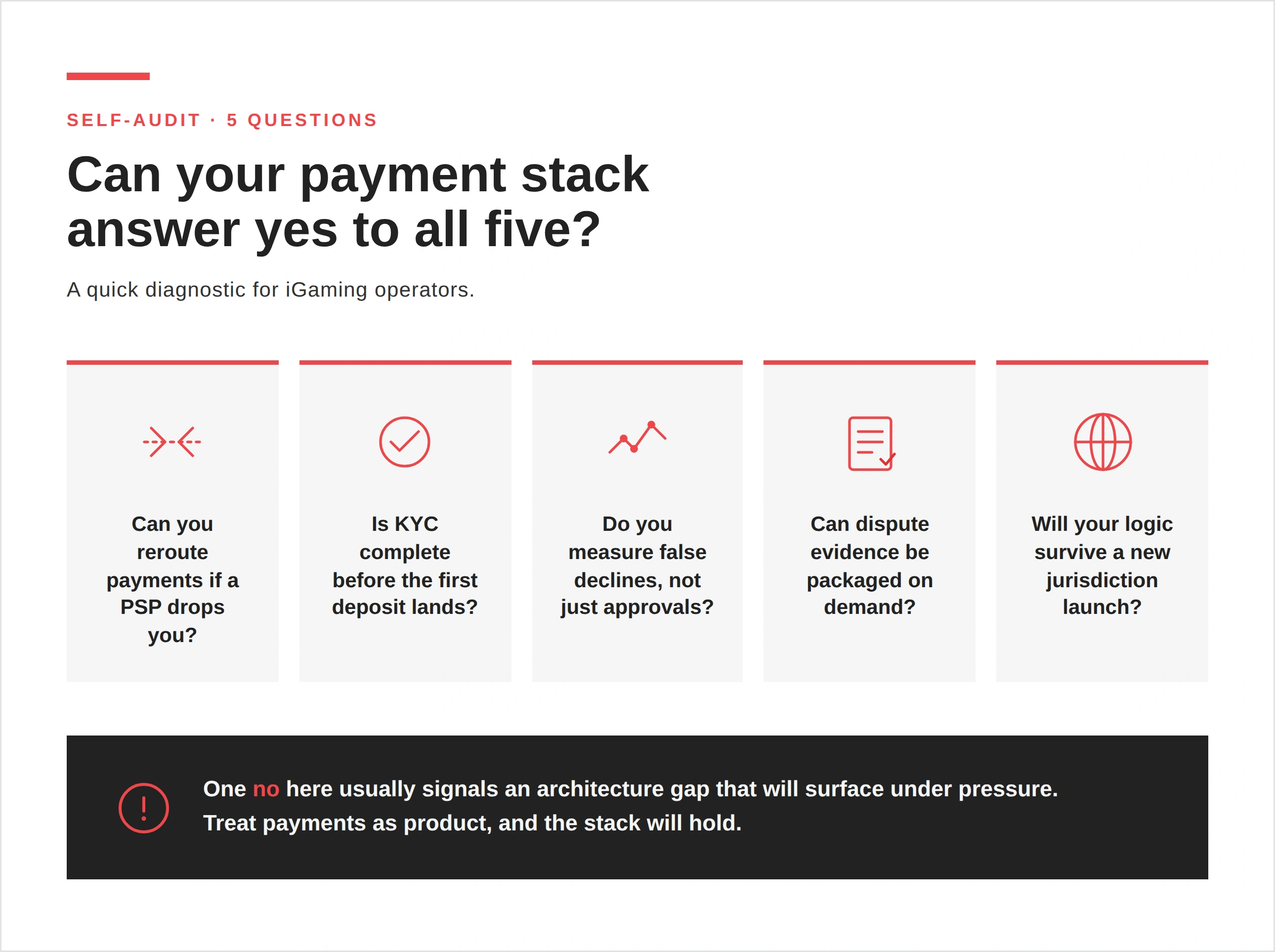
Most startups run with a single PSP because integration is painful. It’s fine until it isn’t. The acquiring bank changes risk appetite, the PSP merges with someone bigger, your chargeback ratio crosses a threshold you didn’t know existed, or the provider decides to exit gambling entirely. You get thirty to ninety days’ notice, and a new integration takes two to eight weeks minimum. That gap is pure revenue lost.
The damage compounds faster than operators expect. During the cutover window you can’t take deposits, players find other platforms, reviews turn negative, SEO rankings slide, and the fresh PSP wants to see a cleaner track record than the one that just got you dropped.
Resilient platforms do four things differently:
- Run at least two live PSPs from month six onward.
- Tokenize card data through a neutral vault so you can switch PSPs without re-onboarding players.
- Build a payment orchestration layer that routes transactions dynamically.
- Maintain a warm relationship with a backup acquirer before you need one.
This isn’t a vendor problem. It’s an architecture problem, and solving it properly is a dev project that needs to happen before you’re in crisis mode.
Threat 5: False Declines Quietly Bleeding Revenue
The real cost isn’t the fraudster you block, but the loyal player your system flags by accident.
Aggressive fraud rules create false declines, and a rejected legitimate player rarely tries a second time. Rejections during a live match or a big promo window carry the highest lifetime-value damage of all, because the player is in the mood to spend and you’re the reason they can’t.
Most operators don’t even measure false declines properly. Approval rates look healthy on a dashboard because the denominator excludes everyone who walked away silently.
What actually works is a more adaptive approach:
- Dynamic risk scoring that weighs device history, player tenure, and payment method.
- BIN-level smart routing, which can lift approvals 5-7% on the same volume.
- Trusted-user allowlisting for high-LTV players.
- Sharper iGaming fraud detection that adapts to player behaviour instead of relying on static rules.
The goal is to say no only to the right people, and knowing exactly how much the wrong nos are costing you every month.
Threat 6: Crypto Brings Speed and New Risk Categories
Crypto and stablecoins solved some real iGaming payment problems, like near-instant payouts, borderless collections, and lower fees than card rails for operators dealing with high-risk geographies. But speed brings new failure modes, and most operators haven’t priced them in yet.
Volatility exposure on non-stablecoin balances, wallet security and cold-storage discipline, smart-contract risk in Web3-native casinos, and regulatory uncertainty across jurisdictions are all live issues. The UK still doesn’t permit licensed crypto casinos. The EU requires MiCA licensing for crypto-linked payment flows. The US picture varies state by state. AML controls for crypto are technically different from card AML, even when the regulatory goal is the same.
The teams getting this right pair stablecoin-first strategies with blockchain analytics tools like Chainalysis, Elliptic, and TRM Labs. They segregate player funds properly, and they build MiCA-aligned KYC into the wallet flow rather than bolting it on afterward.
Crypto isn’t inherently riskier than cards. It’s just riskier when you treat it like cards.
Threat 7: iGaming Payment Risk Management Starts in the Codebase
Here’s the part nobody writes about. You can buy the best fraud detection tools on the market, hire the best compliance team, and sign with the best-reviewed PSP. None of it saves you if your own payment integration is buggy, under-tested, or cracks under load during a major event.
We see the same technical failures over and over in audits:
- Gateway integrations without proper failover logic, so a single provider outage drops deposits across the whole platform.
- KYC flows that silently break on edge cases like non-Latin names or missing middle names.
- Load tests that never simulated a 10x spike during a Champions League final or a major title fight.
- Reconciliation gaps between gateway and backend that quietly lose transactions over weeks.
- Dispute-evidence flows that can’t assemble the packet Visa needs inside the response window.
Any of those turns into payment failures under pressure, and payment failures under pressure turn into everything from chargebacks to churned VIPs to regulatory letters.
The Claude Code leak in March 2026 is a good reminder of how one misconfigured file can expose 512,000 lines of proprietary code without a single line of malicious activity. Payment infrastructure isn’t different. The same unreviewed setting can leak player PII or drop a week of settlement logs.
Serious operators bake payment security into every phase of development. Strong SDLC best practices, a proper software audit, and continuous QA testing are what separate the stacks that survive an incident from the ones that don’t.
Keep Your Payments Standing Before They Have To
These seven threats share one trait. They compound. Weak fraud tooling creates chargebacks, chargebacks create PSP termination risk, termination risk creates compliance stress, compliance stress exposes gaps that fraud rings target next. You don’t fix iGaming payments one silo at a time. You fix it at the architecture level.
iGaming payment risk management is a system you build, test, and audit. The operators winning in 2026 are the ones who treat their payment stack as core product. The ones losing are usually the ones who found out too late.
If your platform is preparing to launch, scaling into a new jurisdiction, or carrying payment logic written years ago, a proper audit is cheaper than the first regulatory fine you’d collect without one. We’ve been auditing, building, and stress-testing software for twenty years. Contact us whenever you’re ready to pressure-test yours.
FAQ
What is iGaming payment risk management?
iGaming payment risk management is the practice of identifying, preventing, and containing every risk that can disrupt the flow of money through an online gambling platform. It covers fraud detection, chargeback handling, regulatory compliance, PSP redundancy, payout reliability, and the underlying software quality that keeps all of it standing. Done well, it’s an architecture-level system rather than a set of isolated tools.
What chargeback ratio triggers problems with Visa?
Visa’s Acquirer Monitoring Program (VAMP) flags merchants once the chargeback ratio crosses 0.9% of transactions. Ratios between 0.9% and 1.8% attract monthly acquirer fines and enhanced monitoring. Above 1.8%, account termination becomes the realistic outcome, and terminated merchants can end up on the MATCH list for up to five years, which effectively blocks them from card processing industry-wide.
Why is compliance the biggest payment risk for iGaming operators in 2026?
Compliance changed faster in the last eighteen months than in the previous five years. Brazil, Curaçao, the UK, the EU, and Google itself all shipped major rule updates that touch iGaming payments directly. The risk is the fragmentation across jurisdictions and the fact that most payment stacks weren’t built to enforce different rules for different markets at the same time.
See how we extended security-critical software trusted by 50+ fintech and telecom enterprises, and what it takes to build payment-grade infrastructure that holds up under audit.