OpenClaw went from zero to 150,000 GitHub stars in days, but sadly, OpenClaw security best practices haven’t kept pace. There are over 30,000 OpenClaw instances currently exposed to the open internet, with more than 340 malicious skills found in its ClawHub marketplace. A security analysis of nearly 4,000 skills found that 7.1% contained critical flaws leaking credentials in plaintext. China’s Ministry of Industry and Information Technology has issued a national security alert about it.
Unlike a chatbot, OpenClaw acts, reads your files, accesses your credentials, and interacts with your messaging platforms. That autonomy is the point of the tool, but it’s also the main problem. Traditional LLM safety focuses on controlling harmful outputs, an essential part of AI solution development. However, OpenClaw AI security is a different game entirely. When an AI operates with system-level access, the attack surface isn’t just the model but your entire infrastructure. The question isn’t “what could it say?” It’s “what could it DO to your systems, your data, and your business while you’re not watching?” That’s what this guide is about.
OpenClaw Security Risks Explained
It’s essential to understand exactly what OpenClaw AI security risks are in order to build effective strategies for managing them. OpenClaw’s vulnerabilities are directly tied to its functionality, which is why they are so difficult to negate. You will have to build a solution using these agents with a security-first architecture to minimize risk.
Prompt Injection & Indirect Prompt Injection
OpenClaw doesn’t just respond to your prompts. It ingests external content: emails, web pages, tickets, Slack messages, and documents. Attackers can embed malicious instructions inside that content, and the agent will dutifully execute them. CrowdStrike demonstrated a real attack chain: an attacker posts a seemingly innocent message in a Discord channel monitored by an OpenClaw bot, and within moments, the agent exfiltrates private conversations and posts them publicly. The agent never knew it was being manipulated. That’s the insidious part — indirect prompt injection collapses the boundary between data and instructions. Every email your agent reads is a potential attack vector.
Skill/Plugin Supply Chain Attacks
OpenClaw’s power comes partly from its skill ecosystem (ClawHub). The problem? Researchers have found hundreds of malicious skills on ClawHub masquerading as legitimate utilities. A Snyk analysis of 3,984 ClawHub skills found that 7.1% contained critical flaws that exposed sensitive credentials within the LLM’s context window. Some skills contained outright stealer malware, backdoors for remote access, and data exfiltration payloads. These are OpenClaw security vulnerabilities hiding in plain sight inside tools that look completely harmless.
Over-Privileged Agents
OpenClaw runs with whatever permissions you give it, which is a lot by default (filesystems, messaging platforms, API tokens, and shell access). Microsoft’s Security Research team frames it bluntly: running OpenClaw is not a configuration choice, it’s a trust decision about which machines, identities, and data you’re prepared to expose. Most organizations skip that decision entirely and run it with full system access.
Autonomous Execution Risks
Agents can chain multiple tool calls together to accomplish complex tasks, which is great for productivity, and dangerous for security. A single successful injection can trigger a cascade: reconnaissance, lateral movement, credential theft, and data exfiltration. The OpenClaw AI security risks here compound quickly, because the agent’s legitimate access to APIs, databases, and cloud services becomes the attacker’s access, executed at machine speed without human oversight.
AI Agent Security Approaches That Work for OpenClaw
Before the checklist, let’s talk principles, because individual tactics without a coherent framework are just whack-a-mole. When managing OpenClaw vulnerabilities, your main focus should always be on limiting access and instilling safeguards through every step.
- Zero-Trust Agent Design
Treat everything as untrusted by default, every input, every skill, every external tool call. Don’t assume the data an agent reads is safe just because it came from a known source. - Least Privilege
Give your agent the minimum permissions it needs to do its job. If it only needs to read a specific directory, don’t give it access to the entire filesystem. If it needs to send emails, don’t give it a token that can also delete your cloud infrastructure. - Isolation
Agents should never run on your primary workstation or alongside production systems. Think of them as semi-trusted processes that should be contained regardless of their behavior. - Human-in-the-Loop (HITL)
For any sensitive action, for example, sending messages or executing shell commands, require explicit human approval before the agent proceeds.
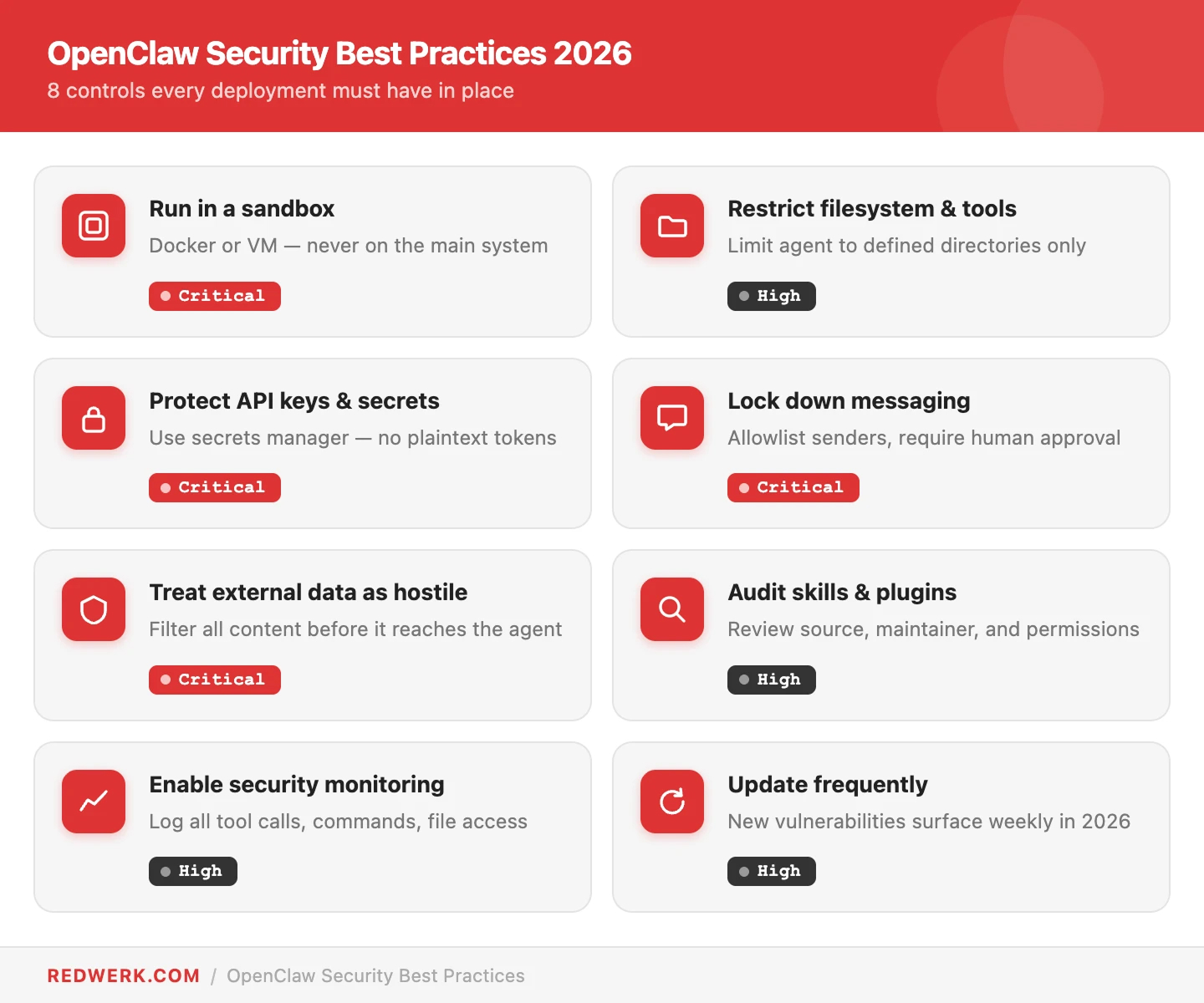
OpenClaw Security Best Practices 2026
Here’s where we get practical and explain OpenClaw security best practices we implement when building agent-integrated systems for clients. We outline the general approach, but bear in mind that the solution is tailored for every business case. Therefore, we often combine these strategies with additional security tools and practices to fit the exact situation.
Run OpenClaw in a Sandbox
Never, ever run OpenClaw directly on your primary machine or a production system. This is the single most impactful control you can implement, and it costs almost nothing.
The right approach is to:
- Run OpenClaw inside a Docker container, a dedicated virtual machine, or another form of isolated environment.
- The key point is to treat the environment as disposable. If you suspect the agent has been compromised, rebuild it. Don’t try to clean it, just wipe and restart. Agent compromise often manifests as subtle configuration changes rather than obvious malware drops.
- Keep secrets completely outside the agent’s filesystem. The agent should not have access to your .env files, credential stores, or configuration files that contain tokens. This approach significantly reduces OpenClaw security vulnerabilities stemming from misconfigured deployments.
Restrict Filesystem and Tool Access
Give your agent a defined workspace and nothing more.
- If OpenClaw’s job is to draft reports from a specific data directory, restrict it to that directory only.
- Disable shell access unless your use case explicitly requires it. Restrict external tool calls to only those the agent actually needs to function.
This is the principle of least privilege in practice. OpenClaw’s documentation includes Docker-based tool sandboxing, but it’s not enabled by default, so you have to enable it explicitly. Workspace-scoped access ensures that even if the agent is compromised, attackers can’t pivot to sensitive parts of your system.
Protect API Keys and Secrets
Agents are leaky. Even without malicious intent, language models can inadvertently reproduce sensitive data they’ve encountered, including API keys, tokens, and credentials, in their outputs or logs. This is a documented class of OpenClaw security issues that affects many deployments.
The solution: never expose secrets directly to the agent.
- Use a secrets manager (AWS Secrets Manager, HashiCorp Vault, or similar).
- Inject environment variables at runtime.
- Route API calls through a proxy that handles authentication on the agent’s behalf.
- Rotate tokens regularly and treat any token the agent has touched as potentially compromised if anomalous behavior is detected.
Lock Down Messaging Interfaces
OpenClaw’s integrations with messaging platforms (Slack, Discord, Telegram, WhatsApp) are among its most powerful features and its biggest attack surfaces. An attacker who knows your agent monitors a public channel can post a message containing malicious instructions. It’s a zero-effort attack delivery mechanism.
The solution: lock it down!
- Configure allowlisted senders so that the agent processes messages only from trusted users.
- Disable open group access.
- Use mention gating so the agent only responds when explicitly called.
- Require human approval before the agent takes any action in response to an external message.
These controls directly address a key category of OpenClaw AI agent security risks: external parties issuing commands to your agent remotely.
Treat External Data as Hostile
This is a mindset shift, not just a technical control. Anything OpenClaw reads, emails, URLs, PDFs, documents, Slack messages, or web pages should be treated as potentially weaponized.
The security model should be: untrusted data → filtered and sanitized → then passed to the agent.
In practice, this means:
- Implementing input sanitization layers before data reaches the agent.
- Stripping control sequences from ingested content.
- Flagging inputs that contain unusual instruction-like patterns.
This is particularly important for organizations where OpenClaw is reading from high-volume data sources, such as email inboxes or ticketing systems.
Audit Skills and Plugins
Before installing any ClawHub skill, perform a basic security review:
- Check the source code
- Verify the maintainer’s identity
- Review what permissions the skill requests
- Look for any external network calls that shouldn’t be there.
Simple rule: If you can’t read the code, don’t install it.
A solid OpenClaw security audit process for skills includes checking the skill’s SHA-256 hash against VirusTotal, reviewing its GitHub history for sudden changes, and testing it in an isolated environment before deploying to anything important. Malicious skills are often cloned from legitimate ones with small name variations.
Treat skill installation the same way you’d treat installing a new dependency in a production codebase: with scrutiny. If you are already running an agent, you can use software audit services to review the security of your setup.
Enable Security Monitoring
If it’s not logged, it didn’t happen, at least not as far as your security team is concerned. OpenClaw should be configured to log every tool call, shell command, network request, and file access. These logs should be shipped to a security information and event management (SIEM) system and monitored for anomalous behavior.
What does anomalous look like?
- An agent suddenly accessing directories it’s never touched before.
- Outbound network calls to unusual destinations.
- A spike in shell command execution. A skill that installs a new package at 3 AM.
As an OpenClaw security tool, comprehensive logging is your earliest warning system. It won’t prevent a compromise, but it gives you the information you need to contain one quickly.
Update Frequently
OpenClaw is evolving at a pace that makes most software releases look sluggish. Therefore, new OpenClaw security vulnerabilities are discovered regularly. Luckily, some of them have already been patched, including a one-click remote code execution flaw and an authentication bypass that exposed API tokens over WebSocket.
- Subscribe to OpenClaw’s security advisories
- Monitor the project’s GitHub releases
- Maintain a clear patching process to ensure updates are deployed quickly
- Re-scan the skill you use on VirusTotal after significant updates
OpenClaw AI Security: Enterprise Deployment Considerations
Organizations deploying OpenClaw as part of enterprise software development need controls that go beyond individual instance hardening, such as:
- Identity Management
Each agent instance should have its own dedicated identity with scoped permissions. Never share credentials between agents or between agents and human users. Use short-lived tokens where possible and build automated token rotation into your deployment pipeline. OpenClaw AI agent security risks in 2026 in enterprise environments often stem from shared credentials, which allow the compromise of one agent to cascade across the entire deployment. - Network Controls
Restrict outbound traffic from agent hosts to known, allowlisted destinations. Route all API calls through a proxy that can inspect and log traffic. Block direct internet access for agent processes unless explicitly required. These controls significantly reduce the exfiltration surface. - Monitoring
Integrate agent activity logs with your SIEM from day one. Build playbooks around agent identity compromise: isolation, token revocation, consent review, and workspace forensics. The hunting queries provided by Microsoft Defender XDR for OpenClaw deployments are a strong starting point for detection engineering.
Emerging Solutions for OpenClaw Security Issues
The security tooling ecosystem around OpenClaw is catching up slowly, but meaningfully.
- SecureClaw
SecureClaw is a community-developed security plugin that adds rule-based enforcement, auditing, and real-time agent monitoring to AI agent deployments. It provides a more structured approach to OpenClaw security governance, particularly useful for teams that need policy-as-code controls over agent behavior. - VirusTotal Skill Scanning
OpenClaw has partnered with Google-owned VirusTotal to scan all ClawHub skill uploads using VirusTotal’s threat intelligence platform, including its Code Insight capability. Skills are hashed, cross-referenced against VirusTotal’s database, and analyzed for malicious patterns. Clean skills are automatically approved; suspicious ones are flagged; confirmed malicious skills are blocked. All active skills are re-scanned daily. OpenClaw’s maintainers appropriately caution that this isn’t a silver bullet, but it meaningfully raises the bar for attackers.
How to Manage OpenClaw Security Risks with the Right Partner
OpenClaw represents something new: AI that doesn’t just talk, but acts. That shift from advisor to operator changes the security calculus entirely. The threat model for an AI agent with shell access, file permissions, and API tokens is closer to that of a privileged internal service than to that of a chatbot. Treat it accordingly.
Openclaw AI security done right requires isolation before deployment, strict permission models from day one, continuous monitoring, and meaningful human oversight for sensitive actions. Security cannot be bolted on after the fact.
We’ve seen this dynamic play out across client engagements. When we worked with Enorasys, a project that was later recognized by IBM, to future-proof their cyber threat management platform, the lesson was clear: proactive architecture beats reactive patching every time. The same principle applies to OpenClaw security concerns: plan for adversarial conditions before you’re in them, not after.
At Redwerk, our AI development process includes an end-to-end security architecture for agent-based systems, from sandboxing and design to software audits, monitoring, integration, and skill vetting. Whether you’re digitalizing your operations with AI automation or modernizing a legacy platform to support agent workflows, we make sure security is built into the foundation.
Ready to integrate OpenClaw or another AI agent framework without losing sleep? Let’s talk.
See how we built
an AI-powered recruitment app
acquired by a US staffing giant