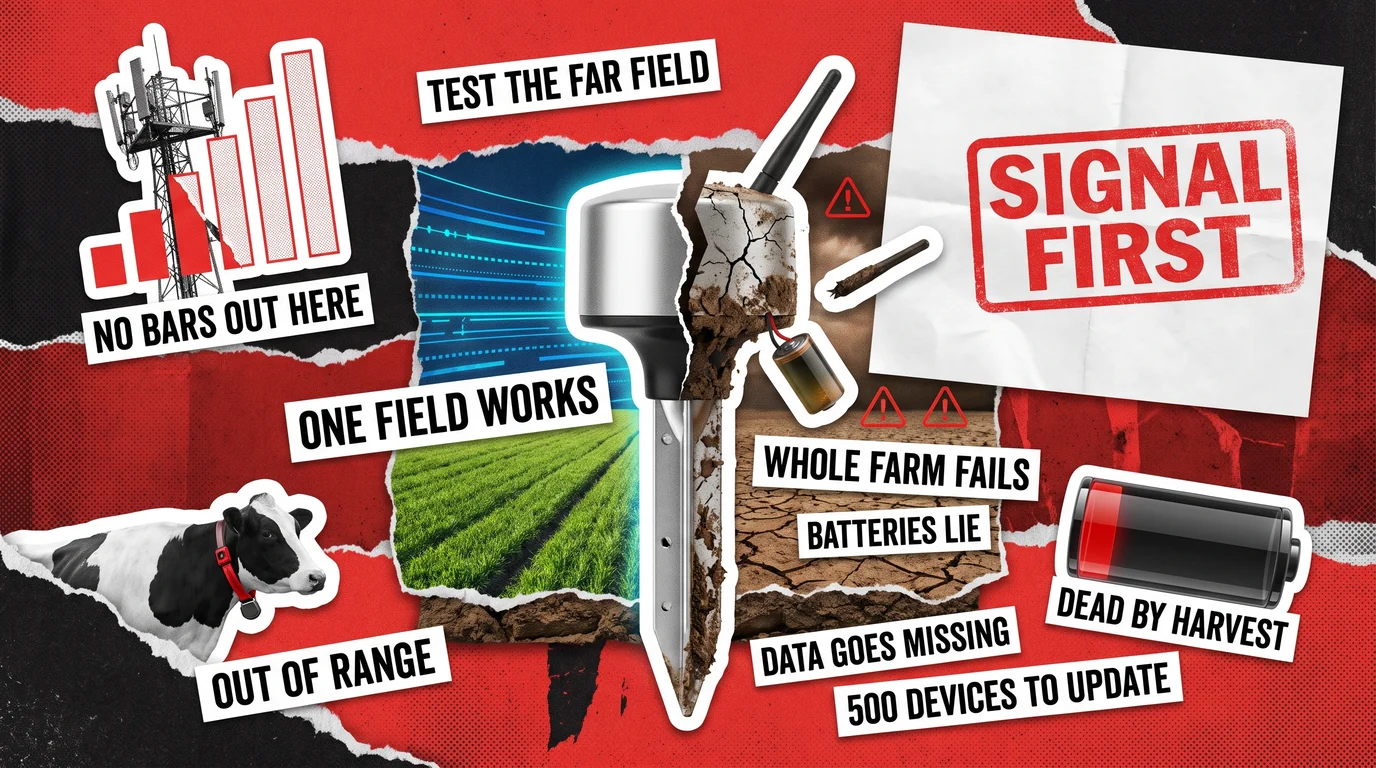
IoT in agriculture means placing sensors in fields, barns, and on livestock to measure things like soil moisture, rainfall, and animal health. Each device then sends its readings over a wireless network to software that helps farmers decide what to do. Get that hardware or network wrong, and you could be replacing hundreds of devices after the first season.
If the term is new to you, IoT stands for the Internet of Things. It simply means everyday objects fitted with a small computer and a radio so they can report what they measure. This guide covers how farm data travels, which hardware to buy, and what breaks as a project grows.
Most farm IoT projects that fail do so at the sensor and network stage, before anyone has analyzed a single reading. Gaps in the data are costly too, since every reading has to arrive clean, complete, and ready to use. Data engineering services solve this by building the systems that collect, check, and store readings from every device.
What Are the Connectivity Options for Remote Farmland?
Getting data back from rural land is harder than it sounds, since fields stretch for miles with spotty cell coverage and no power outlets. That’s why a smart farming IoT setup usually runs on a low-power wide-area network (LPWAN). An LPWAN sends small messages, like a soil moisture reading, over long distances on very little battery. In practice, you’ll choose between three types of network:
- LoRaWAN: Your sensors send readings to a gateway, a box on a pole or barn roof that passes them on to the internet. You buy and place these boxes yourself. The LoRa Alliance, which maintains the standard, puts the range at up to about 9 miles (15 km) in rural areas and battery life at more than 10 years. Hills and trees shorten that range. You get full control and no fees to a cellular carrier, but you also own the upkeep of every gateway.
- NB-IoT and LTE-M: These are slimmed-down versions of the technology in your phone, so each device carries a SIM card and uses towers a cellular carrier already runs. The GSMA, the wireless industry’s trade group, says NB-IoT supports battery life of more than 10 years. It also puts LTE-M modems at 20% to 25% of the cost of older 2G ones. There’s nothing to install, but you pay a plan for each device, and the service only helps where there’s cell coverage in your fields.
- Satellite: Devices send small messages to a satellite overhead, which relays them to a ground station. The standards body 3GPP added sensor connections over satellite to its Release 17 specifications. It reaches places nothing else does, but it can cost more per message and needs a clear view of the sky. Some services may send data in batches rather than instantly.
How Do LoRaWAN, NB-IoT, and Satellite Compare for Farms?
The table below puts the three options side by side, and the right choice depends mostly on the terrain you need to cover. Some deployments mix them, with LoRaWAN across the main farm and satellite for remote water tanks.
Who runs the network
You, through your own gateways
A cellular carrier
A satellite operator
Reach
Up to about 9 miles per gateway in open country
Wherever the carrier has coverage
Anywhere with a clear view of the sky
Battery life
10+ years possible
10+ years possible
Depends on the device and how often it sends
Ongoing costs
Power, internet, and upkeep for each gateway
A plan for each device
Fees per device or per message
Best fit
Large, connected farms a few gateways can cover
Farms with reliable cell coverage across the land
Remote ranches and scattered sites with no other option
Which Sensors Does IoT Precision Agriculture Actually Need?
Precision agriculture means treating each part of a field, or each animal, according to what it needs instead of treating everything the same. In IoT precision agriculture, sensors supply the measurements that make this possible. Four kinds of hardware cover most projects:
- Soil probes sit in the ground and measure moisture, temperature, and sometimes salt levels at several depths.
- Weather stations record rainfall, wind, humidity, and temperature for one spot, which matters because conditions vary across a large farm.
- Livestock collars, or ear tags that do the same job, track where an animal is, how much it moves, and sometimes its body temperature.
- Cameras watch crops, gates, or feeding areas. They need far more power and data capacity than the other three, so they usually get a cellular or Wi-Fi connection of their own.
When you compare sensor models, check four things:
- Battery life: How long does the battery last at the reporting rate you need?
- Upkeep: How often does it need recalibrating? Soil probes slowly drift out of accuracy, so someone has to test them against a known reference and correct them from time to time.
- Network fit: Does it work with the network you chose in the previous section?
- Data access: Can you export the raw readings, or are they locked inside the vendor’s app? Open access lets you combine brands and feed the data into your own software later.
A cheap probe that needs a visit every month quickly costs more than a pricier one you can leave alone for a season.
How Should You Lay Out the Network Across Your Fields?
Once you’ve chosen how your data will travel, the next question is how the devices on your land connect. Engineers call this arrangement the network’s topology, and farms usually pick one of two designs.
The simpler of the two is a star layout, where every sensor talks straight to a gateway, much like spokes meeting at the hub of a wheel. LoRaWAN is built this way, and the LoRa Alliance calls its version “star-of-stars,” with several of these hubs reporting to one central server. Each device has a single, direct link, so problems are easy to find and fix. The weakness shows up at the edges of your land, where anything beyond a gateway’s reach simply can’t send its readings.
By contrast, a mesh layout fixes that edge problem by letting sensors pass messages along to each other until one reaches a gateway. That makes it useful on long, narrow, or oddly shaped fields, and in valleys where a direct signal can’t get through. The relaying has a downside, though. Sensors that carry their neighbors’ messages drain their batteries faster, and if one of them fails, the devices that depended on it lose their route out. That’s why most farms stick with a star layout and add a gateway or two, saving mesh for genuinely awkward terrain.

What Breaks When a Farm IoT Pilot Grows?
A pilot with 20 sensors on one field can hide problems that a rollout of 500 will expose within months. Three come up again and again:
- Battery drain: Spec-sheet battery life assumes ideal conditions, but frequent reporting, weak signal, and cold nights all shorten it. Set the reporting rate by what your decisions need, since hourly soil moisture readings are often enough. Also make sure devices restart and keep recording after a power outage.
- Missing or late readings: No wireless network delivers every message, and a device that loses its connection often sends stored readings late or out of order. Have each sensor stamp readings with the time they were taken, hold them until the link returns, and let the software remove duplicates and restore the order. Readings also arrive in bursts when hundreds of devices reconnect after a storm, which a serverless architecture handles well by adding computing power only while it’s needed.
- Remote updates: Every sensor runs firmware, the built-in software that controls how it measures and sends data, and changing it on 500 devices means delivering updates over the air. Update a small group first, check those devices report normally, and keep the previous version on each one so it can fall back if the new update fails.
All three fixes live in the software. For example, we did such work for SystemDataRecorder, a server monitoring tool for a Finnish software company. Our team wrote lightweight C programs that used about 2 MB of memory each and restarted themselves after a power outage. Kooky, a reusable cup system in Zurich and Basel, tracks every return box with software we built, the kind of dashboard a fleet of soil probes needs.
Where Does IoT in Agriculture Hand Off to AI?
Sensors and networks produce raw readings. Simple alerts, like a dry-soil warning, need only basic rules. More complex decisions, such as when to irrigate, which animal to check, or what yield to expect, are the job of AI models built on top. Our companion guide, AI in Agriculture, covers what they achieve in practice and the business case behind them.
Between the sensors and the AI models sits a data pipeline, the software that collects, cleans, and stores readings, then hands each one to the dashboard, alert, or AI model that needs it. It’s the least visible part of the system and the one that decides whether a model gets trustworthy data. That’s what makes it so important: if the pipeline accepts duplicate or mistimed readings, the model learns from a version of the farm that never existed.
Data also has to flow the other way. Once software makes a decision, it often needs to tell a device to act, such as opening a valve or a gate. For My Bike Valet, we built the cloud app that talks to each bike tower’s controller, checking the user’s details and unlocking the gate on request. An irrigation valve on a remote field follows the same pattern, with the cloud confirming permission and then sending the command to the hardware. Once your data is flowing reliably and you’re ready to build AI models on top of it, our artificial intelligence development services cover that next step.
How Do You Get an Agriculture IoT Project Right From the Start?
Success with IoT in agriculture is decided in the planning stage, well before anyone trains a model. Three choices shape the outcome: the network you pick, the sensors you buy, and how you’ll power, update, and monitor them. Together, they determine whether the project still works when it grows from one field to the whole farm.
IoT isn’t always the right answer, though. On a small plot or a single barn, checking by hand each morning can still cost less than a network of sensors. When in doubt, run a trial on one field for one season before placing a large order, so the numbers come from your own land.
Many agribusinesses and AgTech companies have strong field and agronomy teams but nobody in-house to build the cloud side: the pipeline, the device dashboard, and the update system. That’s the work we take on. Our engineers already know the technologies involved, from the C language that runs on small, low-power hardware to cloud platforms. We’re also comfortable starting before every requirement is fixed. That suits farming, where each season teaches you something new.
Planning a sensor rollout? We’ve shipped software for connected devices and data pipelines before, so talk to us about your AgTech project.
FAQ
What is IoT in agriculture?
IoT in agriculture is a system of connected devices that measure conditions on a farm and report them automatically. It has three parts: sensors such as soil probes or livestock collars, a wireless network that carries their data, and software that turns it into alerts. For example, a soil probe can report dry ground, which triggers a reminder to water that field.
What is the best network for farm sensors?
The best network for farm sensors depends on your land. If your fields sit close together and you can mount and power a gateway, LoRaWAN, a private radio system you run yourself, gives you the most control. Where cell coverage reaches every field, NB-IoT and LTE-M use existing towers, so there’s nothing to install. For remote sites beyond both, satellite is the fallback.
How long do farm IoT sensor batteries last?
Farm IoT sensor batteries can last 10 years or more on low-power networks, but only under ideal conditions. Before buying, ask the vendor how long a device will run at the reporting interval you plan to use, such as one reading per hour. Then budget for replacing batteries across all your devices, and consider solar-powered models for ones that send data often, such as livestock collars.
Do you need Wi-Fi on a farm to use IoT sensors?
Most farm IoT sensors don’t need Wi-Fi. Soil probes, weather stations, and livestock collars usually send small readings through LoRaWAN, a low-power radio standard, through NB-IoT or LTE-M on existing cell towers, or by satellite. Cameras are the main exception, because video needs far more data, so they typically rely on Wi-Fi or a regular cellular connection.
How do you update firmware on remote farm sensors?
Firmware is the software built into each sensor, and on a remote farm it’s changed over the air, through the same wireless network that carries its readings. Before buying, check three things. Can the device receive remote updates? Does it keep its previous version to fall back on? Who sends new releases, you or the vendor? Roll out each new version to a small group first.
See how our custom ERP tools helped Mass Movement reach $2.74B in revenue growth