Most teams learn what an AI agent really costs about six months after it goes live, in the meeting where someone proposes turning it off. The build was the affordable part. The expensive hour goes on explaining why the agent issued two refunds for one order, why nobody can reconstruct its decision, and who authorized the permission behind it. Enterprise AI agent governance is what makes that meeting short, and it is an architecture decision rather than a policy written afterward.
Treat it as a supervision layer with four moving parts: who defines the agent’s scope, who can stop it mid-task, who notices when its permissions grow, and what happens on the day you need it gone. Each part needs an owner, a mechanism, and a test. Skipping them means paying for the same agent twice, once to build it and once to unpick it from the workflows built around it. This is the layer our AI agent development company work builds in from day one, rather than treating supervision as something bolted on once the agent is already live.
The Rollback Paradox in Enterprise AI Agent Governance
The rollback numbers are worse than most boards realize. Research covered by Customer Experience Dive in May 2026, drawn from a survey of more than 2,500 senior decision-makers, found that three-quarters of enterprises have already rolled back or shut down a customer-facing AI agent after it went live. The stated reasons sit closer to control than to capability: nearly a third cited customer data exposure, 22% hallucination or brand risk, and 16% an inability to diagnose what the agent had done.
One detail changes how that headline reads: among organizations with the most mature governance frameworks, the rollback rate climbs to 81%. Mature teams catch failures earlier and pull the agent while the damage is small, so a rollback there is evidence that supervision works. Teams without a supervision layer report fewer rollbacks because they find out later, usually from a customer.
That reframes the goal for anyone running AI agents in production. The target is a rollback that is cheap and boring, the way a good pipeline turns reverting a bad release into a five-minute decision. Companies that have gone furthest with handing entire workflows to software agents tend to have the most rehearsed exits.
Three Governance Failures Behind the Rollback Data
Rollback causes get logged as technical incidents, and they line up as governance gaps once sorted. Deloitte’s State of AI in the Enterprise 2026 report, from a survey run in late 2025, found only one in five companies has a mature model for governing autonomous AI agents. That leaves four in five improvising the three failures below, and serious AI agent governance closes all three before the first production task runs.

Scope Drift
Scope drift starts as a favor. The agent was approved to answer order-status questions, then someone notices it could handle simple refunds too, adds a payments tool, and the scope doubles without a fresh approval. Six weeks later it is doing four jobs, three of which nobody reviewed.
The mechanical cause is that scope lives in a prompt and a toolset, and both are easy to edit. A contractor handed keys to one room cannot repaint the whole floor unnoticed, while an agent handed one extra tool doubles its reach in a single pull request. Teams treating agents as a way to add capacity without adding headcount hit this first, because every absorbed task looks like more return on the same build.
No Stop-the-Agent Authority
Stop authority is a separate question from scope, and it gets discovered at the worst possible moment. IBM’s Institute for Business Value, surveying 2,000 senior technology executives with Oxford Economics between January and April 2026, found two-thirds of CIOs and CTOs are accountable for AI systems they do not fully control, and 70% say teams deploy faster than IT can track. Accountability without a switch is a fairness problem for whoever holds it and a safety problem for everyone else.
Ask three questions before enterprise AI agents touch a customer. Who can stop this agent at 2am on a Saturday, what does stopping do to work already in flight, and how long does a stop take to reach every queue and integration. Most teams answer the first confidently and stall on the second.
Governance Bolted on after Launch
The third failure is sequencing. Oversight added after launch inherits every shortcut taken before it, which is why the audit trail so often starts the week after the incident that made everyone want one. In the same IBM study, only 11% of technology executives called themselves fully ready for the scale of agent deployment they expect within the year.
Retrofitting supervision costs more than building it in, much as adding tests to untested code costs more than writing them alongside. The AI agent deployment that survives its first year usually had logging, a stop path, and a named owner from day one, all cheap before there is live traffic to protect.
Scope Authority as the First Guardrail
Scope authority means one named person approves what the agent may do, in writing, at the level of individual actions. They own the list, so every addition becomes a decision with a name on it rather than a quiet config change. Four properties separate a real scope definition from a job description:
- An allowlist of actions. Write “reads invoice records, drafts replies, escalates disputes to a human queue” in place of “handles billing questions”.
- An explicit forbidden list covering the adjacent actions people will ask for later, such as issuing credits, editing customer records, or emailing outside the account owner.
- One named approver per tool and credential, recorded next to the grant, so widening scope requires a conversation with a specific human.
- Scope changes reviewed like code changes, through the same pull request, the same reviewer, and the same log.
Good AI agent guardrails are boring in exactly this way, because they turn “the agent decided to” into “someone approved that it could”. Agreeing that approver list early is the difference between a governed rollout and a negotiation held during an outage, which is why agentic AI workforce transformation work starts by mapping who owns which action.
Real-Time Intervention That Actually Halts
“Stop the agent” hides three mechanisms, and teams that build only one find the gap during an incident. Halting new task intake leaves in-flight work running to completion. Aborting in-flight tasks leaves half-finished sequences behind, a refund recorded without its notification, a ticket closed without its credit. Revoking credentials stops everything instantly, including the parts working correctly.
An assembly line stop cord is a better model than a power switch, because it halts the line in a known state with every station holding its part. For an agent that means idempotent actions, compensating steps that unwind a half-done sequence, and a queue that survives the halt so nothing is dropped. Effective agentic AI governance treats that path as a shipped feature with its own tests and owner.
Then rehearse it. The stop path deserves the same drill as a database restore, run on a schedule, with somebody timing decision to full halt. Teams that build it into their AI development work from the start surface the awkward cases early, usually a third-party API with no cancel endpoint and a queue that cheerfully keeps redelivering.
Drift Monitoring on Permission Expansion
Scope authority sets the boundary and stop authority enforces it in the moment. Drift monitoring is the slow-motion instrument telling you the boundary has been moving. The figure worth a dashboard is the delta between the tools, scopes, and credentials the agent held at launch and what it holds today.
Three signals catch drift while it is still cheap to reverse. Permission count over time makes creep visible, especially where a temporary grant for a one-off migration never expired. The distribution of actions taken, week over week, shows when a support agent starts spending 30% of its calls on a payments tool it barely touched in month one. Per-action audit records, each carrying the input, the tool called, and the reason, are what make an incident diagnosable, which matters when 16% of rollbacks trace back to nobody being able to tell what the agent did.
Set an expiry on every temporary permission as you grant it, and review the full set monthly. A well-instrumented enterprise AI agent deployment renders drift in a single view, so that review takes twenty minutes and produces a short list of grants to revoke. Without the view it becomes an archaeology project and stops happening by the third month.
Rollback Plan as a Launch Gate
Reversibility belongs in the launch criteria, next to the accuracy threshold everyone argues about. Database migrations ship with a down migration, and agents deserve the same discipline. A rollback plan written on launch day is a document, while one written during an incident is a guess.
A usable plan answers five things: the trigger thresholds that start the conversation, the person who makes the call, the fallback that absorbs the work, the reconciliation steps for actions already taken, and the customer communication that goes out. Write down the staffing assumption in particular. Teams that reassigned the people the agent replaced learn that rolling back means rebuilding a team, which is why a warm fallback is worth keeping through the first two quarters.
Honesty about the limits matters here. Some actions cannot be reversed at any sensible cost, including money that has moved, emails already sent, and records a partner system has consumed. Those belong behind a human approval step, and sorting them from the reversible ones is part of the wider digital transformation question of what software may do on its own.
The Four-Part AI Agent Supervision Checklist
Four questions decide whether an agent survives its first year of live traffic. Each needs an owner, a mechanism, and evidence you could show an auditor, and any “we handle that informally” marks the gap that produces the next rollback.
Scope authority
Which specific actions may this agent take, and who approved each one?
A written allowlist and forbidden list, with a named approver against every tool and credential.
Stop authority
Who can halt it, how quickly, and what happens to work already in flight?
A tested stop path with a documented time from decision to full halt.
Drift monitoring
Have its permissions or its behavior changed since launch?
A permission delta view against the launch baseline, plus a monthly review with revocations logged.
Rollback plan
If we remove it tomorrow, what absorbs the work?
A signed-off runbook with trigger thresholds, a named decision-maker, and a staffed fallback.
Run this against an agent you already have live. The usual outcome is three filled rows and one honest blank, and the blank is where the next incident is waiting.
The Supervision Layer in Practice
The agent work that reaches us arrives at one of two moments. Sometimes before the first production task, when a team wants the supervision layer designed alongside the agent. More often after a pause, when a promising build was switched off and has to return in a form the risk owners will accept.
A retrofit starts with an inventory, because almost nobody has a current list of the tools, credentials, and data their agent can reach. From there the order stays consistent: add per-action logging, test the stop path, write the allowlist and forbidden list with a named approver against each grant, then write the rollback runbook and rehearse it.
One honest limitation belongs on the table. If the agent’s job cannot be written down as a bounded list of actions, supervision will not rescue it, and the right move is narrowing the job until it can be. A support agent that answers billing questions and escalates everything else is governable this week, while an agent asked to “own the customer relationship” will drift regardless of the monitoring on it. Redwerk’s teams are usually brought in for the stack a client already runs, which is why this work sits inside the same enterprise software development practice as the .NET or Python services the agent calls, not a separate AI-only track.
The companies keeping their agents live are rarely the ones with the best models. They are the ones who can answer four questions on the spot: what it may do, who can stop it, whether it has changed since launch, and what absorbs the work if it goes away. Those answers are cheap before launch and expensive to reconstruct after an incident, and they separate a pilot that graduates from one quietly switched off. If you are weighing that work for something you have already built, or something about to ship, talk to our team and we will map what the supervision layer looks like on your stack.
FAQ
What is enterprise AI agent governance?
It is the set of controls deciding what an autonomous system may do inside a company: who approves each capability, who can halt it mid-task, how its permissions are monitored after launch, and how it is withdrawn. In practice it lives in code, access grants, and runbooks rather than in a policy document.
How do you govern AI agents in production?
Give one named person ownership of the action allowlist, ship a tested halt path with a known time to full stop, compare permissions against the launch baseline every month, and keep a rehearsed withdrawal runbook with a staffed human fallback. Each control needs evidence an auditor could read.
Why do enterprise AI agent deployments fail?
The reported causes cluster around control rather than model quality: customer data exposure, brand risk from wrong answers, and an inability to reconstruct what the system actually did. Underneath sit three gaps, a boundary that widened quietly, no rehearsed way to halt the work, and oversight added after launch.
What percentage of AI agents get rolled back?
Research covered in May 2026 found three-quarters of surveyed enterprises had already rolled back or shut down a customer-facing agent after deployment, rising to 81% among organizations with the most mature governance frameworks. The higher figure reflects earlier detection, since mature teams spot problems while they are still small.
What are AI agent guardrails?
They are the technical limits keeping an autonomous system inside its approved job: an allowlist of permitted actions, an explicit forbidden list, per-tool credentials with named approvers, a human approval step for irreversible actions, and logging on every action taken. Guardrails constrain capability, and monitoring reports on it.
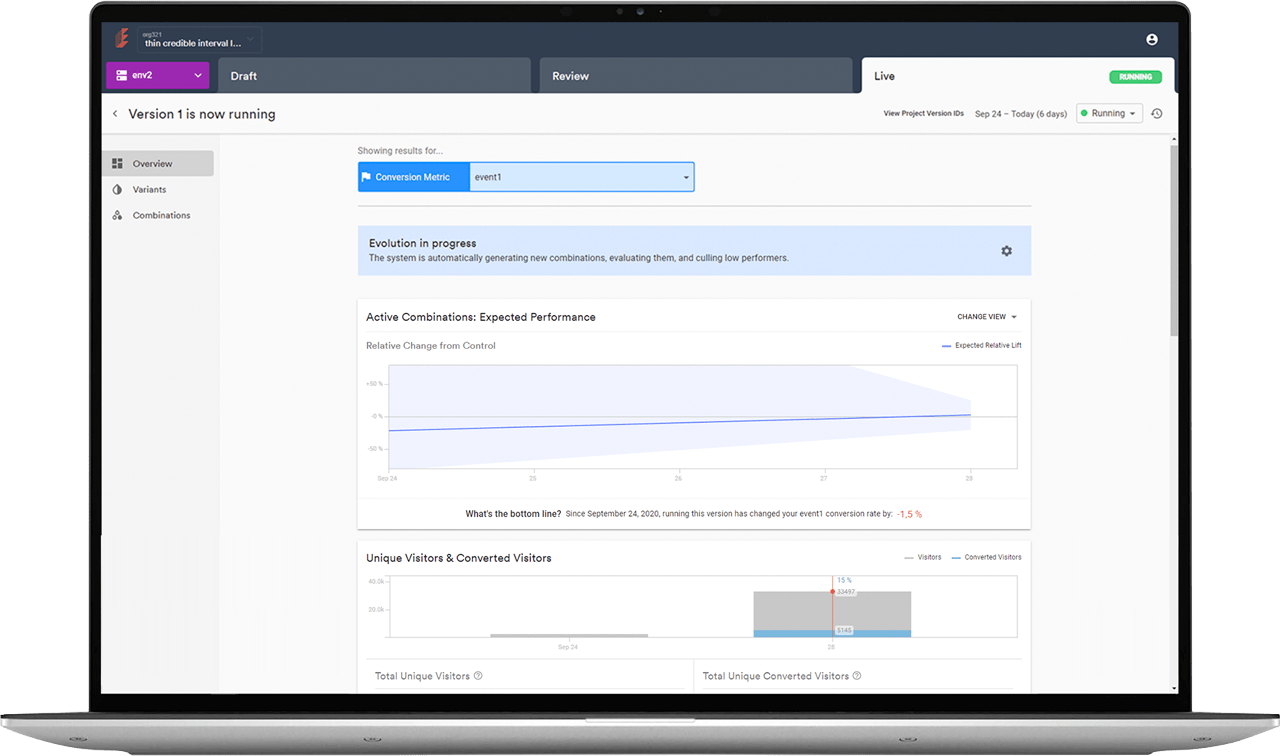
See what operator control looks like on a live AI platform: the analytics and QA views we built for Evolv across 20+ production releases