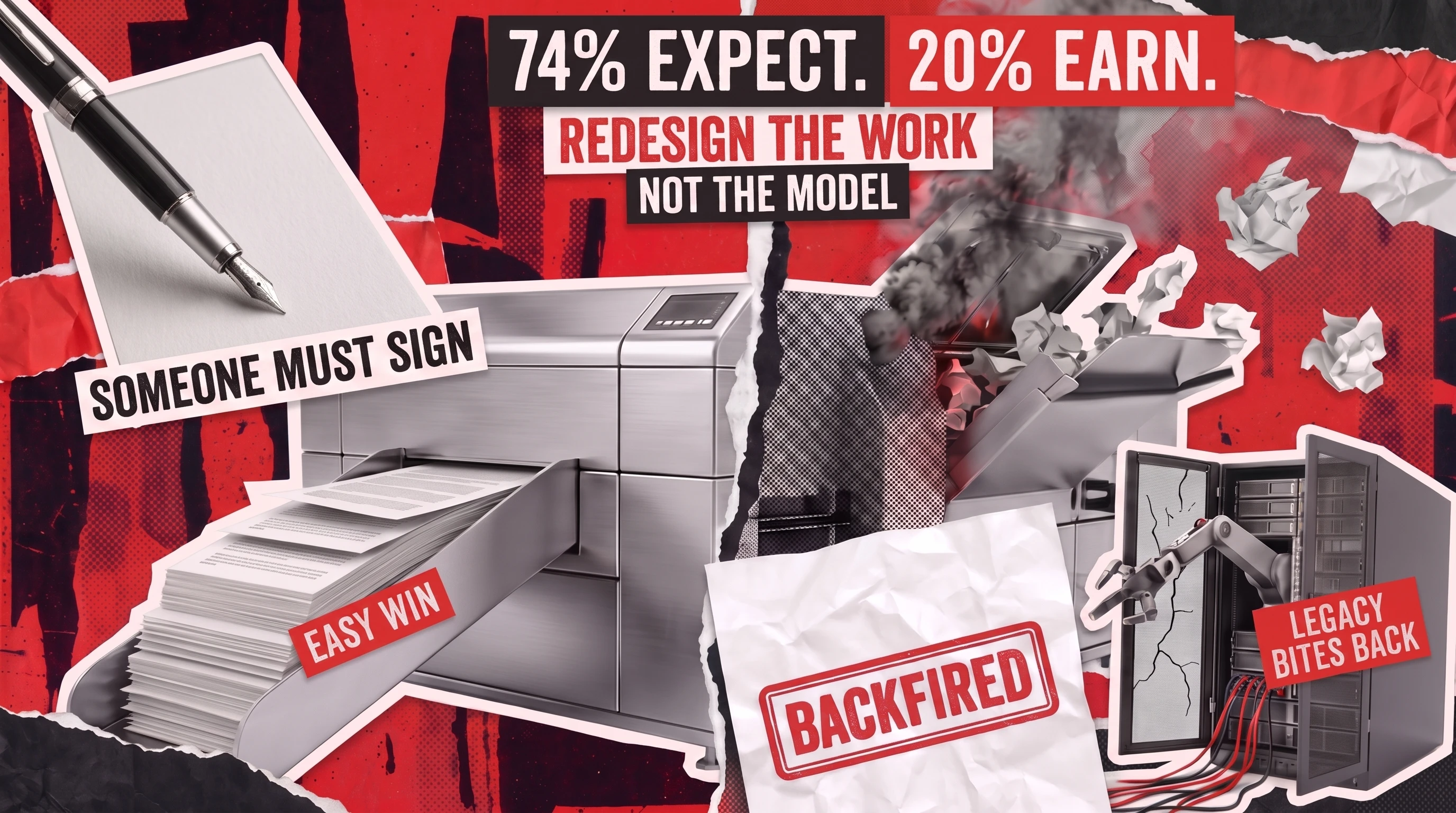
Seventy-four percent of organizations expect AI to grow their revenue. Twenty percent are actually doing it. That gap comes from Deloitte’s 2026 State of AI in the Enterprise, a survey of 3,235 business and IT leaders across 24 countries, and it is the most honest summary available of where digital transformation with AI actually stands.
AI transformation is digital transformation where AI redesigns the work itself, not just the tooling wrapped around it. It reliably accelerates document-heavy, high-volume, rule-bound workflows. It backfires on core system rewrites, compliance-critical decisions, and anything running on undocumented legacy code. The deciding variable is workflow redesign, not model choice.
This matters more than it sounds. One version gives you a faster copy of the company you already run. The other gives you a different company. Most teams only work out which one they bought a year or two in, once the budget is spent. We have watched that play out across two decades of digital transformation projects.
What Is AI Transformation, and How Is It Different From Digital Transformation?
Digital transformation moves a process from analog or on-premise to digital and cloud. The process itself usually survives the trip. You still route the same approvals, you just route them through a web app instead of a filing cabinet.
AI transformation changes what the process is. Instead of giving an analyst a faster spreadsheet, you remove the step where a human reads 400 rows and forms a judgment, and you rebuild the workflow around a system that produces that judgment continuously. That is the whole distinction, and it explains why so many AI programs stall: they are digital transformation projects wearing an AI label.
The practical test is simple. If you could switch the AI off tomorrow and your process would run exactly as before, only slower, you have added a tool. If switching it off would break the workflow because the workflow no longer contains that human step, you have transformed something. Most organizations are in the first category and reporting it as the second. If you are still sequencing the underlying program, our digital transformation roadmap guide covers the ordering problem before AI enters the picture.

Adoption Is Historic, Value Is Not
Adoption has been genuinely historic. Stanford HAI’s 2026 AI Index reports generative AI reaching 53% population adoption within three years, faster than either the personal computer or the internet managed, with usage in at least one business function at 70% of organizations. China and Europe posted the highest year-over-year increases among organizations.
Then the value numbers arrive and deflate the mood. Deloitte found 66% of organizations capturing productivity and efficiency gains, which is real, but the revenue picture is that 74%-hoping against 20%-achieving split. Productivity gains are the easy half. They show up when individuals work faster. Revenue gains require the organization to do something it could not do before, and that is a structural change, not a tooling change.
Harvard Business Review’s editors call this the micro-productivity trap in their piece on moving from AI experimentation to AI transformation: thousands of individual time savings that never aggregate into a business result, because nobody redesigned the system those individuals work inside. Everyone is 12% faster and the profit and loss statement does not notice. It is a familiar pattern to anyone who has watched a digital transformation fail for reasons that had nothing to do with the technology.
Where Digital Transformation With AI Reliably Accelerates
AI has a consistent profile of what it is good at, and it is more mundane than the marketing suggests. Before assessing any candidate workflow, check it against four conditions.
- High volume. Enough repetition that a small percentage improvement is worth engineering for.
- Text-shaped or pattern-shaped. The input is documents, records, or numerical patterns rather than relationships or physical judgment.
- Tolerant of a small error rate. A 2% miss is an inconvenience, not a lawsuit.
- Already has a reviewer. Someone checks this output today, and that person can shift from reviewing everything to reviewing exceptions.
Four workstreams clear those conditions consistently:
- Document and data-entry heavy workflows. The clearest win of the group. Claims intake, invoice matching, contract review, employee and customer onboarding paperwork, records reconciliation. Harvard Business Review’s guidance on transforming the middle office with AI targets exactly this layer, the low-visibility processing work that sits between the customer-facing front office and the back office and absorbs enormous headcount without differentiating anybody.
- Tier-one customer operations. Reliable, provided you scope it honestly. Password resets, order status, returns eligibility, appointment changes. The trap is treating tier one as the whole support function and discovering that your escalation path was load-bearing.
- Forecasting and planning. Demand forecasting, inventory reordering, staffing projections, and pricing all involve continuous recalculation against changing inputs, which is work humans do badly and infrequently because it is tedious. This is where applied generative AI for digital transformation tends to produce a measurable number rather than a feeling.
- Legacy system comprehension. This deserves particular attention, because it is the one place AI helps most with the thing that actually blocks transformation. Point a model at a twelve-year-old system nobody documented and it will map what the code does, which parts touch which data, and where the old business rules are buried. A developer piecing that together by hand takes weeks. This takes days. It does not rewrite the system, it tells you what you are dealing with, which is often the missing input for the entire program, and it is why we treat legacy code as a discovery problem before it is an engineering one.
Where AI Backfires
The same four conditions run in reverse. Where volume is low, where the output is a judgment call, where errors are expensive, or where nobody is positioned to check the work, AI adds risk instead of speed. These four categories account for most of the AI write-offs we see.
- Core system rewrites. The most expensive mistake on the list. A migration is either right or wrong: the new system has to return exactly the same answers as the old one for every past record, or you have corrupted your data without noticing. AI writes code that looks correct, and looking correct is not the same as being correct. Use it to understand the old system and to write the tests that prove the new one matches. Leave the migration itself to engineers.
- Compliance-heavy and regulated flows. Lending decisions, benefits eligibility, clinical pathways, anything carrying a statutory audit trail. You may need to explain why one specific person got one specific decision, months later, to someone with the legal authority to ask. AI systems handle that badly, and being wrong here costs far more than being slow.
- Agents layered onto unmodernized systems. This is the one Gartner has put a number on. Gartner predicts over 40% of agentic AI projects will be canceled by the end of 2027, citing escalating costs, unclear business value, and inadequate risk controls, and noting specifically that integrating agents into legacy systems is technically complex, disrupts workflows, and demands costly modifications. Gartner also estimates only around 130 of the thousands of vendors marketing agentic AI are real, which is worth remembering during procurement.
- Judgment and relationship work. Key account management, senior hiring decisions, partner negotiation, and anything where what you are producing is trust rather than a deliverable.
Document processing, invoice and claims intake
Accelerates
High volume, text-shaped, error-tolerant with human exception review
Automate the flow, keep a reviewer on exceptions only
Tier-one customer support
Accelerates
Repetitive, bounded, clear escalation path
Scope to tier one explicitly, instrument the handoff
Demand forecasting and reordering
Accelerates
Continuous recalculation humans do rarely and badly
Run alongside the current process until parity is proven
Legacy system comprehension
Accelerates
Reading and mapping code is faster than doing it by hand
Use for discovery and test generation, not the rewrite
Core system migration and rewrites
Backfires
Correctness is binary; code that looks right is not right
Deterministic engineering, with AI generating the parity tests
Regulated and compliance-critical decisions
Backfires
Requires per-decision explainability and an audit trail
Keep the decision human, use AI for evidence assembly
Agents over unmodernized legacy
Backfires
Integration cost and disruption exceed the value
Modernize the specific data path first, then automate
Judgment and relationship-driven roles
Backfires
Output is trust, not throughput
Support the human with better inputs, do not replace
How Does AI Enablement Drive Digital Transformation?
Through workflow redesign, and the evidence on this is unusually consistent. McKinsey’s State of AI research tested 31 different organizational habits to see which ones genuinely separate the companies making money from AI from everyone else. The winners, roughly 6% of respondents, were those crediting AI with at least 5% of their operating profit, formally earnings before interest and taxes (EBIT). Those companies were nearly three times as likely to have fundamentally redesigned individual workflows, and that redesign ranked among the strongest contributors to business impact of everything McKinsey measured.
BCG frames the same finding as a budget allocation. Their 10-20-70 principle attributes 10% of AI value to the algorithms, 20% to data and technology, and 70% to people and processes. It is a framework rather than a survey result, but it predicts the failure mode well: organizations spend their attention inversely to that ratio, agonizing over model selection while nobody owns the process redesign.
Deloitte’s depth data shows how few companies have crossed that line. Only 34% are starting to use AI to deeply transform by creating new products or reinventing core processes, 30% are redesigning key processes around AI, and 37% are using AI at a surface level with little or no change to existing processes. That last third is where the productivity-without-revenue pattern lives.
MIT Sloan’s guidance on accelerating AI transformation adds a useful mechanic: redesign by task, not by job title. Break a role into its 15 to 20 constituent activities, map how the work is genuinely performed rather than how the org chart says it is, then decide activity by activity what moves to a system and what stays with a person. Roles are too coarse a unit to redesign. Activities are the right grain, and this is the same discipline behind any durable set of digital transformation strategies.
How to Integrate AI Into a Transformation Already in Flight
Most organizations reading this are not starting fresh. There is a program underway, a roadmap with committed dates, and now a mandate to add AI to it. Here is the order that actually holds up once real deadlines and real legacy systems get involved.
- Pick a workflow, not a department. “AI in operations” is not a project. “Invoice exception handling, currently 3.2 full-time staff, 14,000 documents a month, 6% error rate” is a project, because it gives you a baseline you can be measured against.
- Make the data boring before you make it smart. Clean, accessible, connected data is the precondition, and it is where most of the timeline actually goes. If the relevant records live in four systems with three different customer identifiers and no reconciliation between them, that is your first-quarter project, whatever the AI roadmap says.
- Fix only the plumbing the AI actually touches. Rebuilding your whole technology estate before any AI work is a multi-year way of doing nothing. You need to modernize just the systems that feed the workflow you picked, plus the connections between them. One caution: when those systems move to the cloud, redesign them on the way rather than copying the old structure across unchanged. Copying it across looks cheaper in month one and costs more every month after.
- Build the evaluation layer before you build the agent. You need automated checks that tell you the system is degrading before a customer does. Teams skip this step because it produces no demo, and it is the step that determines whether the thing survives in production.
- Prove one function, then expand. One workflow, measured against its baseline, running in parallel with the existing process until parity is demonstrated. Then the next one. Organizations that scale capacity without hiring get there by compounding proven functions, not by launching eight pilots at once.
Vertical context shifts the starting point but not the method. Retail transformation usually begins with demand forecasting, reordering, and tier-one support, which we break down in detail for AI retail digital transformation. E-learning platforms typically start with content generation and adaptive assessment. Public sector and welfare delivery start with intake triage and case routing, where volume is high and the rules are already written down. Logistics starts with route and inventory optimization. Human resources and recruiting start with screening and scheduling, with a firm boundary around final hiring judgment.
The Workforce Question You Cannot Skip
Let us be direct about what most executives are actually asking. Yes, AI can reduce headcount, and in the right workflows the reduction is permanent and substantial. Document processing, tier-one support, and routine reconciliation genuinely need fewer people once the work is rebuilt around a system instead of a queue. Anyone telling you otherwise is selling reassurance.
Most of the damage comes from moving too fast. Gartner predicts that by 2027, half of the companies that attributed headcount reductions to AI will rehire staff for similar functions under different job titles. A related Gartner survey of 321 customer service and support leaders found only 20% had actually reduced agent staffing because of AI, which suggests the press releases have been running well ahead of the deliveries.
Klarna is the example most often cited, because the company was unusually candid about it. After cutting roughly 700 customer service roles and routing the work to an AI assistant, chief executive Sebastian Siemiatkowski told Bloomberg the company had focused too heavily on efficiency and cost, that the result was lower quality, and that it was hiring humans again. The technology worked. The scoping did not.
What separates the companies that cut once from the companies that cut and then rehire is an impartial read of the work before anyone is let go. That means somebody mapping which workflows can be redesigned, how each should be rebuilt, what a system can and cannot absorb, and, the part almost everyone skips, where the freed capacity gets redeployed to generate new revenue rather than just a smaller cost line. A transformation that only removes cost is half a transformation.
This is the case for treating AI workforce transformation as its own engagement with its own evidence standard. Letting people go is the easy part, and it is the only part that is hard to undo. Working out precisely what should be automated, with which technology, on what timeline, at a cost that actually clears the savings, and then repairing your standing with customers and remaining staff if you got it wrong, is the difficult part. It is also considerably cheaper to do first. The specific architectural mistakes behind these reversals are covered in why AI workforce transformation fails.
Why Redwerk
We have been delivering digital transformation since 2005, which means we learned the fundamentals of it well before AI became the reason anyone commissioned one. That matters more than it sounds. Knowing how a transformation actually succeeds, where the sequencing traps are, and which parts of a business resist change is what lets us judge where AI belongs in a program and where it would only add risk to something already difficult.
From library branches to any browser. When COVID closed the physical locations that AWE Learning’s early-childhood education product depended on, they needed the offline product to become a cloud product quickly, without losing the safety controls that made it appropriate for children. We built it: modern, configurable, centrally managed, and reachable by anyone with a browser rather than anyone who could reach a library branch.
One dashboard for welfare work across every channel. For US human services agencies, we built Current, a SaaS platform that replaced fragmented, largely manual welfare-delivery processes with real-time dashboards and predictive analytics. Case workers can now see the full workload across every access point, lobby, phone, mail, and online, in one place, and track what is moving. That is what a transformation looks like when it changes the work rather than digitizing it.
Decades of pricing expertise turned into the product itself. With KillerBee, the raw material was decades of construction-materials pricing knowledge living in people’s heads and spreadsheets. We turned it into an automated smart-pricing platform now used worldwide, which is the pattern behind most successful AI business transformation work: encode the expertise you already have rather than importing someone else’s.
We are also comfortable with projects that arrive half-finished. Taking over a stalled build, working productively before the requirements are fully written, and putting specialists on the exact stack you are already running are the three things clients hire us for most often. If you want to know where AI would genuinely accelerate your transformation and where it would put it at risk, book a discovery call and we will walk through both.
FAQ
Is AI part of digital transformation?
Yes, and for most organizations it is now the largest part of the program. Generative AI is already running in at least one business function at the majority of companies, so the useful question is no longer whether AI is involved but how deeply. Plenty of organizations run AI without changing a single underlying process, and that is precisely the line between adopting AI and transforming with it.
What is the difference between AI transformation and digital transformation?
Digital transformation moves a process from analog or on-premise to digital and cloud while keeping the process itself intact. AI transformation changes the process, removing or restructuring the human steps inside it. The practical test: if switching the AI off would leave your workflow functional but slower, you have added a tool rather than transformed anything.
How does AI enablement drive digital transformation?
Through workflow redesign, not through tool adoption. The organizations getting measurable financial results from AI are consistently those that rebuilt how specific work gets done, rather than handing faster software to people performing the same jobs in the same sequence. The practical implication is that most of the effort and most of the value sit in process and people, while the choice of model or vendor matters far less than the attention it usually attracts.
Where should a mid-market company start with AI in digital transformation?
Start with one high-volume, document-heavy or pattern-heavy workflow that has a measurable baseline, such as invoice exception handling, claims intake, or demand forecasting. Instrument it, run it in parallel with the existing process until parity is proven, then expand. Avoid starting with core system migrations or compliance-critical decisions.
Does AI driven digital transformation require replacing legacy systems first?
No, and attempting a full technology overhaul before any AI work usually stalls the program before it starts. Modernize only the specific systems and data connections that your chosen workflow actually depends on. Dropping AI agents onto old systems never designed for them tends to cost more in integration and disruption than the automation returns, so narrow and targeted beats either extreme.
See how we built an AI-powered recruitment app acquired by a US staffing giant