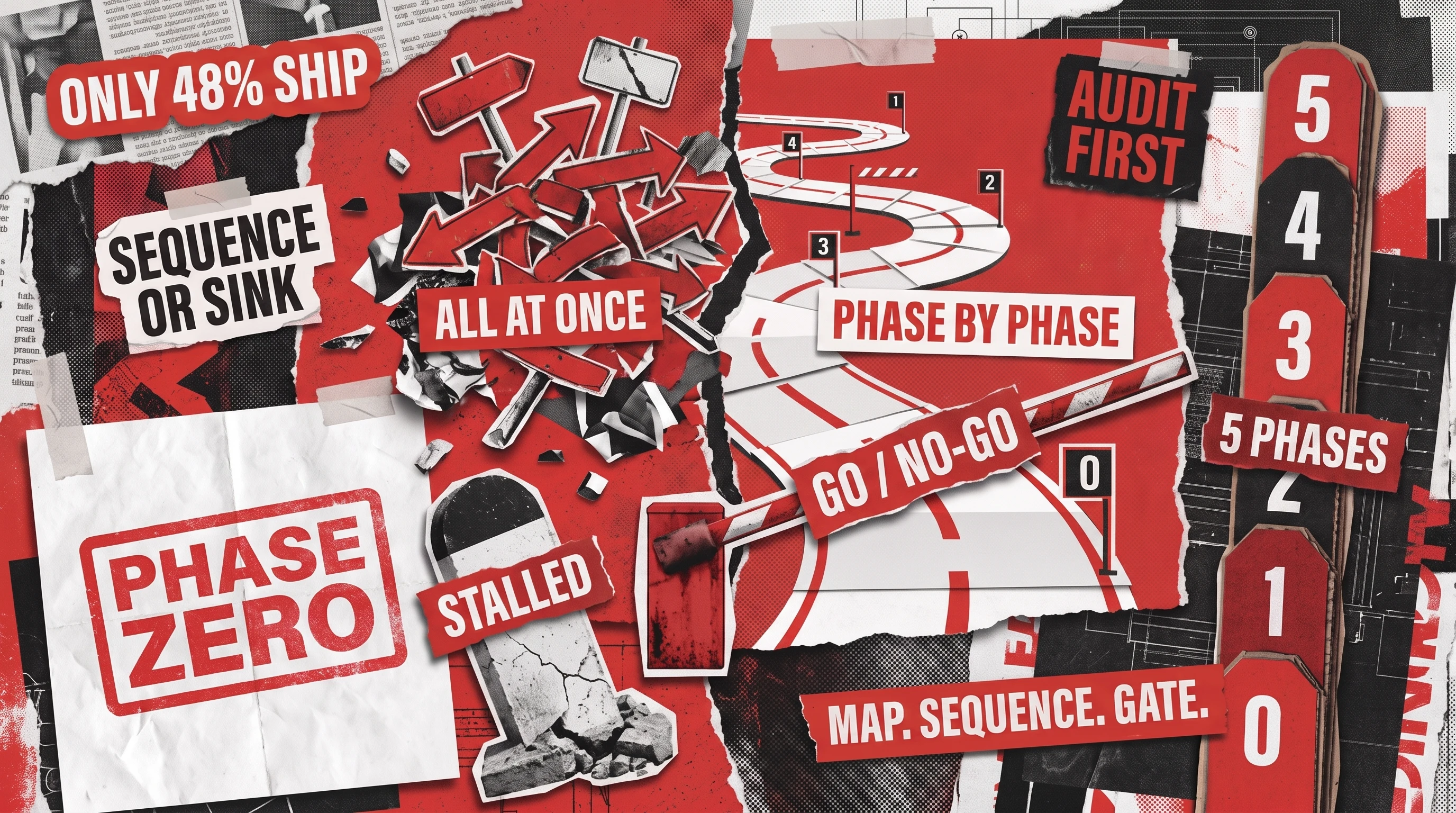
Every stalled digital transformation has roughly the same origin story: plenty of budget, full executive backing, a vision deck everyone applauded, and then months later, not much to show for it. The problem is rarely the ambition. It is the absence of a real digital transformation roadmap, the sequence that decides what gets built first, what waits, and how you know a stage is safe to leave behind.
The odds are not in your favor by default. Only 48% of digital initiatives meet or exceed their business outcome targets, according to a Gartner survey of 3,186 CIOs and technology executives across 88 countries. That is barely better than a coin toss, on projects that often run into the millions. The encouraging part is that closing the gap is less about a bolder strategy and more about sequencing.
A digital transformation roadmap is what turns “we’re modernizing” into work a team can actually deliver. This guide shows you how to build one, how to sequence it so it does not collapse at the first surprise, and what a real plan looks like, with a sample roadmap you can copy. If you would rather hand the whole thing to a team that has done it before, that is exactly what Redwerk’s digital transformation services are for.
What Is a Digital Transformation Roadmap?
A digital transformation roadmap is a phased execution plan that breaks a modernization program into sequenced stages, each with a fixed timeline, named dependencies, and a decision gate that must pass before the next stage is funded. It is the difference between a vision deck and a plan someone can be held to. Think of the strategy as where you are going and the roadmap as the turn-by-turn directions that get you there.
This piece is about execution sequencing only. If you are still deciding which approach to take, start with our guide on digital transformation strategies, and if you are choosing what kind of transformation you are running, our breakdown of digital transformation models covers the types. From here on, we assume those two calls are already made and it is time to build the plan.
How Do You Create a Digital Transformation Roadmap?
To create a digital transformation roadmap, split the program into four to six sequenced phases, give each a timeline range, write down what it depends on, and put a go or no-go gate at the end of every one. Start with an audit as phase zero so the whole sequence is built on the real state of your systems rather than a hopeful guess.
The instinct to jump straight to the exciting parts is strong, and it is exactly how programs end up in the failed half. A roadmap is only credible when the money question is answered honestly and the sequence respects reality. The three moves below are what separate a plan that ships from a wish list with dates on it.
Sequence for Quick, Self-Funding Wins
McKinsey’s research on large transformations is blunt about momentum: sequencing with a view to quick returns is what builds scale fast, because the more value a program captures early, the more it funds itself and the more support it earns. Their three-horizon model stabilizes the fundamentals first, then layers on growth and enablement, then makes the one or two big bets that reshape the business. In practice that means aiming for meaningful value in the first 12 to 18 months and transformational value across three to five years, not one heroic launch at the end. Put the wins that pay for the next phase near the front.
Name Every Dependency Before You Date It
A dependency is anything that has to be true before a phase can start, and unwritten dependencies are where timelines go to die. For example, your new online store cannot go live until the system that feeds it product and order data is ready, so that is a hard dependency, not a preference. Write each one down next to the phase it blocks. The classic trap is the forgotten spreadsheet or script that one team has quietly relied on for years; it tends to surface in the middle of a migration, exactly when nobody planned for it.
Put a Real Decision Gate at the End of Each Phase
A decision gate is a go or no-go checkpoint with pass criteria set in advance and one named person accountable for the call. Its whole job is to stop a troubled phase from silently funding the next one. Gartner found that the top performers, a cohort it calls the “Digital Vanguard,” hit their targets 71% of the time versus the 48% average, and the thing they do differently is co-own delivery between IT and business leaders rather than tossing it over the wall. A gate with a named owner from both sides is that co-ownership made concrete.
How Do You Plan a Digital Transformation Without It Falling Apart?
Planning is the work of turning phases and gates into a document you can defend in a budget review and a team can actually act on. The failure data is sobering here too: BCG studied hundreds of transformations and found that only 30% succeed, while 44% create some value but miss their targets and 26% deliver almost nothing lasting. The encouraging half of their finding is that six factors, applied together, lift the odds of success up to 80%, and none of them work alone.
Those six factors map cleanly onto a good plan, so use them as your checklist. Getting three or four of them right is not a partial win; BCG found those companies failed anyway.
The Six Ingredients of a Plan That Survives Contact With Reality
The factors BCG credits for that jump from 30% to 80% are:
- An integrated strategy with clearly quantified goals
- Committed leadership from the CEO down through middle management
- High-caliber talent with real expertise
- An agile governance mindset
- Honest monitoring against defined metrics
- A modular, business-led technology platform
Notice how many of those are about people and accountability rather than tools. A plan that names owners, sets measurable gate criteria, and staffs each phase with people who have actually done the work is quietly ticking most of these boxes.
Timelines as Ranges, Rollbacks as Requirements
Write timelines as ranges, because “10 to 16 weeks” survives the first surprise and “done by March 14” does not. For every phase, especially the risky ones, write the rollback answer: if this goes sideways, how do we get back to a working state by end of day? A plan without a rollback path is a plan with a hidden single point of failure, and you will find it at the worst possible moment.
What Are the Phases of a Digital Transformation Roadmap?
Most mid-market roadmaps settle into five phases. What matters is the order and the gates between them. One rule never bends: a phase starts only when the previous gate has passed, never because the calendar says so.
Here is what each phase is actually for, and why skipping or reordering one is what turns a plan into a pileup.
Phase 0: Audit
You cannot plan what you have not measured. The audit is where you find out how your systems really work today, not how the documentation claims they do, and that gap is almost always wider than anyone expects. It surfaces the undocumented script finance runs every month, the integration nobody owns, and the data that turns out messier than the last report suggested.
Every date in the rest of the plan rests on what this phase finds, which is why we treat it as phase zero and run it through our discovery phase and software development audit work before anything else is scheduled. If you inherited a transformation that already stalled, this is also where the rescue starts: you audit what actually shipped instead of trusting the plan it was supposed to follow.
Phase 1: Foundation
The foundation is the plumbing everything else stands on: where your software runs, how it ships, how people sign in, and how it stays secure. It is invisible to customers, which is exactly why it gets rushed. Set it up well and the later phases go more smoothly, because they are building on something stable. Rush it, and the gaps tend to show up again as problems in the phases that follow.
Phase 2: Core Migration
This is the big one: moving the system that actually runs the business, your orders, inventory, or core platform, onto the new setup. It carries the most risk and the most reward, which is why it sits in the middle of the plan rather than at the start, and why it is deliberately kept away from your busiest season. Running the old and new systems side by side for a while lets you prove the new one is right before you switch off the old one, so a bad surprise never takes the business down with it.
Phase 3: Customer-Facing Rebuild
This is the part your customers actually see: the storefront, the portal, or the app. It has to come after the core migration because it reads from that new core, and launching it first means building on a foundation that is still moving. Rolling it out to a small slice of traffic before everyone gets it means you catch problems while they are still small and cheap to fix.
Phase 4: Optimization and Scaling
A transformation is not finished the day the new storefront goes live. This phase is where the payoff compounds: switching off the old systems so you stop paying to run two of everything, automating the manual work the migration exposed, and adding the analytics or AI that only became possible once the data was clean. Skip it and you keep paying to run the old systems alongside the new ones for longer than you need to.

The most common sequencing mistake is rebuilding the customer-facing layer before the core it depends on is stable in production. Do that and you rebuild the storefront twice, which your CFO will remember for years.
What Does a Digital Transformation Plan Example Look Like?
A digital transformation plan example is a stage-by-stage document where each phase shows its duration, its upstream dependencies, and its exit gate. Rather than invent a company, here is the reusable template you can drop your own systems into. It reads as a sequence of commitments, each one protecting the next.
Picture a mid-market retailer moving off an aging on-premise ERP onto a cloud core and a modern storefront, without stalling holiday sales:
- Phase 0: Map the ERP, the payment and inventory integrations, and those quiet finance scripts, exiting on a signed-off risk list.
- Phase 1: Stand up the cloud environment and prove the pipeline by migrating one low-risk workload, like an internal returns dashboard.
- Phase 2: Move inventory and order management onto the cloud core, running old and new in parallel for two cycles before cutover, scheduled deliberately away from the seasonal peak.
- Phase 3: Rebuild the storefront on the new order API and launch to 10% of traffic before ramping.
- Phase 4: Decommission the old servers and layer on automation and forecasting once the data is clean.
The whole sequence to a live storefront runs roughly 9 to 12 months, with optimization open-ended after that. What the order protects is worth saying out loud: the riskiest work sits away from peak season, the storefront cannot launch before the core it reads from is stable, and every phase can be stopped at its gate before the next one gets funded.
Why Partner With Redwerk for Your Digital Transformation
Redwerk has been shipping software since 2005, which means we have modernized systems built in eras most vendors would rather not touch and stood up brand-new cloud products on the latest stacks. That range matters on a roadmap, because phase zero usually finds legacy that has to keep running while the new core comes up beside it. We plan for both worlds instead of pretending the old one does not exist.
The wins are concrete:
- AWE Learning: We migrated a 25-year-old early-literacy product from physical library installations into a cloud SaaS platform on ASP.NET Core, Vue.js, and Azure. It now runs in 50% of US public libraries and won a 2021 Modern Library Award.
- KillerBee: We built a smart-pricing SaaS from scratch that made quote generation 90% faster and bridged modern tools to legacy systems clients could not afford to replace, now used across the US, France, and New Zealand.
- Mass Movement: We delivered five enterprise apps that synchronized logistics across warehouse, technician, and mobile workflows over 6,000-plus engineering hours.
- Change & Innovation Agency: We built a fully ADA-compliant government case-management platform on Azure and Angular that ten state and county agencies adopted.
That is the pattern we bring to your plan: map first, sequence around the real risks, and gate every phase. If you would rather have a senior team that has run this sequence before, book a call with our digital transformation team.
FAQ
How do you create a digital transformation roadmap?
Split the program into four to six phases, give each a timeline range, name its dependencies, and add a decision gate that must pass before the next phase is funded. Start with an audit as phase zero so the sequence reflects your real systems instead of an assumed inventory.
How do you plan a digital transformation?
Turn the phases into a document with quantified goals, named owners for each gate, timeline ranges rather than fixed dates, and a rollback path per phase.
What does a digital transformation plan example look like?
A stage-by-stage document: audit, foundation, core migration, customer-facing rebuild, then optimize and scale. Each phase lists its duration, its upstream dependencies, and the gate criteria it must clear to exit, as in the template above.
What are the phases of a digital transformation roadmap?
Audit (phase zero), foundation, core migration, customer-facing rebuild, and optimize and scale. A phase begins only when the prior gate passes, and the customer-facing layer never launches before the core it depends on is stable in production.
How long does a digital transformation take?
For a mid-market company, the core sequence from audit to a live customer-facing rebuild typically runs 9 to 12 months, with optimization continuing after that. McKinsey advises sequencing for meaningful value in the first 12 to 18 months and transformational value over three to five years.
Why do most digital transformations fail?
Gartner reports only 48% of digital initiatives meet their targets, usually because everything is scheduled at once, gates pass on optimism, and the audit gets skipped. The top performers hit 71% by co-owning delivery between IT and business leaders and by sequencing around real dependencies.
See how decades of niche domain expertise became the #1 automated pricing solution used worldwide.