Your costs are climbing from four directions at once, and your board wants the labor line to shrink anyway. Persistent inflation, supply chain disruption, and tariffs are squeezing margins, while every operational hire costs more than it did a year ago. Deloitte found that 95% of retail executives expect global trade policies to push their costs higher this year. You feel it hardest if you run a retailer in the $20 million to $200 million range, with real operational overhead and no enterprise budget to absorb a bad bet.
You already know AI is the answer. The question is what to build and in what order. The internet is no help here. Search ‘AI retail digital transformation,’ and you get the same tidy definition, the same five technologies, and a Walmart example you cannot copy.
So here is our solution to that in the form of an actual guide you can put into practice. Transformation fails when AI is painted on top of how you already work. However, it succeeds when specific team functions are rebuilt as agent systems that own the job end-to-end. This article shows you how to build that, for whom the economics work, and which functions to leave alone. We call this discipline AI workforce transformation.
What Retail Digital Transformation Actually Means in 2026
Retail digital transformation is the process of rebuilding how a retail business sells, serves customers, and runs its operations around modern technology, data, and connected systems. It goes well beyond launching an online store or swapping in a new point-of-sale system. When done properly, it changes how decisions are made and who or what makes them.
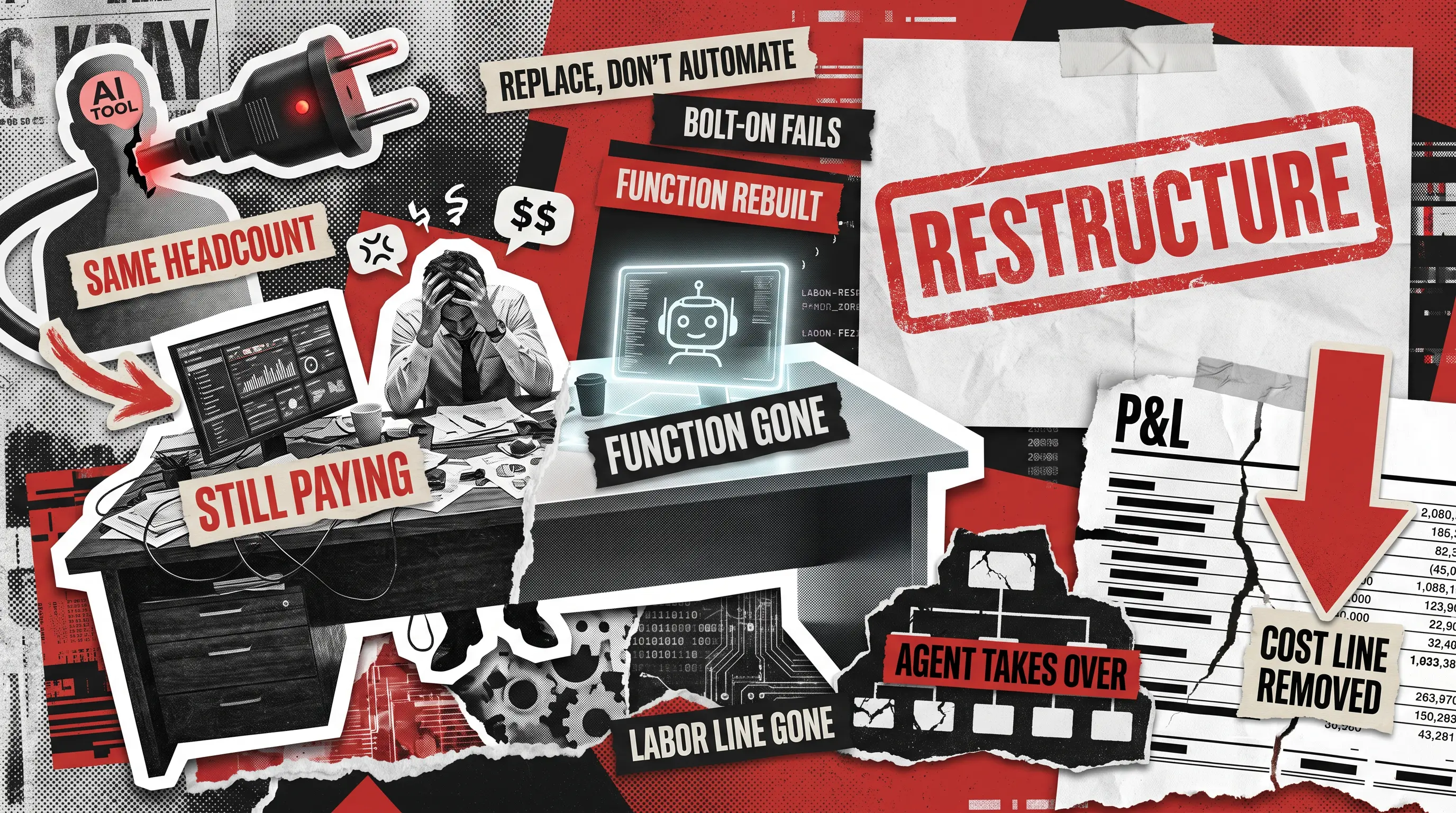
Most guides stop at that definition and move on. However, we want to draw a line that almost nobody else talks about, because it determines whether your budget lives or dies. There is a meaningful difference between digitizing a function and replacing it. Digitalizing your demand planning means giving your analyst a better dashboard. However, replacing it entails building a system that performs the forecasting, so the analyst’s hours no longer appear as a cost line.
The first approach makes your existing operation slightly faster, but the second changes your whole cost structure. Therefore, if your goal is lower labor cost, only one of these actually delivers. You can read more about the broader strategic picture in our explanation of the digital transformation service and how it maps to business outcomes.
Is AI Part of Digital Transformation, or Is It the Whole Game Now?
Yes, AI is part of digital transformation, and in retail, it has quietly become the part that matters most. For years, transformation meant cloud migration, mobile apps, and connecting your systems so they no longer contradicted each other. Without a doubt, those things still matter, but the definition is much broader now. The shift is that AI now does work that used to require people, and that changes the economics in a way no previous wave of technology did.
Deloitte’s research backs this up in the 2026 Retail Industry Global Outlook, where 68% of retail executives said they expect to deploy agentic AI for core operational and enterprise activities within the next 12 to 24 months. Agentic AI simply means software that can take actions on its own toward a goal, rather than waiting for a human to click every button. When two-thirds of your competitors plan to implement that kind of system within two years, the technology stops being optional and becomes the table everyone is sitting at.
Why Bolt-On AI Transformation Fails for Mid-Market Retailers
Here is the trap that many smart retailers walk straight into. You buy an AI tool, give it to your existing team, and wait for the savings to start rolling in. Six months later, your team is the same size, but now you have a new software bill and no factual savings. What went wrong?
The tool helped your people work faster, which sounds good until you look at the math. Faster work is not the same as reduced cost. Your planning analyst now produces forecasts in three hours instead of six, and that is a nice productivity gain, but you are still paying for the analyst, and now for the tool too. In essence, you just added an expense to a process you never restructured. However, the function itself was the cost driver, and you left it standing.
Replacing the function through AI retail digital transformation works differently. Instead of handing a tool to the analyst, you build a system that owns the forecast end-to-end. It pulls the sales history, weighs the seasonality, factors in the promotions calendar, and produces the numbers your buyers act on. All this happens without a person in the loop for the routine cases. Therefore, the analyst’s recurring hours are deducted from your books and show up in your profit and loss statement. If you want to learn more about this subject, we dig deeper into picking the right approach in our breakdown of digital transformation strategies that actually work.
How to Use AI Agents in Retail: The Function-Replacement Model
When we talk about replacing a function with an agent, we do not mean a chatbot with a friendly name. Instead, we are talking about a system built for one job, fed your real data, and trusted to run a defined slice of your operation. The following three functions are the strongest starting points for AI retail digital transformation for almost every mid-market business:
- Demand Forecasting
A demand forecasting agent replaces the planning analyst’s day-to-day work. It studies your sales history, reads the seasonal patterns, accounts for promotions and known events, and tells your buyers how much of each item to expect to move. It does not get tired in the fourth quarter or lose the thread when you add three hundred new SKUs. - Inventory Reordering
An inventory reorder agent replaces the operations coordinator’s work. It monitors stock levels across all locations, knows your supplier lead times, and triggers reorders at the right time. Therefore, you stop bleeding money from stockouts and overstock. The dull, constant, error-prone job of keeping shelves correctly full becomes a system that simply runs. - Tier-One Customer Support
A tier-one support agent replaces your first-response customer service team. It handles the questions that make up the bulk of your ticket volume, such as ‘where is my order?’ and ‘how do I return this?’. The agent hands off the genuinely tricky cases to a human with full context attached. Our e-commerce AI automation guide walks through how these support and reorder pipelines get wired together in practice, with real numbers on what each one saves.
The common thread is that all three functions are high-volume, data-rich, and built on rules that a machine can learn. That is exactly why they are the right candidates, and it leads neatly to the more important question: how do you choose a good flow for automation before spending anything?
Which Retail Functions to Automate First: A Build-or-Keep Scoring Guide
Not every function should become an agent, and choosing wrong is how AI workforce transformation budgets get torched. The functions worth replacing share four traits:
- They run on clear rules rather than gut feel
- They sit on plenty of clean data
- Their decisions are reversible, so a mistake is cheap to correct
- They carry enough labor cost to make the build worth it
Score your functions against those four traits, and the priority order reveals itself.
Inventory reorder and replenishment
High
High
High
High
Build first
Demand forecasting and planning
High
High
High
High
Build first
Customer service tier-one
High
High
High
Medium to high
Build first
Logistics and delivery coordination
High
Medium to high
Medium
Medium
Build next
Pricing and markdown management
Medium
High
Medium
Medium
Augment, keep a human deciding
Buyer and supplier relationships
Low
Low
Low
High
Keep human
Store experience and layout design
Low
Low
Low
Medium
Keep human
Strategic merchandising
Low
Medium
Low
High
Keep human
Read the table from the top, and the logic is clear. Inventory operations, demand planning, and tier-one customer service score high on every axis, which is why they are where you start.
Meanwhile, logistics coordination is a strong second wave once the first agents have proven themselves. The functions at the bottom stay human for good reason. Negotiating with a supplier, designing how a store feels, and deciding which brands define your identity all run on judgment, relationships, and taste, none of which lives in your data. Try to automate those, and you will spend a fortune building something worse than the person you already employ. Our piece on digital transformation in the supply chain covers the inventory and logistics end of this in more depth, with examples of where automation pays off fastest.
What Does AI Digital Transformation Look Like for a Mid-Size Retailer?
Now we get to the part that generic guides skip entirely. An agent system is not free to build, so it only pays off when the function you are replacing carries enough cost to clear that investment. This is where your revenue band decides your playbook, and why the advice written for everyone fits almost no one.
The math is not complicated: according to U.S. Bureau of Labor Statistics data tracked by the Federal Reserve, the average hourly earnings in retail trade sit above $25, and a planning or operations role with benefits costs you well north of that across a full year. When a function ties together several such roles to perform repeatable work, the labor cost is high enough that a purpose-built agent pays for itself quickly. However, if a function is half a person’s attention once a week, it’s not going to cover the agent’s cost. Therefore, you should leave it alone, no matter how fashionable automating it sounds.
This is precisely why the $20 million to $200 million band is the sweet spot. Below it, you usually lack the transaction volume and the headcount cost to justify a custom build, and off-the-shelf tools serve you better. Above it, you are an enterprise with the budget for sprawling platform projects and the consultants to match. In the middle, you have real operational costs to remove and real constraints on what you can spend. Therefore, every build has to be scoped tightly and sequenced sensibly. That is a build problem, and it’s the one we enjoy most.

AI Retail Transformation Build Program for Real-Life Operations
A transformation that works does not start with a platform purchase, but rather with a single function and a clear path to proof. Here is how we sequence a retail agent build so you see results before committing to the whole portfolio.
- Scope and Instrument
We pick the single highest-scoring function from your operation, usually inventory reorder or demand planning, and make sure the data behind it is clean, accessible, and complete. This phase is unglamorous and absolutely decisive, because an agent fed bad data produces confident nonsense. We measure how the function performs today so you have an honest baseline to judge the agent against later. - Build and Shadow-Run
We build the agent for that one function and run it alongside your existing team, rather than replacing them. For a few weeks, the agent makes its calls and your people make theirs, and you compare. When the agent matches or beats your team on the decisions that matter, you have proof rather than a promise, and you can retire the manual process with confidence instead of crossed fingers. - Expand the Portfolio
With the first agent earning its keep, you move to the next function on your scoring table and so on. Each new agent is cheaper to add than the first, because the data plumbing and the operational habits are already in place. Over time, you are running a portfolio of agents supervised by a much smaller team. Building these systems well is a craft in its own right, and it is at the heart of our work as an AI agent development company, particularly for retail and e-commerce operations.
What This Looks Like in Practice
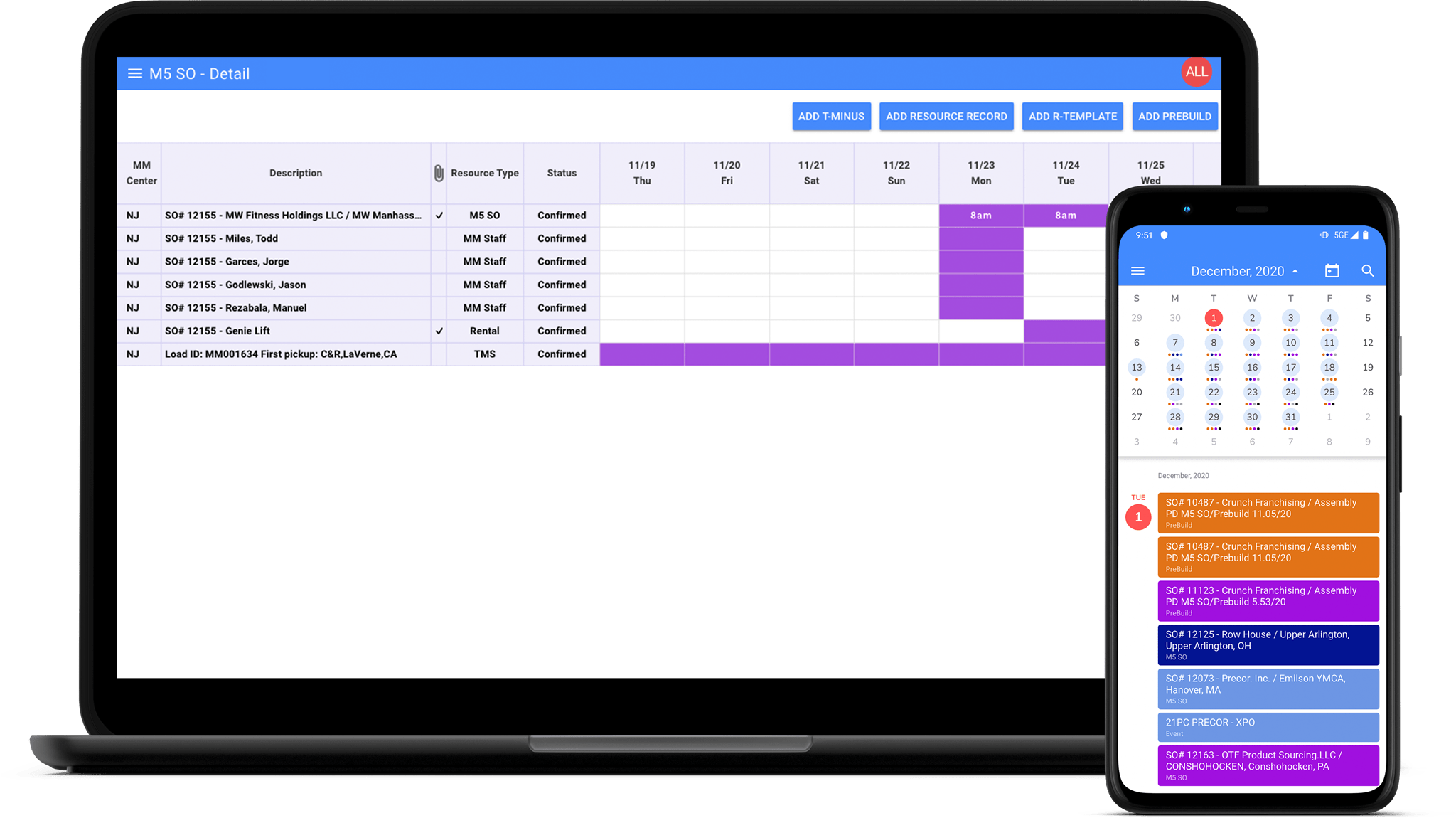
The pattern we are discussing here isn’t theoretical. Mass Movement, a fitness equipment distribution company that had spent more than twenty years refining its operations, came to Redwerk with exactly the problem described in this article. They were running their inventory and planning on ready-made tools that did not fit how their business actually worked, which left their people filling the gaps by hand.
So, we dug deep into their internal processes, learned the logic behind every step, and built them a custom inventory management system and a resource planner from the ground up. The tools now run the work that staff used to stitch together manually.
Notice which functions we rebuilt as inventory operations and planning are the same two functions sitting in the ‘build first’ rows of the scoring table above. Rather than handing their team a faster way to manage stock, we built systems to do it. Therefore, the work that used to eat human hours now runs in the background, and the approach proved sound enough that Mass Movement went on to support a $2.74 billion quarterly revenue stream and was acquired by logistics giant J.B. Hunt. Point that same function-replacement model at retail demand planning, inventory, and tier-one support, and you get the same shape of result.
Stop Asking What AI Can Do: Decide What to Rebuild
The businesses that win the race for AI-driven retail digital transformation will not be the ones that bought the most AI tools. They are the ones who looked closely at their own operation, found the functions eating into labor costs on repeatable work, and rebuilt those functions as agents that run on their own. Everyone else is just paying for software on top of the teams they never restructured, wondering where the savings went.
The point is that you don’t need to transform everything. Instead, focus on picking the right function. Then, build the agent, prove it, and move to the next one. That is a focused engineering program that a mid-market retailer can actually complete. When you are ready to scope which of your functions should go first, our AI workforce transformation team knows where to look and what to build. Give us a call, and let’s start your journey to effective AI adoption.
FAQ
How is AI transforming retail operations?
AI is shifting retail operations from human-run processes to agent-run systems. Instead of analysts forecasting demand and coordinators managing reorders by hand, purpose-built agents now own those functions end-to-end. The result is lower labor cost on repeatable work and fewer errors, while people focus on judgment-heavy work like supplier relationships and merchandising.
How to use AI agents in retail?
Start by replacing one high-volume, rule-based function rather than scattering tools across your team. The strongest first candidates are inventory reordering, demand forecasting, and tier-one customer service because they rely on clear rules and ample data. Build the agent, run it alongside your current team to prove it works, then expand to the next function.
What does AI digital transformation look like for a mid-size retailer?
For a retailer in the $20 million to $200 million revenue range, it looks like a focused build program rather than a sprawling platform project. You identify functions that carry enough labor cost to justify a custom agent, build them one at a time, and prove each one before moving on. The aim is for a smaller team to supervise a portfolio of agents.
Is AI part of digital transformation?
Yes, and in retail it has become the central part. Earlier transformation waves focused on cloud, mobile, and connected systems, thereby accelerating existing work. AI goes further by doing work that previously required people, which is the only change that meaningfully lowers your cost structure rather than just speeding it up.
See how we built tools to transform Mass Movement's workflows, leading to their acquisition by J.B. Hunt