Scale Without Hiring: How Founders Are Running Leaner Teams With AI Agents in 2026
Every founder hits the same wall: revenue needs to climb and you have some opportunities, but you don’t have enough people. Then you look at the real cost of hire and understand that expanding the team is not feasible. And don’t you forget that each new employee takes months of onboarding and management time. The uncomfortable truth is that one more person rarely moves the numbers as fast as the spreadsheet promised. In 2026, owners who hit that wall have an alternative in AI workforce transformation.
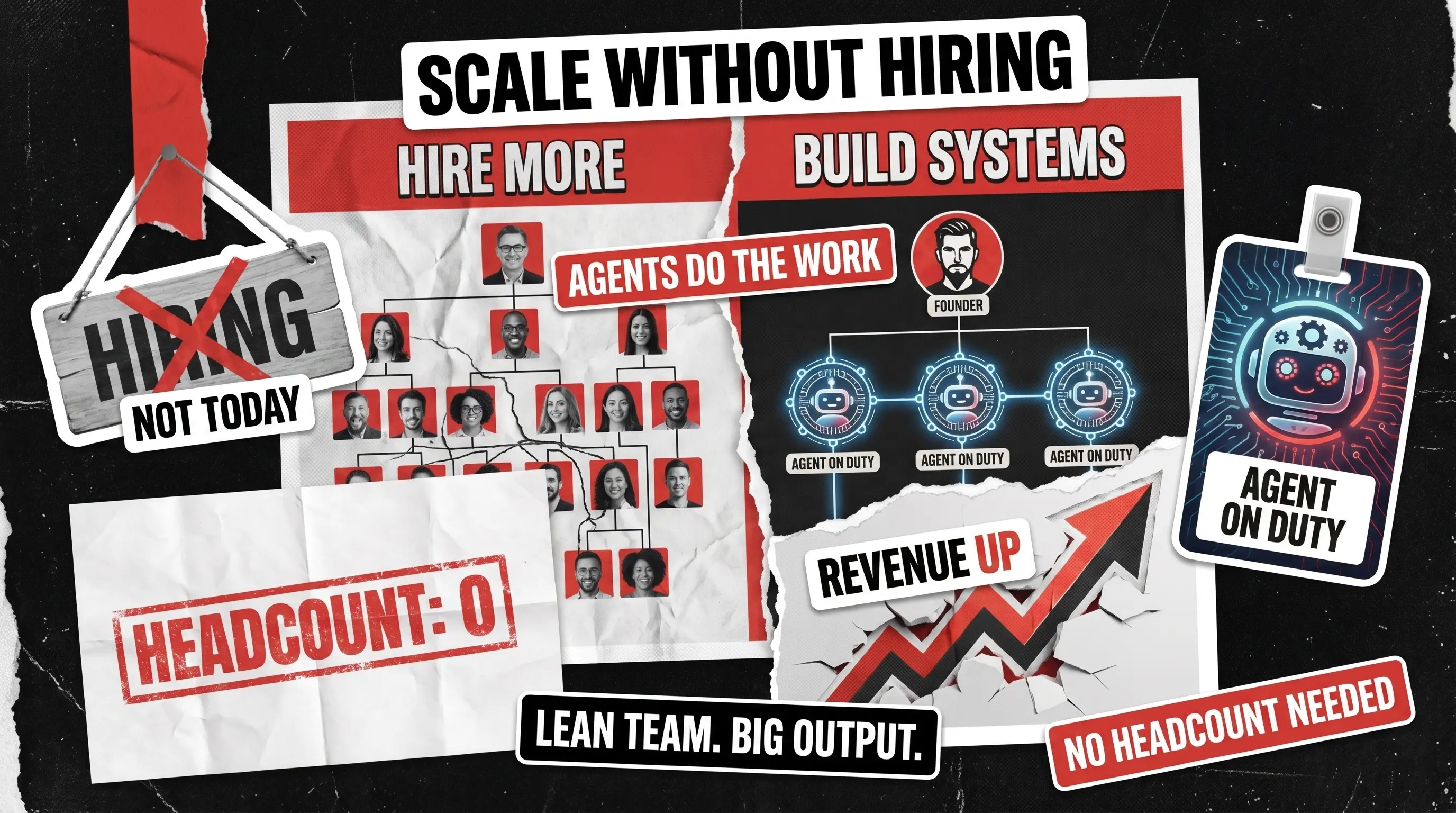
Rather than adding people, you can rethink how the work itself gets done. Hand off repeatable tasks to AI agents and keep your team focused on the calls only a human should make. That shift in perception is exactly what a fast-growing company should look for.
So, can you really grow a business without hiring? The honest answer is yes, but within limits. You do it by separating the work that simply needs to get done from the work that needs a person to do it. Then you build reliable systems for the first group while protecting your team’s time and judgment for the second. The founders pulling this off are not buying their way out of the problem with a clever app. Instead, they are engineering a way through it with the help of a reliable partner. In this article, we will explain how this works in more detail and highlight some examples from real-life businesses that got ahead of the game and are now reaping the benefits of an AI-enhanced workforce.
How AI Is Transforming the Workplace Faster Than the Headlines Suggest
The story most people notice is about big companies cutting big numbers. However, there is a more interesting story happening in small firms, where a founder can reorganize around a new tool in a weekend instead of waiting for a committee. The pressure to run lean is real, and so is the new AI capability that makes it possible.
Look at how CFOs describe their own plans and the picture gets clearer. In a survey run by Duke University’s Fuqua School of Business together with the Federal Reserve Banks of Atlanta and Richmond, nearly six in ten firms reported investing in AI during 2025, and more than eight in ten expect to invest in 2026, with the sharpest jump coming from small companies stepping in for the first time. These leaders ranked productivity and efficiency well above cost-cutting as their motivation, and on average, they do not expect AI to shrink their headcount this year. Instead, they describe a reshuffling of work, away from routine clerical tasks and toward more skilled, judgment-heavy roles.
That detail matters for how you think about your own company. The opportunity here is not to fire everyone and hand the keys to a chatbot, but to redesign the work so your people spend their hours where humans add the most value. The signal investors and founders increasingly watch is revenue per employee, which is simply how much value each person on the team generates. When that number climbs, you have more room to grow without the cost and complexity of a bigger payroll.
How Companies Are Scaling With AI Agents: Four Lean Teams in 2026
Numbers are useful, but it’s stories that stick, so check out the four stories from companies running at a fraction of the headcount you would expect. Each of them can teach you a slightly different lesson:
- Cursor
It’s a coding tool built by Anysphere. The company pushed well past one billion dollars in annual recurring revenue (ARR), which is the predictable subscription income a software business earns each year, while keeping its team in the low hundreds. That ratio puts it among the highest revenue-per-employee figures in software, a level that would have sounded made up a few years ago. The lesson here is that a tightly focused team with the right systems can serve an enormous market without ballooning in size. - Sonora
This one is an online guitar school that has been growing steadily for about seven years. When a more capable AI model arrived in late 2025, the founder, Spencer Handley, realized he could rebuild the expensive software his business ran on. As he told Time, the moment felt like discovering that you could clone a billion-dollar company’s software with little human help. He replaced his customer relationship tool, scheduling app, video platform, and e-signature service with versions tailored to his company, saving him roughly $250,000 a year. The company went from 48 people to 30 without losing revenue, and, by his account, the results actually improved slightly. The part worth underlining is what the remaining team does. They oversee the AI agents that handle marketing copy and customer follow-up, and they help the school’s guitar teachers welcome new students. Sonora did not go to zero employees. Rather, it restructured around a system and kept people in charge of it. - Base44
The third story belongs to Maor Shlomo, who built the app builder Base44 largely on his own and sold it to Wix for about $80 million. This happened about six months after launch, and the product was already profitable and serving hundreds of thousands of users. The interesting wrinkle in this case is that by the time of the sale, he had brought on a handful of people. He started solo, proved the idea with automation doing the heavy lifting, and added humans only where the math clearly justified it. Fortune covered both the promise and the limits of this model in its feature on solo founders using AI. - Tools by Pieter Levels
This is quite a standout example because Levels runs a whole portfolio of products, including Nomad List, Remote OK, and PhotoAI. According to his own public revenue dashboard, the portfolio generates more than $3 million a year with no employees. We flag that figure as self-reported so it’s up to you whether you take it at face value. However, you can take away the lesson of how he builds narrow products for audiences he understands deeply, automates the operations, and treats distribution, not code, as the real moat.
If you put these four side by side, you’ll see a clear pattern that holds true for any AI automation. None of these founders simply bought a stack of subscriptions and watched the money roll in. Instead, each designed a way of working, then kept a human hand on the decisions that carried real risk.
The Agentic Workforce Difference: Engineered Systems, Not a Pile of Tools
The part the breezy tool roundups tend to skip is that the companies winning with an agentic workforce (meaning a setup where AI agents carry out whole functions rather than single tasks) did not do this by signing up for the trendiest app. They succeeded because someone engineered a multi-layered system. For example, there is a real difference between an agent who drafts a nice email and one you can trust to follow up with a paying customer, log the result correctly, and escalate to a human expert when something looks off.
That distinction between a basic tool and infrastructure shows up in the costs as well. Researchers and founders interviewed by Fortune pointed out that the monthly bill for always-on agents at a lean startup can climb into serious money, sometimes rivaling the salaries of the people they replaced. They also noted that AI struggles to stand in for genuine expertise, the kind that lives in a specialist who has seen the edge cases before. An agent can produce something plausible at remarkable speed. However, knowing whether plausible is actually correct is still your job, or the job of someone you trust.
This is exactly where the work gets real: by taking a promising prototype and turning it into something that handles live users, protects sensitive data, and keeps running when the load spikes. Redwerk specializes in that type of AI software development and helps founders to harden and scale the agent-driven tools they have started. Our senior engineers define the boundaries, and there is a human review step before anything ships. When the goal is to automate a recurring process end-to-end, our AI development work focuses on building agents with memory, clear escalation rules, and an audit trail, so you always know what happened and why.

How to Scale a Workforce Without Hiring: Main Question to Ask
Answering the following questions honestly will allow you to understand where your business stands on the scale of needing AI workforce transformation:
- How repeatable is the work, meaning does it follow the same steps with predictable inputs, or does every instance look a little different?
- How costly is a mistake? Would an error be a minor annoyance you can catch later, or a damaging event you cannot undo?
Repeatable, low-risk tasks are natural candidates for automation with an AI agent because the steps are clear and the downside is small. However, work that calls for nuanced judgment, where a wrong move is expensive, must stay with your people. For example, pricing strategy, a delicate negotiation with a key client, the decision to pivot the product, and the moment when a customer needs to feel genuinely heard – these are human domains for good reason.
The founders who manage this well do not try to automate everything at once. In fact, being in a hurry is the most common way these projects fall apart. Instead, you should:
- Pick one repeatable, low-risk function
- Document it carefully
- Build a reliable agent workflow for it
- Move to the next
If you want to understand the architecture choices behind that kind of system, our guide to the best multi-agent AI frameworks walks through when a single agent is enough and when coordinating several is worth the added complexity. The reward for getting the sorting right is leverage. You grow the output without growing the org chart, and you spend your own scarce attention on the decisions that actually deserve it.
Designing for the Agentic AI Future
The reality is that we live in an age when companies are designed before you even think of staffing. That sounds like a slogan, but it describes a practical change in how businesses are built today. You start by mapping the work, engineering systems for the parts that are engineerable, and bringing in people where human judgment earns its keep.
This agentic AI future does not reward the founder with the longest list of tools. Instead, it caters to those who built the cleanest system and kept a steady hand on the wheel. That is the work we do every day. So, if you are weighing which of your team’s functions you could safely hand to agents, and which you should protect, we are happy to think it through with you. Contact us today and let’s start transforming your workforce to maximize productivity.
FAQ
How can you grow a business without hiring?
You grow without hiring by separating the work that simply needs to be done from the work that requires a person, then building reliable AI agent systems for the first group and protecting your team’s time for the second. The aim is higher output per person, not a smaller company for its own sake.
How are companies scaling with AI agents?
Companies are scaling by handing repeatable, lower-risk functions such as customer follow-up, content drafting, and routine operations to AI agents, while people supervise the agents and own the high-stakes decisions. Real examples in 2026 range from Cursor’s tiny team and huge revenue to an online guitar school that restructured around agents without losing revenue.
How do you run a lean team with AI in 2026?
To run a lean team with AI in 2026, automate one well-documented, low-risk process at a time, keep a human review step in the loop, and treat your AI spending and oversight as seriously as you would a new hire. Lean does not mean ‘unmanaged’ but rather focuses on deliberate engineering.
See a recruitment platform we built that was acquired by a Nasdaq-listed company with a 250+ mln market cap