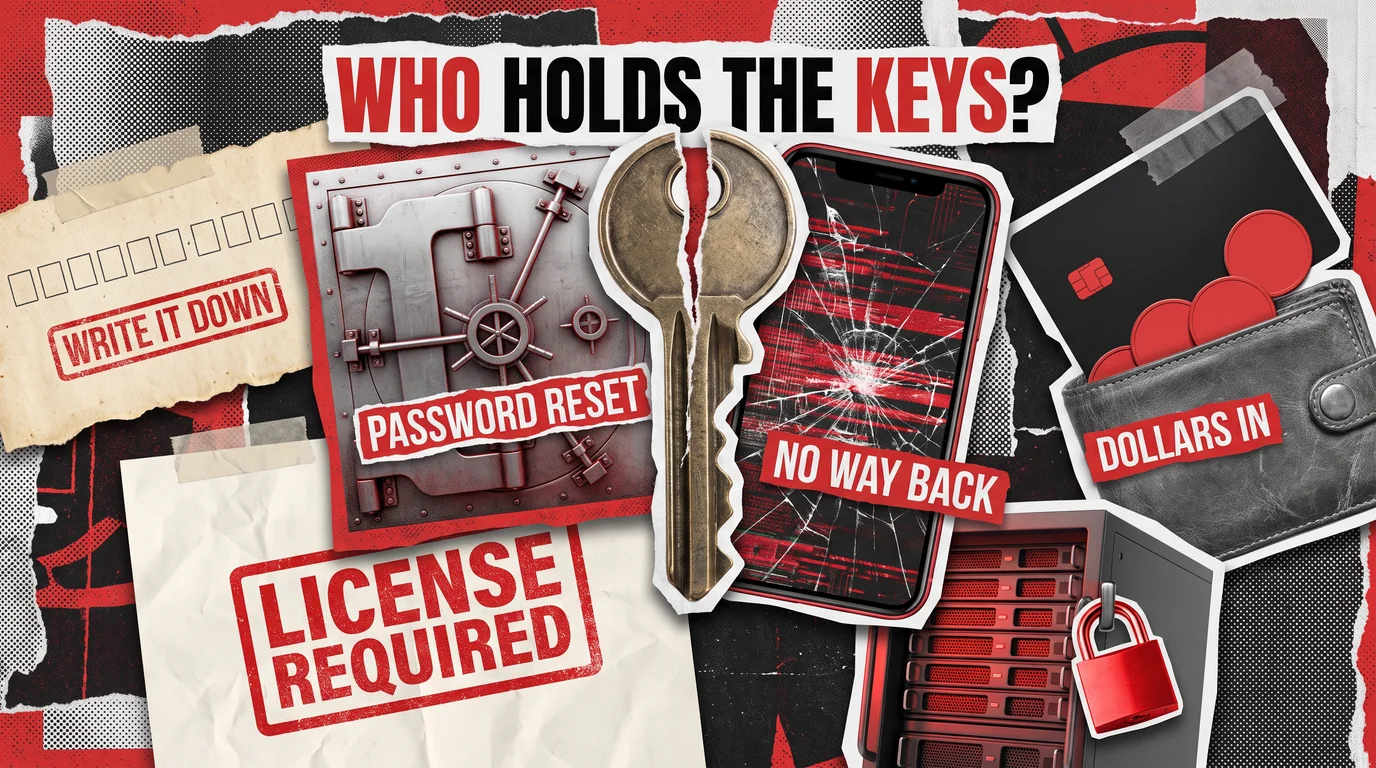
The hardest decision in crypto banking app development is who holds the private keys: your platform or your users. A private key is the secret code that approves every payment from a crypto wallet, so whoever holds it controls the money. The answer shapes how you protect funds, which licenses you need, and how easy the app feels to use.
A crypto banking app is what customers see: a phone or web app where they keep digital currency, send payments, and move money to and from a bank account. The transfers underneath run on the same technology as most blockchain in fintech projects. Much of that underlying layer comes from DeFi, short for decentralized finance: lending, trading, and payment tools that run directly on public networks. When your project reaches that foundation, our DeFi development services can supply the wallets and transaction logic the app will rely on.
Custodial vs Non-Custodial: The Decision That Shapes Everything Else
A custodial app keeps its customers’ private keys on the company’s own systems, much like a bank holds deposits. Customers log in with a password, and if they forget it, support can restore access. However, regulators treat a business that holds other people’s money as a financial service provider.
A non-custodial app leaves the keys on the customer’s own device. The company never touches the funds, which reduces its licensing duties, but users carry full responsibility for security. If someone loses both the phone and the recovery phrase, a list of 12 or 24 words that can restore a wallet, nobody can get the money back.
The New York State Department of Financial Services (NYDFS) draws the line between the two models in its virtual currency licensing guidance. Under those rules, software that lets customers keep their own crypto doesn’t need a license by itself, while a wallet service that holds other people’s funds likely does. At the federal level, the Financial Crimes Enforcement Network (FinCEN) treats custodial providers as money transmitters, the same category as payment and remittance companies. Many states add licensing requirements of their own.
Non-custodial apps also expect more from the people using them. The trade-off showed up in Tingl, an anonymous chat app we built on the public Polygon blockchain. Users signed up through MetaMask, a popular crypto wallet app. Lost accounts could only be restored with a recovery phrase. As a result, using Tingl required some technical knowledge, such as handling gas fees, the small charges a blockchain network collects for every transaction.
Split-Key Wallets and How the Models Compare
Some apps take a middle path and split the key into two pieces, one on the customer’s phone and one on the company’s servers, so neither side can move funds alone. On some networks, passkeys can also replace the recovery phrase. A passkey lets people sign in with the same fingerprint or face scan they already use for other apps. Whether a split-key setup counts as custodial depends on who can move the money without the other party. Your lawyers should confirm that point before the design is final.
Side by side, the three custody models differ on six points:
Key holder
Company
Customer
Shared by both
Account recovery
Through support
Recovery phrase only
With the provider’s help
Licensing load
Heaviest
Lightest
Depends on who controls funds
Main security risk
Breach of company systems
Lost phone or recovery phrase
Flaws in key splitting
User experience
Like a bank app
Extra steps and responsibility
Close to custodial
Best fit
Everyday consumers
Experienced crypto users
Users who want control and easy recovery
Apps aimed at a mainstream audience often choose a custodial or split-key model, because most people expect a password reset when they lose access.
What Crypto Banking App Development Includes
Whatever custody model you pick, crypto banking app features fall into five groups that people already know from their regular bank:
- Wallet management: Balances for each coin, a QR code for receiving payments, and a send screen that checks the destination before money leaves
- Transaction history: Every payment with its fee and a status that shows “pending” until the network confirms the transfer
- Fiat on-ramps and off-ramps: Ways to buy crypto with dollars or other government-issued money and to cash out to a bank account
- Multi-currency support: Several coins plus stablecoins, whose value tracks the US dollar or another currency
- Account protection: Fingerprint or face login, alerts for every transfer, and limits on large withdrawals
Crypto wallet app development covers the first two groups, and many teams launch with those features before adding bank connections. Our blockchain development services cover this customer-facing part of the product, along with the networks and smart contracts behind it. Banks adding custodial crypto wallets to existing products can turn to our banking software development team.
Every feature beyond this core adds work. For example, letting customers swap one coin for another moves the app closer to an exchange. In that case, the app needs order matching, a system that pairs buyers with sellers. Such a system is among the bigger factors behind cryptocurrency exchange app development cost. Similarly, reward programs that pay users in digital tokens borrow an idea from blockchain in marketing and come with accounting questions.
What Happens Behind Each Payment
Every payment in the app passes through behind-the-scenes systems that check the balance, sign the transfer with the right key, submit it, and wait for the network’s confirmation. A custodial app also keeps an internal ledger, a record of what each customer owns, and regularly checks those entries against the blockchain itself.
Custodial platforms usually divide funds between hot wallets, which remain online for fast payouts, and cold wallets, which are kept offline and need extra approvals to move. US banking regulators describe the trade-off in a 2025 joint statement on crypto safekeeping. The document warns that easier-to-access wallets may be less secure. It also names losing control of the keys among the main risks of holding digital assets for customers.
The trade-offs of blockchain payments vs traditional card and bank transfers come down to speed, fees, and the fact that a confirmed crypto transfer can’t be reversed. Beyond everyday transactions, the back end can support lending, where loans are issued and repaid directly between users, without a payment processor or other middleman. Building systems like this for finance companies is part of our blockchain development work.
Some features rely on smart contracts, programs that run automatically once their conditions are met. Staking rewards work this way: users lock up coins for a set period and earn a return. Once live, such code is hard to fix, so reviewers check it before launch, often against a list like our smart contract audit checklist.
Fiat On-Ramps and Off-Ramps: Moving Between Dollars and Crypto
On-ramps and off-ramps are the features that connect a crypto app to the regular banking system. An on-ramp lets customers buy crypto with fiat money, the industry’s term for government-issued currency such as dollars or euros. An off-ramp works the other way: it sells crypto and sends the money to the customer’s bank account. In the app, each ramp looks like a single button, while the work behind it involves bank accounts, card payments, identity checks, and licenses in every region you serve.

Very few teams build the conversion step themselves. Most connect to a licensed ramp partner that already holds the licenses, banking relationships, and fraud controls. Relying on an outside provider has three downsides:
- User experience: Identity screens run by the partner can interrupt your app’s flow.
- Coverage: Each service supports its own list of countries, coins, and ways to pay.
- Dependence: A partner can change its terms or stop serving businesses it considers high risk, as our article on iGaming payment risk management shows.
Build the connection so you can switch or add partners without rewriting the app. Tying checkout to one provider is among the payment gateway integration mistakes founders often regret. The same lesson applies to ramps.
Card purchases need extra care, because a cardholder can dispute a payment weeks later while the crypto it bought is already gone. Transfers between crypto companies also fall under the Travel Rule, which requires the sender’s and recipient’s details to go along with the funds, the same way bank wires work today.
What Licenses and Compliance Checks Your App Needs
Compliance work in crypto banking app development starts at the planning stage, because the custody model decides which rules apply. Any app that holds people’s funds has to verify each customer’s identity and monitor transactions for money laundering. These checks are known as Know Your Customer (KYC) and Anti-Money Laundering (AML).
In the US, a custodial app typically has to meet these requirements:
- Federal registration: Registering with FinCEN as a money services business
- State licenses: Money transmitter approval wherever the app operates, plus the BitLicense, a separate crypto authorization the NYDFS requires for serving New York residents
- Investment products: Staking rewards or interest-style offerings may fall under the oversight of the Securities and Exchange Commission (SEC).
- Stablecoin rules: The GENIUS Act, signed in July 2025 and expected to take effect by January 2027, sets who may issue the stablecoins that apps offer US customers.
Serving customers in the EU adds a license under the Markets in Crypto-Assets (MiCA) framework. Our MiCA regulation compliance team helps companies prepare for those requirements. The exact mix of rules depends on your markets and products, so legal review comes before development. Our service package is shaped around each client’s specific obligations, so compliance guides the app’s design from the beginning.
How to Keep Private Keys and Customer Funds Safe
Security planning centers on protecting the private keys. Common measures include:
- Hardware security modules, tamper-resistant devices that store keys and never release them
- Approval by two or more staff members for large transfers
- Limits on how much can be withdrawn at once
- Independent security testing before launch
The same thinking applies to the money your app moves behind the scenes with its partner banks. Customer wallets usually rely on public networks, but transfers between your company and those partners don’t have to. Those payments can run on a permissioned blockchain, a private network that only approved institutions can join, which keeps them out of public view.
If a third-party custodian stores crypto on your behalf, ask what its theft coverage includes, since policies differ in limits and exclusions. Insurers are also adopting the technology themselves, and blockchain in insurance is a growing area of its own.
Start With Custody and Compliance
In crypto banking app development, the most important decisions are the custody model and the compliance plan. Screens can change in a later release, while switching custody models after launch means redoing much of the app’s core.
Your requirements don’t have to be final when the project starts. During an initial discovery stage, we list your target users, markets, and payment partners. Once that groundwork is done, you choose the custody model knowing what each option means for licenses, security, and user experience. Our team can build both the blockchain systems underneath and the app your customers use. Progress updates skip technical shorthand, which lets founders and business owners take part in every decision.
Our blockchain engineers can help you plan every part of your crypto banking app, from custody to launch. Get in touch whenever you’re ready.
FAQ
What is crypto banking app development?
Crypto banking app development covers designing and building a consumer app that works like a bank account for digital currency. Users can store coins, pay other people, and convert between crypto and dollars. A typical build combines the mobile or web interface, a secure way to manage private keys, connections to licensed payment partners, and the identity checks financial regulators require.
Should a crypto app be custodial or non-custodial?
Choose custodial if your users expect bank-style convenience, such as resetting a forgotten password, and your company is prepared to get money transmitter licenses. Choose non-custodial if your users are comfortable managing their own private keys, the secret codes that control a wallet’s funds. A split-key design, where the app and the user each hold part of a key, sits between the two options.
What features does a crypto banking app need?
A first release usually needs four things: a wallet that shows balances, sending and receiving, a payment history with fees and confirmation status, and secure login with fingerprint or face recognition. Later versions often add buying crypto by card or bank transfer, stablecoins pegged to the US dollar, coin swaps, and spending limits that protect larger accounts.
Do you need a license to launch a crypto banking app?
A license is usually required when the app holds customer assets. In the US, an app that stores funds for its users is typically treated as a money transmitter, which means federal registration, state approvals where it operates, and a separate crypto authorization for New York. An app that only gives people software to manage their own wallets faces far fewer requirements. A lawyer should confirm each market’s rules.
What happens if a user loses their recovery phrase?
A recovery phrase is a sequence of backup words, usually 12 or 24, that rebuilds a crypto wallet on a new device. If a non-custodial app user loses both the phrase and the device, nobody can recover the funds. Custodial apps can restore access after confirming the person’s identity. Newer wallet designs also offer recovery through a passkey or a key share held by the provider.
See how an iterative, user-tested build turned an anonymous web3 messenger into a product acquired within months