OpenFang is the new buzzword around, but the question is whether it’s reliable, adaptable, and secure enough for you to tie your business’s future to. OpenClaw was the same, and perhaps even bigger, phenomenon before it, and it took only six weeks for those specializing in AI agent development to flip from ‘OpenClaw is the future’ to ‘OpenClaw is a security nightmare’.
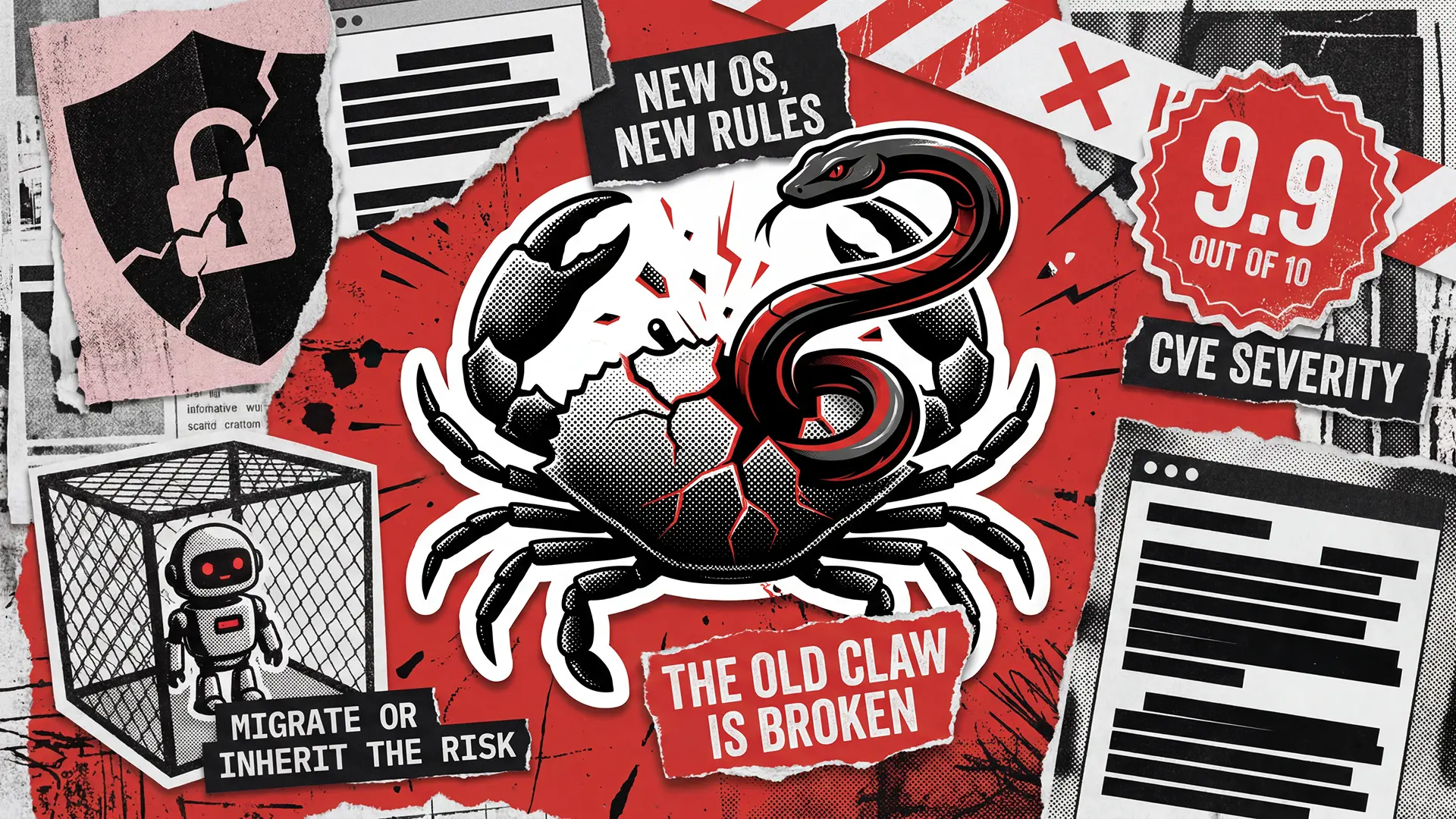
Peter Steinberger pushed the original project to GitHub on November 25, 2025, and by March 2026, it had collected over 340,000 stars, more than 820 community plugins, and at least seven publicly disclosed security vulnerabilities. One of those flaws scored 9.9 out of 10 on the standard severity scale, which is about as bad as things get before the building is officially on fire. Cisco even cited OpenClaw as Exhibit A in its analysis of how personal AI agents create brand-new attack surfaces for businesses. Then OpenFang shipped, and the conversation changed overnight.
In this article, Redwerk’s AI development experts and software engineers will discuss both OpenClaw and OpenFang in detail, highlighting their real-life benefits and risks with brutal honesty. By the end of it, you’ll know whether your business should migrate now, pilot carefully, wait a couple of quarters, or stay put.
What Actually Happened to OpenClaw
The short version of the OpenClaw automation’s formidable rise and subsequent issues is that a brilliant side project went viral long before it was ready for the real world. The solution started its life as Clawdbot, got rebranded to Moltbot, and finally settled on the name OpenClaw after two trademark disputes in as many months. Developers fell in love with it almost immediately, and so did the attackers.
Between February and April 2026, researchers published a stream of critical flaws in the public Common Vulnerabilities and Exposures (CVE) database. Three are worth understanding even if you never write a line of code:
- CVE-2026-32922 allowed an attacker to mint admin credentials by exploiting a broken token-rotation function. It scored 9.9 out of 10 on severity.
- CVE-2026-25253 allowed a carefully crafted link to trick OpenClaw into handing its authentication token to an attacker-controlled server. Imagine your agent mailing the keys to your house to the first stranger who asks.
- CVE-2026-41294 meant a malicious configuration file dropped into a working directory could silently override security settings at startup, serving as a welcome mat for any company running OpenClaw inside a Continuous Integration (CI) pipeline that checks out untrusted code.
There were also sandbox escapes, command injection bugs, server-side request forgery flaws, and a prompt-injection chain that let attackers run arbitrary commands. If you’re still running these agents today, we covered OpenClaw security best practices in detail separately.
Most importantly, you need to understand that OpenClaw isn’t a standalone example of such issues. Anthropic’s accidental Claude Code leak earlier in 2026 made the same point from a different angle. It only took one misconfigured setting for 512,000 lines of proprietary code to go public. Therefore, it’s a fact that AI infrastructure is unforgiving when rushed.
The main security issue with any system in the class of OpenClaw is that it doesn’t live quietly in a browser tab. It sits close to your operating system, touches your local files, holds your Application Programming Interface (API) keys, and executes commands on your behalf. The features that make it useful are the same ones that make its bugs catastrophic. A bug in a note-taking app leaks your notes, but a bug in OpenClaw can leak your AWS credentials and post a surprise update to your company Slack before lunch.
What OpenFang Actually Is (Minus the Jargon)
If OpenClaw is a very capable chatbot that grew plugins like a friendly octopus, then OpenFang is an Operating System (OS) purpose-built for AI agents from the ground up. That distinction changes almost everything about how these tools behave in production.
The following three things about OpenFang matter most to a business leader, and none of them require a computer science degree to understand.
- Agents Run in the Background on a Schedule
You configure an agent once, and from that moment on, it does the work on its own. The OpenFang team calls these agents ‘Hands’, and the platform ships with seven built-in. Think of it as hiring a small team of tireless interns who never ask for vacation and never forget a task. - Security Is Built into the Foundation
Every agent runs in a tightly controlled sandbox that shuts down any code that loops indefinitely or consumes too much memory. Files can only be read or written inside pre-approved folders, and every action is recorded in a tamper-resistant audit trail. If an agent misbehaves, the damage stays small, and you have a clear record of what happened. - OpenFang Ships as a Single 32MB file under the MIT License
This means no vendor lock-in, no awkward licensing call to your legal team, and no surprise invoices later. It uses 40MB of memory in production compared to OpenClaw’s 394MB, and it starts up in 180 milliseconds rather than almost six seconds, which greatly reduces your infrastructure bill. You can run several autonomous agents on a tiny $10-per-month virtual server, around the clock, without bringing the machine to its knees.
Here’s how you can translate this for your board: faster deployment, cheaper infrastructure, more agents per server, no licensing conversations, and a security posture you can walk your auditor through without breaking a sweat.
Why the OpenFang vs OpenClaw Difference Matters for Your Business Now
Here’s how the OpenFang agent OS can actually show up on your income statement:
- Customer support is often the easiest win. OpenFang ships with 40 channel adapters out of the box, so it can communicate natively with Slack, Discord, Telegram, WhatsApp, Teams, email, SMS, and wherever else your customers hang out. One agent reads incoming tickets around the clock, categorizes them by urgency, answers the routine questions, and hands the tricky ones off to a human with all the context already gathered. Your support team walks in on Monday morning to a pre-triaged queue instead of an inbox with 1,200 messages.
- Back-office operations are the next obvious target. Lead scoring, data enrichment, invoice processing, competitor monitoring, and weekly reports are workflows your operations team currently manages by hand turn into scheduled ‘Hands’ that finish overnight and deliver a tidy summary before Monday standup.
- Engineering leverage is the third opportunity, and it’s the one most CTOs quietly miss. Code review summaries, pull request triage, first-draft incident reports, and dependency monitoring are all tasks you currently pay senior engineers to do, even though none of them are really engineering work. Handing them off frees your most expensive people to build the things that actually move the business forward.
Will an agent 10x your output? Absolutely not, and anyone promising that is trying to sell you something. The honest range is 10 to 30 hours of saved human work per well-deployed workflow per week. At roughly $60 per hour for a mid-level employee’s fully loaded cost, that works out to somewhere between $31,000 and $93,000 per year, per agent. Multiply that by the number of workflows you can hand off, and the math gets interesting pretty quickly.
OpenFang vs OpenClaw: The Business Decision, Not the Feature List
Every other comparison article stacks 30 feature rows and calls it a day. We don’t believe in this kind of approach to business decisions. Instead, here is our honest take on the OpenClaw vs OpenFang comparison and what matters most from a founder’s point of view.
Security posture
7+ CVEs in six weeks, 820+ plugins of varying trust
Kernel-enforced sandboxing, 16 security layers, signed manifests
Production readiness
A chatbot with an agent wrapper bolted on
An operating system purpose-built for autonomous agents
Infrastructure footprint
394MB memory, 5.98-second cold start
40MB memory, 180-millisecond cold start
Ecosystem maturity
340,000+ stars, enormous plugin library
Smaller and newer, growing quickly
Migration path
No built-in migration tooling
One-command transfer of configs, history, and skills
Enterprise readiness
Fragmented, ships-first-asks-later
Strong foundation; some features (Single Sign-On (SSO), multi-tenancy) are still being built
To sum it up, OpenClaw has a larger ecosystem, and OpenFang has better architecture. For businesses planning to put agents near customer data, production systems, or money movement, architecture beats ecosystem every time. A massive plugin library doesn’t help much if a chunk of those plugins have never been properly audited.
Therefore, if your use case is internal-only, low-stakes, and deeply tied to a specific OpenClaw plugin, you can stay put for now. However, if your agents will touch anything your auditor or general counsel would care about, it’s time to plan your move.
It’s also worth mentioning that OpenFang and OpenClaw aren’t the only options. LLM frameworks like LangChain, LangGraph, CrewAI, and AutoGen occupy overlapping space, each with a different design philosophy. If you’re earlier in evaluation, our breakdown of LangChain vs LangGraph is a good place to understand how they differ before you commit.
OpenFang Risks Nobody's Telling You About
There are a few crucial things to understand when you consider switching from OpenClaw to OpenFang. First of all, you probably don’t have the in-house talent to run OpenFang on your own just yet. It’s written in Rust, a modern programming language that gives OpenFang much of its speed and security advantages, but it’s uncommon in most product engineering teams. You’ll either hire a Rust specialist (hard and expensive), train someone on your existing team (slow), or bring in a partner with that expertise.
Second, some OpenFang enterprise features are still on the roadmap rather than shipped. According to the OS’s maintainers, multi-tenant isolation, integration with external identity providers such as Okta and Azure Active Directory (Azure AD), durable execution, and team-level budget governance are planned but not yet fully available. If you operate in a regulated industry like fintech or healthtech, and AI compliance is already on your radar, you’ll either build some of these yourself or wait a couple of quarters.
Third, agents are a governance problem dressed up as an engineering problem. An OpenFang deployment with access to 27 different LLM providers and 53 built-in tools can happily rack up a $50,000 OpenAI bill over a single weekend if nobody thought to set spending limits. Worse than the money, an agent can cheerfully take actions you never authorized. You need spending caps, approval workflows, regular audit reviews, and a human in the loop for anything irreversible. Technology doesn’t solve this problem on its own; you need policies for that.
Fourth, the OpenFang ecosystem is still relatively small compared to OpenClaw’s sprawling plugin marketplace. OpenFang ships with 60 bundled skills and a growing marketplace called FangHub, which is plenty for most use cases, but if you need a specific integration today, verify it exists before you sign anything.
Step-by-Step Decision Framework: Should You Migrate from OpenClaw to OpenFang?
If you’re already running OpenClaw or evaluating any agent platform right now, here’s how to decide without burning a whole quarter on analysis paralysis:
- Audit What You Already Have in Your Stack
If OpenClaw is running anywhere in your environment, pull up the public CVE checklist and run your current version against it. If the audit finds real exposure, you’re not evaluating but remediating, and the decision is already made for you. - Pilot One Low-Stakes Workflow
Keep it internal and well away from your customers. Competitor monitoring, pull request summaries, lead enrichment, and internal data cleanup are all excellent candidates. Deploy OpenFang on a single small server, give yourself two to four weeks, and resist the urge to expand scope before you have results. - Measure Honest Numbers
Track hours saved per week, cost per agent-hour (infrastructure spend plus your LLM bills), the error rate, and how much human oversight the agent actually needs. Gut feeling is not data, no matter how experienced your gut is. - Scale, Pause, or Stop Based on Numbers
If the pilot saves more than it costs, plan the next three workflows and map out the migration. If it doesn’t, you’ve lost one month instead of a fiscal year, which is the whole point of piloting small.
A quick note on the one-command migration tool: it’s real, it works, and it handles configuration and conversation history in minutes. What it doesn’t handle is governance, integration testing, or behavior validation in your specific environment. Expect 2 to 6 weeks of real work for a clean cutover in a mid-sized deployment.
Do You Need a Partner to Deploy OpenFang?
Let’s be honest, if you have experienced Rust engineers on staff, a security team that can own a WebAssembly sandbox, and the bandwidth to configure 16 security layers correctly on the first try, you can absolutely self-deploy.
Most mid-market businesses don’t have all three at once, and that’s where a trusted AI development partner earns its fee. The real work involves planning the migration, hardening the deployment for whatever compliance regime you operate under, such as SOC 2, HIPAA, ISO 27001, or something industry-specific, integrating OpenFang with the stack you already run (your CRM or identity provider), and setting up the governance layer that keeps your agents from cheerfully spending your entire quarterly budget over a long weekend.
Redwerk has been building web2 and web3 solutions for over two decades. If OpenFang is on your roadmap and you’d rather ship than rebuild, contact us and let’s talk.
FAQ
Is OpenFang ready for production?
For most use cases, yes. For multi-tenant enterprise deployments with strict single sign-on and stringent regulatory requirements, you’ll need to fill in a few gaps yourself for now. The OpenFang team’s public roadmap on GitHub is the most honest place to check what’s ready and what’s in progress.
Can we run OpenFang and OpenClaw side by side?
Yes, and many teams do exactly that with piloting OpenFang on new workflows while keeping stable OpenClaw deployments running until migration is complete. The two platforms don’t conflict with each other.
How long does migration from OpenClaw actually take?
The one-command tool handles configs, history, and skills in minutes. The real work that includes validating behavior, re-testing integrations, and updating governance, takes two to six weeks for a mid-sized deployment.
Is OpenFang actually more secure or just newer?
It’s both, as OpenFang was designed with kernel-level isolation from day one and hasn’t experienced OpenClaw-class vulnerabilities so far. That said, ‘no CVEs yet’ isn’t the same as ‘no CVEs ever’. Every serious platform eventually ships a serious bug.
Who owns the data my AI agents process?
You do, full stop. OpenFang is MIT-licensed and self-hosted, so your data stays on your infrastructure. The LLM providers you route through have their own data policies, so read those carefully.
See how we transformed this legacy offering into an AI-driven digital growth solution