If the current state of your project makes you think of hiring a software architecture consultant, you’re probably about a year too late. Your cloud bill is already loud, your roadmap has already shrunk, and the rebuild quote is twice what an early architecture review would have cost.
In this post, Redwerk software architects themselves will explain how to spot the moment before the rebuild. We’ll also list the four most common signs that you’ve already missed it and should consider getting some software development consulting services fast. Finally, we’ll also add a few questions that separate a real consultant from a body shop with a fancier title.
The short answer to ‘when to hire a software architect consultant?’ is:
You need software architecture consulting before the next three architectural decisions on your roadmap will cost six months or more to undo. If undoing them takes a quarter, you can probably handle it in-house. If it takes a year, you needed outside eyes yesterday. Below, you’ll find a short self-assessment you can run on your team this afternoon.
The Decision-Reversibility Test: When to Hire a Software Architect Consultant
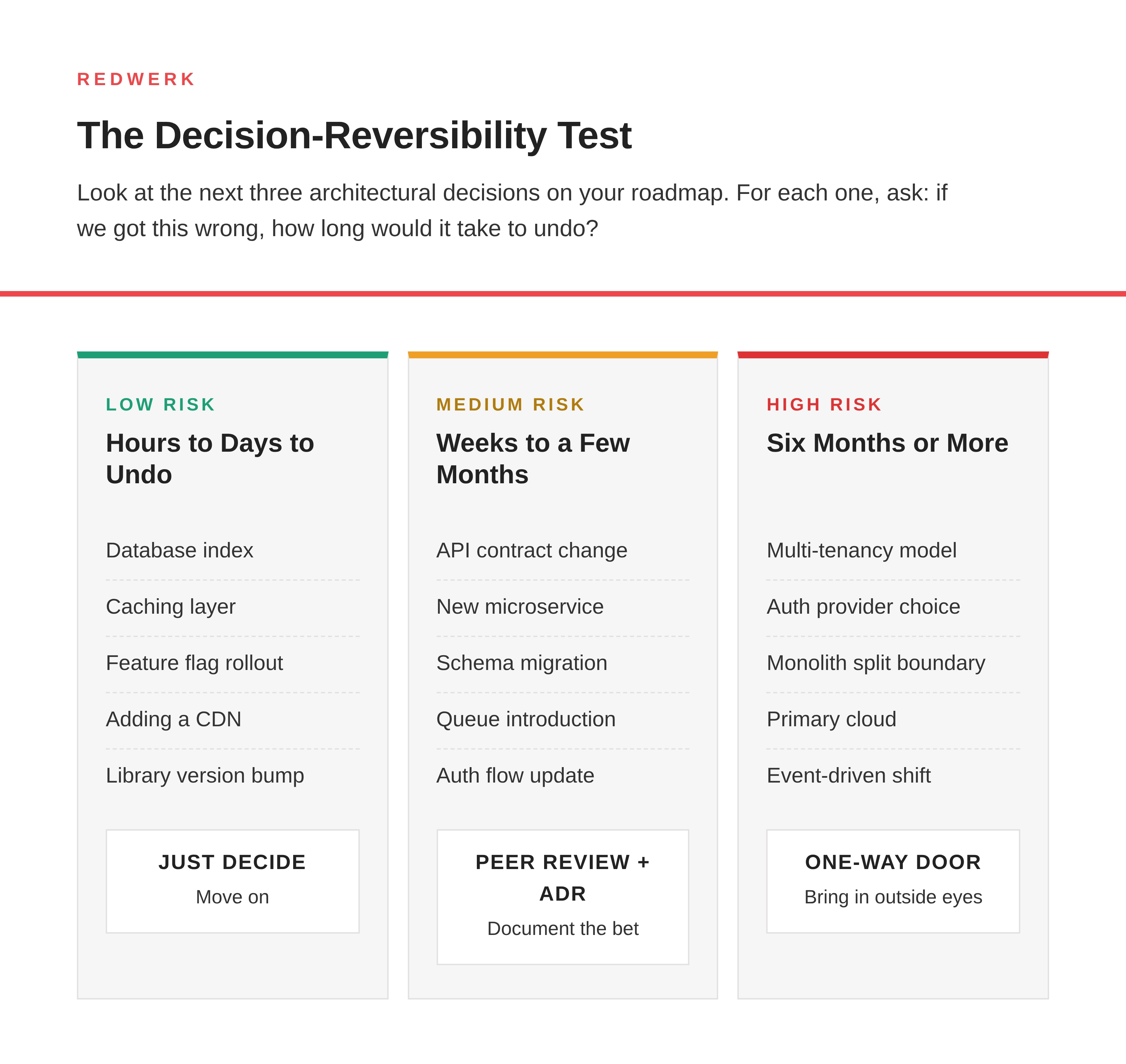
Look at the next three architectural decisions on your roadmap. For each one, ask: if we got this wrong, how long would it take to undo?
- Hours to days: low risk
Make it, see how it performs, and move on. - Weeks to a couple of months: medium risk
In this case, you should rely on peer review and a written Architectural Decision Record (ADR) to cover it. - Six months or more: high risk
This is a one-way door, so you should consider software architecture consulting to avoid preventable issues that will cost your business dearly. One-way doors don’t deserve a sprint planning vote. They deserve outside eyes from someone who has seen what happens when those calls go sideways.
Here are a few examples of such common ‘one-way doors’:
- Multi-tenancy model (single tenant, shared schema, or full isolation)
- Identity and authorization provider (rolling your own, picking a vendor, or going federated)
- Monolith decomposition boundary (where exactly to split, and why)
- Primary cloud and data residency
- Synchronous request architecture vs. event-driven backbone
To compare, take a look at several decisions that look scary but usually aren’t:
- Adding a new database index: allows for boosting customer experience and user satisfaction, along with improving overall operational efficiency.
- Adding a caching layer in front of an existing service: helps you increase speed and improve reliability, which leads to a boost in customer experience and a higher chance of conversions. Most importantly, this type of system optimization enables significant cost reductions.
- A feature flag rollout: decouples code deployment from feature release, which makes your future updates safer, faster, and more controlled.
- Adding a Content Delivery Network (CDN): today, it’s a mandatory requirement for any business that wants to scale globally and deliver top-quality security and user experience while doing it.
The painful thing about ‘one-way doors’ is that in-house teams are structurally ill-equipped to recognize them. There are several reasons for it, for example, recency bias makes the current stack feel more flexible than it is. Sunk cost makes the current architecture feel more ‘done’ than it is. Most importantly, the political pressure to ship this quarter makes ‘we’ll fix it later’ feel like a plan instead of a debt note. None of this is anyone’s fault, but it’s a hard problem to solve from the inside.
That’s where software architecture consulting earns its fee, not by knowing more than your team, but by being on the outside of the political and emotional gravity that pulls every team forward.
4 Signs You Need to Hire a Software Architect from the Outside
If you aren’t sure where you’re at now, evaluate your project with the following four signs in mind. If you recognize your situation, it’s likely that you are already past the point where your team could handle it in-house. Therefore, you should consider hiring a software architect consultant or conducting a comprehensive software audit.
Your Cloud Bill Is Growing Faster Than Your Revenue
According to the Flexera 2025 State of the Cloud Report, 84% of organizations call managing cloud spend their top challenge, and an estimated 27% of cloud spend is wasted. Most teams treat this as a FinOps failing, but it usually isn’t. It’s an architecture problem dressed as a billing issue.
When coupling forces you to scale an entire system to handle a 10x spike in a single feature, you overprovision. Then data flows in the wrong direction between services, and you pay egress fees twice. Also, it might be an issue of retries piling on top of retries during incidents. In that case, you pay for the failure plus the panic. Optimization without an architecture review delivers about 8% and recoups it within a quarter.
Here’s how teams usually rationalize such traps: ‘We’ll optimize next quarter.’
Honestly, you probably will optimize as it’s within the business’s capabilities. However, the bill will still grow. Can you afford these completely avoidable expenses?
Pull Requests Sit for 4 Days Before Merging
Healthy teams merge most pull requests (PR) within 24 hours. If the median creeps past four days, your problem is most likely coupling, not lack of discipline. When changing module A breaks tests in modules B, C, and F, every PR turns into an archaeological dig. Reviewers stop reading for intent and start reading for ‘what else might this break’. That’s the sign of architecture telling you that it no longer has clean boundaries.
Your team will likely say: ‘We need stricter code review standards.’
However, a stricter review of a coupled system is like adding seat belts to a car with poor steering. You’ll feel safer right up until you don’t, and then it becomes an additional hurdle that slows processes even further.
'We Can't Do That Safely' Shows Up in Standups
When engineers stop suggesting features because the system can’t absorb them, the architecture has quietly taken over your product strategy. That’s basically breaking the principle of the thing, because architecture is supposed to enable the roadmap, not narrow it.
This sign is sneaky because the team is still shipping, but they’re shipping smaller. Leadership doesn’t notice because velocity charts look fine, and the customer doesn’t notice because the things that didn’t ship were never announced. But the gap between ‘what the market wants’ and ‘what we can safely build’ widens every sprint.
In this case, you can expect rationalizations like: ‘We’re being responsible.’
It’s true, your team is treating the matter responsibly. However, they are also being trapped and have very little chance to get out of this situation before it snowballs into a more serious issue.
Senior Onboarding Takes More Than 6 Weeks
A senior engineer should be making meaningful PRs in week 2 or 3. Therefore, if that takes longer than six weeks, it usually means the architecture isn’t documented but narrated. Two or three people carry the system in their heads, and onboarding is a series of ‘let me show you’ conversations.
This is the sign that scares acquirers and investors more than any other. A bus factor of 1 destroys valuations during due diligence. It also makes vacations a productivity event. If your CTO can’t take a 10-day holiday without a Slack flood, you’ve already met this sign.
How teams usually treat this by saying: ‘We need better documentation.’
It’s great they understand it, or at least say so. However, documentation written by people inside the gravity well tends to reflect the system as it is, not as it should be. That’s where outside software architect consultants earn their keep. They give you clear, well-organized, and structured documentation that anyone can understand. If you plan to attract investors or sell your business, having that on hand gives you an immediate boost. Check out how we did exactly that for one of our clients, turning their undocumented app into an investor-ready product.
5-Minute Self-Assessment: Do You Need a Software Architecture Review?
Run these eight questions on your team, and be sure to only answer with an honest yes or no.
- Have you postponed a feature in the last 60 days because of platform risk?
- Is there only one person on your team who can approve a database change?
- Has your cloud bill outpaced revenue growth in any of the last three quarters?
- Is there a part of the codebase nobody on the team will touch alone?
- Has a customer asked for a Service Level Agreement (SLA) you couldn’t commit to?
- Would a new senior engineer realistically ship to production in week 3?
- Is there a feature on the roadmap that requires ‘rewriting X’ first?
- Has anyone on the team said ‘we can’t do that safely’ in the last month?
Here’s how you interpret the score on that test:
- 0 to 2 yes: monitor the situation, tighten observability, and revisit in a quarter.
- 3 to 5 yes: book a software architecture review this quarter, not next.
- 6 to 8 yes: you’re scaling on borrowed time, and the next decision should not be made without involving some measure of software architecture consulting services.
What a Software Architecture Consultant Actually Delivers
If the self-assessment landed in the upper range, here’s what a good engagement looks like, so you can spot the difference between a trustworthy consultant and an order-taker.
A real software architecture consulting engagement gives you four things:
- Current-State Architecture Review
It won’t be a tour of your repo but rather a clear-eyed look at coupling, data flows, scaling thresholds, and the specific places where the architecture is now writing your roadmap. - Target-State Roadmap with Sequencing
This includes what to change, in what order, with what blast radius at each step. Bear in mind that order matters more than the list. - Decision Framework to Use after Engagement Ends
This is the deliverable most consultants quietly skip, which is an immediate red flag. If they leave and you can’t make the next big call without them, they are a contractor, not a consultant. - Hand-Off Package Your Team Will Actually Open
This must include Architecture Decision Records, a threat model, scaling thresholds, and runbook updates.
What you should refuse to pay for: a 60-page PDF dropped on the team and a goodbye email.
If you want a sense of what a useful early-stage engagement looks like, our post on discovery phase deliverables that actually reduce development time walks through the artifacts that pay back the fastest. Also, if you’re earlier in the conversation, our breakdown of the 10 key principles for building scalable software architecture is a useful primer to share with the team before the consultant shows up.
3 Questions a Good Software Architect Consultant Asks in the First Call
A good IT architecture consulting partner asks you sharper questions than your last hire did. Here’s what to listen for in the first call.
- What’s the smallest reversible decision your team has made in the last 90 days, and the largest irreversible one?
This tests whether they think in reversible terms before billing you anything. If they don’t ask this, they don’t know how to triage what matters. - Where does your revenue concentration sit, and where does engineering effort sit? Why the gap?
This tests whether they tie architecture to economics, since architecture, decoupled from money, is just an opinion in UML (Unified Modeling Language). - Who on your team will push back on me, and what will they say?
This tests whether they want resistance or compliance. Consultants who only want compliance will tell you what you already think or want to believe in. An experienced software architect consultant isn’t afraid of a challenge, because they are 100% sure they’ll have one on their hands eventually.
If the first call is just ‘what’s your stack and what’s your team size’, you’re getting a body shop with a fancier business card.
Why 20 Years of Experience Matter in Software Architecture Consulting
Most software architecture consulting companies are under 10 years old. The ones that aren’t have something useful: pattern recognition. Redwerk has been doing this since 2005, and we have over 170 engagements on record across North America, Europe, Australia, and New Zealand. Web2, Web3, regulated industries, and a handful of products you’ve probably used.
What that buys you in the context of consulting is recognition speed. To give you a tangible example, we’ve seen issues with PR latency eight times this year alone, so we know within the first call whether it’s coupling, review process, or test infrastructure. That triage time is the difference between a 4-week engagement and a 6-month one. Moreover, the difference between catching the problem at that PR latency stage as opposed to the stage when your senior onboarding becomes too long is roughly 4 times the bill.
Experience is also the key to understanding what doesn’t work, at scale. McKinsey’s 2026 analysis of CIO technology budgets makes the same point in a different language: companies that defer architectural modernization keep paying interest on legacy decisions, and the gap between them and ‘deliberate modernizers’ widens every year.
If, during the self-assessment, your answers indicate anything other than the bare minimum of issues, there’s no time to waste. Contact us and book a consultation today. Worst case, you find out the answer is ‘you’re fine for now’. However, in the best case, you avoid the rebuild.
FAQ
When should a company hire a software architecture consultant?
Think about the next three architectural decisions you have lined up. If they will take you at least six months to undo, you should hire a software architect consultant. The earlier you call, the cheaper the fix. Most teams call after the lagging signs (rising cloud costs, slow PRs, a narrowing roadmap, painful onboarding) have already appeared. By then, you’re usually paying for the rebuild rather than prevention.
What are the signs you need an outside software architect?
The four most common signs are:
- Cloud bill is growing faster than your revenue
- Median PR sits unmerged for 4 or more days
- Phrase ‘we can’t do that safely’ has shown up in standups
- Senior onboarding takes longer than 6 weeks
If two or more of these apply, the in-house decision-making window has closed.
How long does a software architecture review take?
A focused architecture review usually takes 2 to 4 weeks for a small- to mid-sized system and 4 to 6 weeks for a larger one with multiple teams. Anything longer than 6 weeks should be a roadmap-and-implementation engagement, not a review. If a vendor quotes you 3 months for a review, ask what they actually plan to write down.
What's the difference between an in-house software architect and a consultant?
An in-house architect optimizes for the system you have. Meanwhile, a software architect consultant optimizes for the system you’re about to build. The in-house architect knows your edge cases. The consultant knows the patterns across hundreds of systems and which ones survive what you’re about to do to them. You usually want both eventually, but mostly want the consultant first.
Can a software architect consultant work alongside our existing CTO?
Yes, and a good one expects to. Watch out for the anti-pattern: a consultant who only talks to the CEO and bypasses the CTO. The best engagements look like a senior peer joining your CTO’s bench for a few weeks, not a parachute drop with a deck.
See how we helped AWE Learning implement scalable SaaS and migrate to the cloud, reaching users beyond the US